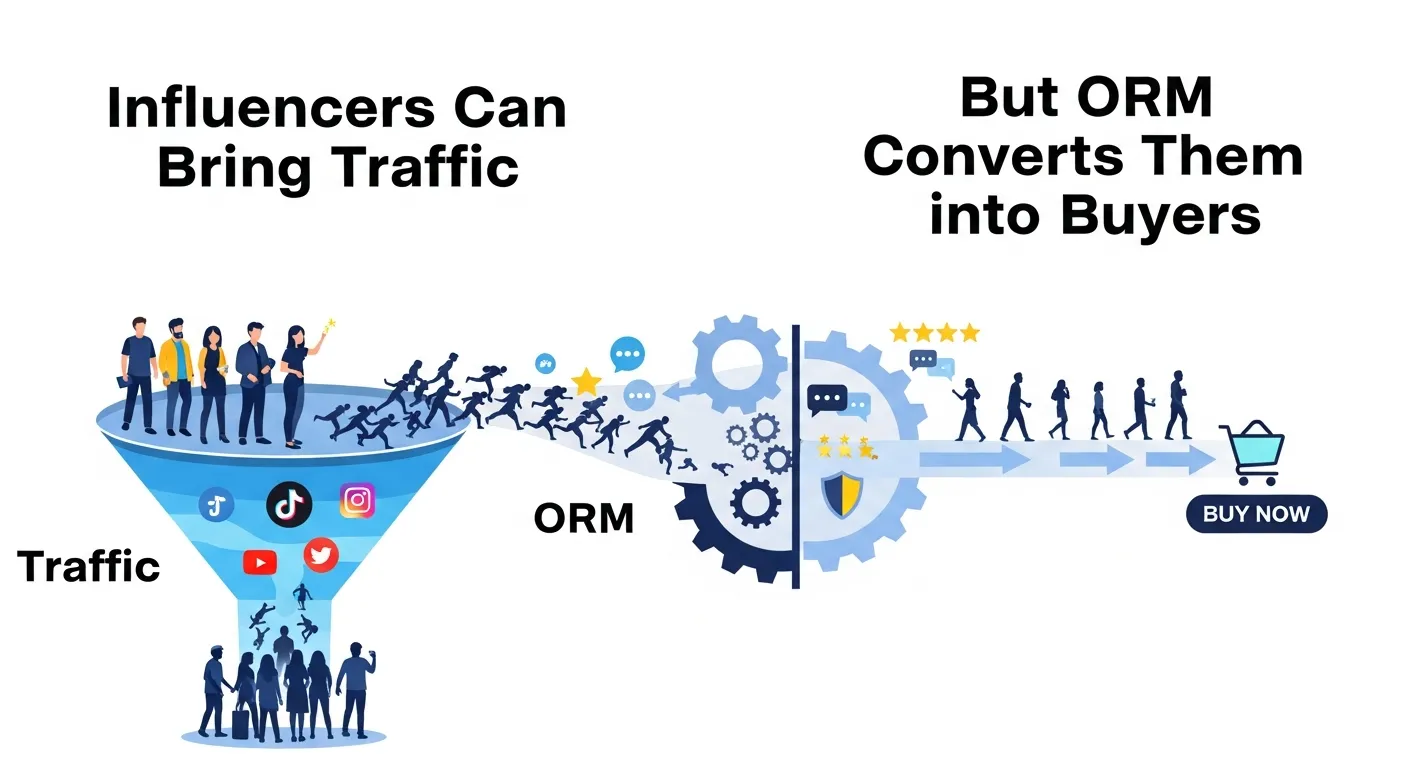
Influencers drive brand awareness and traffic, but Online Reputation Management builds trust through reviews and social proof. This trust reduces buyer hesitation, turning visitors into customers and improving conversion rates and long-term brand credibility.
In the digital era, influencer marketing has become one of the fastest-growing channels for brand visibility and audience engagement. Brands collaborate with creators on platforms like Instagram, YouTube, TikTok, and LinkedIn to reach targeted audiences and generate massive traffic. Influencers help brands cut through digital noise and capture attention in an increasingly crowded marketplace.
However, there is a major difference between traffic and conversions. Traffic refers to visitors clicking on a website, landing page, or product listing, while conversions represent meaningful actions such as purchases, sign-ups, or inquiries. Many brands assume that more traffic automatically leads to more sales, but this is often not the case.
What Is Influencer Marketing?
Influencer marketing is a digital marketing strategy where brands collaborate with individuals who have a loyal and engaged audience to promote products, services, or brand messages. These individuals—known as influencers—can impact consumer opinions and purchasing decisions through authentic content, reviews, and recommendations on social media and digital platforms. Influencer marketing leverages the credibility and reach of content creators to influence their followers’ buying behavior. Instead of brands directly advertising to consumers, influencers act as trusted intermediaries who introduce products in a relatable and engaging way.
Types of Influencers
Influencers are typically categorized based on their audience size and niche authority:
Micro-influencers (1K–100K followers):
- Highly niche audiences
- Strong engagement and trust
- Cost-effective collaborations
Macro-influencers (100K–1M followers):
- Wider reach
- Professional content creators
- Balanced engagement and visibility
Celebrity influencers (1M+ followers):
- Massive reach and brand recognition
- High campaign costs
- Strong impact on brand awareness
Popular Social Platforms for Influencer Marketing
Influencers operate across multiple platforms, including:
- Instagram – Visual storytelling, reels, and stories
- YouTube – Long-form reviews, tutorials, and vlogs
- TikTok – Short-form viral content and trends
- LinkedIn – B2B influencers, thought leaders, and professionals
Benefits of Influencer Marketing
Influencer marketing offers several advantages for brands looking to scale visibility and engagement.
Brand Awareness
Influencers help brands reach new audiences that may not be accessible through traditional advertising channels. Their content introduces brands to highly targeted communities, increasing visibility and recognition.
Audience Reach
By collaborating with influencers, brands can tap into established follower bases without building an audience from scratch. This accelerates market penetration and brand discovery.
Engagement and Social Proof
Influencers generate high engagement through likes, comments, shares, and discussions. This engagement acts as social proof, signaling popularity and relevance to potential customers and encouraging curiosity and clicks.
Limitations of Influencer Traffic
While influencer marketing is powerful for visibility, it has limitations when it comes to driving direct sales.
Low Purchase Intent
Many influencer followers consume content for entertainment rather than shopping. As a result, influencer-driven traffic may have low purchase intent compared to organic search or referral traffic.
Skepticism Toward Sponsored Content
Modern consumers are increasingly aware of paid promotions. When content is labeled as sponsored, audiences may question authenticity and trust, reducing the likelihood of conversion.
High Cost per Conversion
Influencer campaigns can be expensive, especially with macro and celebrity influencers. While they generate high traffic and impressions, the cost per conversion can be significantly higher than other marketing channels if trust and reputation are not established.
What Is Online Reputation Management (ORM)?
Online Reputation Management (ORM) is the process of monitoring, influencing, and improving how a brand, business, or individual is perceived online. It focuses on shaping public perception through reviews, ratings, content, and search results, ensuring that potential customers see positive, trustworthy information when they research a brand.
In the digital age, customers rarely buy without researching first. ORM ensures that when influencer-driven traffic searches your brand, they find credibility, trust signals, and positive experiences—helping convert visitors into buyers.ORM consists of multiple elements that collectively shape how a brand is perceived across digital platforms.
Reviews and Ratings
Customer reviews and ratings on platforms like Google, Amazon, Trustpilot, and industry-specific review sites are powerful trust signals.
- Positive reviews increase confidence and conversion rates
- High star ratings influence buying decisions instantly
- Negative reviews highlight areas for improvement and transparency
Testimonials and Case Studies
Testimonials and case studies showcase real customer success stories and results.
- Testimonials provide social proof and authenticity
- Case studies demonstrate measurable outcomes and ROI
- Video testimonials add emotional credibility
These elements help potential buyers visualize success with your product or service.
Brand Mentions and Sentiment
Brand mentions refer to discussions about your brand on social media, blogs, forums, and news websites.
- Positive mentions build brand authority
- Negative mentions can damage trust if unmanaged
- Sentiment analysis helps brands understand public perception
Managing brand sentiment is crucial for maintaining a positive digital presence.
Search Engine Reputation
Search engine reputation refers to what appears when someone searches your brand name on Google.
- Positive content (blogs, PR articles, reviews) builds credibility
- Negative content (complaints, scandals, bad reviews) can reduce conversions
- SERP management ensures that favorable results rank higher
Search engines are often the first place customers verify brand trust before purchasing.
Why ORM Matters in Digital Marketing
ORM plays a critical role in converting digital traffic into loyal customers.
Trust-Building
Trust is the foundation of every online purchase. ORM builds trust by showcasing real customer experiences, consistent brand messaging, and transparent feedback.
Why trust matters:
- Customers trust reviews more than ads
- Peer opinions reduce purchase hesitation
- Transparency increases confidence
Brand Credibility
A strong online reputation positions a brand as reliable, professional, and customer-centric.
- High ratings and positive mentions improve perceived quality
- Professional content and PR coverage enhance authority
- Consistent reputation signals stability and reliability
Credible brands are more likely to convert visitors into paying customers.
Long-Term Brand Equity
ORM is not just about immediate sales—it builds long-term brand value.
- A positive reputation increases customer loyalty
- Strong brand perception leads to repeat purchases
- Reputation-driven brands gain a competitive advantage
Over time, a strong reputation becomes an intangible asset that drives sustainable growth and premium pricing.
The Traffic vs. Trust vs. Conversion Funnel
In digital marketing, customers don’t move directly from seeing an influencer’s post to making a purchase. Instead, they go through a customer journey funnel where awareness, trust, and decision-making happen in stages. Influencers generate traffic at the top of the funnel, but trust—built through ORM—drives conversions at the bottom.
Awareness Stage: Influencers Drive Attention
The awareness stage is where potential customers first discover a brand. Influencers play a critical role in this stage by introducing products to their followers in an engaging and relatable way.
How influencers drive awareness:
- Sponsored posts, reels, and videos
- Product reviews and unboxing content
- Mentions in stories, blogs, and livestreams
At this stage, users are curious and may click on links or visit the website, but they are not yet ready to buy.
Consideration Stage: Reviews and Reputation Matter
After discovering a brand, customers move to the consideration stage, where they evaluate whether the brand is trustworthy and worth their money.
What customers check during consideration:
- Google reviews and star ratings
- Customer testimonials and case studies
- Social media comments and brand mentions
- Comparison with competitors
This is where Online Reputation Management (ORM) becomes crucial. Positive reviews, credible content, and strong brand sentiment reassure users and keep them moving down the funnel.
Conversion Stage: Trust Seals the Decision
The conversion stage is where users finally make a purchase or take a desired action. At this point, trust becomes the deciding factor.
Trust signals that influence conversions:
- High ratings and positive customer feedback
- Verified testimonials and success stories
- Secure website and transparent policies
- Strong brand presence in search results
When customers feel confident and safe, they are more likely to complete a transaction.
Why Influencer Traffic Often Doesn’t Convert
Influencer marketing can generate massive traffic, but many brands struggle to turn that traffic into actual customers. While influencers excel at creating awareness and engagement, several factors prevent influencer-driven visitors from completing purchases. Understanding these challenges helps brands optimize their conversion strategy.
Consumer Skepticism Toward Sponsored Content
Modern consumers are highly aware of paid promotions. When they see sponsored posts, affiliate links, or branded collaborations, they may question the authenticity of the recommendation.
Why skepticism occurs:
- Influencers are paid to promote products
- Followers assume bias in recommendations
- Overpromotion reduces credibility
As a result, users may click the link but hesitate to buy until they verify the brand’s credibility elsewhere.
Lack of Brand Trust and Reputation
Traffic from influencers often comes from audiences who have never heard of the brand before. Without strong trust signals, these visitors are unlikely to convert.
Common trust gaps include:
- Few or no online reviews
- Low brand visibility on Google
- Lack of testimonials or case studies
- Weak social presence or community
Without ORM, influencer traffic becomes curiosity-driven rather than purchase-driven.
One-Time Exposure vs. Long-Term Relationship
Influencer content is often consumed quickly and forgotten. A single post or video rarely builds a long-term relationship with the brand.
Challenges of one-time exposure:
- Short attention span of audiences
- Limited brand recall after viewing content
- No follow-up nurturing or remarketing
Without consistent trust-building, visitors may leave without converting.
Misaligned Audience Targeting
Not all influencer audiences are ideal customers. Even with high engagement, the influencer’s followers may not match the brand’s target demographic, needs, or buying power.
Examples of misalignment:
- Influencer audience interested in entertainment, not shopping
- Geographic mismatch with product availability
- Different price sensitivity or preferences
This mismatch reduces conversion potential despite high traffic volume.
High Price Sensitivity and Comparison Behavior
Influencer-driven visitors often compare multiple brands before buying. They may search for reviews, discounts, or alternatives, which delays or prevents conversions.
Common behaviors:
- Checking competitor reviews and pricing
- Waiting for offers or discounts
- Seeking third-party validation
Without strong ORM and trust signals, they may choose competitors instead.
How ORM Converts Traffic into Buyers
While influencers attract visitors, Online Reputation Management (ORM) transforms that traffic into paying customers. ORM builds trust, reduces uncertainty, and reassures potential buyers through authentic social proof and positive brand perception. When customers trust a brand, they are far more likely to complete a purchase.
Power of Online Reviews and Ratings
Online reviews and star ratings are among the strongest conversion drivers. Before purchasing, most consumers read reviews to validate product quality and brand reliability.
How reviews drive conversions:
- High ratings increase click-through and purchase rates
- Detailed reviews answer common buyer questions
- Negative reviews with responses show transparency and accountability
A strong review profile turns hesitant visitors into confident buyers.
Social Proof Through Customer Testimonials
Testimonials provide real-world validation and credibility. When potential customers see others achieving success with a product or service, they feel reassured.
Effective testimonial formats include:
- Written customer testimonials
- Video testimonials and success stories
- Before-and-after case studies
These elements humanize the brand and make the buying decision feel safer.
Brand Mentions and PR Coverage
Brand mentions in blogs, news websites, and industry publications increase perceived authority. Media coverage and expert endorsements signal legitimacy and professionalism.
Benefits of brand mentions:
- Builds brand authority and credibility
- Improves search engine reputation
- Increases trust among first-time buyers
When customers see a brand featured in reputable sources, they feel more confident purchasing.
Google SERP Reputation and Search Visibility
When users search for a brand after seeing an influencer post, they often judge credibility based on what appears in Google results.
Important SERP trust signals:
- Positive review platforms ranking on page one
- Official website and social profiles appear prominently
- Helpful content, FAQs, and brand stories
A positive search presence reinforces trust and keeps users in the conversion funnel.
User-Generated Content (UGC) and Community Trust
User-generated content, such as customer photos, videos, and social media posts, acts as authentic proof of real product usage.
UGC benefits:
- Shows real customers using the product
- Builds community and engagement
- Reduces perceived risk and increases confidence
When visitors see real people using and recommending a product, it strongly influences purchasing decisions.
The Traffic vs. Trust vs. Conversion Funnel
In digital marketing, success isn’t just about driving traffic—it’s about building trust and turning that trust into conversions. The Traffic–Trust–Conversion Funnel explains how users move from discovering your brand to becoming paying customers, highlighting the critical role of influencers, online reputation, and social proof at every stage of the customer journey.
Awareness Stage: Influencers Drive Attention
The awareness stage is where potential customers first encounter your brand. At this point, users are not ready to buy—they are simply discovering products, services, or solutions to their problems.
Influencers, social media campaigns, SEO content, and paid ads are powerful tools for generating traffic at this stage. Influencers, in particular, help brands reach highly targeted audiences quickly, leveraging their credibility and audience trust to introduce your brand to new users.
However, traffic alone does not guarantee sales. Awareness is just the first step in the funnel, and without trust, most users will not move forward.
Consideration Stage: Reviews and Reputation Matter
Once users are aware of your brand, they enter the consideration stage, where they compare options and evaluate credibility. This is where online reputation management (ORM) plays a crucial role.
Potential customers actively search for:
- Customer reviews and ratings
- Testimonials and case studies
- Brand mentions on social media and forums
- Search engine results and brand sentiment
Positive reviews and strong brand sentiment reduce perceived risk and increase confidence. Conversely, negative reviews or poor search results can stop users from progressing in the funnel.
At this stage, social proof becomes a decisive factor, influencing whether users trust your brand over competitors.
Conversion Stage: Trust Seals the Decision
The final stage of the funnel is conversion, where users decide to purchase, subscribe, or contact your business. Even if you have high traffic and strong consideration signals, conversions happen only when trust is fully established.
Key trust elements include:
- Verified reviews and ratings
- Trust badges and security seals
- Clear refund and return policies
- Authentic testimonials and success stories
When users feel confident that your brand is reliable, secure, and customer-centric, they are far more likely to complete the purchase.
Key ORM Strategies to Boost Conversions
Online Reputation Management (ORM) plays a critical role in influencing customer decisions and increasing conversions. A strong reputation builds trust, reduces purchase hesitation, and encourages prospects to take action. Here are the key ORM strategies businesses should implement to maximize conversions.
Review Generation Campaigns
Customer reviews are one of the most powerful trust signals. Businesses should actively encourage satisfied customers to leave reviews through email follow-ups, SMS requests, loyalty programs, and incentives. Automating review requests after a purchase or service interaction can significantly increase review volume and visibility across platforms like Google, Trustpilot, and social media.
Reputation Monitoring and Response Strategy
Monitoring brand mentions, reviews, and social conversations is essential. Tools like Google Alerts, Brand24, and Sprout Social help businesses track feedback in real time. Responding promptly to both positive and negative reviews demonstrates professionalism and customer-centricity, increasing trust and conversion rates.
Negative Review Management and Crisis Handling
Negative reviews are inevitable, but how you handle them defines your brand. A structured response strategy—acknowledging the issue, apologizing, and offering solutions—can turn dissatisfied customers into loyal advocates. For large-scale reputation crises, companies should have a predefined crisis communication plan to maintain credibility.
Brand Authority Building (PR, Backlinks, Media Mentions)
Authority signals such as media coverage, backlinks from reputable websites, and PR campaigns enhance credibility. Being featured in industry publications, news outlets, and authoritative blogs builds trust and improves search rankings, directly influencing customer purchase decisions.
Customer Advocacy and Referral Programs
Encouraging loyal customers to share testimonials, case studies, and referrals amplifies trust. Referral programs, ambassador programs, and user-generated content campaigns transform customers into brand promoters, creating organic growth and higher conversions.
Metrics to Measure Influencer + ORM Performance
To evaluate the effectiveness of influencer marketing combined with ORM strategies, businesses must track key performance metrics that reflect both traffic and conversion outcomes.
Traffic vs. Conversion Rate
While influencer campaigns drive traffic, the conversion rate measures how many visitors become customers. A high conversion rate indicates strong trust and persuasive reputation signals.
Review Volume and Rating Score
The number of reviews and average rating directly impact buyer decisions. A higher review count and rating improve credibility and increase click-through and purchase rates.
Brand Sentiment Score
Brand sentiment analysis measures whether online mentions are positive, neutral, or negative. Positive sentiment indicates strong brand trust and correlates with higher conversion potential.
Customer Lifetime Value (CLV)
CLV measures the total revenue a customer generates over time. Strong ORM and influencer trust-building efforts increase retention and repeat purchases, boosting CLV.
Cost Per Acquisition (CPA)
CPA measures how much it costs to acquire a customer. Referral-driven conversions and strong reputation signals often reduce CPA compared to paid ads.
Viral Coefficient
The viral coefficient tracks how many new users each customer brings through referrals. A coefficient above 1 indicates exponential growth driven by trust and advocacy.
Conclusion
In today’s digital landscape, traffic alone is not enough to drive business growth. Brands must build trust through strong online reputation management and social proof to convert visitors into customers. Influencers generate awareness, reviews shape consideration, and credibility seals conversions—making the Traffic–Trust–Conversion funnel essential for modern marketing success. By actively managing reviews, testimonials, and brand sentiment, businesses can strengthen credibility, improve conversion rates, and build long-term brand equity. Ultimately, trust is the bridge between visibility and revenue, and brands that invest in ORM will consistently outperform their competitors.
FAQ: Influencers & ORM
1. What is Online Reputation Management (ORM)?
Answer: Online Reputation Management (ORM) is the process of monitoring, improving, and maintaining a brand’s online image through reviews, ratings, testimonials, and brand mentions across digital platforms.
2. How do influencers help brands generate traffic?
Answer: Influencers promote brands to their followers, increasing visibility, website visits, and social engagement through trusted content and recommendations.
3. Why doesn’t influencer traffic always lead to conversions?
Answer: Many users view influencer content as promotional, which can reduce trust and purchase intent unless supported by credible reviews and a strong brand reputation.
4. How does ORM increase conversion rates?
Answer: ORM builds trust through positive reviews, testimonials, and social proof, helping potential customers feel confident and reducing hesitation before purchase.
5. What is the difference between traffic and conversions in digital marketing?
Answer: Traffic refers to visitors coming to a website, while conversions are visitors who complete desired actions like buying, signing up, or contacting the business.
6. How do reviews influence buyer decisions?
Answer: Reviews act as social proof, helping customers evaluate product quality, reliability, and credibility before making a purchase decision.
7. Can influencers and ORM work together?
Answer: Yes, influencers attract attention, while ORM reinforces credibility. Together, they create a powerful funnel from awareness to trust and conversion.
8. What platforms are important for ORM?
Answer: Google Reviews, Trustpilot, Yelp, social media platforms, forums, and brand mentions on blogs and news websites are key ORM channels.
9. Why is trust critical in digital marketing conversions?
Answer: Trust reduces perceived risk, increases customer confidence, and significantly improves the likelihood of purchase and brand loyalty.
10. How can businesses improve their online reputation?
Answer: Businesses can encourage customer reviews, respond to feedback, showcase testimonials, manage negative comments professionally, and maintain consistent brand messaging.