
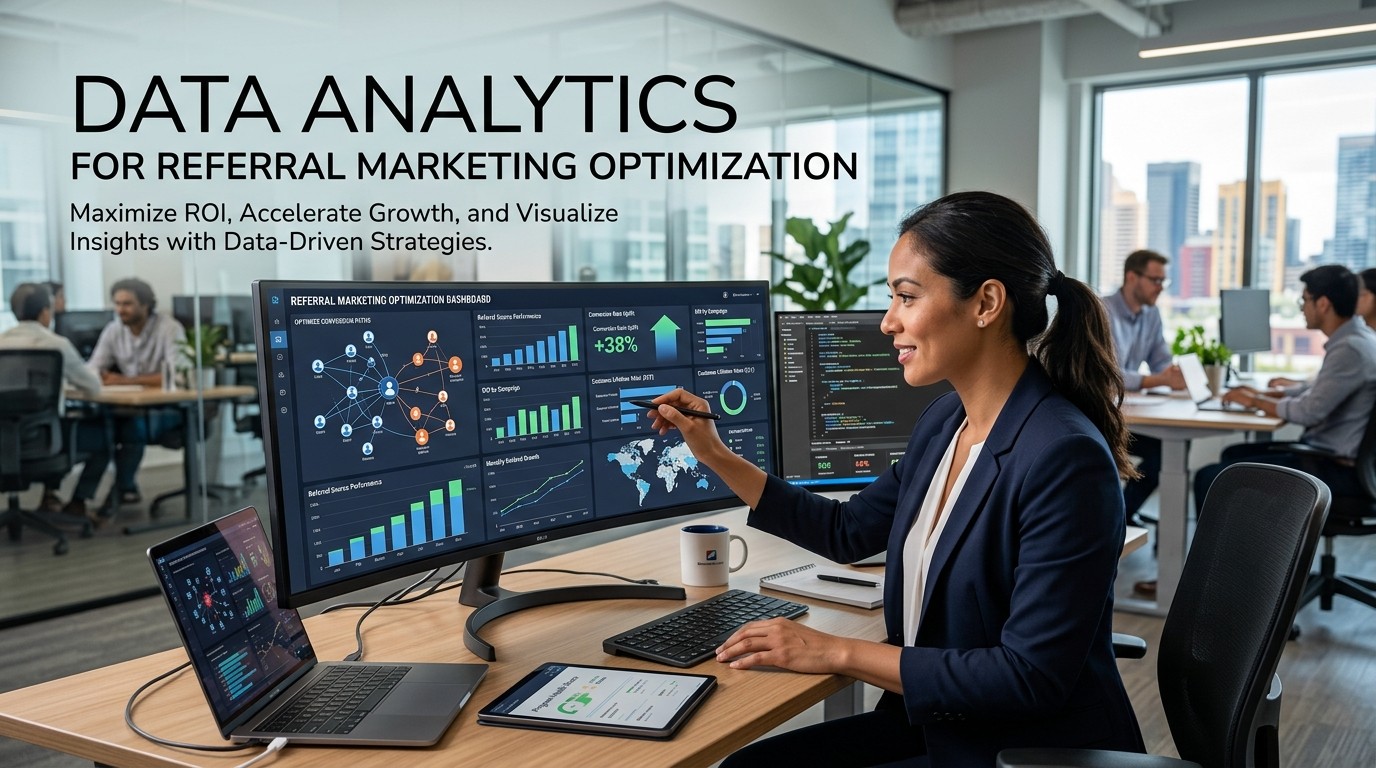
Data Analytics helps marketers understand referral behavior, improve incentive design, and refine tracking so referral programs generate more qualified traffic, stronger conversions, and better long-term ROI.
Referral programs work best when the business understands what actually drives people to share, click, and convert. Data Analytics gives marketers that understanding by turning referral activity into measurable insight. Instead of guessing which incentive, message, or channel will work, teams can study patterns and optimize the program using real evidence.
Referral marketing feels simple on the surface, but successful execution is more complex. People refer friends for different reasons: trust, reward, convenience, status, or personal satisfaction. Data Analytics helps reveal those motivators and shows which ones matter most for a specific audience. That insight makes Referral Marketing Optimization far more effective because decisions stop relying on assumptions.
The strongest referral programs are not just promotional campaigns. They are systems built on clear measurement, clean tracking, and continuous improvement. Data Analytics supports that system by helping teams understand referral sources, user journeys, conversion quality, and incentive performance. When that intelligence is used properly, referral marketing becomes more predictable and scalable.
Why Analytics Matters
Many referral programs fail because companies celebrate signups instead of studying quality. A program may generate a lot of traffic, but if most of it does not convert, the campaign is not truly performing. Data Analytics helps businesses move beyond vanity metrics and focus on the outcomes that matter.
This matters because referral behavior is shaped by psychology. People do not share just because a program exists. They share when the offer feels worthwhile, the message is simple, and the timing makes sense. Data Analytics helps identify those patterns so Referral Marketing Optimization can be based on user behavior instead of creative intuition alone.
Analytics also helps teams understand drop-off points. If users click referral links but fail to complete the next step, the problem may be friction, confusing copy, weak trust signals, or poor mobile experience. Data Analytics shows where that breakdown happens, making optimization more precise.
For marketing leaders, this creates confidence. Instead of guessing why a program is underperforming, they can look at actual user behavior and make changes with more certainty. Data Analytics turns referral marketing into a measurable growth channel rather than an unstructured experiment.
What to Measure
To optimize referral marketing, you need to track the right metrics. Data Analytics becomes useful only when the measurements reflect the real goals of the program. That usually means going beyond raw referral count and looking at quality, conversion, and retention.
Common metrics include referral participation rate, share rate, referral click-through rate, conversion rate, reward redemption rate, and customer lifetime value. Data Analytic helps teams see which referrals are valuable and which ones are merely active without producing meaningful outcomes. That distinction is essential for Referral Marketing Optimization.
It is also important to track source behavior. Referrals from email may perform differently from those shared on social media, inside products, or through direct messaging. Data Analytic can reveal which channels attract the strongest intent. That gives marketers a better foundation for budget and design decisions.
Useful referral metrics
- Referral share rate.
- Click-through rate from referral links.
- Conversion rate of referred users.
- Reward redemption rate.
- Retention and repeat purchase behavior.
Tracking the Funnel
A referral program is only as strong as its tracking framework. Data Analytic helps map the entire funnel from invite to click to conversion to retention. That end-to-end visibility is what makes Referral Marketing Optimization possible.
Many teams stop at the first conversion and ignore what happens next. But referred users may behave differently from non-referred users after signup or purchase. Data Analytic allows marketers to compare these behaviors and determine whether the referral source produces durable value. That is often where the real insight lies.
Tracking should also capture the referral journey itself. Who sent the invite? What message was used? What channel carried it? What device did the recipient use? Data Analytic helps connect these details so the team can identify which referral patterns lead to better outcomes.
This is also where attribution matters. If a referral is one of several touchpoints, teams need a way to understand its contribution. In more advanced environments, Multi-Touch Attribution in Marketo can help marketing teams assign influence more accurately across the journey. That makes Data Analytic even more valuable because it supports a clearer picture of what actually drove the conversion.
Clean Data Foundation

No referral optimization strategy works well with messy data. If duplicate records, incomplete profiles, or inconsistent naming are common, the insights will be unreliable. Data Analytic depends on clean inputs, which means teams need disciplined data management before they try to optimize performance.
When organizations Clean and Normalize B2B Marketing Data, they improve the quality of their reporting and reduce the risk of false conclusions. That is especially important in referral programs, where contact records may come from many sources and different user identities need to be matched correctly. Data Analytics becomes much more actionable once the data is trustworthy.
Clean data also supports better segmentation. If you know which types of customers refer most often, you can design incentives and messages around those patterns. Data Analytics helps reveal those segments, but only if the underlying records are organized and consistent.
For B2B teams, this is especially important because referral journeys are often longer and more complex. Multiple users, accounts, and touchpoints may be involved before a referred lead converts. Data Analytic is only effective when the data model supports that complexity.
Building Better Referral Journeys
A referral program is not just a reward system. It is a journey design challenge. Data Analytics helps marketers understand how users discover, evaluate, and complete referral actions. That makes it easier to simplify the process and increase participation.
The best referral experiences remove friction. If the signup flow is too long, the message too confusing, or the reward unclear, participation drops. Data Analytics can show exactly where users lose momentum. That gives teams a practical way to improve Referral Marketing Optimization without making random design changes.
The message itself matters too. Users respond better when the referral value is easy to understand. A complicated reward structure can reduce participation, even if the reward is attractive. Data Analytics helps teams compare different copy styles and identify what actually motivates action.
It is also important to think about timing. Referral prompts may perform differently after a purchase, during onboarding, or after a positive service interaction. Data Analytics helps identify the moments when users are most likely to share. That timing insight can significantly improve results.
Channel and Audience Insights
Not every audience responds to referrals in the same way. Data Analytics helps marketers see which customer segments are most likely to refer, which channels generate the highest-quality traffic, and which audiences are most valuable over time. This is crucial for Referral Marketing Optimization.
For example, loyal customers may be more willing to share if the reward feels aligned with their values. New customers may need more education before they refer. Data Analytics helps distinguish between those behaviors so campaigns can be tailored accordingly. That leads to better conversion and stronger engagement.
Channel analysis is equally important. A referral shared through email may produce different results than one shared on social platforms or within a product dashboard. Data Analytics reveals those differences and helps marketers invest their efforts where the return is strongest.
The same logic applies to user intent. Some users refer because they genuinely love the product, while others refer only for incentives. Data Analytics can help estimate which group is more valuable in the long run. That insight matters because Referral Marketing Optimization should improve quality, not just volume.
What to Analyze
Referral Psychology
People refer others for different reasons, and Data Analytics helps identify those reasons in action. Some users want a reward, some want to help a friend, and some want to look knowledgeable or helpful. Referral Marketing Optimization improves when these motivations are understood clearly.
Psychologically, referrals work because trust transfers from one person to another. That means the sender’s credibility affects how the message is received. Data Analytics can help determine which referrers influence the most valuable new users. That gives marketers a way to reward the right behavior, not just the most frequent behavior.
Another psychological factor is simplicity. People are more likely to refer when the process feels easy and the benefit is obvious. If they have to think too hard, they often stop. Data Analytics helps identify where this hesitation occurs so the experience can be simplified.
Reciprocity also matters. When users feel appreciated, they are often more likely to share again. Data Analytics can measure how repeat referrers behave and whether certain reward types increase loyalty. These insights help Referral Marketing Optimization become more human-centered and less mechanical.
Tools and Integration

Referral programs usually work better when they connect to broader marketing and CRM systems. Data Analytics becomes more powerful when referral events are captured in a larger customer data environment. That allows marketers to connect referral behavior to lifecycle stages, purchase behavior, and retention trends.
Integration is also important for automation. If referral data flows directly into your CRM or marketing platform, teams can trigger follow-ups, segmentation, and personalized messaging. Data Analytics then becomes operational, not just descriptive. That is a major advantage for Referral Marketing Optimization.
In product-led and B2B environments, this also helps with lifecycle tracking. Referral leads may move through several steps before they convert, and the team needs visibility into that journey. A Referral Marketing API can support this by sending event data into the systems where it can be analyzed and acted on.
The ability to Integrate Referral Programs with analytics dashboards, email platforms, and customer databases makes optimization much easier. Instead of managing data manually, marketers can focus on interpreting patterns and improving outcomes. That is where Data Analytics creates real leverage.
Experimentation and Testing
Referral optimization should never be static. Data Analytics helps teams test different incentives, messages, landing pages, and prompts to see which version performs best. This experimentation mindset is one of the fastest ways to improve referral performance.
Testing can include reward size, reward type, CTA wording, page layout, or the point at which the referral prompt appears. Data Analytics helps measure the effect of each change and identify the most effective combination. That makes Referral Marketing Optimization a continuous process rather than a one-time launch.
It is also useful to test based on segment. Some audiences may prefer discounts, while others value status, exclusivity, or charitable rewards. Data Analytics can show how different groups respond, which helps teams personalize the referral experience more effectively.
The goal is not just to generate more referrals. The goal is to generate better referrals that lead to stronger customer outcomes. Data Analytics supports that shift by keeping the focus on quality and long-term value.
Optimization Workflow
Cross-Functional Value
Referral marketing does not live in a vacuum. Sales, customer success, product, and marketing all influence the referral journey. Data Analytics helps connect those departments by showing how referral behavior interacts with the broader customer lifecycle.
For instance, if customer success interactions lead to more referrals, that is a signal worth capturing. If certain product milestones trigger sharing, the business can build prompts around them. Data Analytics turns those cross-functional moments into usable insight.
This is also relevant when referral workflows depend on operational efficiency. Some teams compare the importance of referral systems with back-office process tools like Supply Chain Automation Software because both rely on structured data and predictable flow. Others think about the speed and reliability benefits in relation to Digital Mailroom Automation Software when document or communication routing affects conversion timing.
In all of these cases, the same principle applies: better visibility leads to better action. Data Analytics creates that visibility and helps different teams work toward the same growth goal.
Avoiding Common Mistakes
Referral programs often fail because companies measure the wrong things. They may celebrate volume without checking quality, or they may optimize for signups without looking at retention. Data Analytics helps prevent those mistakes by keeping the focus on meaningful outcomes.
Another common issue is poor attribution. If referral events are not tracked properly, the team may not know which source or message caused the conversion. Data Analytics needs clean implementation to produce useful results. Without it, Referral Marketing Optimization becomes guesswork.
Messy data is another problem. Duplicate users, inconsistent UTM tags, and incomplete source information can make the reporting misleading. That is why data hygiene is such a critical part of the process. Data Analytics only works if the input is trustworthy.
Finally, many teams overcomplicate the program. A referral system should be easy to understand and simple to share. Data Analytics often shows that complicated programs underperform because users do not take the next step. The best optimization usually comes from clarity, not complexity.
Strategic Growth Impact

When used well, referral optimization can become one of the most efficient growth channels in the business. Data Analytics helps make that happen by revealing what drives acquisition, conversion, and retention. That means the program can be improved over time with greater precision.
The long-term value of referral marketing comes from trust. Referred users often convert better because they arrive with social proof already attached. Data Analytics helps teams identify the conditions that make that trust transfer most effective. That makes Referral Marketing Optimization more sustainable.
It also helps the business allocate resources better. If data shows that one segment or reward type consistently produces high-value customers, the company can focus there. Data Analytics supports smarter investment because it connects behavior to business value.
Over time, this builds a compounding advantage. The referral program improves, the data gets cleaner, and the insights become more reliable. That loop is what turns referral marketing from a nice add-on into a serious growth engine.
Conclusion
Data Analytics gives referral marketers the ability to measure what matters, reduce guesswork, and improve performance with confidence. By tracking the full journey from invite to conversion to retention, teams can identify the segments, messages, and incentives that produce the strongest results. That makes Referral Marketing Optimization more precise and more profitable.
The real strength of Data Analytics is that it helps businesses understand people, not just numbers. Referral behavior is shaped by trust, simplicity, timing, and motivation. When those patterns are visible, marketers can design referral programs that feel easier to use and more valuable to share. That is what turns a basic referral program into a durable growth channel.
Frequently Asked Questions (FAQ)
1. What is the role of Data Analytics in referral marketing?
It helps track user behavior, identify performance gaps, and improve referral program results.
2. Why is Referral Marketing Optimization important?
Because it helps increase quality referrals, not just referral volume.
3. What metrics should I track?
Track share rate, click-through rate, conversion rate, reward redemption, and retention.
4. Why does data cleaning matter?
Messy data leads to inaccurate insights and weak optimization decisions.
5. Can Data Analytics improve referral rewards?
Yes. It can show which incentives generate the best results.
6. How does attribution help?
It shows which touchpoints influenced the referral conversion.
7. Can referral data work with CRM systems?
Yes. Integration with CRM and marketing tools makes analysis more useful.
8. What is the biggest mistake in referral marketing?
Focusing on volume without checking quality and long-term value.
9. How often should referral performance be reviewed?
Regularly, so the team can spot trends and make timely improvements.
10. What makes a referral program successful?
Clear messaging, easy sharing, relevant incentives, and data-driven optimization.