
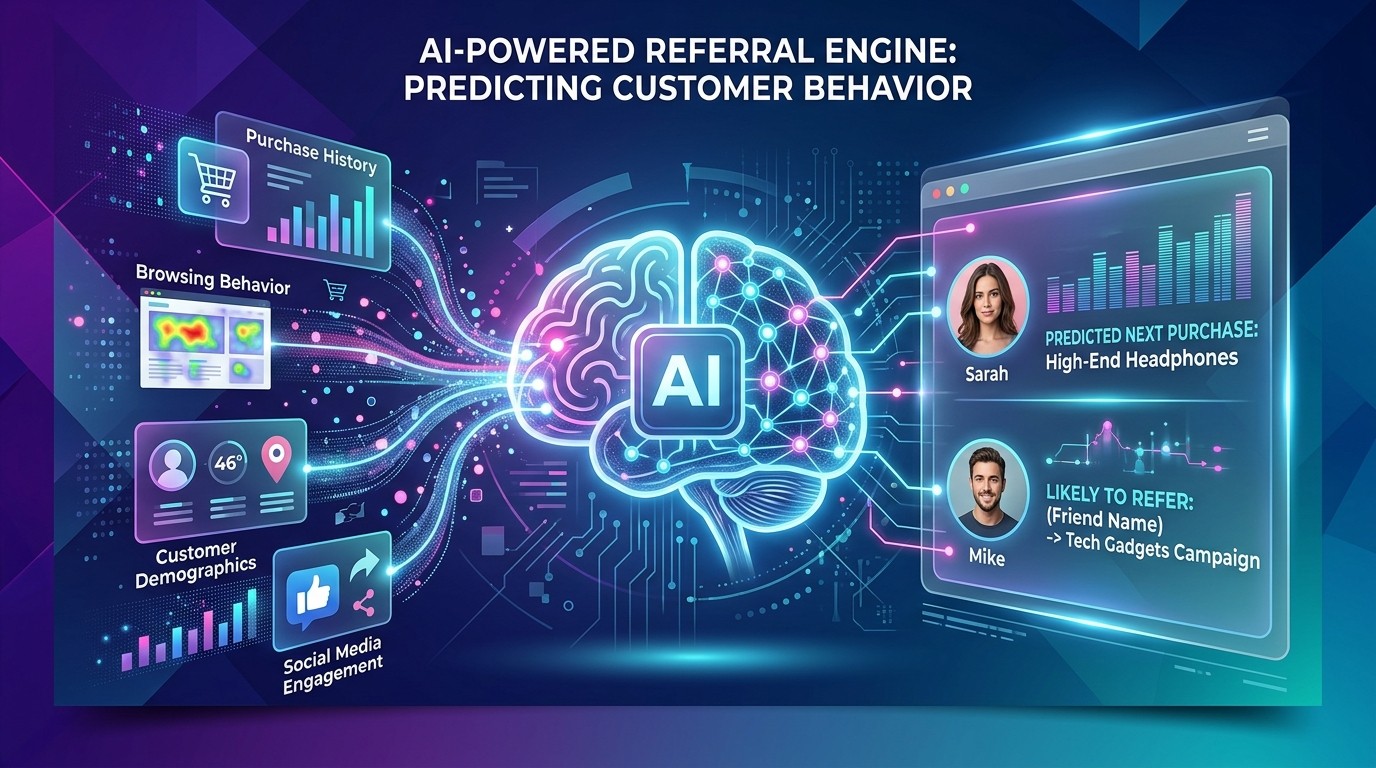
An AI Referral Engine helps businesses predict who will share, who will buy, and when referrals are most likely to convert, using data-driven patterns instead of guesswork.
An AI Referral Engine turns referral marketing from a reactive channel into a predictive growth system. Instead of waiting for customers to make a recommendation, the model studies behavior signals, timing patterns, and purchase history to estimate which people are most likely to refer, which contacts are most likely to accept a referral, and which incentives will produce the strongest response.
That shift matters because referral marketing is no longer just about asking happy customers to spread the word. An AI Referral Engine can analyze who opens messages, who clicks through, who returns to the site, and who completes a purchase after being referred. Over time, those signals become a map of future behavior.
For marketers, this means less waste and more precision. For sales teams, it means better lead quality. For customer success teams, it means stronger retention. When the right data is connected, an AI Referral Engine becomes a practical decision layer that supports campaigns, onboarding, loyalty, and revenue expansion.
This guide explains how the system works, why it improves referral performance, where companies often fail, and how to design a smarter referral strategy that feels human while acting intelligently. You will also see how an AI Referral Engine connects with product analytics, customer psychology, and the larger revenue engine.
How predictive referral systems think
An AI Referral Engine is built to find patterns that people miss. A customer may look ordinary on the surface, yet their actions may show a strong referral habit. They might invite colleagues after every successful purchase, share links only after high satisfaction moments, or respond quickly to social proof. The system notices those repeats and scores them.
At a basic level, an AI Referral Engine compares past referrers with non-referrers. It studies common traits such as purchase frequency, product category, session depth, support interactions, tenure, location, and device behavior. Then it looks for combinations that often lead to a referral action. The result is not a guess; it is a probability estimate based on historical evidence.
A well-trained AI Referral Engine also learns timing. Some people refer right after a milestone. Others wait until they experience a problem and then a solution. Some share only after a webinar, a success story, or a renewal event. Timing helps the system move from static segmentation to living prediction.
This is why the strongest teams treat an AI Referral Engine like a behavioral interpreter. It does not simply label people as “likely” or “unlikely.” It explains why a person might refer, what message could trigger action, and what offer should be shown first.
The data signals that matter most

An AI Referral Engine becomes useful only when the right signals are available. Raw data is not enough. You need signals that describe intent, trust, satisfaction, and shareability. The strongest predictive models combine product usage data, CRM history, referral link behavior, email engagement, support tickets, webinar attendance, and transaction milestones.
The most obvious signal is satisfaction. Customers who complete a goal successfully are more likely to recommend the experience. But the model goes deeper than satisfaction alone. It may notice that users who finish onboarding quickly, engage with education content, and return within a few days are more referral-ready than users who remain active but passive.
Another powerful signal is social behavior. A customer who has previously shared resources, tagged peers, invited teammates, or forwarded content may be more receptive to referral requests. An AI Referral Engine can score those patterns and match them against referral success outcomes.
Support history also matters. People often assume referrals come only from delighted customers, but not every delighted customer shares. Some of the best referrers are people who experienced friction and then saw it resolved quickly. They remember the recovery, not just the issue. That emotional reset can create trust, and trust is one of the strongest drivers inside an AI Referral Engine.
Data quality is critical here. If the inputs are fragmented, the predictions will be weak. Clean identity resolution, accurate timestamps, and properly tracked events give the model the structure it needs to perform well.
Customer psychology behind referral behavior
A strong referral decision is rarely logical alone. People refer when emotion, identity, usefulness, and timing align. That is why an AI Referral Engine must be designed with psychology in mind, not just machine learning. It should recognize the internal reasons people share.
The first reason is self-image. Many customers refer when it makes them feel helpful, knowledgeable, or generous. Sharing a useful product can signal status and competence. The second reason is reciprocity. When a brand gives value first, people feel more open to returning the favor. The third reason is social proof. People prefer to recommend something that already feels trusted by others.
An AI Referral Engine can map those impulses by learning which users respond to educational content, which users react to testimonial language, and which users behave like connectors inside their networks. In practice, this means that a referral prompt should not be sent at random. It should arrive at the moment when the customer is most likely to feel proud of the result they achieved.
There is also a cognitive side to the decision. People avoid recommendations that could damage their reputation. If a product seems risky, complicated, or low quality, referral odds drop sharply. That is why an AI Referral Engine should be paired with trust-building content, product reliability, and clear proof of value. Prediction alone cannot fix a bad experience.
Where the prediction becomes action
An AI Referral Engine creates value only when its predictions are used inside real workflows. If the model identifies a high-probability referrer, the next step is not just a label. It should trigger the right message, at the right time, through the right channel.
For example, a customer who has just had a successful onboarding experience might receive a simple referral invitation with a short explanation of the benefit. A power user who has already shared resources may receive a more advanced incentive. A customer who is excited but hesitant may need a testimonial, not a reward. The model can route each person differently.
This is where the system becomes operational. An AI Referral Engine can support lifecycle automation, loyalty programs, in-app prompts, sales follow-up, and customer success nudges. It can also reduce false outreach by suppressing users who are unhappy, inactive, or in the middle of support issues. That protects brand trust.
The strongest referral systems are not pushy. They are contextual. They respect the customer’s moment, which is why prediction should be used as a guidance layer rather than a blunt sales engine. When the model and the message align, conversion rates improve naturally.
Common referral signals and what they mean
| Signal | What it suggests | How the model can use it |
|---|---|---|
| Fast onboarding completion | Early confidence | Increase referral readiness score |
| Repeat logins | Habit formation | Predict engagement strength |
| Successful support resolution | Trust recovery | Trigger referral timing |
| Webinar attendance | Learning intent | Match educational referral messages |
| Sharing product resources | Social willingness | Increase recommendation likelihood |
| Renewal or upgrade | Strong satisfaction | Prioritize referral prompts |
| High NPS behavior | Advocacy signal | Activate referral ask |
| Team invitations | Network orientation | Predict stronger referral spread |
An AI Referral Engine becomes easier to trust when it is transparent about the signals behind the score. Marketers do not need every math detail, but they do need a clear explanation of why the model flagged a person or segment.
That transparency also helps improve the customer experience. A referral ask based on a successful milestone feels natural. A referral ask based on random timing feels disconnected. If the signal is wrong, the outreach is wrong. If the signal is right, the entire referral journey improves.
How teams build the model in practice
Building an AI Referral Engine usually starts with historical analysis. The team identifies customers who referred others in the past and compares them with similar customers who never referred. Then it examines feature patterns, such as frequency, recency, success milestones, and engagement depth.
After that, the data team creates a scoring system or machine learning model. Some companies begin with simple logistic regression or gradient boosting. Others build more advanced systems that update scores continuously. The important point is not complexity for its own sake. The important point is reliable prediction.
Once the model exists, an AI Referral Engine must be tested against actual outcomes. Does the high-score group refer more often than the low-score group? Do people respond better to personalized referral prompts? Does the model improve conversion and reduce wasted outreach? These are the questions that separate theory from performance.
A good launch also includes monitoring. Customer behavior changes over time. New products, pricing changes, and market conditions can all influence referral patterns. That means an AI Referral Engine should be retrained, recalibrated, and reviewed regularly so predictions stay relevant.
Why referral prediction helps the whole revenue engine

An AI Referral Engine does more than increase referral volume. It improves the quality of growth. When referral campaigns are better targeted, the brand attracts warmer prospects, lowers acquisition costs, and creates more stable pipelines.
This is especially useful in B2B. A well-designed AI Referral Engine can complement a B2B Demand Gen Engine by identifying which customers are likely to introduce peers, advocates, and decision-makers. That gives marketing and sales a smarter path into relevant accounts rather than relying only on outbound pressure.
It also supports education-led growth. If a company is Hosting Effective Webinars, the model can identify which attendees are likely to refer after attending a high-value session. That makes webinar follow-up more strategic, because the system knows which participants are worth an immediate referral ask and which ones need more nurture first.
The broader effect is cleaner revenue math. Better predictions mean fewer wasted impressions, better message fit, stronger conversion, and more predictable pipeline quality. An AI Referral Engine is not only a referral tool; it is a growth efficiency tool.
Common failures that weaken referral prediction
Not every deployment succeeds. In fact, many companies discover that an AI Referral Engine fails because of strategy mistakes rather than model mistakes. The first failure is shallow data. If the model only knows who clicked a referral link, it misses all the context that led to the click.
The second failure is poor incentive design. If rewards are too small, too generic, or too delayed, even a good prediction engine may underperform. The model may identify the right person, but the offer may still be unconvincing.
The third failure is ignoring negative experience. Referral behavior drops when customers encounter friction, unresolved complaints, or confusing value propositions. An AI Referral Engine cannot compensate for a broken product story. It can only amplify the behavior that already exists.
The fourth failure is treating every segment the same. High-value customers, new users, and dormant users should not receive the same prompt. The model should support differentiated outreach, or else the prediction loses much of its power.
Referral Tech Failures to avoid
When people talk about Referral Tech Failures, they often focus on dashboards or broken links. But the deeper problem is usually misalignment. The prediction system may be technically advanced while the referral flow itself feels clumsy, slow, or disconnected from customer intent.
An AI Referral Engine should not be trapped inside a reporting tool. It should feed product messages, customer journeys, lifecycle emails, and account-based actions. If the output never changes user experience, the system is not doing enough work.
Another failure happens when teams over-automate. A customer who just solved a major problem does not want a robotic referral ask that feels opportunistic. The best systems leave room for timing, empathy, and human judgment. Prediction should support relevance, not replace it.
There is also a governance issue. Referral predictions should be monitored for bias, privacy concerns, and overreach. Customers should feel helped, not watched. If the model is too aggressive, trust erodes quickly.
How predictive referral analysis improves targeting
Predictive Referral Analysis turns raw behavior into practical campaign logic. It tells teams who should receive a referral invitation first, what message framing is most likely to work, and which offer style fits the user’s history.
For example, someone who consistently engages with educational resources may respond better to value-led messaging. Someone who has already referred teammates may respond better to a status-based prompt. Someone who is highly price-sensitive may respond to a simple incentive. An AI Referral Engine can help decide among those options.
This analysis also sharpens segmentation. Instead of one broad “advocate” group, the company can create layered clusters: new supporters, repeat advocates, high-value connectors, silent loyalists, and recovery-driven promoters. Each cluster may need different timing and different creative treatment.
When teams use analysis this way, referral marketing becomes more personal and more scalable at the same time. That is the real advantage of prediction: it makes large-scale marketing feel individually relevant.
How to optimize the customer journey around referral intent
The best referral systems do not begin with the ask. They begin with the experience. A customer is more likely to share after a smooth journey, a satisfying outcome, and a clear moment of success. An AI Referral Engine works best when the journey is designed to create those moments.
That means onboarding should be simple, education should be timely, support should be responsive, and value should be visible quickly. Once those conditions exist, the referral ask feels like a natural extension of a positive experience rather than an interruption.
The model can also help identify the right kind of nudge. A user who loves progress milestones might receive a celebratory prompt. A user who values community might receive a peer-sharing invitation. A user who prefers efficiency may respond to a short, direct request. An AI Referral Engine can match those preferences without making the journey feel mechanical.
This is also where brand voice matters. Customers should feel that the referral request was written for them, not for a dataset. Good prediction creates better personalization; good personalization creates better trust.
Measurement : what success should look like
Teams often measure referral success too narrowly. They only track the number of invites or the number of signups. An AI Referral Engine deserves a broader scorecard. You should also monitor conversion rate by segment, time-to-referral, downstream retention, average order value, and the quality of referred customers.
A good program does not only create more leads. It creates better leads. If referred customers stay longer, spend more, and engage more deeply, the model is doing meaningful work. If referrals increase but retention collapses, the strategy needs revision.
You should also compare predicted probability with actual outcomes. That comparison shows whether the model is calibrated or drifting. Over time, an AI Referral Engine can become one of the clearest indicators of how healthy the customer base really is.
The best measurement systems include both growth metrics and trust metrics. High performance should never come at the cost of customer comfort.
Future direction of referral intelligence

As systems improve, an AI Referral Engine will become more adaptive. It will not only predict which customer is likely to refer, but also what language, channel, and timing are most effective for that person in the current moment.
In the future, referral models may combine behavioral signals with sentiment, product path analysis, and real-time context. That will make the system more responsive and less generic. It may even detect when a customer is ready to refer before the customer consciously notices that moment themselves.
At the same time, the most successful brands will keep the human side intact. Prediction should never remove sincerity from the referral process. Instead, it should help companies show up with better timing, better relevance, and more respect for the customer’s experience.
That balance is what makes an AI Referral Engine powerful. It uses intelligence to increase empathy, not replace it.
To operationalize AI Referral Engine, start by mapping the journey from signup to the first share in real time. Use AI Referral Engine outputs to decide whether a customer needs education, reassurance, proof, or invitation. Keep AI Referral Engine scores visible to lifecycle teams so campaigns can respond before interest fades. Pair AI Referral Engine insights with customer success notes to avoid sending referral asks during friction. Train AI Referral Engine on actual referral outcomes, not just clicks, because clicks alone can mislead the model. Audit AI Referral Engine regularly for drift, especially after pricing changes, feature launches, or seasonal shifts. Make sure AI Referral Engine respects privacy rules, consent preferences, and the customer’s expectation of fair use. Let AI Referral Engine inform personalization, but keep human review for edge cases and high-value accounts. Measure how AI Referral Engine changes referred lead quality, not only how many invites are sent. Combine AI Referral Engine with onboarding success signals so referral asks happen after the customer feels progress. Use AI Referral Engine to identify silent loyalists who love the product but rarely speak publicly. Teach sales and marketing teams how AI Referral Engine explains decisions, so adoption feels trustworthy. When AI Referral Engine spots strong advocates, offer shareable stories rather than only discount-based incentives. Let AI Referral Engine flag risky moments too, because the worst time to ask is often after complaint. Use AI Referral Engine to support webinars, community events, and post-purchase follow-up with smarter timing. Keep AI Referral Engine language simple so non-technical teams can act on its recommendations quickly. Revisit AI Referral Engine thresholds often, because the best score today may be too strict next quarter. A strong AI Referral Engine should improve empathy by helping brands understand the customer moment clearly. Never treat AI Referral Engine as a replacement for product quality, because advocacy cannot be manufactured forever. Use AI Referral Engine to find customers who love helping others, then make sharing frictionless for them. Check whether AI Referral Engine performs differently across segments, regions, or product lines before scaling broadly. Let AI Referral Engine guide incentives that feel useful, timely, and proportionate instead of generic and noisy. Pair AI Referral Engine with account health data to separate active advocates from temporarily happy users. Make AI Referral Engine part of a broader growth system so referrals support retention, upsell, and demand creation. A well-tuned AI Referral Engine turns behavior into timing, timing into relevance, and relevance into action. Do not overload AI Referral Engine with weak events, because noisy inputs reduce confidence of every score. Build AI Referral Engine reports that answer one question: who is most likely to refer next, and why?
Conclusion
An AI Referral Engine gives businesses a smarter way to understand advocacy. Instead of guessing who will share, teams can use customer behavior, timing, and intent signals to predict referral readiness with much greater accuracy. The result is better targeting, cleaner messaging, and stronger revenue efficiency. When the model is connected to the journey, it can guide onboarding, customer success, webinars, and lifecycle campaigns in a more human way. Done well, an AI Referral Engine does not make marketing colder. It makes it more relevant, more respectful, and more effective for both the company and the customer at scale.
What is an AI Referral Engine?
An AI Referral Engine is a predictive system that analyzes customer behavior to identify who is most likely to refer others and what action may trigger that referral.
How does it predict customer behavior?
It studies patterns such as engagement, purchase history, support outcomes, sharing habits, and timing to estimate referral likelihood inside the AI Referral Engine.
What data works best?
The best data includes product usage, CRM history, referral activity, email interaction, support records, and milestone events that reveal intent and satisfaction.
Can it improve B2B marketing?
Yes. In B2B, an AI Referral Engine can uncover customers who are likely to introduce peers, making referrals more useful for pipeline generation.
Is it only about rewards?
No. Rewards help, but the strongest referral behavior usually comes from trust, timing, and a positive customer experience, all of which an AI Referral Engine can detect.
What causes referral tech failures?
Common Referral Tech Failures include weak data, poor incentives, bad timing, and a referral flow that feels disconnected from the customer experience.
How does it support webinars?
After educational events, an AI Referral Engine can detect which attendees are most likely to share or refer, making follow-up more personalized.
What is predictive referral analysis?
Predictive Referral Analysis is the practice of using behavior data and scoring methods to forecast which customers are ready to refer.
How often should the model be updated?
It should be reviewed and retrained regularly, because customer behavior changes as products, campaigns, and market conditions change.
What is the biggest advantage?
The biggest advantage of an AI Referral Engine is that it helps brands act on likely advocacy earlier, with better message fit and less wasted outreach.