
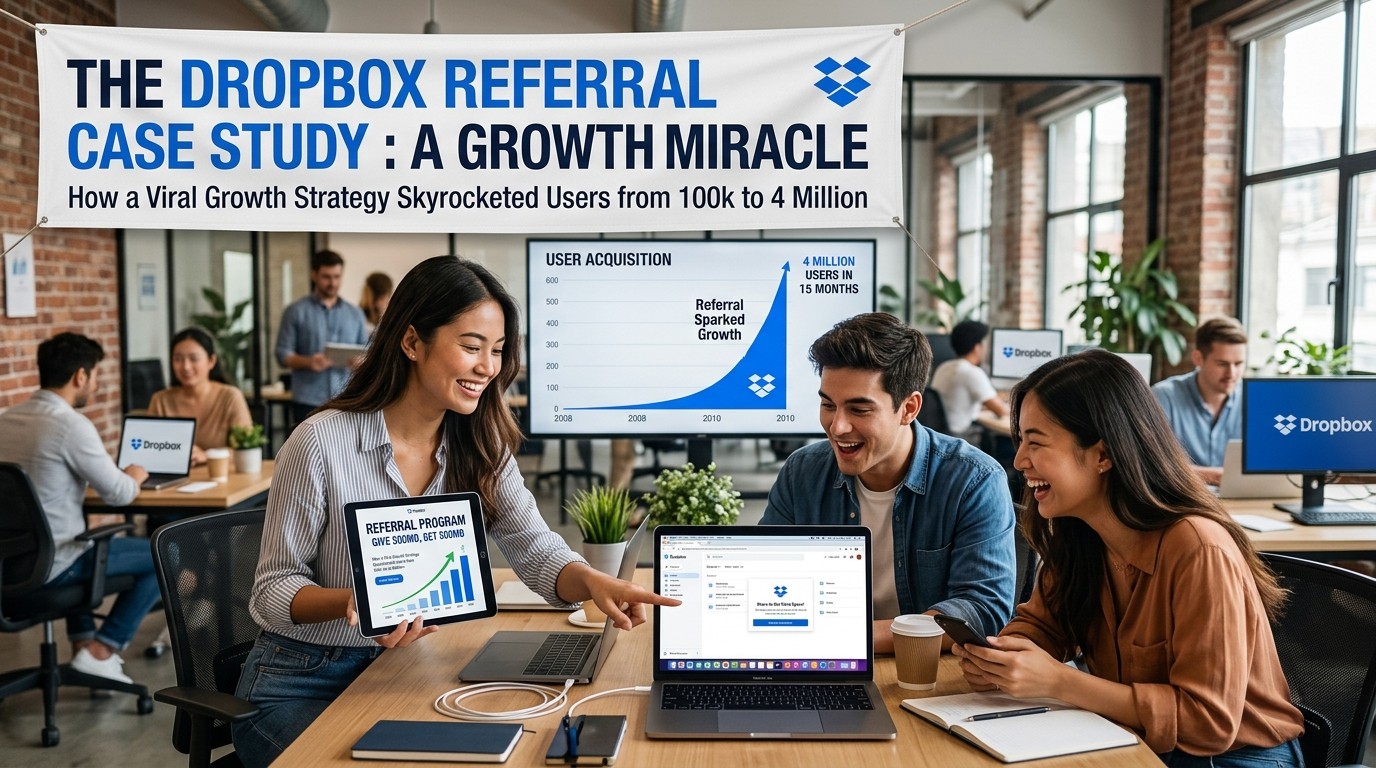
Dropbox Referral Case Study shows how a simple, well-timed incentive loop can turn product value into compounding user growth when the message, reward, and onboarding experience all work together.
Dropbox Referral Case Study is one of the most quoted examples in growth marketing because it proves that a referral system can do more than bring in a few extra users. It can reshape acquisition economics, change how people talk about a product, and create a flywheel that keeps building momentum. In the Dropbox story, the referral engine did not work because it was flashy. It worked because it matched user psychology, fit the product’s core behavior, and gave both sides of the referral a reason to participate.
The reason this story continues to matter is simple: many companies still struggle to make referral marketing feel natural. They add referral links, offer vague rewards, or bury the program where nobody sees it. Dropbox did the opposite. The referral program was simple, visible, and tied directly to a product benefit users already understood. Dropbox Referral Case Study is therefore less about a one-time trick and more about how to design growth around product truth.
Why the Dropbox Story Still Matters
Dropbox Referral Case Study remains relevant because it shows that product-led growth and referral design can work together. Dropbox was solving a real problem at the right moment: people needed a reliable way to store, sync, and share files across devices. That usefulness created trust, and trust made referrals more believable. When people already like the product, they are much more willing to recommend it. That is why the Dropbox model feels so durable even today.
The other reason this example remains powerful is that it demonstrates how growth can come from reducing friction instead of increasing pressure. Dropbox did not depend on aggressive sales outreach to scale the consumer side of the product. It made sharing easier, visible, and rewarding. Dropbox Referral Case Study therefore teaches a lesson many modern teams still need: the best referral program feels like part of the product, not a separate campaign glued on top.
The Core Growth Context

Before the referral engine scaled, Dropbox had already found a product-market fit signal. The product solved a very real daily pain point: file syncing and backup across devices. That made the product easy to explain and easy to value. In the widely cited growth narrative, Dropbox went from about 100,000 users to 4 million users in roughly 15 months, a figure often summarized as 3,900% growth. At peak, users were sending millions of referral invites per month, with many summaries pointing to 2.8 million invites in a single month.
Dropbox Referral Case Study is important because those numbers were not created by paid ads alone. The referral loop amplified existing product demand. That means the referral system worked because the underlying product was already useful enough that users wanted to bring others in. A weak product rarely sustains that kind of word-of-mouth behavior.
The Offer That Made Sharing Feel Fair
Dropbox Referral Case Study succeeded partly because the incentive was balanced. Both the inviter and the invited user received additional storage, which made the reward feel fair rather than one-sided. That symmetry matters psychologically because people are more likely to participate when the benefit does not feel manipulative. Users were not just helping Dropbox; they were helping a friend while also getting something valuable themselves.
This matters because referral marketing often fails when the reward feels disconnected from the product. Dropbox made the reward directly tied to the value of the service: more storage. That meant the incentive was not a gimmick. It was an extension of the product promise. Dropbox Referral Case Study shows that the best rewards often reinforce why the product matters in the first place.
Why Timing Was a Big Part of the Win
Dropbox Referral Case Study also benefited from timing. The market was ready for simpler file sharing, better sync, and less dependence on physical storage. People were becoming more mobile, collaboration was increasing, and cloud-based workflows were becoming more normal. Dropbox entered that environment with a product that solved a pain point people already felt.
When the referral program arrived, it landed on top of genuine demand. That made the incentive easier to understand and easier to trust. Timing is often underestimated in growth discussions because teams like to focus on tactics. But Dropbox Referral Case Study shows that the right tactic at the wrong time would not have worked nearly as well. The market readiness mattered.
Onboarding as a Growth Lever
Dropbox Referral Case Study is often remembered for the referral reward, but onboarding played a major role too. New users were exposed to the referral opportunity early and repeatedly, which made the program hard to miss. A referral program only works if people see it at the moment when they are most likely to care. Dropbox placed the program where it fit naturally within the user journey.
That placement reduced friction. Users did not have to search for the program or decode complicated rules. They saw the offer, understood it quickly, and could act. Dropbox Referral Case Study demonstrates that visibility matters almost as much as the reward itself. If the program is hidden, the loop weakens. If it is obvious and tied to real value, participation grows.
What the Psychology Teaches Us
Dropbox Referral Case Study is really a lesson in human behavior. People share things that are useful, easy to explain, and socially safe to recommend. Dropbox checked all three boxes. It made file sharing simple, the value was easy to communicate, and the product gave people a practical reason to invite others. The referral program did not force social pressure; it gave users a sensible reason to talk about something useful.
That is where trust comes in. A user is more likely to refer a product when the recommendation feels helpful rather than self-serving. Dropbox benefited from that social dynamic. Dropbox Referral Case Study shows that referrals work best when people can say, in effect, “This helped me, and it can help you too.” That sentence is a powerful growth engine.
The Product Was Already Shareable
Dropbox Referral Case Study succeeded because the product itself was built for sharing. File storage and sharing are collaborative behaviors, so the core use case already created natural moments for inviting others. That is a crucial insight for any referral system. If the product does not create natural social moments, the referral program has to work much harder.
Dropbox made sharing a feature, not just a campaign objective. That product behavior created the stage for the referral program. The more a product is used with others, the easier it is to turn usage into invites. Dropbox Referral Case Study is powerful because the product and the referral loop pointed in the same direction.
Audience Segmentation and Message Fit
Dropbox Referral Case Study also suggests a deeper lesson about Audience Segmentation. Not every user is motivated by the same message, and not every channel carries the same intent. Some users respond to extra storage, while others care more about convenience, collaboration, or backup security. The referral program worked because the core promise was broad enough to appeal across user types without losing clarity.
That is why teams should think carefully about Data Signals for Precise Message Tailoring when building referral systems. In Dropbox’s case, user behavior could indicate who was likely to share, who valued storage more, and who was most engaged with the product. Those signals can guide smarter messaging. Dropbox Referral Case Study reminds marketers that the best growth programs often feel personal even when the system is scalable.
A Simple Loop Beats a Complicated One
Dropbox Referral Case Study proves that simplicity can outperform complexity. Many referral systems fail because they add too many steps, too much jargon, or too many conditions. Dropbox kept the loop easy to understand. The user gets more storage, the friend gets more storage, and both parties benefit. That simplicity lowered hesitation and increased action.
Simple systems also scale better because they are easier to explain to others. A user can describe Dropbox’s referral offer in one sentence, which helps the message spread organically. Dropbox Referral Case Study therefore teaches a practical lesson: if a growth loop is hard to explain, it will be harder to share. If it is easy to explain, it is much more likely to travel.
The Economics Behind the Growth
Dropbox Referral Case Study is compelling because it improved acquisition economics. Referral-driven signups are often cheaper than paid acquisition because the user does some of the distribution work. Instead of paying for every impression or click, the brand turns happy customers into a distribution channel. Dropbox took advantage of that structure in a way that was both elegant and financially attractive.
The economic logic is straightforward. If a product can create a low-friction referral mechanism and the reward is cheaper than buying the same user through ads, the system can be highly efficient. Dropbox Referral Case Study shows why this matters so much for startups: early growth budgets are limited, so any channel that compounds organically can be a massive advantage.
Why Trust Amplifies Referrals

Dropbox Referral Case Study also benefited from trust. Recommendations from friends often carry more weight than brand advertising because they feel personal and low risk. When users recommend a product they actually use, the referral carries social proof that paid messaging cannot fully replicate. Dropbox’s product was practical enough that people felt comfortable recommending it.
Trust matters even more when the product solves an everyday problem. Users do not need a long explanation to understand why backup and syncing matter. They already feel the pain. That is one reason Dropbox Referral Case Study remains such a useful teaching example. The program did not invent demand; it captured and amplified existing trust.
How Retention Strengthened the Loop
Dropbox Referral Case Study was not only about acquisition. Retention mattered too. A referral loop only compounds if new users become active users and then eventually invite others. If people sign up and disappear, the loop weakens. Dropbox’s product value supported retention because users quickly experienced the benefit of file sync and sharing in daily life.
That is a major lesson for marketers. The referral itself is not the whole story. The product experience after signup determines whether the new user becomes part of the next growth wave. Dropbox Referral Case Study shows that referral programs work best when activation and retention are strong enough to sustain momentum.
What Modern Marketers Miss
Dropbox Referral Case Study is often copied superficially but not understood deeply. Some companies think they can simply offer a reward and watch growth happen. In reality, the Dropbox effect came from product value, timing, incentive design, visibility, and friction reduction all working together. Without those elements, a referral program usually underperforms.
That is why many modern programs feel disappointing. They are built as marketing add-ons rather than product experiences. Dropbox Referral Case Study reminds teams that the referral system must feel native to the product. If it feels tacked on, users will treat it that way.
Where Other Programs Go Wrong
Many brands compare themselves to Dropbox but ignore the differences in behavior. A referral program for a file-sharing product is not the same as one for a niche service with low repeat use. If the product is not naturally shareable, the referral loop becomes harder to trigger. That is why simple imitation rarely works.
Dropbox Referral Case Study stands out because the offer matched both the product and the user’s mental model. A lot of brands miss that fit. They reward referrals without understanding what kind of action their users are actually willing to take. The best referral systems meet users where they already are.
Comparing Dropbox with Other Referral Models
When people discuss Dropbox Referral Case Study, they often compare it with later referral systems in ridesharing, investing apps, or consumer products. Those comparisons are useful because they show how the referral logic changes by category. A product like the Rivian Referral Program may lean more on brand enthusiasm and community identity, while a Polymarket Referral Program may depend on active participation and platform familiarity.
The important point is that not every category behaves like Dropbox. Dropbox Referral Case Study worked because the product itself was a daily utility and the referral reward directly increased product value. Other industries can borrow the idea, but they must adapt the reward and timing to the user’s actual motivation.
Designing for Social Momentum
Dropbox Referral Case Study shows how social momentum can be engineered without becoming fake. The program succeeded because the social share had real utility. People were not simply forwarding a promotion; they were helping someone access a tool they genuinely found useful. That made the message more credible and the act of sharing less awkward.
This is one reason referral programs can become powerful when they are embedded in the product experience. If a user already trusts the product, the recommendation feels more like assistance than advertising. Dropbox Referral Case Study demonstrates that good growth systems do not just push messages. They encourage behavior that users already want to take.
The Role of Product Clarity
Dropbox Referral Case Study also teaches the importance of product clarity. If users do not immediately understand what the product does, they will not refer it confidently. Dropbox was easy to describe: it helped people store, sync, and share files. That clarity reduced the social effort needed to invite others.
Clarity matters because people do not like explaining things they barely understand. A clear product creates a clear referral. Dropbox Referral Case Study is a reminder that marketing gets easier when the product story is clean enough to retell in a sentence. That simplicity is one of the real reasons the loop scaled.
How the Referral Loop Reinforced the Brand
Dropbox Referral Case Study did more than increase signups. It reinforced the brand as useful, modern, and easy to share. Every referral acted like a small signal that the product was worth recommending. Over time, that repeated social proof strengthened the brand’s identity and expanded its reach.
That is an important lesson for marketers who think only in terms of conversion numbers. Referral loops also shape perception. A strong loop can make a brand feel more trusted because it appears to move through people rather than around them. Dropbox Referral Case Study shows that the best growth systems often build brand and acquisition at the same time.
What the Numbers Suggest
Dropbox Referral Case Study is often summarized with a few headline numbers because the growth was so dramatic. The commonly cited 100,000 to 4 million user expansion in about 15 months, along with millions of monthly invites, helped turn the story into a case-study classic. These numbers are frequently cited across growth analyses, even though not every number is sourced identically in every writeup.
The takeaway is not just that the numbers were large. It is that the growth pattern showed compounding behavior. Once users started sharing, the program reinforced itself. Dropbox Referral Case Study therefore remains one of the clearest examples of a referral engine that produced real scale instead of vanity engagement.
Lessons for Modern SaaS Teams
Dropbox Referral Case Study matters for SaaS because the SaaS buyer journey often depends on trust, clarity, and shared value. If the product can be demonstrated quickly and experienced early, referrals become easier to trigger. SaaS teams can learn from Dropbox by aligning reward, visibility, and product value instead of treating referrals as a side experiment.
SaaS teams should also think about the first moment of usefulness. If users see value fast, they are more likely to invite others. Dropbox Referral Case Study shows how fast activation can support growth because users do not wait months to understand the product. They feel the benefit quickly and then act on it.
Applying the Lesson to New Products

Dropbox Referral Case Study is useful even for companies that are not building file storage. The deeper lesson is that referrals should reward behavior that is already natural to the product. If the product is collaborative, the reward can support sharing. If the product is community-based, the reward can support participation. If the product is high-trust, the reward can support recommendation.
That is where smart Audience Segmentation becomes valuable again. Different users will respond to different triggers, and the message should reflect that. Data Signals for Precise Message Tailoring can help teams understand who is likely to refer and what message will make sharing feel worthwhile. Dropbox Referral Case Study proves that the best growth loops are designed, not hoped for.
The Bigger Growth Principle
Dropbox Referral Case Study ultimately proves a bigger principle: the best growth comes when the product experience itself creates distribution. A referral system is strongest when it mirrors what users already want to do. If people naturally want to invite others, the program should make that easy and rewarding.
This is why Dropbox remains such a powerful teaching example. The referral loop did not replace product quality; it amplified it. That distinction matters. Dropbox Referral Case Study is not a story about tricking users. It is a story about making useful behavior easier to spread.
Conclusion
Dropbox Referral Case Study remains one of the most instructive growth stories because it combines psychology, product design, timing, and incentive structure in a way that still feels relevant. The referral program worked because it was simple, fair, visible, and tied directly to the product’s core value. Users understood the offer quickly, trusted the product enough to recommend it, and had a real reason to participate. The result was not just more signups, but a compounding system that turned happy users into a distribution channel. For modern marketers, the lesson is clear: the strongest referral programs are built around real utility and genuine user motivation. If the product solves a real problem, the referral should make it easier to share that value, not force a behavior that feels disconnected from the experience. That is why this case study still matters. It shows that growth can become a byproduct of usefulness when the system is designed with care, clarity, and user psychology in mind. In a noisy market, that kind of compounding advantage is still one of the most powerful ways to grow.
Frequently Asked Questions (FAQ)
What is the Dropbox Referral Case Study about?
Dropbox Referral Case Study explains how Dropbox used a simple two-sided referral program to turn existing users into a major acquisition channel.
Why did it work so well?
It worked because the reward matched the product, the program was easy to understand, and users already found the product useful enough to share.
How much did Dropbox grow?
Dropbox is widely cited as growing from about 100,000 to 4 million users in roughly 15 months, with millions of referral invites per month at peak.
What made the reward effective?
The reward was extra storage, which directly increased the value of the product rather than offering something unrelated.
Could this model work for other products?
Yes, but only if the product naturally supports sharing and the reward fits what users actually value.
Is referral marketing still useful today?
Yes, especially when the referral is built into the product journey and supported by good onboarding and retention.
What role did onboarding play?
It made the referral offer visible early, which increased participation and kept the loop from being hidden.
Why is audience segmentation important here?
Different users respond to different messages, so better segmentation helps match the referral offer to user motivation.
What can SaaS companies learn from it?
They can learn to connect product value, user behavior, and referral incentives into one clear growth loop.
What is the biggest lesson?
The biggest lesson is that referral growth works best when the product is genuinely useful and the referral feels like a natural extension of that value.