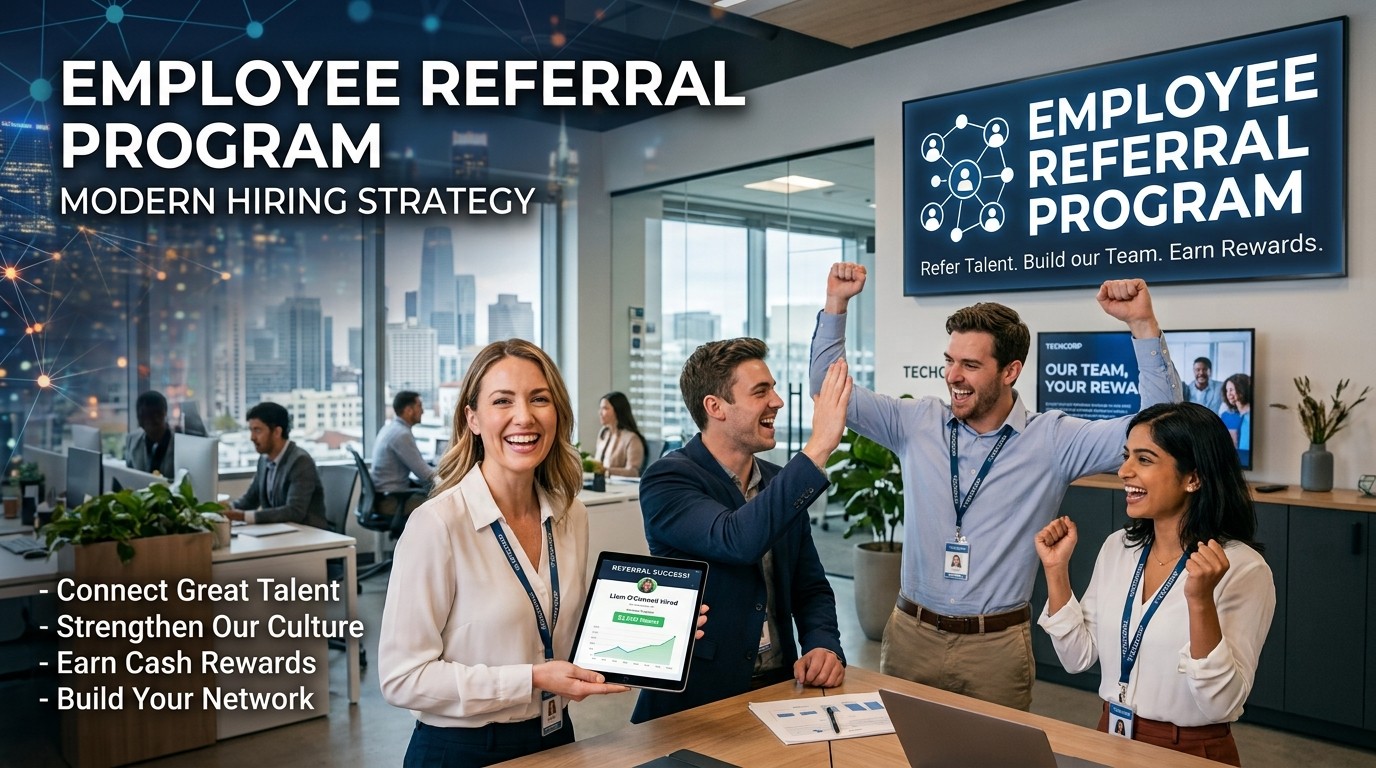
An Employee Referral Program helps companies hire faster, lower recruitment costs, and improve fit by turning trusted employee networks into a practical, repeatable hiring channel.
An Employee Referral Program remains one of the most effective modern hiring strategies because it combines trust, speed, and cultural fit in a way that traditional sourcing methods often cannot. SHRM’s 2025 toolkit on designing and managing employee referral programs emphasizes practical guidance for building programs that improve hiring quality and engagement, while Workable’s 2025 guidance highlights clear objectives like better-quality hires, shorter time-to-hire, and stronger employee participation.
The reason an Employee Referral Program works so well is simple: employees usually recommend people they believe can succeed in the role and fit the company culture. That pre-vetting effect reduces uncertainty for recruiters and creates a more confident hiring process. Joveo’s 2026 guide also reports that referral hires tend to stay longer than employees sourced through online postings, which is one reason referrals are still a high-value channel for talent acquisition teams.
An Employee Referral Program is not just a hiring tactic. It is a behavioral system that encourages employees to act like talent scouts, strengthens internal engagement, and helps the business hire with more consistency. When it is structured well, it can become one of the most reliable parts of a modern recruitment strategy.
Why an Employee Referral Program still outperforms many traditional channels
An Employee Referral Program often outperforms broad job-board sourcing because referrals arrive with context. Recruiters do not start from zero; they start with a candidate who has already been screened informally by someone inside the organization. Workable’s hiring guidance says referral programs are commonly designed to improve hire quality, reduce time-to-hire, and boost employee engagement, which is exactly why they continue to be a top strategy for many HR teams.
The psychology behind this is powerful. Employees are less likely to recommend someone casually if they think that recommendation could reflect poorly on them. That self-protection creates a quality filter before HR even sees the candidate. Over time, that can reduce the “noise” of unqualified applicants and make the shortlist more relevant.
An Employee Referral Program also works because it aligns with how people naturally share opportunities. People like helping trusted contacts, and they like seeing someone they know succeed. When the company makes referring easy and worthwhile, it benefits from behavior that is already socially natural rather than fighting against it.
What an Employee Referral Program actually is
An Employee Referral Program is a structured process that lets existing employees recommend candidates for open roles. The company then reviews those candidates through the normal hiring workflow, usually with referral tracking and a reward policy attached. SHRM’s 2025 toolkit frames this as a practical talent strategy that needs clear rules, process management, and ongoing support from HR.
The best programs are intentionally simple. Workable’s 2025 guide recommends clear goals, a simple process, and incentives tied to overall hiring strategy. Jobs.ie’s 2025 guidance makes the same point in a more operational way: keep the process simple, define eligibility, and explain when incentives are paid so employees do not get confused or disappointed later.
That simplicity is important because an Employee Referral Program should reduce friction, not create it. When employees can submit a referral quickly, understand the reward conditions, and see the status of their referral, participation tends to improve. A confusing process usually lowers participation no matter how attractive the bonus is.
Why employee psychology makes referrals so effective
An Employee Referral Program works because employees already have an emotional stake in who joins their team. They care about workload, team chemistry, and reputation. That means their referrals often reflect both skill judgment and social judgment, which can improve candidate fit before the formal interview process begins.
The social side matters too. A referring employee usually wants the candidate to succeed because the referrer’s own credibility is on the line. That creates a built-in incentive to recommend carefully. This is one reason referral hiring is often associated with stronger candidate quality and stronger retention in the sources reviewed.
An Employee Referral Program also gives employees a sense of agency. Instead of waiting passively for hiring to happen around them, they can actively influence team growth. That tends to support engagement, especially when leadership recognizes and rewards the behavior in a visible way.
Business benefits that make referral hiring worth it

An Employee Referral Program can reduce recruitment costs because it lowers dependence on agencies and paid sourcing channels. Formstack’s recent overview says referral systems can shave days off time-to-hire, cut recruiting costs, create an engaged workforce, and increase retention. Those are exactly the kinds of outcomes that make referrals attractive at scale.
Retention is especially important. Joveo’s 2026 guide says referred hires have an average retention rate of 46%, compared with 33% for employees sourced through online job postings. If a company can improve both hiring speed and retention, the compounding value becomes significant over time.
A strong Employee Referral Program also improves employer brand because employees become advocates. When people hear that current staff are recommending the workplace to others, the organization appears more trustworthy and more attractive. That social proof often influences candidates before they ever visit the careers page.
How to design a simple, high-participation referral flow
A well-designed Employee Referral Program starts with clarity. Workable recommends defining objectives first, then creating a simple process and establishing incentives. That sequence matters because the program should support the business goal, not just reward random referrals.
The referral path should be short enough that employees can complete it without friction. Jobs.ie’s 2025 guidance says clarity on open roles, eligibility, and payout timing prevents confusion. In practice, that means one obvious place to submit a referral, one clear explanation of who qualifies, and one visible timeline for what happens next.
An Employee Referral Program also needs feedback. Employees do not expect every referral to be hired, but they do expect acknowledgment. A confirmation email, status update, or completion note helps the program feel alive rather than invisible. SHRM’s toolkit supports this kind of structured management because ongoing engagement is part of effective program design.
Incentives and reward design that people actually care about
An Employee Referral Program usually needs a reward, but the reward has to feel meaningful. Incentives can be cash, bonuses, recognition, paid time off, or tiered rewards tied to milestones. Workable and Jobs.ie both stress that incentives should be clear and easy to understand, because unclear rewards weaken participation.
The smartest reward structure is often more about timing than size. If the reward is paid only after the candidate passes a probation period, that may improve quality. If a smaller bonus is paid faster, that may improve participation. The best answer depends on whether the company wants volume, quality, or both.
A useful way to think about incentive design is to make the reward feel fair, visible, and achievable. The Cash App Referral Program is a familiar example of how a simple, direct referral incentive can make sharing feel natural when the product is easy to explain and the reward is understandable. While that model comes from consumer growth rather than hiring, it shows why referral behavior tends to work best when the offer is simple and immediate.
Keeping the program fair and transparent
An Employee Referral Program succeeds when employees trust the rules. If people suspect that referrals are handled inconsistently, or that some teams get special treatment, participation can drop quickly. SHRM’s 2025 toolkit emphasizes clear policy and practical management, which is the right foundation for fairness.
Transparency should cover eligibility, payout conditions, open roles, and whether employees can refer former colleagues or external contacts. Jobs.ie’s 2025 guidance highlights the value of stating eligibility and expectations clearly up front. That kind of clarity prevents disappointment and reduces informal confusion across teams.
An Employee Referral Program should also be monitored for bias. Referral channels can strengthen hiring, but they can also reproduce similarity bias if the company is not careful. A fair process keeps quality high while still opening the door to broader talent. That balance is one reason the program must be managed actively rather than left alone.
How to promote the program internally

An Employee Referral Program cannot work if employees forget it exists. Tribepad’s 2025 best-practice guidance says culture change and employee empowerment are key to referral success. In practical terms, that means the company should market the program internally, not just launch it once and hope people remember.
Promotion can happen in team meetings, internal newsletters, onboarding materials, and role-specific hiring updates. The point is to keep the program visible when people are most likely to know someone suitable. Workable also notes that boosting employee engagement is a legitimate referral-program objective, which means promotion is part of the strategy, not an optional extra.
An Employee Referral Program becomes more effective when leaders talk about it as a contribution to team growth. Employees are more likely to participate if they see the program as an opportunity to shape the company, not just a transaction for a bonus. That is where internal storytelling matters.
Measuring success with the right metrics
An Employee Referral Program should be measured like any other hiring channel. The most useful metrics are time-to-hire, quality of hire, retention, participation rate, and cost per hire. Formstack’s 2026 summary says referral systems can reduce time-to-hire, cut recruiting costs, and increase retention, which makes those metrics especially relevant.
A simple metric framework can help HR understand performance more clearly.
| Metric | What it tells you |
|---|---|
| Participation rate | Whether employees are using the program |
| Time-to-hire | Whether referrals speed up hiring |
| Quality of hire | Whether referral candidates perform well |
| Retention rate | Whether referral hires stay longer |
| Cost per hire | Whether the program saves money |
That kind of scorecard makes the Employee Referral Program easier to manage and easier to defend to leadership.
An Employee Referral Program should also be reviewed by department, role type, and location. A program may work very well for technical hiring and less well for another function, so segmenting the data helps reveal where referrals create the most value.
Comparing referral performance with market context
An Employee Referral Program is strongest when the company understands the wider talent market around it. That is where a Comparative Market Analysis Tool can be useful as a comparison mindset, because hiring does not happen in isolation. Companies need to see how their referral outcomes compare with broader hiring conditions, role competition, and market availability.
Some teams also look at Best Market Intelligence Tools when they want a better read on external hiring signals, employer demand, or regional talent movement. The point is not to turn recruitment into a pure market-research exercise; it is to keep the referral strategy informed by reality.
An Employee Referral Program benefits from this wider view because it helps leaders decide where referrals are likely to work best. In a tight talent market, referrals may be especially valuable. In a market with low competition for a role, the same incentive structure may need to be adjusted. That is why context matters.
Learning from examples and success stories
An Employee Referral Program becomes easier to improve when leaders study referral systems that already worked elsewhere. Referral Program Examples and Success Stories are useful because they show patterns, not just results. The main pattern across strong referral stories is usually simplicity, trust, and a reward that feels worth the effort.
The most persuasive examples often share the same logic: the company makes the process easy, communicates the value clearly, and gives employees a reason to care. The candidate quality improves because employees tend to refer people they genuinely believe will perform well, and the company gains a hiring channel that feels more human than cold sourcing.
An Employee Referral Program does not need to copy a famous example exactly. It needs to learn the underlying mechanics: simple process, visible reward, timely communication, and regular promotion. Once those basics are in place, the program can be tuned for the company’s specific hiring needs.
Using technology to manage the program

An Employee Referral Program becomes much easier to run when technology handles tracking and reporting. HR software can record referral source, candidate stage, payout eligibility, and hiring outcomes. That makes the process less dependent on manual spreadsheets and more consistent over time. SHRM’s toolkit and Workable’s 2025 guide both point toward structured administration as a core part of referral success.
Automation also improves employee experience. When people can submit a referral quickly and see status updates without chasing HR, the program feels more professional. A small improvement in usability can have a large impact on participation because employees are far more likely to engage with systems that feel easy and reliable.
An Employee Referral Program should therefore be treated as part of the HR operating system, not a side campaign. The more visible, trackable, and responsive the workflow is, the more likely the program is to keep producing strong candidates.
Common mistakes and how to avoid them
An Employee Referral Program often underperforms for a few predictable reasons. The first is complexity. If the process feels hard to use, employees stop participating. Jobs.ie’s 2025 guidance is blunt on this point: simplicity is crucial, and clear expectations prevent confusion and disappointment.
The second mistake is weak communication. If employees do not know which roles are open, which candidates qualify, or when rewards are paid, the program loses momentum. The third mistake is treating the program as a one-time launch rather than an ongoing habit. SHRM and Tribepad both stress active management and culture change, which means the program must be promoted and refreshed over time.
An Employee Referral Program can also fail if the company does not measure outcomes beyond hires. If retention, quality, and employee engagement are not tracked, leaders may miss the real value of the channel. Good measurement keeps the program honest and useful.
A practical rollout roadmap for modern hiring
An Employee Referral Program works best when it is rolled out in phases. First, define the hiring problem you want to solve. Workable recommends starting with a clear objective, such as increasing quality, reducing time-to-hire, or boosting engagement. That gives the program a purpose.
Next, build the policy and process. Keep the submission path simple, define eligibility, and explain reward timing. Then promote the program internally so employees actually see it and understand it. After launch, track participation, retention, and time-to-hire so you can refine the design based on evidence.
An Employee Referral Program should also be reviewed regularly with recruiting, HR, and leadership. That ensures the program stays aligned with business goals rather than drifting into an old habit. The best modern referral systems are not static; they get better as the company learns what works.
Conclusion
An Employee Referral Program is one of the smartest modern hiring strategies because it uses trust, employee networks, and simple incentives to improve hiring quality and speed. When the program is clear, fair, and easy to use, it can reduce recruiting costs, strengthen retention, and make employees feel like active contributors to company growth. The strongest programs are not complicated; they are consistent, visible, and measurable. If a business wants better hires without adding unnecessary friction, an Employee Referral Program is a strong place to start, and it becomes even more valuable when managed as an ongoing part of the hiring system rather than a one-time campaign.
Frequently Asked Questions (FAQ)
1. What is an Employee Referral Program?
An Employee Referral Program is a hiring system where current employees recommend candidates for open roles, and the company evaluates those candidates through its normal recruiting process. SHRM and Workable both treat this as a structured talent strategy rather than an informal favor.
2. Why do Employee Referral Program hires often perform better?
Referral candidates are often pre-vetted by employees who understand the role and culture, which can improve fit and reduce hiring uncertainty. Workable and JazzHR both describe referral candidates as stronger-fit hires.
3. Does an Employee Referral Program reduce hiring time?
Yes. Workable says referral programs can reduce time-to-hire, and Formstack says they can shave days off hiring. That speed is one of the main reasons companies invest in the channel.
4. Do referral hires stay longer?
Often yes. Joveo’s 2026 guide reports a 46% retention rate for referral hires compared with 33% for employees sourced through online postings. That makes retention one of the strongest benefits of referral hiring.
5. What makes an Employee Referral Program successful?
Clarity, simplicity, fair incentives, and consistent communication are the biggest success factors. SHRM, Workable, and Jobs.ie all emphasize those traits in their guidance.
6. How should rewards be structured?
Rewards should be easy to understand, visible to employees, and tied to the company’s goals. A bonus after a hire, after probation, or after a retention milestone can all work depending on the strategy.
7. Can a referral program create bias?
Yes, if it is not monitored carefully. A referral channel can be effective and still need fairness checks, clear eligibility rules, and active HR oversight.
8. How can HR promote the program internally?
HR can use onboarding, team meetings, internal emails, and recurring reminders. Tribepad’s 2025 guidance says employee empowerment and culture change are critical, which means promotion should be ongoing.
9. What metrics matter most?
Participation rate, time-to-hire, quality of hire, retention rate, and cost per hire are the most useful metrics for evaluating an Employee Referral Program.
10. Should referral performance be compared with other market signals?
Yes. Using a Comparative Market Analysis Tool mindset or reviewing Best Market Intelligence Tools can help HR understand how referral outcomes fit into wider labor-market conditions.