
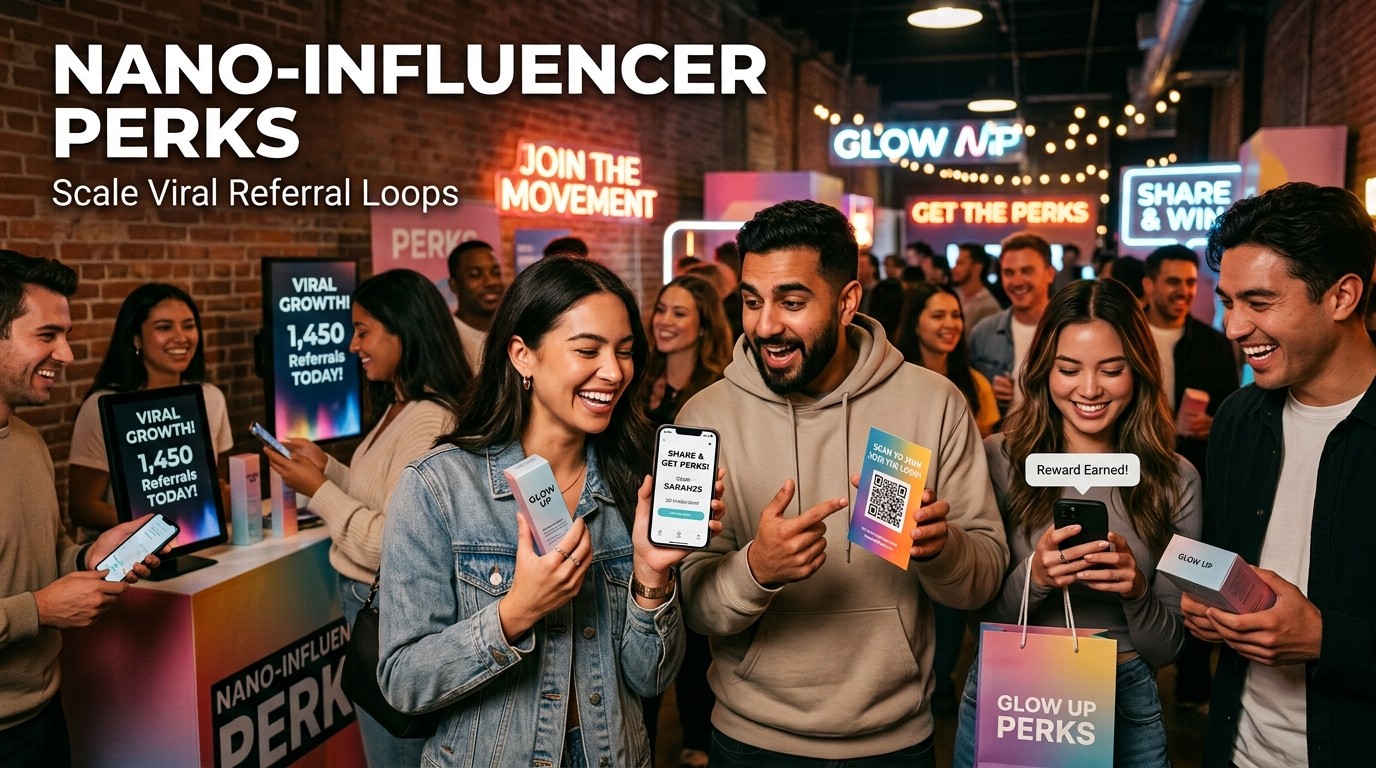
Nano-influencers can turn trusted niche relationships into repeatable referral growth when brands combine meaningful rewards, simple sharing mechanics, authentic content, and measurable incentives.
Influencer marketing has traditionally focused on reach. Brands searched for creators with large audiences, impressive follower counts, and broad visibility. But the logic behind referral marketing is different. A recommendation becomes powerful when people believe it, remember it, and feel comfortable acting on it. That is why Nano-Influencer Perks can become strategically valuable even when the creators involved have relatively small audiences.
A nano-influencer typically operates within a narrow community or specialized interest. Their audience may consist of local customers, hobby enthusiasts, professionals, students, gamers, fitness communities, beauty enthusiasts, parents, collectors, or people sharing a particular lifestyle. Instead of speaking to everyone, they often speak to people who already care about the subject. Nano-Influencer Perks can turn that concentrated relevance into a structured growth mechanism.
The real opportunity is not simply paying smaller creators to publish promotional content. It is designing a system where a creator introduces a product, the audience has a reason to try it, the customer receives a satisfying experience, and the new customer becomes another potential source of referrals. This creates a loop rather than a one-time campaign.
When Nano-Influencer Perks are designed around genuine value, they can lower the distance between recommendation and action. Instead of asking followers to trust an unfamiliar advertisement, the brand enters the conversation through someone the audience already recognizes.
What Are Nano-Influencer Perks?
Nano-Influencer Perks are benefits, incentives, privileges, commissions, discounts, rewards, experiences, or exclusive opportunities offered to nano-influencers as part of a creator or referral marketing strategy.
The word “perks” is intentionally broader than payment. A creator might receive free products, exclusive access, early releases, affiliate commissions, personalized discount codes, event invitations, recognition, performance bonuses, or access to a private community. Nano-Influencer Perks can therefore be financial or non-financial depending on campaign objectives and creator expectations.
This distinction matters because different creators respond to different forms of value. A niche creator who already loves a product may care more about early access than a flat sponsorship fee. Another creator may prefer recurring commissions because they want their content to continue generating revenue. Someone building a personal brand may value exclusive collaborations or recognition within the community.
Effective Nano-Influencer Perks start with the creator’s actual motivation rather than assuming every person wants the same reward.
A good perk should also support the customer experience. If the creator receives an attractive benefit but followers receive nothing useful, the campaign may create attention without meaningful conversion. The strongest structures make the incentive valuable for both sides.
Why Nano-Influencers Are Different From Large Influencers
Large influencers can generate enormous exposure, but exposure does not automatically translate into referral behavior. A viewer may watch a sponsored video and never remember the brand name. In contrast, niche creators often interact repeatedly with smaller communities.
That repeated interaction can increase familiarity. When Nano-Influencer Perks support ongoing collaboration, the creator can mention a product naturally over time rather than forcing every campaign into a single promotional post.
Another difference is conversational context. A large creator may broadcast to a huge audience, while a smaller creator may answer questions, respond to comments, discuss personal experiences, and receive direct messages from followers. Nano-Influencer Perks can strengthen this conversational environment because the creator has a reason to continue participating beyond one sponsored placement.
A smaller audience can also make recommendation patterns easier to understand. Brands can identify which communities respond, which offers generate action, which content formats perform, and which creators attract high-quality customers. In that way, Nano-Influencer Perks can function as both a promotional mechanism and a market-learning system.
The key question is not “How many people saw this creator?”
The more useful question is “How many relevant people took a meaningful action because they trusted this creator?”
The Psychology Behind Creator-Led Referrals

Human decisions are heavily influenced by trust, familiarity, social proof, identity, and perceived risk. These forces are central to Nano-Influencer Perks because the incentive structure changes how a recommendation moves through a community.
A follower may ignore an advertisement from an unfamiliar company but pay attention when a familiar creator demonstrates the same product. The creator adds context. They may explain why they use it, who it is for, what they dislike about it, and how it compares with alternatives.
Nano-Influencer Perks become more powerful when they reinforce that trust instead of replacing it.
Trust Transfers Through Relationships
Trust is difficult for brands to manufacture quickly. Creators may already have months or years of interaction with their audience. Their followers have seen their preferences, mistakes, reviews, routines, and personality.
When a recommendation appears consistent with previous content, it can feel more authentic. Nano-Influencer Perks should therefore encourage genuine product experience before asking for promotion.
Familiarity Reduces Decision Friction
People often hesitate before trying unfamiliar products. They wonder whether the product works, whether it is worth the money, whether the company is legitimate, and whether the product will suit their needs.
A creator can reduce some of that uncertainty by explaining the product in familiar language. Nano-Influencer Perks can make this process repeatable when the creator has a clear incentive to educate rather than simply advertise.
Reciprocity Creates Participation
When someone receives a useful benefit, they may feel motivated to respond. This does not mean every reward should be excessive. Often, a small but relevant advantage can be enough.
That is why Nano-Influencer Perks should feel meaningful rather than extravagant. A creator who receives something genuinely valuable may be more invested in the relationship.
Types of Nano-Influencer Perks Brands Can Offer
There is no single ideal reward structure. Different products, creator categories, customer journeys, and budgets require different approaches.
| Perk type | Example | Best suited for | Main advantage |
|---|---|---|---|
| Product gifting | Free product or sample | Physical products | Encourages authentic testing |
| Affiliate commission | Percentage of sales | Ecommerce and SaaS | Aligns reward with results |
| Discount code | Exclusive audience offer | Consumer products | Easy to communicate |
| Early access | Product before public launch | New releases | Creates exclusivity |
| Performance bonus | Extra reward after milestones | Growth campaigns | Encourages continued activity |
| Tiered rewards | Increasing benefits by results | Long campaigns | Supports progression |
| Event access | Invite to launch or community event | Lifestyle brands | Builds relationship |
| Exclusive content | Creator-only materials | Education and media | Adds perceived status |
| Co-creation | Collaboration on product/content | Community brands | Builds ownership |
The strongest Nano-Influencer Perks usually combine two or three benefits rather than relying on one incentive alone.
For example, a creator might receive a product for testing, a personalized audience discount, and a commission on qualified sales. That creates a relationship that can continue beyond the initial post.
Why Exclusivity Matters
Exclusivity is one of the strongest psychological levers in creator programs. People naturally place greater value on opportunities that feel limited or personalized.
A generic coupon available to everyone has little connection to the creator. But a creator-specific offer can feel like a benefit the community received because of the creator’s involvement.
Nano-Influencer Perks can use exclusivity without becoming manipulative. Brands can create limited bundles, private previews, early registration windows, or special access periods that genuinely offer something different.
The objective is to create relevance, not artificial scarcity.
A good exclusive offer answers one simple question:
“Why should this audience act through this creator?”
When the answer is clear, the referral mechanism becomes easier to understand.
Building a Referral Loop Instead of a One-Time Campaign
A traditional influencer campaign might follow this path:
Brand → Creator → Audience → Purchase
A referral loop creates a longer cycle:
Brand → Creator → Audience → Customer → New Recommendation → New Customer
The second model has greater compounding potential because existing customers become distribution points.
Nano-Influencer Perks can support that loop by giving creators a reason to invite new people while giving referred customers a reason to participate. The system can become increasingly efficient as more relevant users enter.
For example:
A creator recommends a productivity tool.
Ten followers sign up.
Three become paying customers.
One of those customers shares the tool with a coworker.
The coworker joins.
That coworker later participates in the referral program.
The resulting growth does not depend entirely on the original creator anymore.
The objective of Nano-Influencer Perks is therefore not simply to buy attention. It is to create conditions where attention can become repeatable advocacy.
Designing the Right Perk Structure
Not every reward should be given immediately. Progressive incentives can encourage sustained behavior.
For example:
One qualified referral → basic reward
Five qualified referrals → enhanced reward
Ten qualified referrals → premium reward
Twenty-five qualified referrals → exclusive experience
This structure gives creators a reason to continue. The progression also creates a psychological sense of achievement.
Nano-Influencer Perks can become more effective when the milestones are realistic. If the first meaningful reward requires hundreds of conversions, smaller creators may decide that the program is not worth their effort.
A good structure creates an early win.
Once the creator sees evidence that their activity produces results, continued participation becomes psychologically easier.
Connecting Micro-Rewards With Creator Motivation
Referral systems often become complicated because brands try to make one giant reward do all the work. Smaller milestones can create more consistent momentum.
For example, a creator could receive a small benefit for completing onboarding, another after the first qualified referral, another after reaching a conversion milestone, and a larger benefit after sustained performance.
The concept behind Micro-Tier Reward Frameworks can be useful when structuring this progression because multiple smaller rewards can reduce the psychological distance between effort and recognition.
Nano-Influencer Perks should therefore be easy to understand. If creators need a complicated spreadsheet just to determine whether they have earned a benefit, enthusiasm can disappear quickly.
The best program rules fit in a short explanation.
Choosing the Right Nano-Influencers
Follower count should never be the only selection criterion.
A creator with 2,000 followers who consistently receives thoughtful questions may be more useful than someone with 15,000 followers who generates little interaction.
Look at:
Audience relevance
Engagement quality
Comment depth
Content consistency
Topic authority
Audience geography
Past recommendations
Brand fit
Conversion history
Communication quality
Nano-Influencer Perks work best when the creator’s community has a genuine connection to the product category.
A beauty creator recommending accounting software may create an awkward campaign. A finance creator speaking to small-business owners could create much stronger alignment.
The match should make sense without explanation.
Measuring Audience Quality
Engagement rate can be helpful, but it needs context.
Ten comments from genuine customers may be more valuable than 500 generic emojis. A creator’s audience should contain people who plausibly need the product.
Brands can examine:
Who comments
What questions they ask
Whether conversations continue
Whether followers mention using recommended products
Whether the audience overlaps with target customer profiles
Whether previous sponsorships generated meaningful discussion
Nano-Influencer Perks amplify what already exists. They cannot transform a badly matched audience into an ideal customer base.
Creating Offers That Convert
The perk given to the creator and the offer given to the audience serve different purposes.
Creator reward = motivation to promote.
Audience offer = motivation to try.
Confusing these two roles can weaken the campaign.
For example, a creator might receive 15% commission while their audience receives free shipping. The creator gets a performance incentive, while the customer receives lower purchase friction.
Alternatively, a creator might receive early access while followers receive an exclusive product bundle.
Nano-Influencer Perks become stronger when the audience-facing benefit is obvious within seconds.
Personalization and Creator Identity
Generic campaigns can make creators sound like advertisements.
A creator might be given a script saying:
“This product is amazing. Everyone should buy it.”
That approach often creates psychological resistance.
A better structure provides facts, usage guidelines, and boundaries while allowing the creator to speak naturally.
Give them:
Key product facts
Verified claims
Important limitations
Audience offer
Tracking link
Disclosure requirements
Creative freedom
Nano-Influencer Perks should reward authentic communication instead of forcing identical scripts across unrelated creators.
A creator’s personality is part of the value they bring.
The Importance of User-Generated Content
Referral campaigns do not always need polished advertisements. Real demonstrations, screenshots, tutorials, customer stories, reviews, and before-and-after examples can make products easier to understand.
This is where User-Generated Content can support creator-led referral loops. When people see real customers or niche creators using a product in realistic situations, the recommendation can feel more grounded.
Nano-Influencer Perks can encourage creators to produce several types of content instead of one promotional post. A tutorial might create initial awareness, a comparison video might answer objections, and a personal follow-up might push hesitant viewers toward action.
The content becomes part of the sales journey.
Turning Reviews Into Referral Assets
A creator review has value beyond the original publication date.
With permission, brands can repurpose strong creator material into:
Product pages
Email campaigns
Case studies
Social snippets
FAQ sections
Landing pages
Retargeting assets
Educational guides
However, brands should preserve context and obtain appropriate rights before reuse.
Nano-Influencer Perks can include recognition or additional rewards for creators whose approved content is repurposed successfully, creating a second layer of motivation.
Creating Viral Loops Through Community Identity
People share products for social reasons as well as functional ones. A product can become part of how someone expresses identity.
Examples include:
“I use this because I care about productivity.”
“I discovered this through a creator I follow.”
“This is the tool everyone in our community uses.”
“I got early access through our creator group.”
These identity signals can increase sharing because people are not only communicating information; they are communicating affiliation.
Nano-Influencer Perks can reinforce this dynamic by creating community-specific experiences rather than only transactional rewards.
Exclusive badges, creator communities, limited access, member recognition, or special launch opportunities can strengthen belonging.
Nano-Influencer Perks for Ecommerce Brands
Ecommerce is particularly suited to creator-led referral systems because purchases can often be tracked directly through personalized links and discount codes.
A practical structure could be:
Creator receives product
Creator tests product
Creator receives unique referral link
Audience gets exclusive discount
Creator earns commission
Top-performing creators receive additional rewards
The simplicity matters.
Customers should not have to manually search for the product after watching content. A direct link reduces friction.
Mobile checkout should also be fast because creator-driven traffic often arrives from mobile devices.
Nano-Influencer Perks can be especially effective for products that benefit from demonstration, styling, comparison, or personal testimony.
Nano-Influencer Perks for SaaS and Digital Products
Software companies can build creator referral systems around trials, memberships, credits, partner accounts, and recurring commissions.
Suppose a creator teaches freelancers how to organize client work. The creator recommends a project-management platform.
The referral journey could offer:
Free trial for the audience
Extended trial through the creator
Recurring commission for the creator
Bonus for activation milestones
Higher-tier reward after sustained customer retention
This model encourages the creator to focus on quality customers rather than empty registrations.
Nano-Influencer Perks should therefore be linked to meaningful milestones wherever possible.
Nano-Influencer Perks for Gaming Communities
Gaming communities can be highly referral-friendly because recommendations often happen through Discord, YouTube, Twitch, forums, social groups, and private conversations.
Creators can receive early access, exclusive items, community rewards, affiliate revenue, tournament access, or special content opportunities.
Gaming ecosystems also demonstrate why community economics matter. Players may respond to ownership, status, utility, competition, collectibles, or access differently. Brands exploring tokenized gaming ecosystems can study how Blockchain Gaming Economies connect player incentives with digital assets and broader economic participation.
The lesson extends beyond blockchain. Communities respond strongly when rewards fit the culture of the environment.
Nano-Influencer Perks should therefore feel native to the community rather than imported from a generic marketing template.
Cross-Community Referral Opportunities
A powerful referral program allows successful creators to introduce other relevant creators.
For example:
Creator A refers Creator B.
Creator B joins.
Creator B generates customers.
Both creators receive an appropriate benefit.
This can create a secondary referral layer among partners.
The program needs safeguards, however, to prevent low-quality recruitment. A reward based solely on signing up additional creators may generate volume without customers.
Instead, the new creator might qualify after producing approved content or generating meaningful customer actions.
Nano-Influencer Perks become more sustainable when rewards are tied to genuine value creation.
Gamification Without Making the Program Feel Cheap

Leaderboards, badges, milestones, streaks, progress bars, and achievement levels can motivate creators. But too much gamification can make a professional collaboration feel like a points-chasing exercise.
Use gamification where it adds energy.
For example:
“Three more sales unlock your next reward.”
That message is simple and motivating.
An interface showing clear progress can make the reward feel closer.
Nano-Influencer Perks become psychologically stronger when creators can immediately understand how close they are to the next milestone.
The system should celebrate progress without encouraging spam.
Transparency and Disclosure
Creator marketing requires clear communication about commercial relationships. Creators should disclose when they receive compensation, products, commissions, or other benefits where applicable under the rules governing the market and platform.
Transparency can actually strengthen trust.
A creator saying, “The brand sent me this product to test, and I may earn a commission if you purchase through my link,” gives the audience useful context.
Nano-Influencer Perks should never depend on hiding the relationship between brand and creator.
Long-term trust is more valuable than one short-term conversion spike.
Common Mistakes in Nano-Creator Referral Programs
Choosing Creators by Follower Count
Large follower counts can hide poor audience fit.
Offering the Same Perk to Everyone
Different creators value different benefits.
Making the Dashboard Complicated
Confusing tracking reduces participation.
Using Generic Scripts
Creators lose authenticity when every word is dictated.
Rewarding Vanity Metrics
Likes and views are not always connected to revenue.
Ignoring Customer Quality
A cheap referral is not necessarily a valuable referral.
Forgetting Follow-Up
Creators should receive updates about performance and upcoming opportunities.
Waiting Too Long to Reward Progress
Delayed reinforcement can weaken motivation.
A Better Onboarding Experience
Creator onboarding should answer five questions immediately:
What do I promote?
Who should I recommend it to?
How do I share it?
How do I earn?
When do I get paid or receive my reward?
A strong onboarding page should include examples, acceptable claims, content guidelines, tracking instructions, and contact information.
Nano-Influencer Perks become more effective when the onboarding process itself feels like a benefit.
A creator should feel welcomed rather than processed.
Personalized onboarding can be particularly useful for top-performing creators.
Tracking the Referral Funnel
A referral funnel can be viewed as:
Creator recruited → Content published → Link clicked → Visitor qualified → Signup → Activation → Purchase → Repeat purchase → Referral
Each stage measures a different form of friction.
If clicks are high but signups are low, the landing page may be the problem.
If signups are high but purchases are low, the offer or onboarding may need improvement.
If purchases are high but repeat purchases are weak, product experience may be the issue.
Nano-Influencer Perks should therefore be evaluated against the entire funnel rather than one headline metric.
Key Metrics to Monitor
| Metric | What it tells you |
|---|---|
| Creator activation rate | Whether recruited creators actually participate |
| Content output | How consistently creators publish |
| Click-through rate | Audience response to the recommendation |
| Conversion rate | Ability to turn traffic into action |
| Revenue per creator | Commercial contribution |
| Customer acquisition cost | Efficiency of creator acquisition |
| Repeat purchase rate | Customer quality |
| Referral rate | Whether acquired users share onward |
| Reward cost | Incentive efficiency |
| Lifetime value | Long-term customer contribution |
These metrics can reveal why Nano-Influencer Perks are or are not producing profitable growth.
Measuring Viral Referral Loops
A true referral loop should generate secondary referrals.
Imagine 100 customers arrive through creators.
If 20 of those customers independently refer another person, the program has generated a second layer.
Now measure:
First-generation customers
Second-generation customers
Average referrals per customer
Conversion rate by generation
Revenue by generation
Retention by generation
The objective is not to create infinite growth mathematically. The practical objective is to determine whether acquired customers naturally contribute additional acquisition.
Nano-Influencer Perks can help initiate the process, but customer experience determines whether the loop keeps moving.
Understanding Referral Velocity
Speed matters.
A creator publishes content today.
How quickly do clicks happen?
How quickly do people sign up?
How quickly do purchases occur?
How quickly do customers refer others?
Fast referral velocity can signal strong relevance, while a delayed response may indicate a longer research cycle.
Different industries naturally have different timelines. A low-cost product may convert within minutes, while a B2B software purchase can take months.
Nano-Influencer Perks should therefore be measured against realistic buying cycles instead of arbitrary campaign deadlines.
Retention Is Part of Referral Success
Acquiring customers who leave quickly can make a referral campaign look successful on the surface while producing weak economics underneath.
A creator might generate 500 trial signups, but if only 10 become long-term customers, the apparent reach may be misleading.
Retention changes the value calculation.
A smaller creator generating 50 highly relevant customers who stay for a year may contribute more business value than a large creator generating thousands of low-intent clicks.
Nano-Influencer Perks should therefore be connected to customer quality whenever possible.
Building a Creator Tier System
A tier system can help brands manage growing creator networks.
Starter Tier
New creators receive basic resources, product access, and standard commissions.
Growth Tier
Creators with consistent results receive higher commissions, advanced assets, or performance bonuses.
Partner Tier
Top creators gain early access, co-creation opportunities, premium support, and custom campaigns.
This structure gives creators a clear path forward.
The emotional benefit is important: people like knowing that continued effort can unlock meaningful progression.
Nano-Influencer Perks can become increasingly personalized as creators move into higher tiers.
Avoiding Incentive Inflation

Brands sometimes assume every new campaign needs a larger reward than the previous one. That can create unsustainable economics.
Instead of increasing rewards endlessly, improve the quality of the experience.
A better dashboard.
Faster payment.
Better creative resources.
Exclusive product access.
Private communication with the brand team.
Early information.
Recognition.
These benefits can increase perceived value without dramatically increasing cash cost.
Nano-Influencer Perks do not need to become expensive when brands understand what creators genuinely value.
The Role of Exclusive Knowledge
Information can itself be a perk.
Creators may receive:
Product roadmap previews
Educational resources
Industry data
Content research
Expert interviews
Private workshops
Early announcements
This can make the creator better at producing useful content.
Nano-Influencer Perks are more powerful when they improve creator capability, because better creators can generate stronger customer experiences.
Creating a Long-Term Creator Relationship
The highest-value relationships are rarely built around one campaign.
A brand can:
Start with product testing
Move to affiliate collaboration
Introduce performance tiers
Invite the creator into a private partner group
Collaborate on content
Offer early access
Create co-branded campaigns
This progression makes the relationship feel earned.
Creators also become more knowledgeable about the product over time, allowing them to answer audience questions with greater confidence.
Nano-Influencer Perks can serve as the connective tissue across that relationship.
Automation and Human Follow-Up
Automation can manage repetitive tasks such as:
Referral tracking
Sales attribution
Commission calculations
Milestone notifications
Reward fulfillment
Performance summaries
But relationship management should not become entirely automated.
A human message such as “Your last tutorial generated 34 qualified customers” can mean more than an automated dashboard notification.
Nano-Influencer Perks become more meaningful when technology handles administration while people handle relationships.
When a Creator Campaign Is Underperforming
Do not immediately increase the reward.
Diagnose the problem first.
Maybe the audience does not need the product.
Maybe the offer is weak.
Maybe the landing page is confusing.
Maybe the tracking link is broken.
Maybe the creator does not understand the product.
Maybe the content format does not match audience behavior.
Nano-Influencer Perks should be adjusted only after identifying the source of friction.
Increasing an incentive cannot fix an irrelevant product-market match.
How to Test Different Perks
A/B testing can compare incentive structures.
For example:
Group A: product + standard commission
Group B: product + higher commission
Group C: product + exclusive audience offer
Group D: product + milestone bonus
Track not just clicks, but conversion, retention, revenue, and total reward cost.
A higher commission may generate more content but lower profitability.
An exclusive audience discount may increase conversion but reduce margin.
A milestone bonus may produce fewer initial results but stronger long-term participation.
Nano-Influencer Perks should therefore be evaluated economically, not emotionally.
A Practical 90-Day Implementation Plan
Days 1–30: Foundation
Define the target audience.
Choose creator categories.
Create program rules.
Build tracking links.
Design audience offers.
Prepare onboarding materials.
Select an initial creator group.
Days 31–60: Testing
Monitor content quality.
Compare conversion rates.
Collect creator feedback.
Identify friction points.
Test different incentives.
Measure customer quality.
Days 61–90: Optimization
Promote successful creators into higher tiers.
Remove poor-fit partnerships.
Improve onboarding.
Expand winning content formats.
Introduce additional milestones.
Develop community-based referral opportunities.
This progression prevents brands from scaling a flawed system too early.
Building a Creator Feedback Loop
Creators interact with customers directly. That makes them an important source of product intelligence.
They can report:
Common customer objections
Confusing features
Pricing concerns
Missing functionality
Frequently requested products
Competitor comparisons
Content questions
Nano-Influencer Perks can include access to structured feedback channels, turning the program into a source of market intelligence as well as revenue.
When brands actually act on creator feedback, the partnership becomes more valuable.
Digital Ownership and Future Creator Communities
As online communities become more connected, creator partnerships may increasingly involve digital memberships, collectible access, community credentials, and other tokenized experiences.
For brands exploring blockchain-enabled communities, broader questions of asset portability and ownership may become relevant. Research into NFT Interoperability provides context for how digital assets can potentially move between compatible ecosystems while also highlighting the technical limitations involved.
The broader lesson is that creator communities may eventually become more than audiences. They can become participatory ecosystems where people collect, access, contribute, and share.
Nano-Influencer Perks can evolve alongside those systems when incentives remain aligned with actual community value.
How Small Creators Can Become Growth Infrastructure

The most interesting part of creator referral marketing is that the creator does not have to remain a promotional endpoint.
They can become a node in a distribution network.
Creator A introduces customer B.
Customer B introduces customer C.
Customer C joins a community.
Customer C creates a review.
The review attracts customer D.
Customer D discovers another creator.
The network keeps developing.
Nano-Influencer Perks can encourage the first connection, while product quality and customer satisfaction determine whether the network expands.
This is why brands should think in systems rather than posts.
The Future of Nano-Creator Referral Marketing
The future of creator-led referrals is likely to become more performance-oriented, personalized, and community-driven.
Brands have better tracking capabilities than before. Creators can produce more content formats. Customers can move between platforms rapidly. Communities can organize around increasingly narrow interests.
This environment favors relevance.
A small creator can speak directly to a niche need.
A customer can discover a product through that recommendation.
A referral program can reward the creator.
A satisfied customer can become an advocate.
The loop can then repeat.
Nano-Influencer Perks become strategically important because they give brands a flexible way to connect incentives with this process without requiring every creator relationship to look like a traditional sponsorship.
Final Strategic Checklist
Before launching a program, ask:
Is the creator genuinely relevant to the product?
Is the audience likely to need the product?
Is the reward meaningful?
Is the customer offer compelling?
Is the referral process simple?
Can every major event be measured?
Are creators free to communicate naturally?
Are disclosures clear?
Are rewards sustainable?
Are acquired customers valuable over time?
Can customers generate secondary referrals?
If the answers are mostly yes, the brand has a reasonable foundation for testing a creator-led referral loop.
The most successful programs are not necessarily those offering the biggest perks. They are the ones where the incentive, audience need, creator identity, customer experience, and business economics all reinforce each other.
Conclusion
Nano-Influencer Perks can turn small creator relationships into scalable referral systems when incentives are aligned with genuine audience value. Their strength comes from relevance, familiarity, trust, and repeated community interaction rather than follower volume alone. Brands can use product access, commissions, exclusive offers, milestone rewards, recognition, and experiences to motivate creators while reducing customer acquisition friction. The strongest programs connect creator performance with conversion quality, retention, and secondary referrals instead of vanity metrics. Clear tracking, authentic communication, transparent disclosures, and sustainable economics remain essential. Ultimately, Nano-Influencer Perks work best when they support a complete growth loop where creators attract customers, customers experience value, and satisfied users naturally create new recommendations.
Frequently Asked Questions (FAQ)
What are Nano-Influencer Perks?
Nano-Influencer Perks are benefits given to small-audience creators for participating in brand, affiliate, ambassador, or referral programs. They can include products, commissions, discounts, early access, bonuses, recognition, or exclusive experiences.
Why are nano-influencers useful for referral marketing?
Nano-influencers often serve highly focused communities where audience relevance and personal trust can be strong. Their recommendations can feel more conversational and specific than broad mass-market advertising.
What should brands offer as creator perks?
Brands can offer free products, affiliate commissions, personalized audience discounts, milestone bonuses, early access, exclusive events, educational resources, recognition, or customized partnership opportunities.
Should Nano-Influencer Perks be monetary?
Not necessarily. Some creators value commissions, while others may prefer products, access, recognition, networking, exclusivity, or opportunities to collaborate directly with brands.
How can brands measure nano-influencer referrals?
Brands can use unique referral links, discount codes, affiliate platforms, CRM attribution, conversion tracking, customer surveys, and revenue analysis to monitor creator-generated outcomes.
Are follower counts important when choosing nano-influencers?
Follower count can provide context, but it should not be the only selection criterion. Audience relevance, engagement quality, credibility, content consistency, and customer fit can be more useful for referral campaigns.
How do referral loops differ from normal influencer campaigns?
A normal campaign may end after a creator generates awareness or purchases. A referral loop continues when acquired customers share the product with others, creating additional generations of customer acquisition.
Can small creators generate viral growth?
They can contribute to viral growth when their audiences are highly relevant and the product naturally encourages sharing. Viral outcomes cannot be guaranteed because they depend on audience behavior, product value, content, and market conditions.
How much should a brand spend on creator rewards?
There is no universal amount. Reward economics should account for customer acquisition cost, average order value, retention, lifetime value, margins, creator effort, and the expected quality of referrals.
What is the biggest mistake brands make with nano-influencer programs?
One major mistake is focusing too heavily on reach while overlooking audience relevance and customer quality. A smaller creator with a highly appropriate community can be more useful for referral objectives than a larger but poorly matched audience.