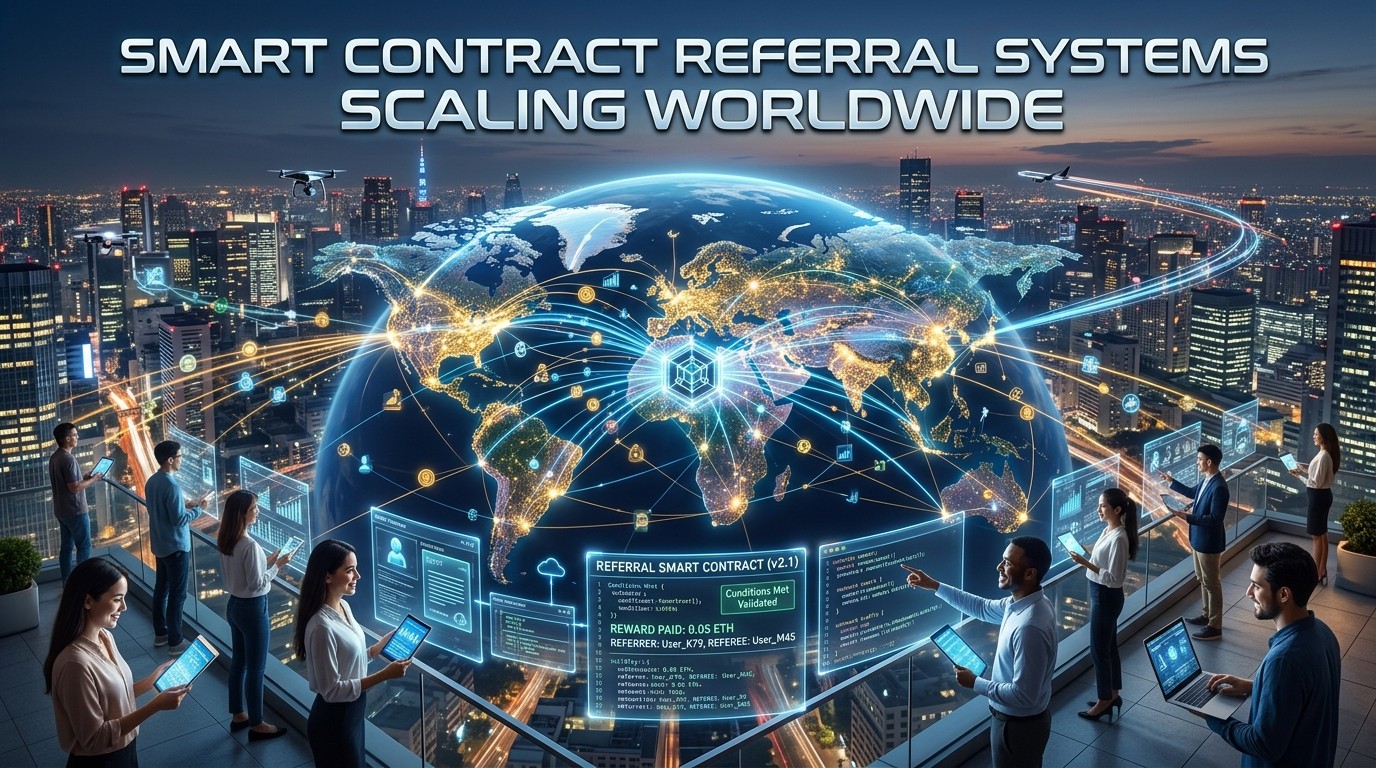
Smart Contract Referral Systems use programmable blockchain rules to automate referrals, reward distribution, attribution, and global partner growth with transparent, verifiable execution.
Smart Contract Referral Systems are changing the way businesses think about referral marketing by moving important reward rules from private databases into programmable blockchain infrastructure. Instead of relying entirely on a centralized platform to remember who referred whom, a smart contract can encode conditions for attribution, eligibility, reward calculation, and distribution.
Smart Contract Referral Systems become particularly interesting when a company wants to operate across countries, currencies, communities, and digital ecosystems without redesigning the entire referral process for every market. A blockchain-based model can create a common ruleset that participants interact with through wallets, decentralized applications, APIs, or connected platforms.
The underlying concept is straightforward. A smart contract is a program deployed to a blockchain that executes according to coded rules when users interact with it. Ethereum describes smart contracts as programs that live at blockchain addresses, contain code and state, and can automatically enforce programmed rules when transactions call their functions.
Smart Contract Referral Systems apply that programmable logic to referral relationships. A user can receive a unique referral identifier, invite another participant, and trigger a sequence in which the relationship is recorded and a reward becomes eligible when predetermined conditions are satisfied.
The important shift is not simply technological. Referral marketing has always depended on trust. A participant wants to know that the referral will be attributed correctly, while the business wants to know that rewards are released only when the required action really happens.
Smart Contract Referral Systems can reduce some forms of uncertainty by making specific rules visible and automatically executable. However, blockchain automation does not eliminate every source of fraud, ambiguity, or operational risk. The quality of the contract, the data feeding it, the interface around it, and the business rules behind it still matter.
This article explains how Smart Contract Referral Systems work, why global businesses are interested in them, how reward logic can be designed, what security issues must be considered, and how organizations can build scalable referral infrastructure without confusing decentralization with automatic perfection.
What Are Smart Contract Referral Systems?
Smart Contract Referral Systems are referral programs in which blockchain smart contracts handle some or all of the core referral logic.
In a conventional referral system, the business may maintain a centralized database containing referral codes, user relationships, purchase records, reward balances, fraud flags, and payout status. An application server then checks those records whenever an event occurs.
Smart Contract Referral Systems can shift selected rules into a blockchain contract. The contract may record referral relationships, verify eligibility conditions based on available data, calculate rewards, and distribute tokens or other blockchain-based incentives.
Not every referral program needs to put every operation onchain. In many practical systems, the most efficient design is hybrid. The customer-facing application, analytics layer, fraud engine, and business intelligence stack can remain partly offchain while the blockchain handles important settlement or verification events.
This NFT Trader Guide-style comparison approach is useful here: businesses should compare what must be decentralized against what simply needs reliable automation. Putting unnecessary data onchain can increase costs and complexity without creating meaningful value.
Smart Contract Referral Systems work best when the business clearly defines which rules require immutability, which actions require automation, and which information can safely remain in traditional infrastructure.
The Basic Referral Flow
A typical blockchain referral journey can look like this:
- A participant connects a wallet or creates a verified account.
- The system generates or associates a referral identifier.
- The participant shares a referral link or code.
- A new user arrives through that referral.
- The platform records the relationship.
- The referred user completes a qualifying action.
- The smart contract or connected application verifies eligibility.
- The reward becomes claimable or is automatically distributed.
- The transaction can be inspected on the relevant blockchain.
Smart Contract Referral Systems can therefore turn a familiar marketing journey into a programmable sequence of conditions and state changes.
Why Businesses Want Referral Infrastructure on Blockchain
The appeal of Smart Contract Referral Systems comes from several connected problems: trust, scale, settlement, attribution, transparency, and cross-border participation.
Traditional referral platforms work well when all users and transactions sit inside one controlled environment. Complexity grows when partners use different systems, currencies, countries, communities, and applications.
Blockchain can provide a shared settlement layer. A participant does not necessarily need to trust a private spreadsheet or wait for a manual reconciliation process if the relevant transaction and payout logic can be independently verified.
Smart Contract Referral Systems can also make incentive rules portable. For example, a digital campaign could distribute a token reward that is usable across a larger ecosystem instead of being locked inside one company’s loyalty database.
That creates opportunities for communities, Web3 applications, gaming ecosystems, creator programs, decentralized protocols, and global digital businesses.
However, businesses must remember that transparency is useful only when the underlying rules are understandable. An unreadable smart contract does not magically become user-friendly merely because its code is public.
The Psychology Behind Referral Growth
Referral marketing is fundamentally psychological. People recommend products when they believe the product is valuable, the recommendation is socially safe, and the reward or recognition feels worthwhile.
Smart Contract Referral Systems can strengthen some parts of that psychological loop by making reward conditions visible and predictable.
Consider a participant who has already invited three friends. If the program clearly explains that five verified conversions unlock a reward, the participant can understand the milestone without repeatedly asking support staff.
The feeling of progress can become even stronger when referral programs introduce multiple milestones.
For example, Micro-Tier Reward Frameworks can encourage participants to remain active by creating several attainable reward stages rather than requiring one distant target.
Smart Contract Referral Systems can encode those stages directly into reward rules. When milestones are objectively defined, participants can see exactly what action is required to unlock the next benefit.
That visibility can reduce ambiguity, but the reward structure still needs psychological balance. Rewards that are too difficult can create discouragement. Rewards that are too easy may create low-quality referrals.
Global Scaling and the End of Geographic Boundaries
Global growth creates difficult referral-management problems.
A business may have advocates in North America, Europe, Asia, the Middle East, Africa, and Latin America. Those participants may use different currencies, payment methods, languages, community platforms, and local partner networks.
Smart Contract Referral Systems can provide a common technical settlement layer across participating regions when the underlying blockchain and application architecture are designed appropriately.
The same contract can theoretically enforce the same core reward rule regardless of where the participant lives, although local laws, tax requirements, platform restrictions, sanctions considerations, and consumer-protection obligations can still affect how the program operates.
This distinction is critical.
Blockchain can remove certain technical boundaries, but it does not remove legal or commercial boundaries.
A global referral company therefore needs both a blockchain architecture and a jurisdiction-aware operating model.
How Referral Attribution Works Onchain
Attribution is the heart of referral marketing.
A referral program must answer a simple question: who deserves credit for generating a qualifying customer action?
Smart Contract Referral Systems can record relationships using blockchain addresses, signed referral messages, referral identifiers, or application-generated mappings.
Suppose Alice shares a referral link and Bob joins through it. The application can associate Bob’s account or wallet with Alice’s referral relationship. When Bob later performs the qualifying action, the system can use predefined rules to determine whether Alice is eligible.
The difficult part is defining what counts as a qualifying action.
Is registration enough?
Must Bob purchase something?
Does the purchase need to remain active for thirty days?
Can a referral be canceled?
Can the same wallet participate in multiple campaigns?
Can a user refer themselves through another wallet?
Smart Contract Referral Systems require these questions to be resolved before deployment because ambiguous rules create disputes even when the code executes perfectly.
Referral Trees and Multi-Level Structures
Some programs use one-level referrals, while others create multi-level structures where a participant can earn from direct referrals and additional referral layers.
Smart Contract Referral Systems can model hierarchical relationships, but businesses should exercise caution before implementing multi-level reward logic.
Each additional layer increases complexity. The contract must determine how rewards are calculated, whether every layer is eligible, whether rewards have caps, how qualification works, and what happens when accounts become inactive.
A three-level system may involve dramatically more state transitions than a simple direct-referral program.
From a business perspective, complexity can also create confusion. Users should understand how the system works without having to study technical documentation.
The simplest rule that creates the desired behavior is often easier to explain, audit, and maintain.
Smart Contract Architecture for Referral Programs
A production referral system typically contains several components.
Front-End Layer
This is the user-facing interface where participants generate referral links, view progress, connect wallets, and claim rewards.
Referral Service
The referral service can handle attribution logic, campaign identifiers, account mapping, analytics, and data that does not need to live onchain.
Smart Contract Layer
The contract stores and executes the blockchain-based rules.
Data and Verification Layer
External systems can provide information about purchases, subscriptions, game activity, completed tasks, or other qualifying actions.
Analytics Layer
Businesses need dashboards for acquisition cost, conversion rate, reward liability, referral velocity, fraud detection, and lifetime value.
Smart Contract Referral Systems rarely exist as a single contract operating independently. The most useful implementations are usually carefully designed systems in which blockchain logic and conventional software perform complementary roles.
Ethereum describes smart contracts as composable programs that can interact with other smart contracts, effectively allowing applications to build more complex functionality from reusable components.
That composability can help referral infrastructure connect with wallets, tokens, marketplaces, games, decentralized finance applications, and other protocols.
Designing the Reward Engine
A referral engine should clearly define reward eligibility.
Possible reward models include:
| Reward Model | Trigger | Typical Use |
|---|---|---|
| Fixed reward | Verified conversion | Simple customer acquisition |
| Percentage reward | Transaction value | Affiliate-style programs |
| Milestone reward | Number of successful referrals | Community growth |
| Tiered reward | Performance level | High-volume advocates |
| Token reward | Onchain action | Web3 communities |
| NFT reward | Campaign milestone | Brand engagement |
| Revenue share | Qualified revenue | Long-term partner programs |
| Hybrid reward | Multiple conditions | Complex ecosystems |
Smart Contract Referral Systems can encode different combinations, but the business should avoid making the contract more complex than the campaign requires.
A fixed reward may be easy to explain.
A percentage reward introduces calculation rules.
A milestone reward introduces state tracking.
A multi-tier reward introduces hierarchical accounting.
A hybrid system may require substantial testing because several independent conditions can interact.
Token-Based Referral Rewards
Tokens can make referral programs more programmable.
A business could reward participants using a fungible token, stablecoin-like asset, NFT, access pass, or ecosystem-specific digital asset, depending on its legal structure and business model.
Smart Contract Referral Systems can automatically distribute these assets when eligibility is met.
However, token rewards introduce additional considerations. Businesses must understand token supply, liquidity, user expectations, transferability, tax treatment, legal classification, and market volatility.
A referral reward should not become so speculative that the participant cares more about token price than the product being recommended.
The strongest programs usually make the underlying value proposition understandable before the incentive is introduced.
Referral NFTs and Digital Credentials
Not every reward needs to be money.
A referral program can issue an NFT representing status, access, achievement, membership, or contribution.
For example, a brand might issue a “Founding Advocate” NFT to participants who generate ten verified referrals during a launch campaign.
Smart Contract Referral Systems can ensure that the credential is associated with a defined achievement.
This creates a different psychological experience from receiving a small discount. The participant receives something that represents identity and recognition within the community.
Gaming platforms can take the concept further by connecting referral achievements to digital items, access privileges, or collectible status.
For context, NFT Gaming Marketplaces shows how blockchain-based digital assets can become part of environments where players discover and exchange game-related items.
That same infrastructure can support referral-based digital achievements without requiring every referral payment to be monetary.
Referral Systems for Gaming Communities
Gaming communities can be particularly suitable for automated referral incentives because players naturally operate through networks of friends, guilds, communities, and teams.
Smart Contract Referral Systems can reward players when invited users complete meaningful actions such as joining a game, completing a tutorial, purchasing eligible content, or reaching a defined achievement.
The key is avoiding rewards that encourage meaningless signups.
A referral is valuable when the referred participant actually contributes to the ecosystem.
In gaming, this could be measured through verified gameplay activity, retention, purchases, or other legitimate engagement events.
The underlying economic environment matters too. Blockchain Gaming Economies explores how blockchain-based game assets can participate in larger systems of ownership, scarcity, utility, and player interaction.
Smart Contract Referral Systems can become another layer within such ecosystems, helping communities reward acquisition and participation while connecting incentives to measurable actions.
Community Referral Growth
Communities can become powerful acquisition engines when members feel that they are helping build something rather than simply distributing advertisements.
Smart Contract Referral Systems can reinforce that feeling by showing transparent progress and automated milestones.
Discord communities are particularly relevant because the referral experience can start in conversation. A participant may share an invitation, an educational resource, a campaign code, or a product link with friends.
A structured Gamified Discord Referral Strategy can use competition, milestones, recognition, and rewards to make that activity more engaging.
The blockchain layer can then handle selected reward mechanics behind the campaign.
The result is a combination of social motivation and programmable settlement.
Still, the community experience must remain authentic. People are more likely to trust referrals that feel like genuine recommendations rather than forced recruitment.
Preventing Self-Referral Fraud
Fraud is one of the biggest challenges in any referral program.
A participant might create multiple accounts, use several wallets, manipulate transaction behavior, exploit loopholes, or coordinate with others to trigger rewards without creating legitimate customer value.
Smart Contract Referral Systems can prevent some types of abuse through onchain conditions, but they cannot automatically understand every real-world identity or commercial relationship.
Businesses often need additional offchain controls such as device signals, identity checks where appropriate, behavioral analysis, transaction heuristics, account reputation, purchase verification, and delayed settlement.
A common design is to make rewards claimable only after a period in which suspicious activity can be reviewed.
This reduces the risk of immediately distributing valuable assets to participants who exploit the system.
The smart contract should therefore be viewed as one component of a larger fraud-control architecture.
Sybil Resistance
A Sybil attack occurs when one actor controls multiple identities or wallets and attempts to appear as many independent participants.
This is particularly relevant to community campaigns and token rewards.
Smart Contract Referral Systems can enforce technical rules, such as one reward per wallet or one referral path per address, but those rules do not necessarily prove that each wallet represents a unique human.
Businesses may therefore combine wallet activity with application-level identity signals.
The objective is not always to identify every participant personally. Instead, the business needs enough confidence to distinguish genuine growth from artificial reward farming.
Projects distributing valuable tokens should model this risk before launch rather than waiting until abuse occurs.
Reward Caps and Budget Control
Referral programs have a financial ceiling even when the blockchain contract does not.
A successful campaign could generate much more activity than expected.
Smart Contract Referral Systems can include caps on individual rewards, campaign rewards, or total reward allocation.
For example, a campaign could specify that no participant receives more than 1,000 reward units during a particular period.
The contract might also limit total distributions to a predefined amount.
These controls are important because an incorrectly designed reward formula can create substantial unexpected liabilities.
Businesses should test worst-case scenarios, not only normal customer journeys.
A reward engine should be evaluated as carefully as a financial system because it controls value movement.
Access Control and Administrative Permissions
Smart contract administration is another critical area.
Who can pause the referral program?
Who can change reward parameters?
Who can add a campaign?
Who can upgrade the contract?
Who can withdraw remaining funds?
Who can recover assets after an operational failure?
Smart Contract Referral Systems need carefully designed permission structures.
OpenZeppelin’s documentation emphasizes that access control determines who is allowed to perform specific actions within a smart contract and describes both simple ownership and role-based access control patterns.
For production systems, role separation can be valuable. The campaign manager may not need withdrawal authority. The analytics operator may not need contract-upgrade permissions.
Separating responsibilities reduces the impact of a compromised administrative account.
Upgradeability and Governance
Blockchain contracts can be difficult to change once deployed.
Ethereum’s documentation notes that smart contract interactions are generally irreversible and that contracts cannot simply be deleted by default.
That makes upgrade planning important.
A referral program may initially launch with a simple reward structure but later need new campaign types, additional chains, or revised eligibility rules.
Smart Contract Referral Systems can be designed with upgradeable architecture, but upgradeability introduces additional trust assumptions and security considerations.
The system should clearly communicate who controls upgrades and under what conditions.
For some businesses, a highly immutable contract may be desirable.
For others, controlled upgradeability may be more practical.
There is no universal architecture. The design should reflect the business’s risk tolerance, governance model, and user expectations.
Oracles and External Data
Some referral conditions cannot be determined from blockchain data alone.
A business may want to reward someone when:
- a subscription remains active for thirty days;
- a customer completes an offline purchase;
- a user finishes a game tutorial;
- a product shipment is delivered;
- an account reaches a specific engagement threshold.
Smart Contract Referral Systems therefore sometimes depend on external data.
That creates an oracle problem: how does the blockchain contract receive trustworthy information from outside the blockchain?
The solution may involve a centralized backend, signed messages, decentralized oracle infrastructure, or specialized automation services.
The architecture needs to define who supplies the data and what happens when the data is wrong.
Automation can also be decentralized. Chainlink’s current documentation describes systems for automating smart contracts based on time, logs, and onchain state, while noting current migration timelines for older Automation versions.
This illustrates an important point: automation itself is an infrastructure layer that needs ongoing maintenance.
Gas Optimization
Blockchain transactions cost money.
Every additional storage operation, contract interaction, or unnecessary transaction can increase operational expenses.
Smart Contract Referral Systems therefore need gas-aware architecture.
Businesses may decide to record only critical states onchain while keeping detailed analytics offchain.
Batching can also reduce repetitive interactions when technically appropriate.
Another approach is delayed settlement. Instead of sending a blockchain transaction every time someone performs a small action, the system can accumulate qualifying events and settle rewards according to a predefined schedule.
This can make the economics more sustainable for high-volume campaigns.
The best architecture balances transparency with efficiency.
Layer 2 Networks and Scaling
High transaction volume can make mainnet settlement expensive for some referral programs.
Layer 2 networks can provide lower-cost execution while continuing to inherit security properties from an underlying blockchain architecture, depending on the network design.
Smart Contract Referral Systems may therefore operate on Layer 2 environments where frequent reward transactions are economically more practical.
The business needs to consider more than transaction cost.
It should evaluate wallet compatibility, user onboarding, bridge requirements, exchange support, ecosystem liquidity, developer tooling, and long-term sustainability.
A low-cost chain is not automatically the best infrastructure if users struggle to access it.
Cross-Chain Referral Programs
Worldwide growth can eventually create demand for multi-chain referral programs.
A participant on one network may refer someone who becomes active on another.
Smart Contract Referral Systems can support cross-chain architectures, but the design becomes substantially more complicated.
The system must determine where referral state lives, how messages move between networks, how duplicate execution is prevented, and how rewards are settled.
Cross-chain bridges and messaging layers introduce their own technical assumptions.
For smaller campaigns, operating on one well-supported network may be far simpler.
For larger ecosystems, multi-chain support can become strategically useful when users genuinely live across different chains.
The guiding principle should be utility rather than technical novelty.
Transparency and User Trust
One of the strongest arguments for blockchain-based referral infrastructure is visible settlement.
If rewards are distributed through a public blockchain transaction, participants may be able to independently verify that the payment occurred.
Smart Contract Referral Systems can make reward movement more transparent than a private database that shows participants only an internal balance.
But transparency must be paired with good communication.
Users should understand what information is public, what is private, how wallets are associated with referrals, and when rewards become claimable.
A system can technically be transparent while still being confusing.
Good UX translates technical transparency into understandable human outcomes.
Privacy Considerations
Public blockchains introduce a major privacy consideration.
Wallet addresses and transactions can often be publicly observed.
Businesses should therefore avoid putting unnecessary personal information directly onchain.
Smart Contract Referral Systems should minimize sensitive data exposure and use offchain databases or privacy-preserving architectures when appropriate.
Referral data can reveal relationships between participants, campaign behavior, purchasing patterns, and community activity.
Companies operating internationally need to consider applicable privacy and data-protection obligations before linking public blockchain addresses with identifiable customer records.
The principle is simple: transparency should apply to the rules and settlement logic, not automatically to every piece of customer information.
Designing for Global Languages and Cultures
Technology can scale worldwide more quickly than communication.
A referral campaign that works well in one market may fail in another because customers respond differently to rewards, status signals, competition, or social recommendations.
Smart Contract Referral Systems should therefore separate programmable reward logic from localized user experiences.
The underlying contract can remain consistent while the interface explains the campaign in different languages.
The same milestone can be communicated through culturally appropriate messaging without changing the blockchain rule itself.
Global growth requires localization of trust, not just translation of text.
Referral Programs for SaaS Companies
Software companies can use referral infrastructure to reward customers who generate subscriptions, upgrades, or qualified trials.
A common model is delayed eligibility.
For example, a referral reward might become claimable only after the referred customer remains active for a defined period.
Smart Contract Referral Systems can encode the final reward settlement once the qualifying event is verified.
The application may still perform customer lifecycle checks offchain.
This hybrid approach can be more practical than trying to put every subscription event directly onchain.
The blockchain component can focus on the part that benefits most from transparent settlement.
Referral Programs for Ecommerce
Ecommerce companies face additional complications because purchases, refunds, shipping, and customer identity usually remain offchain.
A referral system could issue a reward when an order is completed and passes a refund window.
Smart Contract Referral Systems can then distribute a digital reward after the ecommerce backend confirms eligibility.
The business should consider what happens if an order is canceled after the reward has already been distributed.
Possible solutions include delayed settlement, escrow-like reward states, revocation mechanisms where appropriate, or rewards that unlock gradually.
This is a good example of why business logic should be designed before code architecture.
Referral Programs for Fintech and Web3 Products
Financial applications can benefit from programmable referral rewards, but the compliance requirements can be more complex.
Reward systems may intersect with financial incentives, token regulation, consumer-protection requirements, KYC processes, sanctions screening, or jurisdiction-specific restrictions.
Smart Contract Referral Systems should therefore be implemented only after the legal and compliance framework is established.
Technology should enforce approved business rules rather than become a substitute for regulatory analysis.
In sensitive industries, access controls, transaction monitoring, audit trails, and emergency controls can be especially important.
Measuring Referral Performance
A referral program needs metrics beyond the total number of referrals.
Useful measurements include:
| Metric | What It Shows |
|---|---|
| Referral clicks | Interest generated |
| Qualified referrals | Potential customer quality |
| Conversion rate | Referral effectiveness |
| Cost per acquired customer | Acquisition efficiency |
| Reward cost | Incentive expense |
| Retention | Customer quality |
| Fraud rate | Program integrity |
| Revenue per referral | Commercial value |
| Referral velocity | Growth momentum |
| Lifetime value | Long-term customer contribution |
Smart Contract Referral Systems can provide verifiable settlement data, but analytics still require interpretation.
A high number of referrals can be meaningless if most users never become customers.
A lower referral volume with strong retention may create more value.
Businesses should optimize for meaningful outcomes rather than vanity metrics.
Attribution Windows
Referral attribution needs a time window.
Suppose a user clicks a referral link today but purchases sixty days later.
Who receives credit?
The first referrer?
The most recent referrer?
The referrer active when the customer created an account?
Smart Contract Referral Systems must encode a deterministic answer.
Attribution windows should be communicated clearly because participants are more comfortable with rules they can understand.
The program should also define how attribution behaves when a customer interacts with multiple referral links.
Ambiguity is one of the fastest ways to damage trust in a referral campaign.
Reward Vesting
Vesting can improve program sustainability.
Instead of distributing the entire reward immediately, the system could release it over multiple periods or after additional qualifying conditions.
This can reduce the incentive for short-term abuse.
Smart Contract Referral Systems can create reward states such as pending, eligible, claimable, vested, and paid.
This introduces more complexity but can also provide stronger financial controls.
For example, a user might receive 25% immediately and unlock the remaining amount as the referred customer maintains an active subscription.
Such structures should be carefully tested because multiple state transitions create more opportunities for implementation mistakes.
Smart Contract Security
Security is the foundation of any blockchain-based reward system.
A referral contract can potentially control funds, tokens, or valuable digital assets. A coding vulnerability could therefore become a financial incident.
OpenZeppelin provides reusable smart contract components for token standards, access control, governance, and other common blockchain functions.
Smart Contract Referral Systems should be tested through unit tests, integration tests, adversarial scenarios, code review, and independent audits when the financial exposure justifies them.
Businesses should pay special attention to reentrancy, access control, authorization, arithmetic behavior, unexpected token behavior, upgrade permissions, oracle assumptions, and denial-of-service conditions.
Security is not a one-time event.
Dependencies, front-end infrastructure, wallets, APIs, and external data sources can all introduce risks after the contract has been deployed.
Emergency Controls
Production systems should have a response strategy.
What happens if a vulnerability is discovered?
Can reward distribution be paused?
Who has permission to pause it?
How are users informed?
What happens to funds already deposited into the contract?
Smart Contract Referral Systems with large financial exposure should define these procedures before launch.
An emergency pause can reduce damage during an incident, but it also introduces centralized authority.
That tradeoff should be documented clearly.
Users should never discover the governance model only after something goes wrong.
Testing Referral Edge Cases
Testing should go far beyond the happy path.
The system should evaluate:
- duplicate referrals;
- self-referrals;
- multiple wallets;
- refunds;
- canceled purchases;
- partial payments;
- repeated claims;
- expired campaigns;
- maximum reward limits;
- invalid referral codes;
- cross-chain messages;
- failed transactions;
- contract pauses;
- administrator changes.
Smart Contract Referral Systems can execute exactly what developers coded, which makes specification quality crucial.
If an edge case was not considered, the contract may behave consistently but incorrectly.
Automated tests should therefore reflect real customer behavior rather than only ideal scenarios.
Building a Worldwide Referral Program Step by Step
Phase 1: Define the Business Goal
Decide whether the goal is customer acquisition, community growth, product adoption, partner expansion, sales generation, or another measurable outcome.
Phase 2: Define the Referral Event
Specify precisely what counts as a successful referral.
Phase 3: Choose the Reward
Select a reward that supports the business goal and does not create unnecessary financial exposure.
Phase 4: Choose the Blockchain Architecture
Determine whether blockchain is actually needed and identify the appropriate network.
Phase 5: Design Attribution
Define referral ownership, attribution windows, duplicate handling, and dispute rules.
Phase 6: Model Fraud
Identify the cheapest ways users could abuse the system and design protections before launch.
Phase 7: Build the Contract
Use audited patterns and established libraries where appropriate.
Phase 8: Connect Offchain Systems
Integrate CRM, ecommerce, SaaS, payment, gaming, or analytics infrastructure.
Phase 9: Test and Audit
Test expected behavior and hostile edge cases.
Phase 10: Launch Gradually
Start with a controlled population before expanding worldwide.
This staged approach keeps Smart Contract Referral Systems connected to commercial objectives instead of letting technology dictate the campaign design.
The Role of APIs and Traditional Software
Blockchain does not need to replace an entire technology stack.
Most businesses already have CRM systems, analytics platforms, payment systems, customer databases, and marketing automation.
Smart Contract Referral Systems can sit alongside these systems.
For example, the CRM can identify a qualified referral.
The application can submit a verified event.
The blockchain contract can determine or settle the reward.
The analytics platform can then combine onchain and offchain data.
This hybrid architecture is often more practical than attempting to move every business operation onto a blockchain.
The goal is to decentralize or automate the parts where doing so produces a measurable advantage.
Automation at Global Scale
A global referral program can generate thousands or millions of events.
Manual settlement does not scale efficiently.
Smart Contract Referral Systems can automate eligible reward distribution, especially when the qualifying event is already represented in verifiable digital data.
External automation services can help trigger contract functions under predefined conditions. Chainlink’s current documentation describes decentralized automation infrastructure for triggering compatible smart-contract functions based on events, state conditions, or time.
This can reduce the need for a centralized operator to manually process every reward.
However, automated systems still need monitoring.
A broken automation layer can delay rewards even if the contract itself is correct.
Operational observability is therefore part of blockchain scalability.
Monitoring Onchain Referral Activity
Once the program launches, businesses should monitor:
- successful reward transactions;
- failed transactions;
- unusual claim patterns;
- wallet clusters;
- abnormal referral velocity;
- sudden reward spikes;
- contract balances;
- gas consumption;
- external data failures.
Smart Contract Referral Systems benefit from blockchain transparency because many operational events can be independently inspected.
But blockchain monitoring does not automatically provide business context.
A sudden increase in claims might represent successful marketing—or coordinated abuse.
The analytics layer must connect blockchain events with application-level information.
Managing Reward Economics
A referral system can become expensive when incentives grow faster than revenue.
Businesses should model reward liability before deployment.
For example, if every qualifying customer creates a $10 equivalent reward, the company should calculate the maximum cost at different conversion levels.
Smart Contract Referral Systems can enforce campaign limits, but economics should be validated before those limits are coded.
A successful campaign should create positive commercial value rather than simply maximize referral count.
Useful financial questions include:
What is the maximum reward budget?
What percentage of revenue can be allocated to referrals?
How long should rewards remain valid?
How much fraud can the business tolerate?
What is the expected payback period?
These questions matter more than whether the contract contains more advanced blockchain features.
Making Referral Rewards Feel Fair
Fairness is a major component of trust.
Participants should be able to understand why one referral generated a reward while another did not.
Smart Contract Referral Systems can make this easier when eligibility conditions are deterministic and visible.
For example:
“Referral reward unlocks after the invited user completes a verified purchase and remains active for fourteen days.”
This is easier to understand than:
“Rewards may be granted based on qualifying engagement.”
Specificity reduces disputes.
The system should also provide clear explanations for pending, rejected, expired, or disputed referrals.
Blockchain transparency is most valuable when it becomes understandable evidence for ordinary users.
Avoiding Over-Engineering
It is easy to create unnecessary complexity when blockchain is involved.
A company might add tokens, NFTs, multi-level commissions, multiple chains, DAO governance, cross-chain messaging, and elaborate staking mechanics even when a simple referral program would achieve the business objective.
Smart Contract Referral Systems should begin with the smallest reliable architecture.
Complexity should be earned by actual requirements.
Every additional feature creates more code, more testing, more security assumptions, and more potential user confusion.
A simple referral contract with transparent eligibility can sometimes create more practical value than an elaborate ecosystem of interconnected incentives.
Smart Contract Referral Systems and Brand Trust
Referral programs represent the brand.
If a customer has to fight support for a reward, confidence decreases.
If a promised reward disappears because an internal database failed, frustration increases.
Smart Contract Referral Systems can provide a more predictable settlement mechanism when rules are coded correctly.
However, automation can also make a bad rule enforce itself perfectly.
That means transparency should begin before launch.
Businesses should explain how the system works, what is immutable, what can be changed, who controls administrative functions, and when rewards become final.
Trust comes from understandable systems, not simply from blockchain terminology.
Global Partnerships and Affiliate Networks
Large companies can use blockchain-based referral structures for distributed partner programs.
Imagine hundreds of independent creators, agencies, influencers, community leaders, and affiliates sending customers to a product.
A smart contract could settle predefined commissions after qualifying transactions.
Smart Contract Referral Systems can potentially make settlement more transparent across organizations because partners can independently inspect relevant transactions.
But legal contracts should still define the commercial relationship.
Blockchain settlement does not replace partnership agreements, tax documentation, consumer policies, or dispute procedures.
The technical and legal layers should reinforce each other.
Influencer Referral Programs
Influencer campaigns can benefit from programmable attribution when individual creators need distinct referral identities.
An influencer could share a unique link associated with a wallet or campaign ID.
When followers convert, the system records the relevant attribution.
Smart Contract Referral Systems can then settle creator rewards according to predetermined conditions.
This can be particularly interesting for international creators because the payout mechanism may support digital assets instead of requiring separate payment rails for every region.
But influencer programs also need fraud monitoring.
Fake traffic, low-quality audiences, bot activity, and incentivized conversions can distort performance data.
The blockchain can record settlement accurately without proving that the traffic was commercially valuable.
DAO and Community Governance
Some decentralized communities may want referral rules to be governed by token holders or community participants.
Smart Contract Referral Systems can be integrated with governance mechanisms where reward parameters are changed through approved proposals.
This introduces additional transparency but also adds governance complexity.
Businesses and communities must determine who has voting power, what decisions require approval, and how emergency actions work.
Not every referral program needs a DAO.
Governance should exist because the ecosystem actually needs shared decision-making, not because decentralization sounds attractive.
Sustainability of Referral Incentives
A referral campaign should survive after the initial excitement fades.
Short-term rewards can generate rapid participation, but long-term ecosystems need product value.
Smart Contract Referral Systems are most sustainable when incentives reinforce genuine customer behavior.
For example, rewarding an advocate for referring a retained subscriber is more closely connected to business value than rewarding every empty account registration.
A program should therefore reward outcomes rather than noise.
The strongest referral architecture makes the economic relationship understandable:
The participant creates value → the business receives value → the participant receives a defined share of that value.
That simple loop can become increasingly sophisticated, but its underlying logic should remain clear.
Global Scaling Challenges
Worldwide deployment introduces several operational challenges:
Regulatory variation: Rules governing digital assets, incentives, referral compensation, consumer protection, and privacy can differ significantly across jurisdictions.
Currency differences: Participants may understand rewards in local currencies even when settlement occurs in tokens.
Network differences: Transaction costs and supported wallets can vary by blockchain.
Language: Reward rules must be understandable in every supported market.
Support: Users still need human assistance when wallets, transactions, or account attribution fail.
Fraud: Global campaigns can attract coordinated abuse at larger scale.
Smart Contract Referral Systems can help solve the infrastructure component, but they cannot independently solve each business challenge.
Building a Human-Friendly Blockchain Referral Experience
Blockchain terminology should stay behind the interface whenever possible.
A participant should not need to understand storage slots, gas mechanics, contract addresses, or transaction hashes just to invite a friend.
The interface can say:
“You referred 4 verified customers. One more successful referral unlocks your next reward.”
Behind that message, the blockchain may be storing and verifying several pieces of state.
Smart Contract Referral Systems should make the technology disappear into a clear customer experience.
The best implementation is not necessarily the one with the most visible blockchain language.
It is the one where users receive the benefits of programmable infrastructure without unnecessary technical friction.
The Future of Worldwide Referral Networks
Referral programs are moving toward more programmable forms of engagement.
Instead of a static “Invite a friend and get $10” model, future systems can include dynamic milestones, portable credentials, community reputation, tokenized rewards, gaming achievements, partner settlements, and cross-platform loyalty.
Smart Contract Referral Systems can serve as the settlement layer connecting those experiences.
A gaming ecosystem might reward players for bringing in active teammates.
A creator network might distribute transparent revenue shares.
A SaaS platform might automatically settle affiliate commissions after verified retention.
A global community might issue reputation credentials based on measurable contribution.
The common thread is programmable incentives.
But the future will not be determined by technology alone.
Successful systems will still depend on product quality, meaningful rewards, trust, user experience, and sustainable economics.
Smart Contract Referral Systems: Strategic Checklist
Before launching a blockchain referral campaign, a business should answer these questions:
| Strategic Question | What to Define |
|---|---|
| What is the goal? | Acquisition, revenue, adoption, community growth |
| Who qualifies? | Customer, partner, creator, member |
| What counts as a referral? | Registration, purchase, retention, activity |
| How is attribution recorded? | Link, wallet, account, signed event |
| What is the reward? | Token, NFT, discount, revenue share |
| When does the reward unlock? | Immediately, after verification, after retention |
| What prevents abuse? | Caps, identity signals, fraud checks |
| What is onchain? | Attribution state, eligibility, settlement |
| What remains offchain? | Personal data, analytics, customer records |
| Who controls the contract? | Owner, roles, multisig, governance |
| Can rules change? | Immutable or upgradeable |
| What is the emergency plan? | Pause, recovery, communication |
| Which networks are supported? | Mainnet, Layer 2, multiple chains |
| How is success measured? | Revenue, retention, CAC, referral quality |
This checklist keeps Smart Contract Referral Systems focused on outcomes instead of technical novelty.
Smart Contract Referral Systems for Startups
Startups often have limited engineering resources, so they should avoid building a complicated blockchain system before validating referral demand.
A practical startup model could begin with a conventional referral application and introduce onchain settlement only after the business understands participant behavior.
Smart Contract Referral Systems become more compelling when there is a real reason for programmable, transparent, or portable rewards.
Startups should also consider whether users already have wallets.
If the target audience has no blockchain familiarity, forcing users to create wallets for a small referral reward can destroy conversion.
Account abstraction and simplified onboarding can help reduce this friction where the chosen infrastructure supports it.
The user experience should determine the technology architecture, not the other way around.
Smart Contract Referral Systems for Enterprises
Enterprises face different requirements.
They may need permission management, auditability, legal controls, integration with CRM systems, regional compliance, accounting workflows, and reporting.
A hybrid design is often particularly relevant.
The enterprise can continue using existing systems for customer management while employing blockchain settlement for specific partner or loyalty transactions.
OpenZeppelin’s access-control tools illustrate how production smart-contract systems can use ownership or role-based permissions to separate operational authorities.
For enterprise adoption, governance can be as important as the contract itself.
Who owns the infrastructure?
Who audits it?
Who can upgrade it?
Who can stop it?
Who handles disputes?
The answers need to be documented.
Operational Monitoring After Launch
Deployment is not the end.
Smart Contract Referral Systems require continuous monitoring because external conditions change.
Blockchain networks change.
Wallet behavior changes.
Campaign rules change.
Fraud techniques evolve.
Dependencies are updated.
Third-party APIs can fail.
Businesses should therefore establish operational dashboards that track both technical and marketing health.
A technical incident may appear as a drop in successful transactions.
A marketing problem may appear as falling conversion rates.
A fraud problem may appear as abnormal referral clusters.
The right monitoring system connects these signals instead of treating blockchain data and marketing data as separate worlds.
Documentation and User Education
A referral system should have clear documentation.
Participants should understand:
- how referrals are attributed;
- what actions qualify;
- when rewards become available;
- whether rewards can expire;
- how wallet changes affect attribution;
- what happens after refunds;
- who to contact when something goes wrong.
Smart Contract Referral Systems benefit from written rules because transparency becomes more valuable when participants know where to find the source of truth.
Technical documentation can explain the contract.
Customer documentation should explain the experience.
Both are necessary.
Why the Smart Contract Alone Is Not the Product
It is tempting to describe a referral program as innovative because it uses a smart contract.
But customers do not buy smart contracts.
They buy products, services, access, experiences, or opportunities.
The smart contract is infrastructure.
Smart Contract Referral Systems create practical value when that infrastructure improves something users actually care about: faster rewards, transparent attribution, portable incentives, lower settlement friction, or reliable partner payouts.
Technology should serve the commercial experience.
This perspective also prevents businesses from building expensive blockchain systems that solve problems users never had.
A Balanced Implementation Model
For many businesses, the most practical architecture may look like this:
User Interface → Referral Tracking → Fraud Verification → Qualified Event → Smart Contract Settlement → Wallet Reward → Analytics
The interface provides simplicity.
The referral tracker provides attribution.
The fraud engine protects the budget.
The verification layer confirms eligibility.
The smart contract provides programmable settlement.
The wallet receives the reward.
Analytics measure the commercial outcome.
Smart Contract Referral Systems become the settlement engine inside a larger ecosystem rather than an isolated application.
Measuring Long-Term Value
The best referral program should eventually answer a financial question:
Did referred customers create enough value to justify the rewards and operational costs?
This means analyzing lifetime value rather than celebrating referral volume alone.
A campaign producing 100,000 low-quality referrals may be less commercially useful than a campaign producing 5,000 highly retained users.
Smart Contract Referral Systems can automate reward distribution, but the company’s analytics team still needs to understand customer economics.
Track retention.
Track purchase frequency.
Track revenue.
Track support costs.
Track fraudulent activity.
Track reward expenses.
Then compare referred customers with customers acquired through other channels.
This creates a complete view of the referral program.
Final Perspective
The worldwide scaling potential of programmable referral infrastructure is significant because referral marketing naturally involves rules, attribution, incentives, and settlement.
Smart Contract Referral Systems can encode these processes into blockchain-based logic while allowing conventional software to manage customer interfaces and business intelligence.
The technology is particularly interesting when transparency, portability, programmable rewards, or cross-border settlement create real benefits.
However, the strongest implementation will not necessarily be the most decentralized or technically complicated.
It will be the one that makes the reward relationship clear, prevents predictable abuse, controls financial exposure, protects users, integrates with existing systems, and creates measurable business value.
Blockchain provides programmable infrastructure.
The business still needs a compelling product, a credible incentive, a fair referral rule, strong security, and a human-friendly experience.
Conclusion
Smart Contract Referral Systems can transform referral marketing by automating attribution, eligibility, reward calculation, and settlement through programmable blockchain infrastructure. Their greatest value appears when businesses need transparent rules, scalable incentives, portable rewards, or global partner participation. Yet blockchain does not replace fraud detection, compliance, privacy protection, analytics, customer support, or sound reward economics. A successful implementation usually combines smart contracts with traditional applications, external verification, monitoring, and carefully designed user experiences. Businesses should begin with a clear commercial objective, define referral rules precisely, test edge cases, secure administrative permissions, control reward exposure, and scale gradually. The technology becomes valuable when it makes legitimate referral growth easier, clearer, and more trustworthy.
Frequently Asked Questions (FAQ)
1. What are Smart Contract Referral Systems?
Smart Contract Referral Systems are referral programs that use blockchain smart contracts to automate selected processes such as referral attribution, eligibility checking, reward calculation, and digital reward distribution. Smart contracts are blockchain programs that execute coded rules when called by transactions or other supported mechanisms.
2. How do Smart Contract Referral Systems work?
A typical system associates a referral with a participant, tracks a qualifying action, verifies eligibility, and then allows a smart contract to distribute or record the applicable reward. The exact architecture can be fully onchain or hybrid.
3. Can Smart Contract Referral Systems prevent referral fraud completely?
No. Blockchain can enforce predefined technical rules, but it cannot automatically determine whether every wallet represents a unique genuine customer. Businesses often need offchain fraud controls, identity signals, transaction analysis, and behavioral monitoring.
4. Can Smart Contract Referral Systems support global referral campaigns?
Yes, blockchain infrastructure can provide a common settlement layer for participants across different regions. However, businesses still need to account for local laws, taxation, consumer protection, privacy, sanctions requirements, and digital-asset rules in the jurisdictions where they operate.
5. What kinds of rewards can Smart Contract Referral Systems distribute?
Depending on the architecture, rewards can include tokens, NFTs, digital credentials, access rights, stable-value digital assets, or other programmable benefits. The appropriate reward depends on the business model and applicable legal requirements.
6. Are Smart Contract Referral Systems expensive to operate?
Costs depend on the blockchain, transaction volume, contract design, and settlement frequency. Blockchain networks charge transaction fees, so businesses can reduce expenses through efficient contract design, batching, delayed settlement, or suitable Layer 2 infrastructure where appropriate.
7. Can Smart Contract Referral Systems integrate with normal business software?
Yes. A hybrid architecture can connect blockchain contracts with CRM platforms, ecommerce systems, SaaS applications, payment systems, analytics platforms, gaming systems, and marketing automation tools.
8. How important is access control for referral smart contracts?
Access control is extremely important when administrators can change campaigns, pause rewards, upgrade contracts, or manage funds. OpenZeppelin provides ownership and role-based access-control components designed to restrict who can perform specific contract actions.
9. Can Smart Contract Referral Systems support gaming and community campaigns?
Yes. They can be used for player referrals, community milestones, digital credentials, token incentives, and other measurable participation events. Gaming-focused ecosystems can combine referral mechanics with broader blockchain-based ownership and economic systems.
10. What should a business do before launching a Smart Contract Referral System?
The business should define its commercial goal, referral rules, reward model, attribution window, fraud controls, privacy requirements, administrative permissions, blockchain architecture, testing process, emergency plan, analytics framework, and legal requirements before deployment.