

A referral marketing website helps businesses grow through trusted customer recommendations, reducing marketing costs, increasing conversions, boosting loyalty, and enabling scalable viral growth through automated tracking and reward systems.
A Referral Marketing Website is a digital platform designed to encourage customers to recommend a brand, product, or service to others in exchange for rewards, discounts, or incentives. These websites automate referral tracking, reward distribution, and campaign management, making it easy for businesses to turn loyal customers into brand advocates. Referral marketing is powerful in modern digital growth because people trust recommendations from friends and family more than traditional ads. Studies show that referred customers are more likely to convert and have higher lifetime value. Companies like Dropbox, Airbnb, and Uber achieved massive growth by using a Referral Marketing Website strategy that rewarded users for inviting others.
In this guide, you’ll learn how a Referral Marketing Website works, key features to include, tools to build one, and strategies to maximize referrals and conversions effectively.
What Is a Referral Marketing Website?
Definition and Concept
A referral marketing website is a platform designed to help businesses acquire new customers through word-of-mouth recommendations. It enables existing customers to refer friends, family, or colleagues in exchange for rewards such as discounts, cash, points, or free products. Instead of relying solely on paid ads, businesses use social trust to drive organic growth.
Referral marketing websites differ from affiliate marketing platforms in several ways. Referral marketing focuses on existing customers sharing with people they know, often driven by personal trust and incentives. Affiliate marketing, on the other hand, usually involves bloggers, influencers, or publishers promoting products to a broader audience for commissions. Referrals are relationship-based and community-driven, while affiliates operate more like performance marketers.
How Referral Marketing Websites Work
Referral marketing websites function by assigning unique identifiers to each user so their referrals can be tracked accurately. These identifiers come in the form of referral links, referral codes, or invitation links. When a user shares their referral link via email, social media, messaging apps, or QR codes, new users who sign up or purchase through that link are attributed to the referrer.
The customer-to-customer sharing process typically follows a simple flow. First, a customer joins the referral program and receives a unique link or code. Next, they share it with their network. When someone clicks the link and completes a desired action—such as signing up, installing an app, or making a purchase—the system records the referral. Finally, rewards are automatically issued to both the referrer and the referred customer, creating a win-win growth loop.
Key Components of a Referral Marketing Website
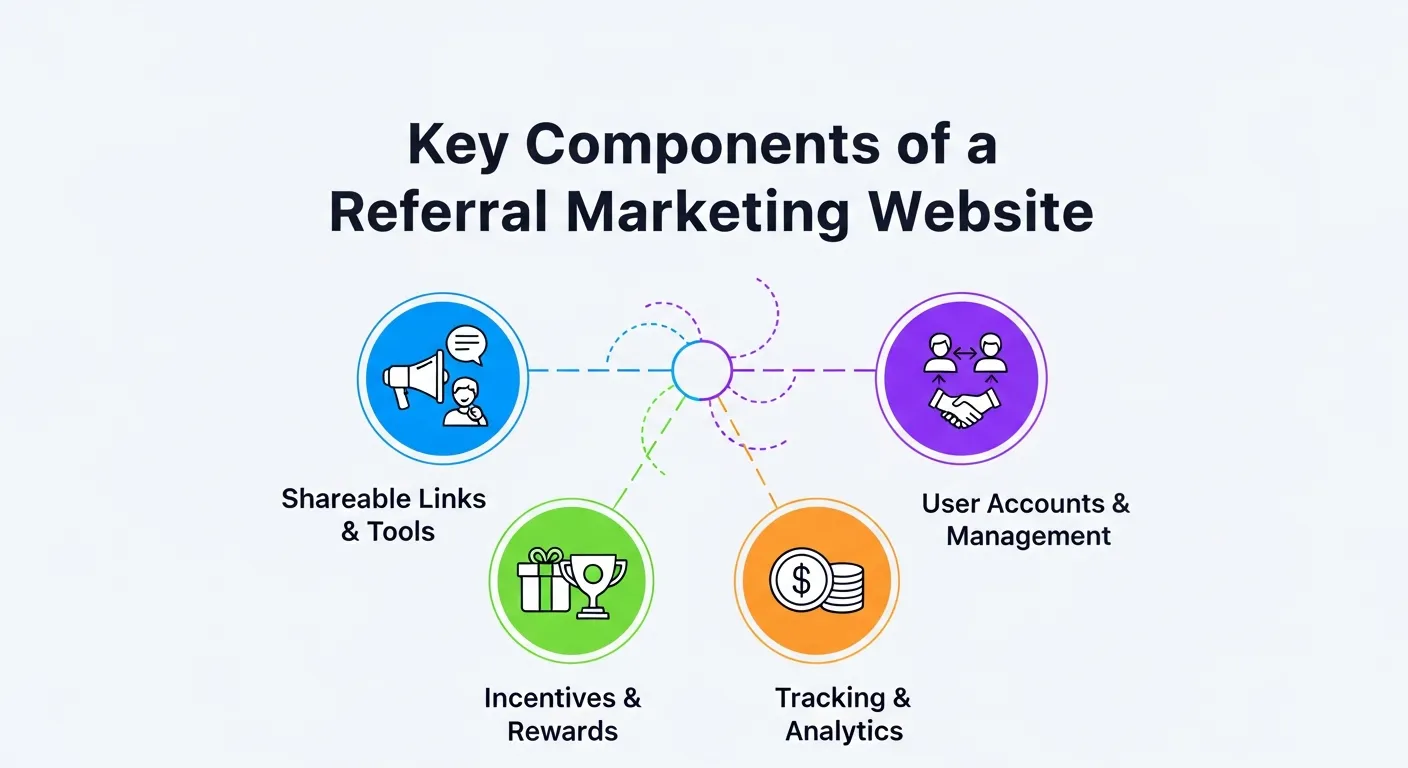
Landing Pages
Landing pages are the entry point for referred users. These pages explain the referral offer, highlight the benefits of joining, and guide visitors to sign up or purchase. A well-optimized landing page increases conversion rates by clearly communicating the value proposition and using strong calls-to-action. Many referral marketing websites use personalized landing pages that display the referrer’s name or reward details to build trust and credibility.
Referral Dashboards
A referral dashboard is a user interface where participants can view their referral performance. Customers can see how many friends they referred, how many conversions they generated, and how much reward they have earned. Dashboards often include sharing buttons, social media integrations, and copyable referral links to make sharing effortless. For businesses, an admin dashboard provides insights into campaign performance, user activity, and program ROI.
Reward Systems
Reward systems are the core motivation behind referral programs. These can include discounts, cashback, free subscriptions, gift cards, loyalty points, or tiered rewards. Some referral marketing websites offer double-sided incentives, rewarding both the referrer and the new customer to boost participation. Advanced reward systems also include gamification features such as leaderboards, badges, and milestone bonuses to increase engagement and repeat referrals.
Analytics and Tracking Tools
Analytics and tracking tools ensure accurate attribution and performance measurement. These tools track clicks, sign-ups, purchases, referral sources, and conversion rates. Businesses can analyze which channels drive the most referrals and optimize campaigns accordingly. Fraud detection tools are also important to prevent self-referrals or fake accounts. Integration with CRM systems, email marketing tools, and payment platforms helps businesses automate reward distribution and manage customer relationships effectively.
Overall, referral marketing acts as a scalable growth engine, leveraging customer trust and data-driven automation to generate high-quality leads and sustainable business growth.
Benefits of Building a Referral Marketing Website
Increased Customer Acquisition
Referral marketing helps businesses attract new customers through trusted recommendations. People are more likely to try a product or service when it is recommended by friends, family, or peers, resulting in higher-quality and more relevant leads.
Lower Marketing Costs
A referral marketing website significantly reduces paid advertising expenses. Since customers promote your brand organically, your cost per acquisition (CPA) becomes much lower compared to traditional marketing channels like PPC or social media ads.
Higher Conversion Rates
Referral-driven visitors convert faster because they already trust the recommendation source. Social proof plays a powerful role in influencing buyer behavior, making referred users more likely to complete purchases.
Boosts Customer Loyalty and Retention
A referral marketing website encourages customers to become brand advocates. By rewarding referrals, businesses build strong communities, increase customer lifetime value, and improve retention rates.
Scalable Word-of-Mouth Growth
Referral systems create viral growth loops, where each new customer brings additional users. This compounding effect makes referral marketing one of the most scalable and sustainable growth strategies for businesses.
Referral Marketing Website Strategy for Rapid Business Growth

Designing a High-Converting Referral Marketing Website
User-Friendly Referral Pages
A referral marketing website must have simple and intuitive referral pages that make sharing effortless. Clear layouts, minimal steps, and easy sharing options increase participation rates and reduce friction for users.
Mobile Optimization and Speed
Mobile optimization is essential because most referrals happen on smartphones. A fast-loading, responsive referral website improves user experience, reduces bounce rates, and increases referral conversions.
Clear Call-to-Action (CTA)
Strong and visible CTAs guide users to take action, such as inviting friends or claiming rewards. A clear CTA improves engagement and ensures visitors understand how to participate in the referral program.
Creating an Effective Referral Program Structure
Single-Sided vs Double-Sided Rewards
Single-sided rewards incentivize only the referrer, while double-sided rewards benefit both the referrer and the referred user. Double-sided rewards often drive higher participation and trust.
Tiered and Gamified Referral Programs
Tiered rewards encourage users to refer more people by unlocking higher incentives. Gamification elements like leaderboards, badges, and milestones increase engagement and repeat referrals.
Viral Loop and Network Effect Strategy
Referral marketing websites create exponential growth through viral loops, where each new user refers others. Successful viral referral campaigns, such as Dropbox and Airbnb, demonstrate how network effects can rapidly scale customer acquisition.
Customer Advocacy and Community Building
Turning customers into brand ambassadors is a powerful growth strategy. Integrating loyalty programs and community features into a referral website strengthens relationships, boosts retention, and encourages long-term advocacy.
Key Features of a Successful Referral Marketing Website
Referral Tracking and Analytics
Attribution Tracking
Accurate attribution tracking identifies which referrals generate conversions, helping businesses measure performance and optimize campaigns.
Real-Time Dashboards
Real-time dashboards provide insights into referral traffic, conversions, and rewards, enabling data-driven decision-making.
Custom Rewards and Incentives
A referral website should support flexible rewards such as cash incentives, discounts, loyalty points, and free products. Custom incentives increase participation and appeal to different customer segments.
CRM, Email, and eCommerce Integrations
Integrations with platforms like Shopify, WooCommerce, HubSpot, and Mailchimp streamline automation, customer management, and referral tracking across marketing channels.
Fraud Prevention and Security Features
Duplicate Referrals
Duplicate referral detection prevents abuse by identifying repeated or fake referrals.
IP Tracking
IP tracking helps identify suspicious referral activity and ensures genuine referrals.
Fake Account Prevention
Security measures such as email verification and anti-fraud algorithms prevent fake account creation and reward abuse.
Custom Branding and White-Label Dashboards
UI Customization
Customizable UI elements allow businesses to align the referral website with their brand identity.
Customer Portals
White-label dashboards and customer portals provide a branded experience for users, increasing trust and engagement.
How to Build a Referral Marketing Website Step-by-Step
Building a referral marketing website requires a structured approach that combines technology, user experience design, and marketing strategy. A well-built referral marketing website can turn customers into powerful growth drivers by encouraging them to share your brand with others.
Step 1 – Choose the Right Referral Software or Platform
The first step is selecting the right referral software or platform that supports automation, tracking, and reward management. Your chosen solution should integrate seamlessly with your website, CRM, and eCommerce platform. Cloud-based referral tools help automate referrals, track performance, and prevent fraud, making it easier to scale your referral marketing website.
Step 2 – Design Referral Landing Pages
Referral landing pages should be visually appealing, simple, and optimized for conversions. These pages must clearly explain how the referral program works, the rewards offered, and how users can participate. A high-converting referral marketing website uses strong CTAs, social proof, and a mobile-responsive design to maximize participation.
Step 3 – Set Reward Rules and Referral Conditions
Defining reward rules is essential for ensuring fairness and motivation. You should decide whether rewards will be single-sided or double-sided and set conditions such as purchase completion or account signup. Clear referral terms and conditions help build trust and prevent abuse while motivating users to share your referral website.
Step 4 – Integrate Tracking and Analytics Tools
Tracking and analytics tools help measure referral performance and ROI. Integrating analytics platforms like Google Analytics, CRM dashboards, and referral tracking software enables businesses to monitor referral traffic, conversions, and reward distribution. Data-driven insights help optimize your referral marketing website for better results.
Step 5 – Launch and Promote the Referral Program
After setup, launch your referral website and promote it across multiple channels such as email marketing, social media, influencer campaigns, and in-app notifications. Continuous promotion ensures users are aware of the referral program and actively participate, driving consistent growth.
Best Referral Marketing Website Tools and Platforms
Choosing the right tool is crucial for building and scaling a referral marketing website. The following platforms are widely used for automation, analytics, and reward management.
ReferralCandy
ReferralCandy is a popular referral marketing tool designed for e-commerce businesses. It automates referral tracking, reward distribution, and email campaigns. ReferralCandy is ideal for Shopify and WooCommerce stores looking for a plug-and-play referral marketing website solution with minimal setup.
Friendbuy
Friendbuy is an enterprise-level referral platform that offers advanced personalization, A/B testing, and fraud detection features. It is best suited for large brands and subscription-based businesses that require scalable referral website infrastructure and deep analytics.
Yotpo
Yotpo is a comprehensive marketing platform that combines referrals, loyalty programs, and reviews. It integrates well with eCommerce platforms and helps brands build trust-driven referral marketing websites by leveraging user-generated content and social proof.
Ambassador
Ambassador is a flexible referral and affiliate marketing platform that supports B2B and SaaS companies. It provides automation, custom reward structures, and integrations with CRM tools, making it ideal for businesses that need advanced referral marketing website customization.
Post Affiliate Pro
Post Affiliate Pro is a robust tracking software that supports referral, affiliate, and partner programs. It offers real-time tracking, multi-tier commissions, and fraud prevention tools. This platform is ideal for businesses that want full control over their referral marketing website infrastructure.
Referral Marketing Website vs Affiliate Website

A referral marketing website and an affiliate website both aim to generate customers through third-party promotion, but their strategies, audiences, and business models differ significantly. Understanding these differences helps businesses choose the right growth strategy.
Key Differences in Strategy and Audience
A referral marketing website focuses on existing customers who recommend products or services to friends, family, or peers. The strategy is based on trust and word-of-mouth marketing, making it highly effective for customer-driven growth.
An affiliate website, on the other hand, targets marketers, bloggers, and content creators who promote products in exchange for commissions. Affiliates are not necessarily customers, and their promotion is often transactional rather than trust-based.
Cost and ROI Comparison
Referral marketing websites generally have lower acquisition costs because rewards are given only when a successful referral converts. This performance-based model ensures a high return on investment.
Affiliate websites often require higher commission payouts and ongoing partner management, which can increase marketing costs. However, affiliates can generate large volumes of traffic, making them useful for scaling quickly.
Which One Is Better for Business Growth?
For long-term sustainable growth, a referral website is often more effective because it builds trust, loyalty, and customer advocacy. Affiliate websites are better for short-term traffic generation and expanding reach. Combining both strategies can create a powerful hybrid growth engine for businesses.
Common Mistakes in Referral Marketing Websites
Many businesses fail to achieve results from referral programs due to avoidable mistakes. A well-optimized referral marketing website requires strategic planning and continuous optimization.
Poor Incentives
Offering unattractive or irrelevant rewards reduces motivation for customers to refer others. Incentives should be valuable, easy to understand, and aligned with customer preferences to maximize participation.
Weak Promotion Strategy
Simply launching a referral marketing website is not enough. Without active promotion through email, social media, in-app notifications, and content marketing, customers may never discover the referral program.
Not Tracking ROI and Analytics
Many businesses fail to track referral performance metrics such as conversion rates, customer lifetime value, and referral ROI. Without data-driven insights, it becomes difficult to optimize and scale the referral marketing website effectively.
Complex User Experience
A complicated referral process discourages users from participating. Referral pages should be simple, mobile-friendly, and easy to use, with clear instructions and minimal steps for sharing referral links.
Future Trends in Referral Marketing Website Strategy
The future of referral marketing websites is driven by technology, automation, and community-based engagement. Businesses that adopt emerging trends will gain a competitive advantage.
AI-Powered Referral Automation
Artificial intelligence will automate referral personalization, targeting, and reward optimization. AI-driven referral marketing websites will predict user behavior and suggest the best referral incentives to maximize conversions.
Blockchain-Based Referral Tracking
Blockchain technology will improve transparency and prevent fraud in referral programs. Decentralized tracking systems will ensure accurate attribution and secure reward distribution in referral marketing websites.
Gamification and Loyalty Integration
Gamified referral programs with points, leaderboards, and badges will increase engagement and motivation. Integrating referral systems with loyalty programs will create a unified customer retention and growth strategy.
Influencer and Community-Based Referral Growth
Communities and micro-influencers will play a major role in referral websites. Brands will leverage online communities, forums, and creator networks to amplify referrals and build strong brand advocacy ecosystems.
Case Studies of Successful Referral Marketing Websites
Real-world case studies prove that a well-designed referral marketing website can drive massive growth. Some of the world’s most successful companies scaled rapidly using referral-based strategies.
Dropbox Referral Program
Dropbox built one of the most famous referral marketing websites by offering free storage space for every successful referral. Users received additional storage when they invited friends, and new users also benefited from bonus storage. This double-sided incentive created a viral growth loop that helped Dropbox grow from thousands to millions of users without heavy advertising costs.
The Dropbox referral marketing website focused on simplicity, seamless sharing, and instant rewards, making it easy for users to participate and share referral links.
Airbnb Referral System
Airbnb used a referral marketing website to encourage users to invite friends and earn travel credits. Both the referrer and the referred user received rewards, which increased participation and trust. Airbnb optimized its referral landing pages, personalized referral links, and integrated referral sharing into email and mobile apps.
This strategy helped Airbnb expand globally by leveraging trusted social networks, demonstrating the power of a referral marketing website for international growth.
Uber Referral Growth Strategy
Uber’s referral marketing website strategy focused on ride credits for both referrers and new users. The referral program was integrated directly into the app, making sharing effortless. Uber also localized rewards for different markets to maximize adoption.
This referral-driven growth strategy helped Uber scale rapidly in competitive markets with minimal traditional advertising.
Lessons Learned and Strategies Used
These case studies highlight key strategies for building a successful referral marketing website. Simple referral processes, double-sided incentives, seamless integration, and personalized referral links are essential for driving participation. Viral loops and user-centric rewards are the foundation of scalable referral growth.
SEO Strategy for Referral Marketing Website
A strong SEO strategy ensures that your referral marketing website ranks high in search engines and attracts organic traffic. Combining keyword optimization, content strategy, and backlink building is essential for long-term growth.
Keyword Optimization Strategy
Keyword optimization is the foundation of SEO for a referral marketing website. Primary keywords such as “referral marketing website” should be strategically placed in titles, headings, meta descriptions, and throughout the content. Secondary keywords include referral program software, referral marketing strategy, word-of-mouth marketing, and customer referral programs. LSI keywords such as viral growth, customer advocacy, referral tracking, and referral incentives help search engines understand topical relevance. Maintaining a natural keyword density of around 1.30 percent ensures SEO effectiveness without keyword stuffing.
Content and Internal Linking Strategy
High-quality content is essential for ranking a marketing website. Creating in-depth guides, tutorials, case studies, and FAQs helps attract organic traffic. Internal linking between related blog posts, referral tool reviews, and marketing strategy pages improves site structure and SEO performance. A strong internal linking strategy increases dwell time, reduces bounce rate, and boosts search engine rankings.
Backlink and Authority Building Tips
Building backlinks from authoritative websites improves domain authority and search visibility for a referral marketing website. Guest blogging, digital PR campaigns, influencer collaborations, and publishing original research can generate high-quality backlinks. Consistent content marketing and outreach help establish your website as an industry authority, driving long-term organic growth and credibility.
Conclusion
A referral marketing website is a powerful growth tool that turns satisfied customers into active promoters of your brand. By leveraging trust-based recommendations, businesses can acquire high-quality customers at a lower cost while increasing conversion rates and loyalty. With the right components—landing pages, dashboards, reward systems, and analytics—you can build a scalable system that drives continuous word-of-mouth growth. When implemented strategically, referral marketing creates a viral loop that compounds results, strengthens brand credibility, and delivers sustainable long-term business success.
FAQ: Referral Marketing Website
1. What is a referral marketing website?
A referral marketing website is a platform that encourages existing customers to refer new users in exchange for rewards, helping businesses grow through word-of-mouth marketing.
2. How does a referral marketing website work?
It provides users with unique referral links or codes that they share with others. When someone signs up or makes a purchase, the referrer earns a reward.
3. Why is a referral marketing website important for business growth?
A referral marketing website increases customer acquisition, builds trust, reduces marketing costs, and generates high-quality leads through trusted recommendations.
4. What rewards can be offered on a referral marketing website?
Common rewards include cash, discounts, store credits, loyalty points, free products, or exclusive access to premium features.
5. How is a referral marketing website different from an affiliate website?
A referral marketing website targets existing customers who share products with friends, while affiliate websites target marketers and publishers who earn commissions for promotions.
6. What tools are used to build a referral marketing website?
Popular tools include ReferralCandy, Friendbuy, Yotpo, Ambassador, and Post Affiliate Pro, which automate tracking, rewards, and analytics.
7. How can SEO help a referral marketing website?
SEO helps attract organic traffic, improve visibility, and increase sign-ups by ranking the referral marketing website for relevant keywords like referral programs and customer advocacy.
8. What are the common mistakes in referral marketing websites?
Common mistakes include poor incentives, weak promotion, not tracking ROI, and complicated referral processes that discourage users.
9. How can businesses prevent referral fraud?
Fraud prevention includes IP tracking, duplicate account detection, referral validation rules, and automated monitoring systems.
10. Is a referral marketing website suitable for all businesses?
Yes, a referral marketing website works for eCommerce, SaaS, subscription services, and local businesses, especially those with loyal customers and repeat buyers.
You can learn about: How to Prevent Fraud in Referral Marketing?