
B2B Referral Marketing ROI Measurement helps teams connect referrals to revenue, not just leads, so they can optimize programs with confidence, clarity, and better commercial decisions.
B2B referral programs are often praised for trust, lower acquisition friction, and stronger intent, but praise alone does not prove business value. That is why B2B Referral Marketing ROI Measurement matters. It turns a promising referral motion into a measurable growth system. Instead of assuming referrals are working because a few deals look good, teams can see which sources, messages, incentives, and customer segments actually create profitable outcomes.
The challenge is that referral programs often sit between marketing, sales, customer success, and finance. Each team sees a different part of the journey. Marketing may see the referral source. Sales may see the pipeline. Customer success may see the relationship that initiated the referral. Finance may care only about payback and margin. B2B Referral Marketing ROI Measurement connects those viewpoints into one coherent story.
That story matters because referrals can be deceptively complex. A small number of high-quality referrals may outperform hundreds of weaker leads. A program with modest volume may still generate excellent margin. Or the opposite may happen: a referral program may create activity without meaningful revenue. B2B Referral Marketing ROI Measurement shows the difference.
This guide explains how to evaluate referral ROI, what metrics matter most, how to build a practical measurement workflow, and how to improve outcomes with better outreach and operational design. It also connects related execution layers such as B2B SaaS Referral Programs, SaaS Referral Programs, Practical Outreach Workflow, and High Converting Outreach Strategy so the measurement system reflects how referrals actually work in real companies.
Why ROI Measurement Changes Referral Strategy
Many teams launch referral programs with a simple idea: happy customers should introduce new buyers. That idea is correct, but it is not enough. Without B2B Referral Marketing ROI Measurement, the program may become a guess. You may know people are referring others, but you may not know whether the effort is worth the cost.
ROI measurement changes the conversation from activity to value. It forces teams to ask whether referred deals convert faster, stay longer, purchase more, or cost less to acquire. It also helps teams decide whether they should invest more in the program or fix the parts that are underperforming. B2B Referral Marketing ROI Measurement gives structure to that decision.
The psychological benefit is important too. Teams feel more confident when they know what is working. Executives trust referral programs more when the numbers are connected to revenue. Customer-facing teams also become more motivated when they see that referrals are not just goodwill; they are measurable business assets.
What Counts as ROI in Referral Marketing
ROI is not only “how much money came in.” In referral marketing, it should include acquisition cost, conversion rate, revenue quality, payback period, lifetime value, and operational cost. That is why B2B Referral Marketing ROI Measurement must be broader than a simple lead tally.
A referral may look cheap to acquire, but if the referred customer churns quickly, the real return is weak. Another referral may take longer to convert, but once closed it may produce strong retention and expansion. B2B Referral Marketing ROI Measurement needs to capture both the immediate and downstream impact.
A practical ROI view often includes these components:
- Referral source cost
- Incentive or reward cost
- Sales and support cost
- Conversion rate by stage
- Average deal value
- Customer lifetime value
- Retention and expansion potential
When these elements are measured together, teams can see whether the referral motion is truly efficient. B2B Referral Marketing ROI Measurement works best when it reflects total business value rather than vanity performance.
The Core Metrics That Matter Most

Not every metric deserves equal attention. Some metrics explain performance, while others only decorate the report. B2B Referral Marketing ROI Measurement should focus on the indicators that change decisions.
Referral Volume
How many qualified referrals are actually entering the pipeline? Volume matters, but volume alone is not enough.
Lead-to-Opportunity Conversion
This shows whether referred leads are serious enough to move deeper into the funnel.
Opportunity-to-Close Rate
If referrals close at a much higher rate than other channels, that is a major signal of quality.
Average Contract Value
A smaller number of higher-value deals can outperform larger volumes of low-value accounts.
Payback Period
How quickly does the program recover its costs?
Retention and Expansion
Referred customers often perform differently over time, so post-sale value matters.
Referral Incentive Cost
Rewards, discounts, credits, or gifts should be counted directly.
Internal Operating Cost
Admin work, software, sales coordination, and support time all affect ROI.
B2B Referral Marketing ROI Measurement becomes much stronger when those metrics are reviewed together instead of separately.
How Referral Economics Work in B2B
B2B referrals are different from consumer referrals because the deal cycle is longer, the buying committee is larger, and the revenue value is often higher. That creates both opportunity and complexity. B2B Referral Marketing ROI Measurement must account for these realities.
A referred lead may not convert immediately, but it may arrive with trust already built. That trust can reduce sales friction, increase response rates, and lower acquisition costs. Yet the sales cycle may still involve multiple stakeholders, compliance reviews, and budget approvals. B2B Referral Marketing ROI Measurement should therefore look beyond the first conversation.
The economics of B2B referrals often improve when the referred customer matches a strong use case, an existing ICP, or a known pain point. In those cases, referral quality tends to rise. But if a referral program is too broad, it can produce low-intent leads that look promising at the top of the funnel but underperform later. B2B Referral Marketing ROI Measurement shows which pattern is happening.
Mapping the Referral Journey
To measure ROI correctly, you need to understand the journey from referral to revenue. That journey usually includes the trigger, the referral act, the initial response, qualification, sales engagement, close, onboarding, and post-sale value. B2B Referral Marketing ROI Measurement should follow each stage.
A referral trigger might come from customer delight, an account manager conversation, a support success moment, or a structured incentive. The referral act itself may happen in email, a form, a direct introduction, or a program portal. Then the sales team takes over. Each stage introduces drop-off risk.
The more clearly you map the journey, the easier it is to improve it. If referrals are being generated but not qualified, the issue may be messaging. If they are qualified but not closing, the issue may be targeting or offer fit. B2B Referral Marketing ROI Measurement helps isolate the weak point.
Building the Measurement Framework
A good framework is simple enough to maintain and detailed enough to inform action. B2B Referral Marketing ROI Measurement should start with a clean definition of what counts as a referral, what counts as a qualified lead, and what counts as a successful outcome.
Without that clarity, teams report different numbers and argue over definitions. One department may count introductions. Another may count only sales-qualified referrals. Another may count closed deals only. B2B Referral Marketing ROI Measurement avoids confusion by standardizing the rules.
A useful framework should answer four questions:
- Where did the referral come from?
- How much did it cost to generate and manage?
- How far did it move through the funnel?
- What value did it produce after close?
This simple structure supports better reporting and better decisions.
B2B SaaS Referral Programs and ROI Potential
B2B SaaS Referral Programs are especially interesting because SaaS economics reward efficiency, retention, and expansion. A referred SaaS customer may be less expensive to acquire and more likely to trust the product narrative. That can improve payback and total lifetime value.
However, SaaS also introduces complexity. Free trials, self-serve signup paths, account-based sales motion, and product-led behavior can blur the referral source. B2B Referral Marketing ROI Measurement should track not only the referral itself, but also whether the referred account activates, converts, and remains engaged.
The strongest SaaS referral programs usually align with customer success moments. Users refer when they genuinely believe the product solved a problem. That makes B2B Referral Marketing ROI Measurement particularly useful because it can reveal whether delight is translating into profitable acquisition.
SaaS Referral Programs and Expansion Value
SaaS Referral Programs often become more valuable when the referred account can expand over time. A simple first-year revenue number may understate the real return. B2B Referral Marketing ROI Measurement should therefore include expansion revenue, seat growth, upgrades, and renewals where relevant.
This matters because one referred customer can lead to a long relationship. If the program consistently attracts accounts with strong retention and usage, the ROI may be far higher than the original closed-won number suggests. B2B Referral Marketing ROI Measurement helps surface that long-term benefit.
When teams ignore expansion, they may undervalue referrals and underinvest in them. When they overestimate expansion without proof, they may spend too much on incentives. The answer is disciplined measurement.
Attribution Problems and How to Solve Them
Attribution is one of the hardest parts of referral measurement. A referred customer may read your content, compare alternatives, talk to sales, and later convert through another channel. Without careful tracking, B2B Referral Marketing ROI Measurement can become blurred.
The solution is to define attribution logic before the program scales. You need to know whether you are using first-touch, last-touch, multi-touch, self-reported source, or assisted attribution. In B2B, multiple-touch logic often gives the most honest picture because referrals usually support the buying journey rather than replace every other influence.
B2B Referral Marketing ROI Measurement should also capture assisted value. Even if a referral does not close directly, it may shorten the sales cycle or increase trust in the first meeting. That contribution still matters.
Data Sources That Support Better ROI Analysis
Good measurement depends on good data. If CRM records are incomplete, if referral forms are inconsistent, or if sales notes are not standardized, B2B Referral Marketing ROI Measurement becomes noisy.
Useful data sources usually include the CRM, referral platform, billing system, analytics tool, support records, and customer success notes. Each source contributes a different part of the story. The CRM may show pipeline movement. The billing system may show revenue. Support records may show customer satisfaction. B2B Referral Marketing ROI Measurement becomes stronger when these sources are connected.
A common mistake is relying on one source alone. That creates blind spots. The referral may look good in the CRM but weak in the accounting system. Or it may look quiet in analytics but strong in expansion revenue. The best teams compare systems rather than trusting one view.
Practical Outreach Workflow for Referral Activation
Referrals do not activate themselves. Someone usually has to follow up, route the lead, confirm interest, and move the conversation forward. A Practical Outreach Workflow makes that process repeatable.
This workflow is especially important when referrals come from existing customers or partners. The faster the handoff, the better the experience. B2B Referral Marketing ROI Measurement often improves when outreach is timely, personalized, and clearly connected to the original relationship.
The workflow should define ownership. Who receives the referral? Who responds first? Who qualifies the account? Who follows up after the first meeting? Without clear ownership, good referrals can stall. That hurts conversion and weakens the return.
A Practical Outreach Workflow also makes measurement more reliable because each step leaves a record. That makes it easier to identify where the referral pipeline is leaking.
High Converting Outreach Strategy and Message Relevance

If the referral handoff is clumsy, the ROI suffers. A High Converting Outreach Strategy helps the first response feel relevant and valuable. It should reference the context of the referral, acknowledge the relationship, and make the next step easy.
That matters because referred prospects often expect a warmer experience than cold leads. They may already trust the source, but they still need a reason to engage. B2B Referral Marketing ROI Measurement improves when outreach strengthens that trust instead of wasting it.
The message should not be generic. It should fit the buyer’s situation. A good strategy uses the referrer’s credibility without overusing it. It also avoids sounding overly scripted. People can feel the difference between a helpful introduction and a sales template.
Incentives, Costs, and Hidden Waste
Referral programs often fail to measure hidden costs. Incentives are the obvious expense, but not the only one. Staff time, tool subscriptions, manual management, and delays all affect the final return. B2B Referral Marketing ROI Measurement should include these costs.
Sometimes a program looks attractive because the incentive is small, but the admin burden is large. In other cases, a generous reward seems expensive, yet the revenue return is so strong that the program is still highly profitable. The only way to know is to measure correctly.
Hidden waste can also show up when the referral incentive attracts the wrong behavior. If people refer low-quality leads just to get the reward, the program may generate activity without value. B2B Referral Marketing ROI Measurement helps detect that pattern early.
How to Separate Quality From Volume
A mature program focuses on quality, not just quantity. A hundred weak referrals are not better than ten strong ones. B2B Referral Marketing ROI Measurement should rank not only how many referrals arrive, but how well they fit your target customer profile.
Quality is reflected in conversion speed, meeting attendance, pipeline progression, and eventual retention. If a referral source consistently produces accounts that convert faster and stay longer, that source deserves more attention. If another source creates noise, it should be adjusted or removed.
The best teams often segment by referrer type, customer segment, industry, account size, or use case. That makes B2B Referral Marketing ROI Measurement much more actionable.
Tables That Help Make the Data Clear
A simple table can make reporting easier for internal teams and stakeholders.
| Metric | Why It Matters | What It Tells You |
|---|---|---|
| Referral volume | Size of the program | Whether the program is active |
| Conversion rate | Funnel effectiveness | Whether referrals are relevant |
| Average deal size | Revenue efficiency | Whether referrals are valuable |
| Retention rate | Long-term quality | Whether customers stay engaged |
| Incentive cost | Program expense | How much the program consumes |
| Payback period | Financial speed | How quickly costs are recovered |
B2B Referral Marketing ROI Measurement becomes easier to discuss when the data is this clear. People can immediately see the relationship between effort and outcome.
How Marketing and Sales Should Work Together
Referral programs often fail when marketing and sales operate separately. Marketing may promote the referral motion, but sales may not follow up with enough speed or consistency. Sales may close the deal, but marketing may not hear which referral sources are producing the best accounts. B2B Referral Marketing ROI Measurement bridges that gap.
The best setup is collaborative. Marketing defines the program, sales executes the follow-up, customer success supports the relationship, and finance validates the cost assumptions. That shared structure creates accountability.
When the teams align, the referral program becomes easier to scale. Each department knows how it contributes to the result, and B2B Referral Marketing ROI Measurement becomes a shared business language rather than a reporting burden.
What Good ROI Reporting Looks Like
Good reporting tells a story. It does not just dump numbers on a page. B2B Referral Marketing ROI Measurement should show performance over time, segment results, cost comparisons, and downstream value.
A useful report should answer questions like:
- Which referrers produce the highest-value deals?
- Which segments convert fastest?
- Which incentives are most efficient?
- Which sources bring the best retention?
- Where does the referral funnel break down?
If the report answers those questions, the team can act. B2B Referral Marketing ROI Measurement should make decision-making easier, not more confusing.
Common Mistakes in Referral ROI Tracking
One common mistake is tracking only closed revenue and ignoring cost. That creates an inflated view of success. Another is ignoring assisted deals, which can cause undervaluation. A third is failing to segment referral sources, which hides useful patterns.
Another problem is inconsistent definitions. If one team counts a referral at introduction and another counts it at qualification, the numbers will never match. B2B Referral Marketing ROI Measurement needs common definitions.
A final mistake is looking at the program only once in a while. Referral performance changes. Measurement should be continuous enough to catch trends early.
How to Improve ROI Without Rebuilding the Whole Program
You do not always need a full redesign to improve results. Small changes can have a large effect. Better onboarding for referrers, clearer referral prompts, faster follow-up, and more relevant incentives can all improve outcomes.
A stronger Practical Outreach Workflow can increase conversion rates without increasing spend. A better High Converting Outreach Strategy can improve response quality. Clearer segment targeting can raise lead fit. B2B Referral Marketing ROI Measurement tells you which lever matters most.
That is the benefit of a measured approach. You can improve one layer at a time instead of guessing where the issue lives.
When to Scale and When to Pause
Not every referral program deserves more budget. Sometimes the right move is to pause, review, and correct the design. If referral volume is high but conversion is low, scaling will only amplify the problem. B2B Referral Marketing ROI Measurement helps you know when to expand and when to hold.
If the program produces strong deals, good retention, and efficient payback, then scaling makes sense. If the data is weak or incomplete, improving the measurement system should come first.
This disciplined mindset protects the company from overspending on attractive but ineffective motions.
The Role of Customer Trust
Referrals work because trust transfers. The person who refers someone is lending credibility. That is why the quality of the relationship matters. If customers feel valued and successful, they are more likely to refer the right people.
B2B Referral Marketing ROI Measurement should therefore include not only the transactional result but also the relationship quality that creates the referral in the first place. Healthy customer success often leads to healthier referrals.
A Simple Operating Checklist
A practical checklist can keep the program healthy.
- Define what counts as a referral
- Track source and segment
- Measure cost, conversion, and value
- Review follow-up speed
- Check retention and expansion
- Segment high and low performers
- Adjust incentives and messaging
When this checklist becomes routine, B2B Referral Marketing ROI Measurement becomes much easier to sustain.
Strategic Takeaways
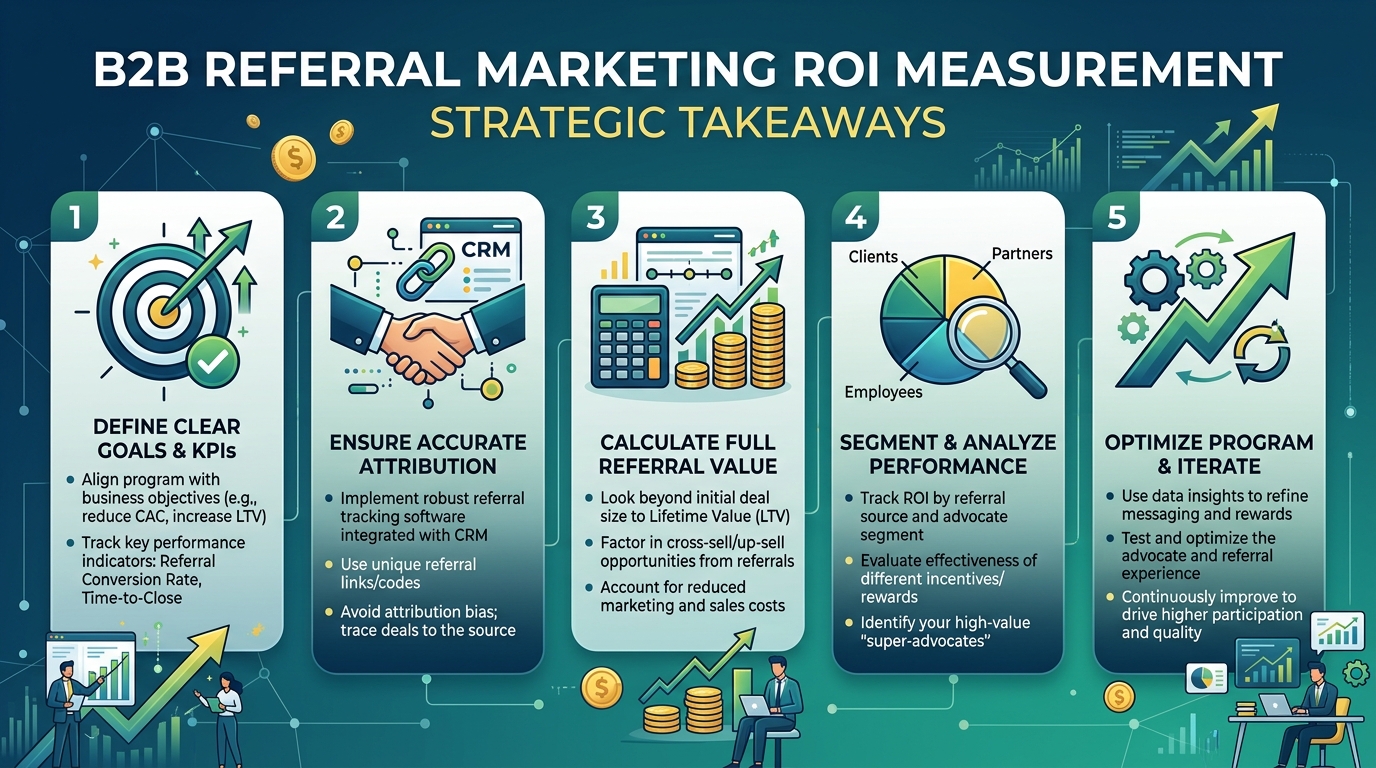
The main lesson is that referral programs are only as strong as the systems behind them. If you do not measure cost, quality, conversion, and long-term value, you may mistake activity for performance. B2B Referral Marketing ROI Measurement gives the program discipline.
It also shows that referrals are not just a marketing tactic. They are a cross-functional growth motion that depends on customer success, sales execution, and operational clarity. When the measurement is strong, the program becomes easier to trust and easier to scale.
Conclusion
B2B referral programs can be one of the most efficient growth channels in a company, but only when they are measured properly. B2B Referral Marketing ROI Measurement turns referrals from a hopeful idea into a business case. It shows which sources create valuable pipeline, which incentives are worth the cost, which outreach methods improve conversion, and which accounts stay profitable after the close. When teams track the full journey, they can make smarter decisions, reduce waste, and invest in the parts of the referral motion that truly work. That is how referrals move from being a nice channel to becoming a dependable revenue engine.
Frequently Asked Questions (FAQ)
1. What is B2B Referral Marketing ROI Measurement?
It is the process of evaluating referral performance by comparing cost, conversion, revenue, and long-term value.
2. Why is it important for B2B companies?
It helps companies see whether referrals are actually profitable and worth scaling.
3. Does referral volume matter most?
No. Quality, conversion, and retention often matter more than volume alone.
4. How do B2B SaaS Referral Programs affect ROI?
They can improve efficiency and retention, but only if activation and expansion are strong.
5. What is the role of SaaS Referral Programs in measurement?
They often require tracking beyond the first sale because long-term value is a major part of ROI.
6. Why is a Practical Outreach Workflow necessary?
It ensures referrals are followed up quickly and consistently, which improves conversion.
7. How does a High Converting Outreach Strategy help?
It makes the first contact more relevant, which can increase response and close rates.
8. What costs should be included in ROI?
Incentives, staff time, tools, support, and any operational overhead should be included.
9. Should referrals be measured with one-touch attribution only?
Usually no. Multi-touch or assisted attribution often gives a better picture in B2B.
10. What is the best way to improve referral ROI?
Improve targeting, speed up follow-up, simplify the process, and measure results consistently.