

Referral marketing vs affiliate marketing differ in promoters, rewards, and goals. Referral marketing uses customers to recommend brands, while affiliate marketing uses partners for commissions. Both strategies help businesses grow their customer base and revenue.
Referral marketing vs affiliate marketing are two powerful strategies that businesses use to grow customers and increase sales. While both rely on recommendations and partnerships, they work in different ways and serve different purposes. Referral marketing focuses on encouraging existing customers to recommend a brand to their friends and family, while affiliate marketing involves external partners promoting products in exchange for commissions. Understanding the key differences between referral marketing vs affiliate marketing can help businesses choose the right strategy, improve customer acquisition, and maximize return on investment (ROI).
What Is Referral Marketing?
Referral marketing is a powerful customer acquisition strategy that encourages existing customers to recommend your products or services to people in their network. These recommendations—often called referrals—are highly effective because they come from trusted sources such as friends, family members, or colleagues.
Unlike traditional advertising, referral marketing relies on word-of-mouth marketing, which is one of the most trusted forms of promotion. When customers share positive experiences, they help build brand credibility, increase conversions, and drive high-quality leads.
How Referral Marketing Works
The foundation of referral marketing is customer satisfaction and trust. When customers have a great experience with a product or service, they are naturally more likely to share it with others. Businesses amplify this natural behavior by creating structured referral programs that make it easy and rewarding to share recommendations.
Referral programs typically use unique referral links, codes, or tracking systems to identify who referred a new customer. This allows businesses to measure performance and reward participants accurately.
Benefits of Referral Marketing
Referral marketing offers multiple advantages, including:
- Higher conversion rates: Referred customers are more likely to make a purchase because they trust the recommendation.
- Lower customer acquisition costs: Referrals reduce the need for expensive advertising campaigns.
- Increased brand loyalty: Customers who participate in referral programs often feel more connected to the brand.
- Quality leads: Referrals often attract customers who closely match your target audience.
What Is Affiliate Marketing?
Affiliate marketing is a performance-based digital marketing strategy where businesses reward affiliates (partners, publishers, or influencers) for driving traffic, leads, or sales to their products or services. Affiliates promote a company’s offerings using unique tracking links, and they earn a commission whenever a user completes a specific action—such as making a purchase, signing up, or downloading an app.
In simple terms, affiliate marketing is a revenue-sharing model between a brand and marketers who help promote its products online.
How Affiliate Marketing Works
Affiliate marketing operates through a structured partnership between four key parties:
- The Merchant (Advertiser): The business selling a product or service.
- The Affiliate (Publisher): A blogger, influencer, website owner, or marketer who promotes the product.
- The Affiliate Network (Optional): A platform like Amazon Associates, ShareASale, or CJ Affiliate that connects merchants and affiliates and tracks performance.
- The Customer: The end user who clicks the affiliate link and completes the desired action.
Affiliates receive a unique tracking link or code to monitor clicks, conversions, and commissions.
Types of Affiliate Marketing
There are several common models of affiliate marketing:
- Pay-Per-Sale (PPS): Affiliates earn a commission when a sale is completed.
- Pay-Per-Click (PPC): Affiliates earn money for driving traffic, regardless of purchase.
- Pay-Per-Lead (PPL): Affiliates earn commissions when users sign up or submit a form.
Benefits of Affiliate Marketing
Affiliate marketing offers significant advantages for both businesses and affiliates:
For Businesses:
- Cost-effective marketing: Pay only for results, not impressions.
- Scalable growth: Easily expand marketing reach without hiring large teams.
- Access to new audiences: Affiliates help brands reach niche markets.
For Affiliates:
- Passive income opportunities: Earn commissions from content and traffic.
- Low startup costs: No need to create products or handle customer service.
- Flexible work model: Promote products through blogs, social media, email, or YouTube.
Key Differences Between Referral and Affiliate Marketing
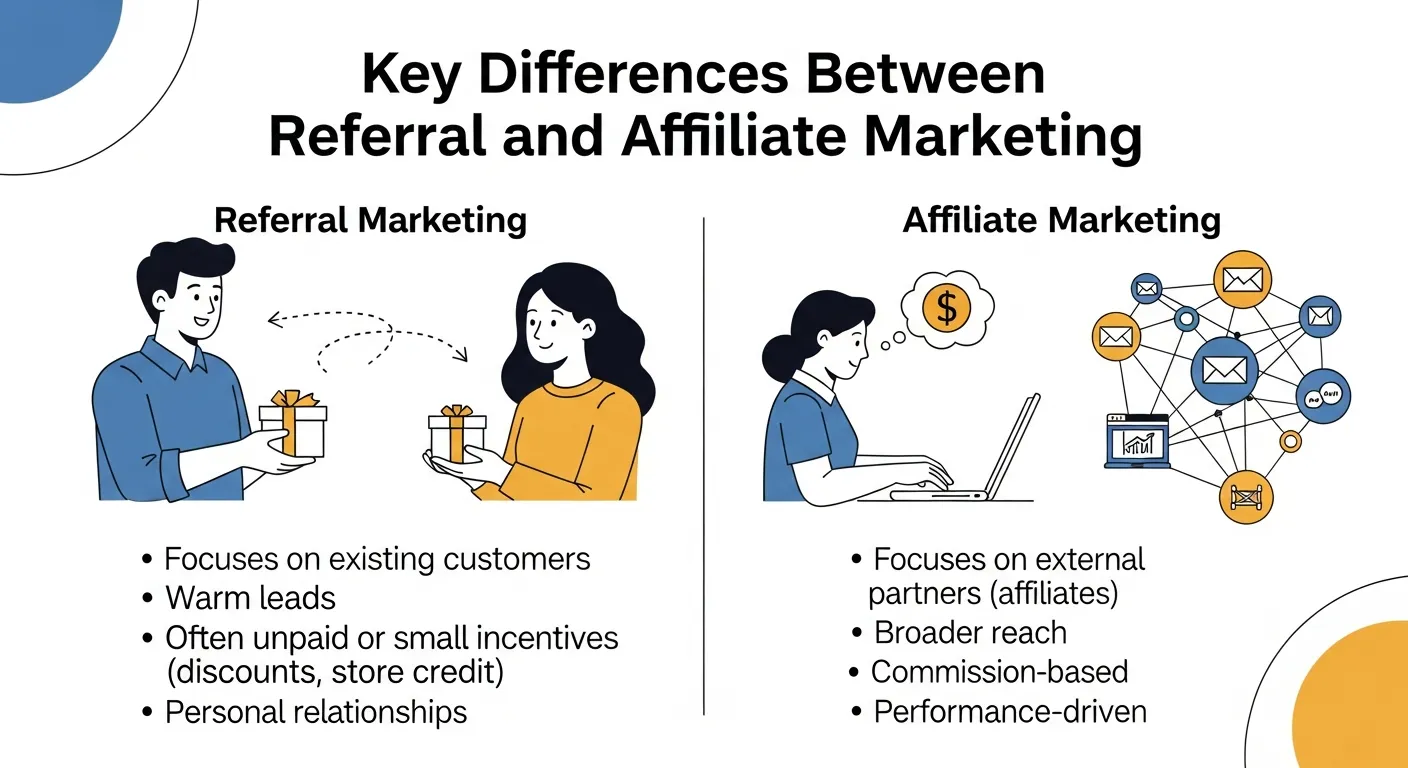
Relationship Structure
The most fundamental difference lies in the relationship between promoters and your business, as detailed in referral marketing vs affiliate marketing. Referral marketing builds on existing customer relationships, while affiliate marketing creates new promotional partnerships.
Referral participants have direct experience with your product or service. They make recommendations based on personal satisfaction and genuine belief in your offerings. This authentic experience creates more credible and persuasive recommendations.
Affiliate partners may never have used your product. They promote based on commission potential, market research, and promotional materials you provide. While this can still be effective, the recommendations lack the personal authenticity that comes from direct experience.
Motivation and Incentives
Customer motivations differ significantly between these approaches. Referral participants are primarily driven by the desire to help friends and family, with rewards serving as secondary motivation. The social satisfaction of sharing a great discovery often outweighs financial incentives.
Affiliate motivations center on earning potential. While some affiliates genuinely believe in the products they promote, their primary goal is to generate commission income. This creates different promotional behaviors and messaging strategies.
Audience Reach and Targeting
Referral marketing reaches highly qualified prospects through personal networks. These audiences typically share demographic similarities and trust levels with existing customers, creating higher conversion potential but limiting overall reach.
Affiliate marketing can access broader, more diverse audiences through various promotional channels. Affiliates often serve specific niches or demographic segments, allowing businesses to reach markets they might not penetrate through referral programs alone.
Content and Messaging Control
Referral marketing offers greater control over messaging and brand representation. Customers typically share experiences in their own words, but businesses can provide suggested language and promotional materials that maintain brand consistency.
Affiliate marketing involves less direct control over promotional content. While businesses can provide guidelines and approved materials, affiliates create their own promotional content across various channels. This independence can lead to creative approaches but may result in inconsistent brand messaging.
Cost Structure and ROI
Referral marketing metrics that matter in the craze era highlight that referral programs typically involve lower upfront costs but may require ongoing technology investments and reward fulfillment. The cost per acquisition through referrals is often lower because the primary promotional work comes from satisfied customers rather than paid marketing efforts.
Affiliate marketing costs vary significantly based on commission rates, affiliate recruitment efforts, and program management requirements. While individual affiliate commissions may be higher, the scalability potential can justify these costs for businesses with strong profit margins.
Performance Tracking and Analytics
Both strategies require robust tracking systems, but the metrics and analysis differ substantially. Referral programs focus on customer lifetime value, referral rates, and program participation levels. Success measurement often includes qualitative factors like customer satisfaction and brand advocacy strength.
Affiliate marketing emphasizes conversion rates, click-through rates, and commission-to-revenue ratios. The analysis is typically more transactional, focusing on immediate sales performance and affiliate productivity metrics.
Advantages and Disadvantages of Each Approach
Referral Marketing Benefits
Referral marketing generates highly qualified leads through trusted personal recommendations. The conversion rates from referral traffic typically exceed those of other marketing channels because prospects receive recommendations from people they know and trust.
Customer acquisition costs through referral programs are often lower than traditional advertising. Since existing customers handle much of the promotional work, businesses save on advertising spend while achieving strong results.
Referral programs also strengthen customer loyalty and retention. When customers become active promoters, they develop deeper connections with your brand and are more likely to remain long-term customers themselves.
Referral Marketing Limitations
The primary limitation of referral marketing is scale. Even highly satisfied customers have limited network sizes, which constrains the total reach of referral programs. This limitation can slow growth for businesses that need rapid market expansion.
Referral programs also depend heavily on customer satisfaction levels. If product quality or service delivery declines, referral activity decreases quickly. This dependence makes referral marketing less predictable than other acquisition channels.
Affiliate Marketing Benefits
Affiliate marketing offers exceptional scalability potential. Businesses can recruit unlimited affiliates across various niches and geographic markets, creating opportunities for rapid growth and market penetration.
The performance-based payment structure means businesses only pay for actual results. This cost efficiency makes affiliate marketing attractive for companies with tight marketing budgets or those testing new markets.
Affiliate marketing also provides access to specialized audiences and expertise. Many affiliates have deep knowledge of specific market segments and can provide valuable insights about customer preferences and effective promotional strategies.
Affiliate Marketing Limitations
Quality control presents ongoing challenges in affiliate marketing. Since affiliates operate independently, businesses must monitor promotional activities to ensure brand compliance and ethical marketing practices.
The relationship between affiliates and prospects lacks the personal trust factor that makes referral marketing so effective. Affiliates must work harder to build credibility and overcome skepticism about promotional motivations.
Competition for top-performing affiliates can drive up commission rates and program costs. Successful affiliates often promote multiple competing products, making it challenging to maintain exclusive promotional relationships.
When to Choose Referral Marketing
Referral marketing works best for businesses with high customer satisfaction levels and products that generate strong emotional connections. If your customers frequently recommend your business without formal incentives, implementing a referral program can amplify these natural behaviors.
Service-based businesses often find referral marketing particularly effective because personal recommendations carry significant weight in service selection decisions. Professional services, healthcare, and personal care industries frequently achieve strong results through referral programs.
Referral marketing also suits businesses with limited marketing budgets but strong customer relationships. The relatively low cost and high conversion potential make referral programs attractive for startups and small businesses building market presence.
When to Choose Affiliate Marketing
Affiliate marketing excels for businesses needing rapid scale and market expansion. If your primary goal is reaching new audiences quickly, affiliate partnerships can accelerate growth beyond what referral programs achieve.
E-commerce businesses with strong profit margins often benefit from affiliate marketing because the performance-based structure aligns costs with revenue generation. Digital products and services with low fulfillment costs can support higher commission rates that attract quality affiliates.
Affiliate marketing also works well for businesses entering new geographic markets or demographic segments. Local affiliates can provide market knowledge and credibility that would be difficult to develop through other channels.
Implementing Hybrid Strategies

Many successful businesses combine referral marketing vs affiliate marketing to maximize growth opportunities. This hybrid approach leverages the strengths of both strategies while mitigating individual limitations.
A hybrid strategy might include a referral program for existing customers alongside affiliate partnerships for market expansion. This combination ensures you capture organic advocacy while actively pursuing new audience segments.
When implementing hybrid strategies, maintain clear distinctions between program structures and participant expectations. Confusion about roles and rewards can undermine both programs’ effectiveness.
Measuring Success in Both Approaches
Effective measurement requires different metrics for each strategy. Referral marketing success indicators include referral participation rates, customer lifetime value increases, and program ROI calculations based on long-term customer relationships.
Affiliate marketing measurement focuses on conversion rates, average order values, and commission-to-revenue ratios. Track affiliate performance individually to identify top performers and optimize program offerings.
Both strategies benefit from qualitative feedback collection. Survey participants about their experience and motivation to identify improvement opportunities and program optimization potential.
Choosing the Right Strategy for Your Business
Choosing between referral marketing vs affiliate marketing depends on several factors, including your business model, growth goals, target audience, and available resources. Both strategies can drive customer acquisition and revenue, but they work best in different scenarios. Understanding your current market position and customer behavior is essential before implementing either approach.
Evaluate Your Business Model and Goals
Start by analyzing your business model and growth objectives. Referral marketing works best for businesses with a strong existing customer base, such as SaaS platforms, subscription services, and eCommerce brands with high customer satisfaction. On the other hand, affiliate marketing is ideal for companies looking to scale quickly, reach new audiences, and drive large volumes of traffic through external partners and influencers.
If your primary goal is customer retention and brand loyalty, referral marketing is a powerful choice. If your focus is on rapid market expansion and revenue growth, affiliate marketing may be more effective.
Assess Customer Advocacy and Brand Trust
Next, evaluate your current level of customer advocacy. If your customers already recommend your products or services organically, a referral program can formalize and amplify these behaviors. Structured referral incentives encourage loyal customers to actively promote your brand, turning them into brand ambassadors.
However, if your brand awareness is still limited and customers are not actively recommending your business, affiliate marketing can provide immediate exposure. Affiliates, bloggers, and influencers already have established audiences, making it easier to generate traffic and conversions quickly.
Consider Budget and Resource Availability
Budget and resources play a critical role in choosing between referral marketing and affiliate marketing.
- Referral marketing programs usually require lower upfront investment. Costs are mainly associated with rewards, referral tracking tools, and program management.
- Affiliate marketing programs often require higher commission payouts and dedicated affiliate management platforms, but they offer predictable and scalable growth.
If you have limited resources, starting with a simple referral program can be cost-effective. If you have a marketing budget and want measurable ROI, affiliate marketing can deliver scalable performance.
Test and Optimize Both Strategies
Before committing significant resources, test both referral and affiliate marketing on a small scale. Launch pilot programs, track key performance metrics such as conversion rates, customer acquisition cost (CAC), and lifetime value (LTV), and analyze which strategy performs best in your market.
Testing allows you to identify what resonates with your audience, optimize incentives, and refine your marketing strategy based on real data.
Combine Referral and Affiliate Marketing for Maximum Growth
Many successful businesses use both referral marketing vs affiliate marketing together. Referral programs strengthen customer loyalty and retention, while affiliate programs expand reach and drive new customer acquisition. By integrating both strategies, you can create a sustainable and scalable growth engine.
Conclusion
In conclusion, referral marketing vs affiliate marketing are both effective growth strategies, but they target different promoters and audiences. Referral marketing builds trust through loyal customers and strengthens brand loyalty, while affiliate marketing expands reach through professional marketers and influencers. Businesses can benefit from using both strategies together to drive sustainable growth, increase conversions, and reduce marketing costs. By understanding their differences, advantages, and use cases, companies can design smarter marketing campaigns and achieve long-term success.
FAQ: Referral Marketing vs Affiliate Marketing
1. What is the main difference between Referral Marketing vs Affiliate Marketing?
Answer: The main difference between referral marketing vs affiliate marketing is who promotes the product. Referral marketing involves existing customers recommending a brand, while affiliate marketing involves marketers, influencers, or publishers promoting products for commissions.
2. Is referral marketing the same as affiliate marketing?
Answer: No, referral marketing and affiliate marketing are not the same. Referral marketing focuses on customer-to-customer recommendations, while affiliate marketing is a structured partnership with external promoters who earn commissions.
3. Which is better: Referral Marketing vs Affiliate Marketing?
Answer: Both strategies are effective, but the best choice depends on your business goals. Referral marketing builds trust and loyalty, while affiliate marketing helps scale reach and drive sales quickly.
4. Do affiliates get paid in referral marketing?
Answer: No, affiliates are typically paid commissions, while referral marketing usually rewards customers with discounts, credits, or incentives rather than cash commissions.
5. How does tracking work in Referral Marketing vs Affiliate Marketing?
Answer: Both use tracking links or codes. Affiliate marketing uses advanced tracking platforms to measure clicks and sales, while referral marketing tracks customer referrals through referral codes or CRM systems.
6. What are the benefits of Referral Marketing vs Affiliate Marketing?
Answer: Referral marketing builds trust, increases customer loyalty, and drives high-quality leads. Affiliate marketing expands brand reach, increases traffic, and generates scalable revenue through performance-based commissions.
7. Can businesses use both referral and affiliate marketing together?
Answer: Yes, many businesses use both strategies. Referral marketing boosts customer retention, while affiliate marketing helps acquire new customers and expand market reach.
8. What industries benefit most from Referral Marketing vs Affiliate Marketing?
Answer: Referral marketing works best for SaaS, eCommerce, and subscription businesses, while affiliate marketing is popular in eCommerce, finance, travel, and digital products.
9. Is referral marketing considered word-of-mouth marketing?
Answer: Yes, referral marketing is a structured form of word-of-mouth marketing, where businesses incentivize customers to recommend their products or services.
10. How can beginners start with Referral Marketing vs Affiliate Marketing?
Answer: Beginners can start referral marketing by creating a referral program with rewards. For affiliate marketing, they can join affiliate programs, promote products through blogs or social media, and earn commissions from tracked sales.
Learn more: How Referral Marketing Builds Trust and Drives Conversions