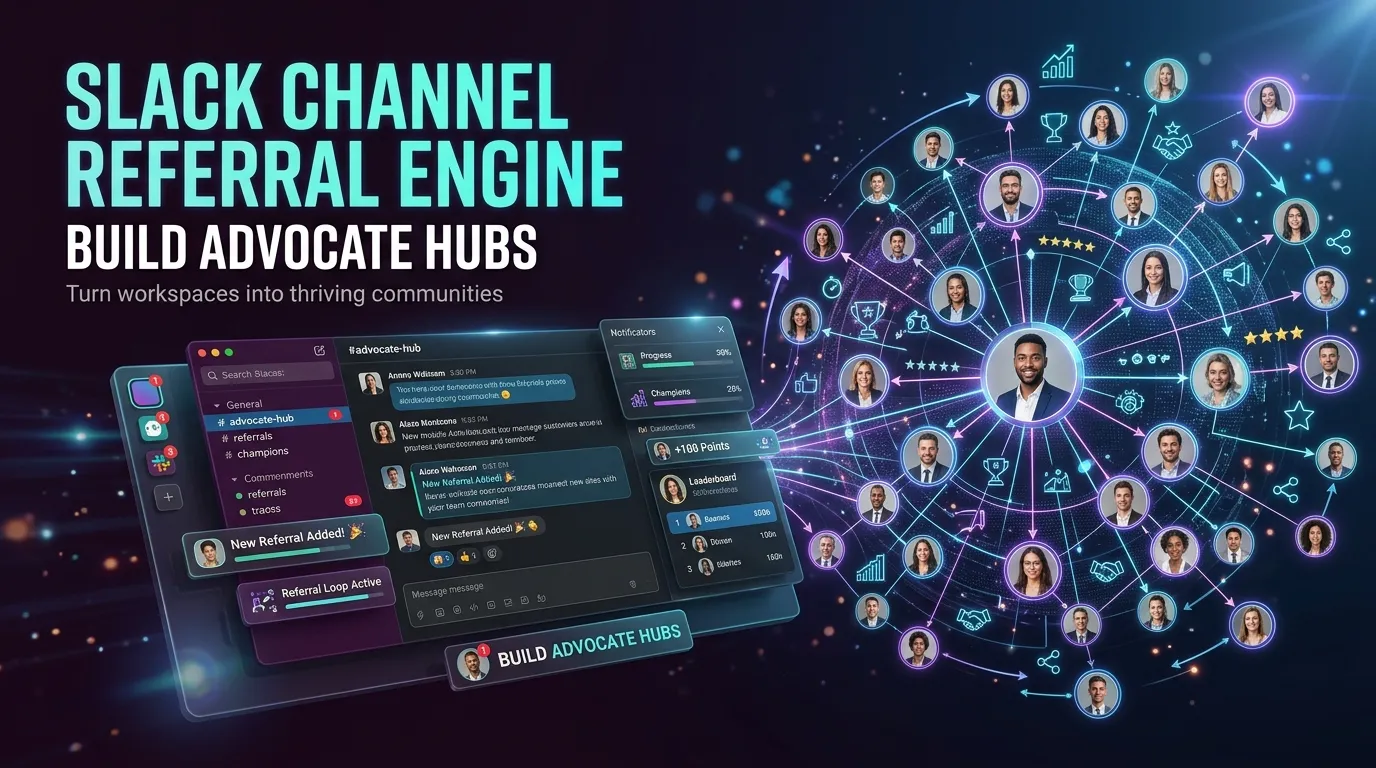
A Slack Channel Referral Engine turns satisfied users into organised advocates by combining focused communities, useful resources, referral workflows, transparent rewards, and measurable attribution across the customer journey.
Customer recommendations have always played an important role in business growth. People are more likely to consider a product or service when someone they trust shares a positive experience. However, many companies still treat referrals as occasional marketing activities rather than building an organised system around customer advocacy.
A satisfied customer might recommend a product during a conversation, share a useful link with a colleague, or mention a service within a professional community. These interactions can generate valuable opportunities, but without a structured process, businesses often struggle to identify where referrals originate, support their advocates, and measure the results.
This is where a Slack Channel Referral Engine becomes useful. Instead of relying entirely on occasional promotional messages, businesses can create dedicated Slack channels where customers, partners, employees, and community members receive resources, discuss experiences, access referral opportunities, and participate in an organised advocacy programme.
Slack provides a familiar communication environment for organisations and professional communities. Its channel-based structure makes it possible to separate discussions, share resources, coordinate activities, and introduce automated workflows. A business can use these capabilities to build an advocate hub that supports relationships beyond individual referral transactions.
Consider a SaaS company with 500 active customers. Some users regularly recommend its software because it saves time, simplifies daily work, or solves a specific business problem. The company may already receive referrals, but it has no consistent way to identify its strongest advocates or recognise their contributions.
By introducing a dedicated Slack community, the company can give those customers a place to exchange experiences, access approved resources, participate in product discussions, and learn about its referral programme.
The objective is not to turn every Slack conversation into a sales opportunity. It is to make recommending a useful product easier, more transparent, and more rewarding for people who genuinely believe in it.
A well-designed Slack Channel Referral Engine combines community building, customer experience, advocacy management, and referral attribution. The result is a repeatable growth system built around relationships rather than constant promotional activity.
What Is a Slack Channel Referral Engine?
A Slack Channel Referral Engine is a structured advocacy system that uses dedicated Slack channels, community participation, referral resources, automated processes, and external tracking tools to encourage and manage customer recommendations.
It turns Slack from a simple workplace messaging platform into a central coordination environment for an organised referral initiative.
The concept involves bringing the right people together, providing them with helpful information, making referral participation straightforward, and recognising meaningful contributions.
A Slack Channel Referral Engine generally includes five connected elements:
- Advocate community: A dedicated space for customers, employees, partners, or supporters.
- Referral resources: Approved messages, product information, demonstrations, and shareable links.
- Participation workflows: Processes that help advocates register, request resources, report referrals, and receive updates.
- Reward management: Recognition, incentives, and transparent eligibility rules.
- Performance tracking: Data showing referral activity, conversions, revenue, and advocate participation.
These elements should work together. A Slack channel without useful activities may become inactive, while a referral programme without reliable tracking can create disputes about attribution and rewards.
Slack Is the Community Layer, Not the Entire Referral Tracking System
One important distinction deserves attention: Slack does not automatically provide a complete referral-management platform.
Its channels, integrations, and Workflow Builder can support coordination and routine processes, but businesses generally need a referral platform, CRM, analytics system, or custom integration to generate unique referral links and calculate commissions or rewards.
The most effective architecture uses Slack for engagement and communication while dedicated systems handle attribution, customer records, eligibility, and financial calculations.
This distinction helps businesses avoid creating complicated manual processes that become difficult to maintain as participation grows.
Why Slack Is Suitable for Building Advocate Hubs
A referral community needs more than a collection of people with access to promotional links. It needs a place where members can understand the programme, exchange useful experiences, ask questions, and remain connected to the organisation.
Slack’s channel-based communication structure can support these requirements.
Organised Conversations Instead of Scattered Communication
In traditional referral programmes, businesses may communicate with advocates through emails, individual messages, spreadsheets, and separate campaign documents.
Important information becomes scattered across several systems. An advocate might receive an outdated promotional message or struggle to find the correct referral link.
Slack provides dedicated spaces for different activities. A company can organise onboarding, product education, referral announcements, community discussions, and recognition without placing everything in one conversation.
This creates a more predictable experience for participants.
Faster Access to Helpful Information
Advocates often need specific information before recommending a product.
They may ask about pricing, important features, integrations, product limitations, or suitable customer profiles.
A well-managed community allows these questions to be discussed in relevant channels. Approved resources can be pinned or shared where members can find them easily.
The goal is to reduce the effort required to make an informed recommendation.
Stronger Relationships Through Regular Participation
People participate more naturally when they feel that a community offers something valuable beyond promotional opportunities.
For example, a software company might invite its experienced customers to discuss productivity challenges, explore new features, and share practical workflows.
The company benefits from stronger relationships, while members receive opportunities to learn and exchange knowledge.
A Slack Channel Referral Engine becomes more sustainable when advocacy develops as a natural extension of community participation.
Understanding the Psychology Behind Customer Advocacy
People recommend products for different reasons. Financial incentives may influence their decisions, but they are rarely the only motivation.
Trust, identity, belonging, personal experience, professional reputation, and the desire to help others can all influence whether someone recommends a product.
A successful advocate hub should consider these motivations rather than treating every participant as someone waiting for a reward.
Trust Is More Valuable Than Promotional Pressure
People generally want to recommend products they can confidently stand behind.
If a company constantly encourages members to share promotional messages without providing meaningful product experiences, recommendations can begin to feel artificial.
Instead, give advocates opportunities to understand the product, ask difficult questions, and receive honest answers.
A transparent community is more likely to support credible recommendations.
Recognition Creates a Sense of Belonging
People appreciate having their contributions noticed.
An advocate who helps another member solve a problem, shares a useful implementation tip, or introduces a genuinely suitable customer is contributing value beyond a referral transaction.
Recognising these activities can strengthen participation.
Recognition might include a personal thank-you, a community spotlight, early product access, or invitations to exclusive discussions.
Reciprocity Encourages Natural Participation
When businesses provide useful resources, responsive support, and genuine opportunities to learn, members may become more willing to contribute in return.
This does not mean every helpful interaction should be followed by a referral request.
The relationship should provide value independently of whether someone generates a sale.
Autonomy Makes Advocacy Feel Authentic
Participants should have control over how and when they recommend a product.
Some people enjoy sharing professional experiences publicly. Others prefer introducing a product privately to colleagues.
A Slack Channel Referral Engine should support different participation styles without pressuring members to advertise constantly.
The more natural the activity feels, the more likely members are to remain involved over time.
Planning the Structure of Your Slack Advocate Hub
The structure of an advocate community influences how easily members understand where to participate.
A poorly organised workspace can create confusion, unnecessary notifications, and duplicated discussions. A clear channel architecture makes the community easier to navigate.
Create a Dedicated Advocate Workspace or Channel Group
Start by identifying whether the referral initiative needs a separate Slack workspace or a dedicated group of channels within an existing workspace.
A small internal employee advocacy programme may operate inside an existing company workspace.
A customer-facing programme may require a more carefully controlled environment where external members can participate without accessing confidential company discussions.
For collaboration with customers or partners from other organisations, Slack Connect may be relevant. Slack’s official documentation explains that Slack Connect channels can support collaboration between multiple organisations, with up to 250 organisations in a channel. Channel participation, paid-plan requirements, and administrative permissions should be checked before implementation.
Recommended Channel Architecture
A practical advocate hub might include the following channels:
| Channel | Purpose | Typical activity |
|---|---|---|
| #advocate-start-here | Member onboarding | Welcome messages and programme instructions |
| #referral-announcements | Official programme updates | New campaigns and eligibility information |
| #share-resources | Approved marketing material | Product guides and referral links |
| #success-stories | Recognition and learning | Customer wins and member achievements |
| #product-feedback | Customer insights | Questions, suggestions, and product discussions |
| #referral-help | Participant support | Troubleshooting and programme questions |
| #community-chat | General interaction | Networking and informal discussions |
Not every organisation needs all these channels.
A small community may operate successfully with three or four well-defined spaces. Additional channels should be created when there is a genuine need rather than simply to make the workspace appear larger.
Establish Channel Guidelines
Every channel should have a clear description explaining its purpose and expectations.
For example, the referral announcement channel should contain official information rather than unrelated conversations.
The success stories channel should encourage genuine experiences without allowing unverified customer claims.
Guidelines should explain whether self-promotion is permitted, how members can request assistance, and where they should report technical problems.
A Slack Channel Referral Engine benefits from simple rules that members can understand without reading a lengthy policy document.
Choosing the Right Advocates
A successful referral community does not necessarily need thousands of members.
It needs people who understand the product, have relevant relationships, and can make credible recommendations.
Identify Existing Customer Advocates
Start by examining customer behaviour.
Potential advocates may include:
- Customers who regularly provide positive feedback.
- Users who recommend the product voluntarily.
- Customers who participate in product discussions.
- Long-term users with strong product knowledge.
- Members who help other customers.
- Partners who work with the target audience.
These individuals already demonstrate some level of engagement.
Inviting them into an advocacy programme gives the company an opportunity to strengthen existing relationships instead of trying to manufacture interest.
Segment Advocates by Experience
Not every member has the same knowledge or influence.
A new customer may be comfortable sharing a basic product recommendation but unable to explain advanced implementation.
An experienced customer may be able to discuss integrations, workflows, and business outcomes in greater detail.
Consider creating segments such as:
| Advocate segment | Characteristics | Recommended support |
|---|---|---|
| New advocates | Recently joined the programme | Basic resources and onboarding |
| Active advocates | Regularly share referrals | Campaign support and recognition |
| Expert advocates | Strong product knowledge | Advanced discussions and case studies |
| Community leaders | Help other members | Leadership opportunities |
| Strategic partners | Reach relevant business audiences | Co-marketing resources |
Segmentation helps businesses provide relevant resources without overwhelming every participant with the same information.
Build an Application or Invitation Process
An advocate programme should have reasonable entry requirements.
A short application or invitation process can establish whether participants understand the product and agree with the programme’s expectations.
Ask for information that is genuinely necessary. Avoid collecting sensitive personal details simply because a form allows it.
The strongest communities are built around shared interests and relevant participation, not arbitrary membership numbers.
Designing a Referral Journey Inside Slack
An advocate should understand what to do from the moment they receive an invitation.
Confusing instructions create unnecessary friction and reduce participation.
A straightforward referral journey makes the programme easier to adopt.
Stage One: Welcome and Orientation
New members should receive a clear welcome message explaining:
- What the advocacy programme does.
- Who is eligible to participate.
- How referrals work.
- Where referral resources are available.
- How rewards are calculated.
- Which activities are not permitted.
- Where to request support.
The welcome experience should answer essential questions before asking members to promote anything.
Stage Two: Product Education
Provide relevant information about the product and the customers it serves.
This might include demonstrations, comparison resources, customer stories, implementation guides, and answers to common questions.
Advocates should understand who benefits most from the product and where it may not be suitable.
Honest education protects their credibility.
Stage Three: Referral Activation
Once members understand the programme, show them how to generate or access their referral links.
A referral platform can generate unique tracking URLs associated with each advocate.
The link should direct prospects to a relevant landing page, product trial, consultation form, or registration process.
Avoid forcing advocates to search through old messages for the correct promotional materials.
Stage Four: Referral Progress Updates
Members should know whether a referral has been received, is being reviewed, has converted, or is eligible for a reward.
Share only the information that participants are authorised to see.
For example, a community message could confirm that a referral was successfully attributed without exposing another person’s private account details.
Stage Five: Recognition and Continued Engagement
After a successful referral, acknowledge the contribution according to the programme’s rules.
The company can highlight meaningful achievements and invite members to share lessons from their experiences.
A Slack Channel Referral Engine works better when the customer journey continues after the initial conversion.
Using Slack Workflow Builder to Automate Referral Activities
Manual administration becomes increasingly difficult as an advocate community grows.
Employees may need to send welcome messages, collect referral information, answer recurring questions, distribute resources, and update internal teams.
Slack’s Workflow Builder offers tools for automating routine processes within Slack. Workspace administrators can manage access and permissions, and the available capabilities depend on the organisation’s plan and configuration.
A workflow can reduce repetitive tasks while keeping the experience familiar for members.
Create an Advocate Onboarding Workflow
An onboarding workflow can guide new members through a standard introduction.
For example:
- A new member joins the relevant channel.
- The member receives a welcome instruction.
- A workflow presents essential programme information.
- The member completes an approved registration form.
- The responsible team receives a notification.
- The advocate receives access to the appropriate resources.
The process should remain simple. Too many required fields can discourage participation.
Automate Referral Submissions
Members may need a clear way to report a referral or ask for help with an existing referral.
A workflow can collect basic details and pass them to an external referral platform or CRM through an approved integration.
The tracking system should remain the source of truth for attribution and reward calculations.
Slack should not become an unofficial database containing unnecessary customer information.
Automate Recognition Messages
When a referral platform confirms a qualifying conversion, an integration could notify an appropriate channel.
For example, the system might announce that a member has achieved a milestone.
The message should respect the advocate’s preferences and avoid revealing sensitive customer or commercial information.
Feature Important Workflows
Slack also supports featuring frequently used workflows in the Workflows tab of channels and direct messages. This can help members access an onboarding process, request form, or other routine action without searching through old conversations.
See Slack’s official guidance on managing workflows in channels and DMs.
Building a Reliable Referral Tracking and Attribution System
Community participation is not the same as a successful referral.
A member may share a link several times without generating a qualified lead. Another member may introduce a customer through a private conversation without using a tracking link.
A reliable system needs clear definitions and consistent attribution rules.
Generate Unique Referral Links
Every advocate should receive a unique referral identifier or tracking link.
The referral platform can associate the link with the relevant participant and record the resulting customer journey.
A typical link might contain a unique campaign identifier and advocate reference.
The structure should avoid exposing sensitive personal information.
Define What Counts as a Successful Referral
A company must decide which actions qualify for recognition or rewards.
Possible milestones include:
- A completed registration.
- An eligible free trial.
- A qualified sales enquiry.
- A completed purchase.
- A paid subscription.
- A retained customer after a defined period.
These milestones serve different business objectives.
For a SaaS company, rewarding only registrations may encourage low-quality sign-ups. Rewarding qualified paid customers may better reflect commercial value.
Establish Attribution Rules
Attribution becomes complicated when prospects interact with multiple channels.
A customer might discover the company through an advertisement, attend a webinar, receive a recommendation from an advocate, and later purchase through the website.
The programme should define how referral credit is assigned.
Consider the following questions:
- Does the first qualifying referral receive credit?
- Can a referral replace an earlier attribution?
- What happens when multiple advocates refer the same person?
- Is there an attribution window?
- How are returning customers treated?
- How are duplicate accounts identified?
The answers should be documented before launching the programme.
Connect Slack with Your CRM
A CRM helps manage leads, customer records, sales activity, and conversion stages.
Integrating the CRM with the advocacy system can provide a clearer picture of referral performance.
For example, a referral form submission could create or update a CRM record. A later conversion could trigger an internal Slack notification.
Only authorised users should receive access to relevant customer information.
Keep the Referral Database Accurate
Maintain consistent records for advocate identifiers, referral links, programme eligibility, conversion status, and reward history.
Without accurate records, the business may accidentally duplicate rewards or credit conversions to the wrong advocate.
A Slack Channel Referral Engine should provide convenient communication while leaving critical attribution calculations to a properly maintained tracking system.
Creating Referral Resources Advocates Actually Want to Share
People are more likely to recommend a product when they have something useful to explain.
A generic promotional message often requires the advocate to rewrite it before sharing. Many people simply abandon the process.
Good resources reduce that effort.
Develop a Shareable Resource Library
Create a central resource collection containing:
- Product introduction pages.
- Short demonstration videos.
- Case studies.
- Product comparison guides.
- Frequently asked questions.
- Feature explanations.
- Approved referral messages.
- Relevant social media graphics.
- Trial or consultation links.
Every asset should have a clear purpose and current information.
Offer Multiple Message Formats
Different advocates communicate in different ways.
Some prefer a brief professional introduction. Others may want to share a personal experience or explain a specific product benefit.
Prepare adaptable examples rather than forcing every participant to use identical promotional language.
For instance:
Professional introduction:
“I have been using this platform to simplify parts of our workflow. It may be worth exploring if your team is dealing with similar challenges.”
Experience-led recommendation:
“What I found most useful was how the platform organised our daily process. I thought it might be relevant to your team as well.”
These examples should remain honest and reflect genuine experiences.
Focus on Customer Problems
The best referral material explains why a product may be useful.
A product feature by itself may not persuade a prospective customer.
Instead of promoting an automated reporting feature, explain how it can reduce repetitive work and help a team understand performance.
This makes the recommendation more relevant to the recipient’s needs.
Designing Rewards That Encourage Long-Term Advocacy
Rewards can motivate people to participate, but the structure needs to be carefully designed.
An incentive that is too small may not attract attention. An overly aggressive reward can encourage spam, low-quality referrals, and dishonest behaviour.
The objective is to reward genuine value without making recommendations feel forced.
Financial Rewards
Common financial incentives include:
- Account credits.
- Discounts.
- Commission payments.
- Gift cards.
- Subscription benefits.
- Cash rewards where legally and contractually appropriate.
The rules should clearly explain eligibility, payment timing, cancellation conditions, and any restrictions.
Non-Financial Recognition
Not every meaningful contribution needs a cash incentive.
Community recognition can help advocates feel appreciated.
Examples include:
- Member spotlights.
- Exclusive product demonstrations.
- Early feature access.
- Invitations to private events.
- Expert discussion opportunities.
- Community leadership roles.
These benefits can make the programme more valuable to people who enjoy professional networking or product involvement.
Avoid Reward Structures That Encourage Low-Quality Activity
A referral programme that rewards every registration may attract fake accounts or people who have no genuine interest in the product.
Consider rewarding outcomes that reflect real business value.
For example, a company could recognise qualified paid subscriptions rather than raw sign-up numbers.
Publish Transparent Programme Rules
Members should know exactly what they are agreeing to.
Explain whether rewards are available, when they become payable, what makes a referral valid, and which activities are prohibited.
A well-managed Slack Channel Referral Engine relies on confidence in the rules as much as enthusiasm for the rewards.
Keeping Your Advocate Community Active
Launching an advocate hub is only the beginning.
Communities often experience an initial increase in activity followed by declining participation. This can happen when members receive few meaningful updates or feel that the space exists only to promote products.
Consistent value is necessary to maintain interest.
Establish a Predictable Communication Rhythm
A simple weekly schedule might include:
| Day | Activity | Purpose |
|---|---|---|
| Monday | Product or industry insight | Provide useful information |
| Tuesday | Advocate discussion | Encourage member participation |
| Wednesday | Referral resource spotlight | Support recommendations |
| Thursday | Member success story | Recognise contributions |
| Friday | Questions and feedback | Identify issues and opportunities |
The schedule should match the size and interests of the community.
Too many announcements can create notification fatigue, while long periods without meaningful interaction may make the community feel abandoned.
Introduce Community Challenges
Short challenges can encourage participation without making every activity sales-focused.
For example:
- Share one workflow improvement.
- Explain a useful product feature.
- Describe a customer problem the product helps solve.
- Contribute a practical implementation tip.
- Participate in a product feedback discussion.
Challenges should reward useful contributions rather than the number of promotional messages posted.
Celebrate Real Success Stories
Success stories help members see how others use the product.
A company could share a customer’s experience of reducing repetitive work or improving collaboration.
Always obtain appropriate permission before publishing identifiable customer stories.
Do not exaggerate outcomes or turn an individual experience into a guaranteed result for everyone.
Collect Advocate Feedback
An active community should also create opportunities for members to influence the programme.
Ask what resources are missing, which referral steps are confusing, and what would make participation easier.
This can help identify operational weaknesses before members lose interest.
Connecting Slack Referral Activities with Your Wider Marketing Strategy
A Slack advocate hub should not operate independently from the rest of the marketing operation.
It can complement organic search, paid advertising, email campaigns, partnerships, social media, and customer education.
The key is to ensure that each channel supports a consistent customer experience.
Combine Advocate Activity with Paid Acquisition
Paid advertising can introduce a brand to new audiences, while advocates provide personal experiences and recommendations.
For example, a business might use Microsoft Advertising to reach relevant search audiences and use its advocate community to support word-of-mouth discovery.
These activities serve different functions.
Advertising creates visibility and helps attract prospects. Advocacy can add context, social proof, and trusted recommendations.
Use Campaign Data to Improve Acquisition
Performance marketing data may reveal which audience segments respond to particular messages.
A business using Performance Max in Google Ads can analyse campaign performance across Google’s eligible advertising inventory.
The insights can help identify useful customer segments and messaging themes that deserve further investigation.
However, an automated advertising campaign should not be confused with referral attribution. The advocate programme still needs its own reliable tracking rules and conversion records.
Connect Referrals Across Customer Touchpoints
A prospect may encounter a brand through a website, advertisement, professional event, social media post, or recommendation from a friend.
A coordinated Omnichannel Referral Funnel can help businesses maintain consistent referral experiences across relevant touchpoints.
Slack can act as an internal coordination centre where advocates receive resources and programme updates.
The broader journey should remain consistent, regardless of where the customer first discovers the product.
Build a Wider Technology Referral Ecosystem
Technology companies often have multiple communities that can support growth.
These might include implementation partners, consultants, software developers, customers, integration specialists, and industry educators.
A structured Tech Referral Program can help coordinate these different referral relationships while maintaining clear eligibility and attribution rules.
Slack can support communication among the participants, but the commercial programme should still have a clearly documented operating structure.
Measuring the Performance of Your Slack Advocate Hub
The number of people inside a Slack workspace is not a reliable measure of referral success.
A community with 100 engaged advocates who consistently introduce qualified customers may generate greater business value than a workspace containing 2,000 inactive members.
Measurement should focus on meaningful participation and business outcomes.
Community Engagement Metrics
Monitor:
- Total approved advocates.
- Monthly active advocates.
- Channel participation.
- Workflow completion rates.
- Resource downloads.
- Questions and discussions.
- Member retention.
- Feedback submissions.
These indicators help explain whether the community is providing ongoing value.
Referral Performance Metrics
Referral measurements should include:
| Metric | Meaning |
|---|---|
| Referral clicks | Number of visits generated through referral links |
| Referral registrations | Number of attributable registrations |
| Qualified referrals | Referrals meeting programme criteria |
| Conversion rate | Percentage of referrals that convert |
| Revenue per advocate | Revenue attributable to an advocate |
| Reward cost | Total incentive expenditure |
| Referral fraud rate | Share of identified invalid activity |
| Customer retention | Continued customer activity after conversion |
Calculate Referral Conversion Rate
A simple referral conversion formula is:
Referral Conversion Rate = (Number of Converted Referrals ÷ Total Qualified Referral Visits) × 100
For example, if a programme generates 400 qualified referral visits and 40 become customers:
Referral conversion rate = (40 ÷ 400) × 100 = 10%.
This figure provides a useful starting point, but it should be compared with the conversion rate of other acquisition channels and evaluated over a sufficient period.
Calculate Advocate Programme ROI
A basic return-on-investment calculation is:
ROI = ((Attributable Revenue − Programme Costs) ÷ Programme Costs) × 100
Programme costs may include incentives, software subscriptions, administration, content production, and operational expenses.
Revenue should be measured using a consistent attribution model.
For subscription businesses, it may also be useful to examine gross profit, customer lifetime value, and retention rather than relying entirely on initial sales revenue.
Measure Advocate Quality
Not all advocates contribute in the same way.
Some generate numerous low-quality visits, while others refer a smaller number of highly relevant customers.
Compare advocates through qualified leads, conversion quality, retention, and attributable revenue.
This helps the business recognise valuable contributions without encouraging aggressive promotion.
Preventing Spam, Fraud, and Low-Quality Referrals
A referral programme should protect the trust that makes word-of-mouth marketing valuable.
Without appropriate safeguards, members may repeatedly post links, create fake registrations, or attempt to manipulate reward eligibility.
A community with poor moderation can quickly become frustrating for genuine participants.
Set Clear Promotion Rules
Explain where referral links may be shared and what types of promotional activity are allowed.
For example, members may be encouraged to recommend a product when it is genuinely relevant to a conversation, but prohibited from repeatedly posting promotional content in unrelated discussions.
Detect Duplicate and Self-Referrals
Tracking systems should check for duplicate registrations, suspicious activity patterns, and attempts to claim rewards through self-referrals where prohibited by programme rules.
The business should define its fraud criteria in advance.
Automated detection can flag suspicious activity, but important decisions should have an appropriate review process.
Monitor Link Abuse
Track abnormal referral activity, including sudden spikes in low-quality visits or repeated conversions associated with suspicious patterns.
Rate limits and campaign controls can reduce abuse.
Never make referral rewards entirely dependent on a single unverified event.
Maintain Professional Moderation
Moderators should handle spam, disputes, and inappropriate promotional activity consistently.
A member who makes an honest mistake should receive clear guidance rather than immediate public criticism.
The community should remain a place where participants feel comfortable asking questions and sharing experiences.
Privacy, Transparency, and Referral Programme Compliance
Businesses that collect customer information or encourage people to refer others should consider applicable privacy and marketing regulations.
This is particularly important for organisations operating in the UK.
The Information Commissioner’s Office explains that the Privacy and Electronic Communications Regulations (PECR) apply to organisations that send or instigate the sending of direct marketing by electronic mail.
Its guidance also specifically discusses refer-a-friend activity. Encouraging people to forward marketing emails or texts can make the organisation responsible for instigating those communications.
Collect Only Necessary Information
A referral process should collect only the information needed to identify the advocate, record the referral, and administer the programme.
Avoid exposing personal contact information in public channels.
Use the referral platform or CRM to manage private records and restrict access to authorised employees.
Be Transparent About Incentives
Advocates should understand when they receive a reward and whether their relationship with the company should be disclosed when making a recommendation.
A paid or incentivised endorsement should not be presented in a way that misleads its audience.
Provide clear guidance on the applicable advertising disclosure expectations for the markets where the programme operates.
Obtain Appropriate Consent
Do not automatically message a referred person’s email address or phone number merely because an advocate provides it.
Check the legal basis and relevant marketing rules before sending promotional communications.
The ICO’s guidance on electronic mail marketing explains the applicable requirements, including consent and refer-a-friend situations.
A well-designed Slack Channel Referral Engine should encourage responsible recommendations rather than uncontrolled distribution of marketing messages.
A Practical 90-Day Plan to Launch Your Slack Referral Engine
A structured launch allows businesses to establish their advocate community, test the referral process, and make improvements before expanding participation.
Days 1–30: Strategy and Foundation
The first month should focus on planning.
Identify suitable advocates, define the programme’s objectives, select referral software, and establish the Slack channel structure.
Create programme rules covering eligibility, attribution, rewards, communication, and moderation.
Prepare the resources required for onboarding.
Expected deliverables:
- Referral programme objectives.
- Advocate selection criteria.
- Slack workspace or channel structure.
- Programme guidelines.
- Referral tracking configuration.
- Initial resource library.
- Privacy and compliance review.
The objective is to make sure the system works before inviting a large group of participants.
Days 31–60: Pilot and Community Activation
Invite a small group of existing customers, employees, or partners.
Give them access to the onboarding resources and demonstrate how referral links work.
Observe their questions and identify areas where the experience is confusing.
Test the connection between Slack, the referral platform, and the CRM.
Collect feedback about the available rewards and communication experience.
Expected deliverables:
- Active pilot advocate group.
- Tested onboarding workflow.
- Verified referral links.
- Initial referral submissions.
- Support and moderation procedures.
- First performance review.
A successful pilot should demonstrate that participants can understand the programme and complete the referral process without unnecessary assistance.
Days 61–90: Improve and Scale
Use the pilot results to refine the programme.
Improve unclear instructions, update outdated resources, and adjust workflows where manual administration is causing delays.
Invite additional qualified advocates once the system is stable.
Introduce a regular community schedule and establish monthly reporting.
Expected deliverables:
- Expanded advocate membership.
- Improved referral resources.
- Consistent engagement schedule.
- Referral conversion dashboard.
- Reward administration process.
- Quarterly optimisation priorities.
After the initial 90 days, review the programme against its commercial objectives rather than expanding membership simply to increase community size.
Common Mistakes When Building a Slack Advocate Hub
Even a well-funded referral programme can struggle when its community structure does not support genuine participation.
Treating Slack as a Promotional Broadcast Channel
Sending promotional messages every day can reduce engagement.
Members may begin ignoring announcements or leave the community entirely.
Use Slack to encourage useful conversations, answer questions, share relevant insights, and provide occasional referral opportunities.
Inviting Too Many Members Too Early
A large launch may appear impressive, but it can create moderation and onboarding problems.
Start with a smaller group that has demonstrated genuine interest in the product.
Improve the experience before expanding the programme.
Using Too Many Channels
Creating separate channels for every minor activity can fragment discussion.
Members may not know where to ask questions or find relevant information.
Use clear channel purposes and consolidate conversations when appropriate.
Offering Unclear Rewards
Ambiguous reward conditions can create disappointment and disputes.
Explain exactly what qualifies, when rewards are issued, and how attribution is determined.
Ignoring Feedback
Advocates often have valuable insights about product usability, customer objections, and market expectations.
Ignoring their contributions weakens the relationship and reduces the programme’s long-term value.
Measuring Membership Instead of Results
A large community is not automatically a successful community.
Focus on active participation, qualified referrals, conversions, customer retention, and programme profitability.
How to Scale a Slack Referral Community Without Losing Quality
Once the initial programme becomes established, expansion should focus on increasing the number of meaningful relationships rather than simply growing membership.
Introduce Community Leaders
Experienced advocates can help new members understand the programme, share product knowledge, and maintain healthy discussions.
Give community leaders clear responsibilities and access to the resources they need.
Do not assume that a popular member automatically has the skills or availability to moderate an entire community.
Create Specialised Advocate Groups
Some organisations may benefit from different advocate groups based on industry, customer type, location, or expertise.
For example, a SaaS company might organise separate discussions for agency partners, ecommerce businesses, and technology consultants.
This can make conversations more relevant while allowing members to exchange knowledge with people facing similar challenges.
Expand Through Strategic Partnerships
Businesses can invite suitable partners into selected discussions where there is a genuine shared objective.
Slack Connect may provide a useful collaboration option, subject to plan availability, invitation controls, and the policies of the participating organisations.
Partnerships should be based on clear responsibilities and appropriate information-sharing boundaries.
Use Feedback to Improve the Product
An advocate hub can become a valuable source of customer insight.
Repeated questions may reveal gaps in documentation, while recurring complaints may indicate a product or onboarding issue.
Share relevant feedback with the teams responsible for improving the customer experience.
The best communities create benefits for both the business and their members.
Conclusion
A successful Slack referral community is built around relationships, trust, and useful participation rather than constant promotion. Give advocates clear channels, practical resources, simple referral processes, transparent rewards, and opportunities to contribute. Connect Slack with dedicated tracking systems so that every meaningful referral can be measured accurately. Start with a focused group, learn from real interactions, and expand only when the programme delivers genuine value. Most importantly, protect the authenticity of recommendations by respecting member choice, customer privacy, and programme transparency. When community engagement and referral operations work together, advocates can become a sustainable source of qualified business growth.
Frequently Asked Questions (FAQ)
What is a Slack Channel Referral Engine?
A Slack Channel Referral Engine is an organised advocacy system that uses dedicated Slack channels to connect advocates, distribute referral resources, coordinate activities, and support referrals. It usually combines Slack with external referral tracking software or a CRM to manage attribution, conversions, and rewards.
Can Slack automatically track customer referrals?
Slack does not provide a complete native referral attribution system for every business requirement. However, Workflow Builder, apps, and integrations can support referral submissions and notifications. Dedicated referral software or a CRM should manage unique links, conversion records, and reward calculations.
How many channels should an advocate community have?
There is no fixed number. A small programme may need only onboarding, referral resources, and general discussion channels. Larger communities may require separate spaces for product feedback, announcements, support, and recognition. Each channel should have a clear purpose.
Who should be invited to a Slack advocate community?
Suitable participants include satisfied customers, active users, experienced product advocates, implementation partners, employees, and community leaders. Prioritise genuine product experience and relevant audience relationships instead of selecting members only because they have large social media followings.
How can I encourage advocates to share referral links?
Provide relevant resources, clear explanations, straightforward tracking links, and transparent rewards. Make recommendations easy without applying pressure. People are more likely to participate when they trust the product and have useful experiences they can confidently share.
Can Slack Workflow Builder automate referral activities?
Yes. Slack Workflow Builder can automate routine processes such as onboarding, collecting information, and directing requests. With suitable integrations, referral activity can also trigger notifications or updates in external systems. Available capabilities depend on workspace permissions, plan, and configuration.
What is the best way to measure referral performance?
Track referral clicks, qualified leads, registrations, conversion rates, attributable revenue, reward costs, and customer retention. Also monitor active advocate participation and programme engagement. A combination of community and commercial metrics provides a more complete performance picture.
Are Slack referral programmes suitable for small businesses?
Yes. Smaller businesses can begin with a simple advocate channel, a few satisfied customers, unique tracking links, and a straightforward reward policy. They can introduce automation and additional channels as participation and administration requirements increase.
How can businesses prevent referral spam?
Establish clear promotion rules, define valid referral criteria, identify duplicate or suspicious registrations, and monitor unusual activity. Reward genuine customer outcomes rather than indiscriminate link sharing. Use consistent moderation and an appropriate review process for disputed referrals.
How long does it take to build a successful Slack referral programme?
The initial structure can be established within a few weeks, but developing a consistently active advocate community takes longer. A 90-day pilot provides a practical starting framework for testing onboarding, referral tracking, engagement, and rewards before expanding the programme.