
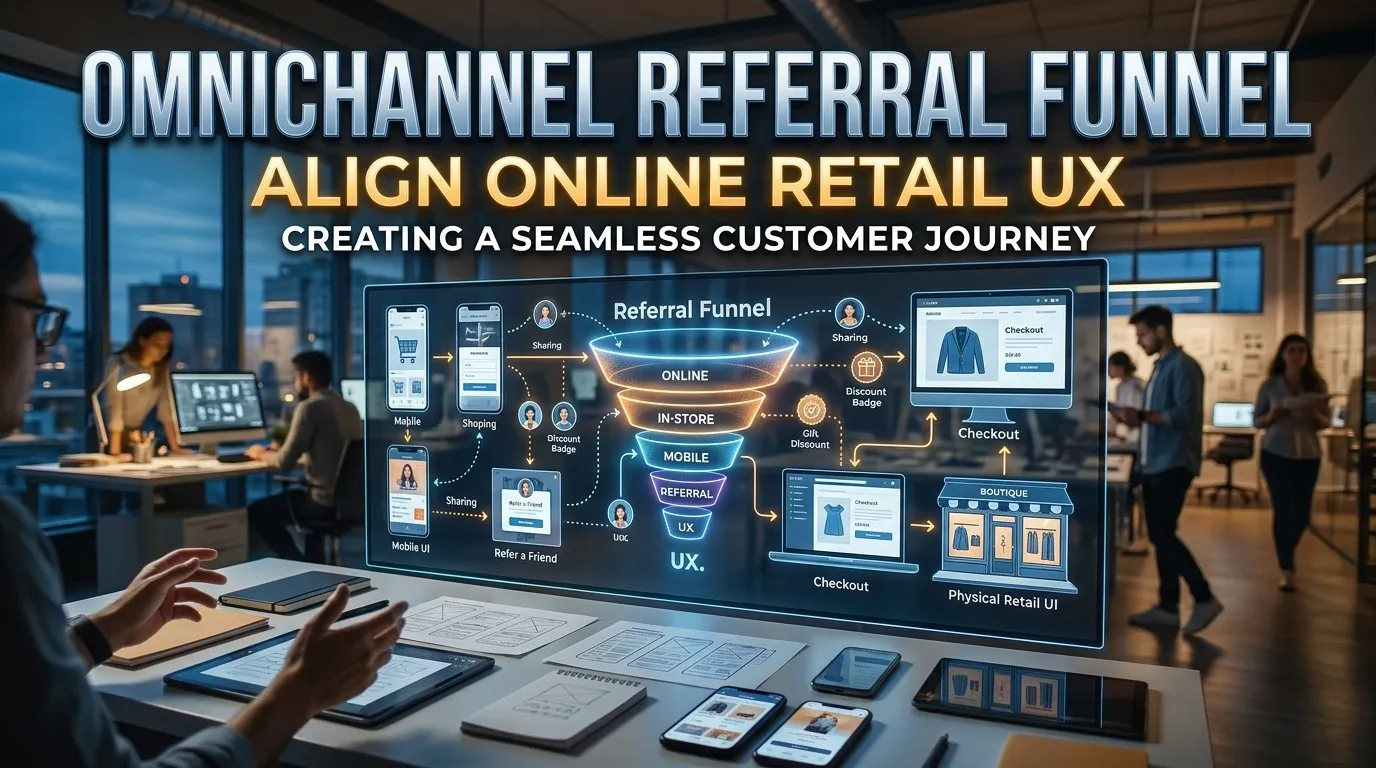
An Omnichannel Referral Funnel connects product discovery, personal recommendations, shopping, and repeat buying across retail touchpoints, reducing friction while creating a consistent experience for advocates and new customers.
Modern shoppers rarely follow a perfectly straight path from discovering a product to completing a purchase. Someone might see a product in a social media video, visit an online store, compare prices on a mobile device, ask a friend for an opinion, and eventually complete the purchase through a desktop website. After receiving the product, that same customer might recommend it through a messaging application or share a discount with someone they know.
This changing behaviour creates a challenge for retailers. Being present on multiple platforms is no longer enough. Customers expect the shopping experience to remain consistent when they move between devices, websites, applications, social platforms, and physical stores. The same expectation applies when a purchase begins through a personal recommendation.
An Omnichannel Referral Funnel connects these interactions into one coordinated customer journey. Instead of treating referral marketing, ecommerce, social media, email, and customer retention as separate activities, businesses organise them around a shared customer experience.
Consider a simple example. An existing customer recommends a clothing brand to a friend. The friend opens the referral link on a smartphone, explores the recommended product, checks the available sizes, and adds an item to the cart. However, they do not complete the purchase immediately. Later, they visit the retailer’s website through a laptop and finish checkout.
A disconnected system might lose the referral attribution, remove the promotional offer, or require the customer to start shopping again. A connected experience should preserve the relevant information and make the transition as straightforward as possible.
The opportunity goes beyond generating additional orders. Retailers can create stronger customer relationships, reduce acquisition friction, improve repeat purchasing, and encourage satisfied buyers to recommend the business to others.
To achieve these outcomes, an Omnichannel Referral Funnel must connect the referral mechanism with product discovery, shopping experience, checkout, fulfilment, customer support, and post-purchase engagement.
This guide explores how online retailers can design that experience, connect different channels, create effective referral incentives, measure results, and build a sustainable referral growth strategy.
Understanding the Omnichannel Referral Funnel
An Omnichannel Referral Funnel is a coordinated marketing and shopping journey through which an existing customer recommends a retailer or product, allowing a new customer to discover, evaluate, purchase, and engage through connected channels.
The concept combines two important business strategies: omnichannel retail and referral marketing.
Omnichannel retail focuses on creating a consistent experience across customer touchpoints. Referral marketing uses existing customer relationships to introduce a business to potential buyers.
An Omnichannel Referral Funnel brings these strategies together. It ensures that a recommendation does not lose its value when the recipient moves between channels.
For example, an existing customer might share a product through WhatsApp. The recipient opens the link through a mobile browser, reads the product description, and decides to purchase later using a desktop computer.
The referral journey should make it possible to preserve the relevant promotion, product destination, and attribution information without unnecessarily complicating the customer’s experience.
The objective is not to force customers to use one specific platform. It is to make different platforms work together.
Multichannel Versus Omnichannel Referral Marketing
Although the terms multichannel and omnichannel are frequently used together, they describe different approaches.
Multichannel marketing means that a retailer communicates with customers through multiple channels. These might include a website, mobile application, social media, email, and physical stores.
Omnichannel marketing goes further by connecting those channels and coordinating the customer experience.
| Area | Multichannel approach | Omnichannel approach |
|---|---|---|
| Customer experience | Different experiences across platforms | Consistent connected experience |
| Referral attribution | May be separated by channel | Coordinated journey-level tracking |
| Promotions | May have different conditions | Consistent offer rules |
| Shopping cart | May restart on another device | Context can be preserved |
| Product information | May differ between channels | Core information stays aligned |
| Customer support | Limited interaction history | Relevant customer context is available |
| Measurement | Separate channel reports | Connected customer journey analysis |
An Omnichannel Referral Funnel does not require every channel to offer identical functionality. A mobile application may support features that a website does not, while a physical store may provide services that are unavailable online.
The important consideration is that customers should understand what is available and should not encounter conflicting information when moving between touchpoints.
The Main Stages of an Omnichannel Referral Journey
A connected referral journey normally includes several stages.
Customer experience: An existing customer purchases a product and develops an opinion about the retailer.
Referral invitation: The business provides an optional opportunity to recommend the product or service.
Sharing: The customer shares a referral link, code, or recommendation.
Discovery: A potential buyer opens the referral and learns about the recommended product.
Consideration: The recipient evaluates price, quality, features, delivery, and other purchase requirements.
Conversion: The customer completes the qualifying purchase or action.
Fulfilment: The retailer delivers the order and provides appropriate support.
Retention: The new customer receives useful communication and develops a relationship with the business.
Advocacy: A satisfied customer may eventually recommend the retailer to another person.
An Omnichannel Referral Funnel connects these stages while allowing customers to move between channels naturally.
Why Referral Marketing and Online Retail UX Must Work Together

Referral marketing generates interest through personal recommendations. However, the quality of the shopping experience determines whether that interest becomes a successful purchase.
A customer may trust a friend’s recommendation, but that does not mean they will ignore confusing prices, unclear product information, poor website navigation, or unexpected checkout conditions.
The referral introduces the opportunity. The user experience must make the opportunity easy to evaluate.
Personal Recommendations Create an Initial Trust Advantage
Traditional advertisements compete for attention. A personal recommendation begins with an existing relationship.
Someone recommending a skincare product to a friend may already understand that person’s preferences. A customer suggesting a particular laptop might know the recipient’s budget and technical requirements.
This context gives recommendations personal relevance.
An Omnichannel Referral Funnel should preserve that relevance by sending recipients to an experience that matches the recommendation.
For instance, sharing a specific product should lead to that product rather than a generic homepage. Sharing a seasonal collection should lead to the relevant collection with accurate availability and pricing.
The recipient should immediately recognise the reason they opened the link.
Poor UX Can Destroy Referral Momentum
Imagine receiving a recommendation for a product with a special introductory discount. You open the link and discover that the landing page does not mention the discount. After navigating through several pages, you finally locate the product, but the promotional code does not work.
Even if you originally trusted the person who shared the link, the shopping experience creates doubt.
Common problems include:
- Referral links opening irrelevant pages.
- Promotional codes disappearing during navigation.
- Different prices appearing across channels.
- Complicated registration requirements.
- Slow mobile loading.
- Unclear delivery and return policies.
- Checkout forms requesting unnecessary information.
- Customer support being unable to recognise the referral.
The purpose of an Omnichannel Referral Funnel is to eliminate these unnecessary obstacles.
Referred Customers Still Need Information
Another mistake is assuming that referred visitors are ready to purchase immediately.
A personal recommendation provides an initial reason to investigate, but customers may still need answers.
They may want to understand product compatibility, compare different models, check delivery times, examine customer reviews, or confirm whether a particular discount applies.
Retailers should design the experience around these questions.
An effective referral landing page provides enough information to support an independent decision rather than relying entirely on the advocate’s recommendation.
Map the Customer Journey Before Building the Funnel
Technology should support customer behaviour rather than dictate it.
Before choosing a referral application or changing the ecommerce platform, businesses should understand how people discover products, share recommendations, and move towards purchasing decisions.
An Omnichannel Referral Funnel begins with journey mapping.
Identify the Advocate Journey
The advocate is the existing customer who recommends the business.
Start by identifying when customers have experienced enough value to make a recommendation meaningful.
For a clothing retailer, this might happen after successful delivery. For a subscription business, it could be after the customer has used the service for several weeks.
For a furniture retailer, it may occur after delivery and installation.
The invitation should appear at a reasonable moment rather than interrupting an important customer interaction.
Identify the Referred Customer Journey
Next, map the journey of the person receiving the recommendation.
Understand where they are likely to discover the referral, which device they use, what information they need, and how they may complete the purchase.
An Omnichannel Referral Funnel should account for different situations.
For example:
| Customer action | Possible friction | Recommended improvement |
|---|---|---|
| Opens a referral link | Incorrect destination | Use relevant deep links |
| Browses on mobile | Difficult navigation | Improve mobile UX |
| Saves a product | Lost shopping context | Support account-based saved items |
| Changes devices | Referral attribution disappears | Use suitable attribution methods |
| Visits a store | Staff cannot validate offer | Integrate POS processes |
| Completes purchase | Discount is rejected | Align promotional rules |
| Requests support | Referral cannot be identified | Provide support visibility |
Mapping these interactions helps businesses understand where the experience breaks down.
Identify the Most Important Customer Touchpoints
Not every retailer needs an application, physical store integration, or complicated loyalty infrastructure.
The appropriate channels depend on the business model.
An online clothing retailer might prioritise mobile web, social sharing, email, and desktop checkout.
A beauty brand may place additional importance on creators, visual platforms, product reviews, and repeat purchasing.
An electronics retailer may need detailed product comparison tools, live assistance, store availability, and technical support.
The Omnichannel Referral Funnel should be built around the channels customers actually use rather than an unnecessarily large technology stack.
Design a Referral Experience That Encourages Sharing
The referral invitation is an important moment because it determines whether an existing customer becomes an advocate.
A good programme makes recommending the business feel natural, convenient, and optional.
Customers should understand the value of participating without feeling pressured to promote every purchase.
Choose the Right Time to Request Referrals
Timing can influence how customers respond.
An invitation sent immediately after payment may arrive before the customer has experienced the product. Conversely, waiting too long may mean the purchasing experience is no longer memorable.
Consider sending invitations after:
- Successful product delivery.
- Completion of an onboarding process.
- A positive customer service interaction.
- A repeat purchase.
- Completion of a service.
- A meaningful loyalty milestone.
Avoid automated invitations immediately after an unresolved complaint or negative customer interaction.
An Omnichannel Referral Funnel should consider customer satisfaction and lifecycle stage when deciding when to make an invitation.
Make Referral Sharing Simple
Customers should not need to understand complicated marketing instructions before sharing a recommendation.
Provide a convenient referral link, a clearly explained offer, and suitable sharing options.
Depending on the audience, these options may include:
- WhatsApp.
- Email.
- Facebook.
- Messenger.
- Social media sharing.
- Copy link.
- Personal sharing.
The shared message should remain editable. Customers should be able to explain why they recommend the product in their own words.
Avoid forcing advocates to use exaggerated advertising language. Authentic recommendations are more valuable than messages that feel artificially promotional.
Explain Referral Rewards Clearly
Customers are more likely to participate when they understand the benefit and its conditions.
Explain whether rewards are issued after the first purchase, after delivery, or following the return period.
Make the following details accessible:
- What the advocate receives.
- What the new customer receives.
- Which purchases qualify.
- Whether a minimum order value applies.
- When rewards become available.
- Whether rewards expire.
- Whether multiple promotions can be combined.
An Omnichannel Referral Funnel should communicate the same essential reward conditions wherever a customer encounters the programme.
Create a Referral Landing Page That Converts
The landing page is where a personal recommendation becomes a direct interaction with the retailer.
It needs to maintain the trust created by the advocate while providing enough information for the recipient to continue comfortably.
Match the Landing Page to the Referral Message
A referral invitation should lead to a relevant destination.
If someone shares a particular pair of trainers, the recipient should see those trainers rather than a general product catalogue.
If a customer shares a particular skincare collection, the landing page should provide information about that collection.
The connection between the message and the destination should be immediately understandable.
Display the Referral Offer Clearly
Do not force customers to search for the promotional benefit.
Show the offer near the relevant call to action.
For example:
“Your friend invited you to explore our collection. Receive 10% off your first qualifying order.”
The exact offer depends on the programme, but the conditions should remain accessible.
An Omnichannel Referral Funnel should also explain whether the benefit is automatically applied or requires a promotional code.
Reduce Unnecessary Checkout Steps
Every additional checkout requirement creates another opportunity for abandonment.
Review the information being requested. Determine which fields are essential, which can be completed later, and whether guest checkout is appropriate.
Allow customers to use familiar payment methods where available.
Make shipping costs, delivery estimates, and return conditions visible before the final purchase step.
Preserve Referral Context Across Navigation
A customer may explore related products before purchasing the original recommendation.
The retailer should maintain the referral context according to the disclosed programme rules.
For example, if an offer applies to the customer’s first qualifying purchase, the system should explain how it applies when the buyer adds other eligible products.
This prevents confusion when someone moves beyond the originally shared item.
Connect Website, Mobile, Social, Email, and Retail Channels
A connected shopping experience depends on the ability to move between touchpoints without unnecessary disruption.
An Omnichannel Referral Funnel should coordinate these experiences while respecting the particular advantages of each channel.
Website and Desktop Experience
The website often becomes the main destination for referral traffic.
It should provide reliable navigation, accurate product details, transparent offers, and convenient checkout.
Make sure the referral link continues working when customers move from the landing page to product pages, category pages, and checkout.
Customers who start on a mobile device may complete their purchase on a desktop computer. The transition should not require them to find the original invitation again.
Mobile Web and Application Experience
Mobile devices are important referral entry points because shared links frequently arrive through messaging and social platforms.
The mobile experience should prioritise readable content, convenient navigation, accessible buttons, and efficient checkout.
If the business operates a mobile application, referral links may support app deep linking.
However, customers should still have a usable web alternative.
An Omnichannel Referral Funnel should never assume that everyone wants to download an application simply to access a recommendation.
Social Media and Messaging
Social platforms can help advocates introduce products through the communication environments they already use.
Businesses can support this behaviour with convenient sharing buttons and editable messages.
However, social engagement should not be confused with completed purchases.
Someone might click a referral link, explore the product, and return several days later.
Use appropriate attribution methods to understand this behaviour without overstating how accurately every cross-platform interaction can be identified.
Email Marketing Integration
Email can support referral invitations, reward notifications, programme updates, and post-purchase engagement.
Each message should have a clear purpose.
For example, an advocate may receive an update when a qualifying referral has been completed. The new customer may receive an order confirmation and delivery information.
An Omnichannel Referral Funnel should coordinate these messages with other marketing activities to avoid overwhelming customers.
Physical Stores and Point-of-Sale Integration
Some online retailers also operate physical stores.
In this environment, referrals can start online and finish in store, or begin in store and lead to an online purchase.
A customer might show a referral code to an employee, scan a QR code, or ask whether an online offer is available at the branch.
Retailers need a clear process for recognising these transactions.
The point-of-sale system should validate eligible codes, apply the correct benefit, and communicate relevant redemption information to the referral platform.
If a referral is not eligible for store purchases, disclose that limitation clearly.
Build a Consistent Referral Reward Strategy
Rewards influence participation, but an attractive incentive cannot compensate for a confusing shopping experience.
The best reward structure is one that makes sense for the product category, customer expectations, and business economics.
Two-Sided Referral Rewards
A two-sided reward provides a benefit to both the existing customer and the referred buyer.
For example, an existing customer may receive store credit after a successful referral, while the new customer receives a first-order discount.
This structure creates a reason for both parties to participate.
An Omnichannel Referral Funnel can make this experience more convenient by automatically explaining the rewards to both customers and displaying their status.
Advocate-Only Rewards
In this model, the existing customer receives the incentive after a referral meets the programme conditions.
Possible rewards include loyalty points, store credit, exclusive products, or discounts on future purchases.
This approach may be suitable when the business already has a strong relationship with its customers.
Friend-Only Incentives
The recipient receives an introductory benefit, while the advocate recommends the business because they genuinely appreciate the product.
This can be useful for brands that want to reduce the perceived commercial nature of a recommendation.
Tiered Referral Rewards
Tiered programmes reward customers as they complete additional qualifying referrals.
For example, the reward may increase after three, five, or ten successful recommendations.
However, businesses should avoid creating unnecessary complexity.
Customers should understand the requirements and should never feel pressured to make recommendations they do not genuinely support.
Non-Monetary Rewards
Not every programme needs a discount.
Depending on the audience, retailers may offer:
- Exclusive product access.
- Early collection releases.
- Free samples.
- Loyalty membership benefits.
- Special community access.
- Limited-edition merchandise.
The Omnichannel Referral Funnel should communicate these benefits consistently across all relevant channels.
Avoid Reward Conflicts
Referral offers often operate alongside seasonal promotions, loyalty discounts, and other marketing campaigns.
Establish a clear rule for combining promotions.
The checkout should explain which discount has been applied and why another promotion may not be available.
An unexpected reward rejection at the final step can damage the customer’s confidence and increase support enquiries.
Align Product Discovery and Content With Referral Intent
A referral landing page should not always focus exclusively on the original product.
Some customers need additional information before deciding, while others may want to compare alternative options.
Product discovery should support these needs without distracting the customer from the original recommendation.
Create Useful Product Categories
Organise products according to customer needs rather than internal inventory structures alone.
For example, an electronics retailer might organise products by intended use, performance level, compatibility, and budget.
A clothing retailer could make it easy to explore products by occasion, fit, material, and style.
This improves navigation for referred shoppers who are still evaluating their options.
Use Content to Answer Purchase Questions
Customers may have questions that product descriptions cannot fully answer.
Helpful content can include buying guides, comparison articles, product tutorials, size guides, and frequently asked questions.
These resources should explain genuine product differences and help customers make suitable decisions.
An Omnichannel Referral Funnel becomes more useful when the referral destination connects customers with the information they need at each stage.
Keep Advertising and Referral Messaging Consistent
Paid advertising and referral marketing have different roles.
Advertising can introduce products to new audiences, while referrals allow existing customers to share their experiences.
They should support each other without becoming indistinguishable.
For example, retailers can use Demand Gen Targeting to introduce relevant products to potential shoppers across visual discovery environments. A referral programme can then provide a separate recommendation route through existing customer relationships.
The distinction matters when measuring acquisition performance.
A customer who sees an advertisement and later receives a referral may have been influenced by both activities. Businesses should establish attribution rules rather than automatically assigning the entire conversion to the last interaction.
Use Visual Advertising to Support Product Discovery
Visual advertising can keep products visible to customers who have previously expressed interest.
However, repeated advertising should not interfere with an ongoing referral journey.
For example, someone who has already purchased a product should not continue receiving acquisition messages for the same item without an appropriate reason.
Google’s current advertising structure is particularly relevant here. In 2026, Google began a phased migration of eligible Display campaigns into Demand Gen, integrating Google Display Network inventory with other visual advertising environments. Demand Gen provides access to YouTube, Discover, Gmail, Maps in beta, and Display inventory, with channel controls for managing eligible placements. The migration is being rolled out in stages, so advertisers should check their actual account settings and current documentation. Google Display Ads provides additional context about this development.
An Omnichannel Referral Funnel should distinguish these paid interactions from customer-generated recommendations so that referral performance remains measurable.
Personalise the Referral Journey Without Increasing Friction
Personalisation can make shopping more relevant, but it should serve the customer rather than create an uncomfortable experience.
A retailer can use relevant contextual information to improve product discovery, remember customer selections, and provide suitable recommendations.
However, excessive personalisation can make customers feel that their behaviour is being monitored too closely.
Use Relevant Shopping Context
Useful information may include:
- The product shared by the advocate.
- The selected product variant.
- The referral promotion.
- The preferred shopping channel.
- Previously saved products.
- Relevant customer preferences.
- Available delivery options.
An Omnichannel Referral Funnel should use this information only where appropriate and according to applicable privacy requirements.
Avoid Irrelevant Recommendations
Someone arriving through a referral for a particular product does not necessarily want to see unrelated promotions.
Recommendations should support the customer’s original interest.
For example, a person viewing a coffee machine may appreciate compatible accessories, filters, or cleaning products.
Showing unrelated products simply because they have higher margins may reduce the quality of the shopping experience.
Understand Customer Psychology
Customers make purchasing decisions through a combination of logical evaluation, personal preferences, and emotional responses.
Retailers should understand how people perceive value, trust, convenience, and social recommendations.
This is where behavioural research can inform the design process.
Related concepts explored in Neuro-Marketing Hacks can help marketers understand attention, perceived value, and customer decision-making.
However, psychological insights should be used to remove confusion and improve relevance, not to manipulate people into purchases they do not need.
An effective Omnichannel Referral Funnel makes a buying decision easier rather than artificially creating pressure.
Integrate Referral Marketing With E-Commerce Growth Strategy
Referral marketing should not operate independently from the retailer’s wider growth strategy.
It can complement content marketing, paid acquisition, email automation, loyalty programmes, and customer experience improvements.
The key is to give each activity a clear purpose.
Connect Customer Acquisition and Retention
Paid advertising and SEO may introduce a large number of new visitors.
However, customers acquired through these channels may require additional reassurance before purchasing.
Referral marketing introduces another acquisition opportunity through people who already understand the product.
An Omnichannel Referral Funnel can connect this acquisition process with post-purchase engagement.
After completing an order, a customer receives useful information, experiences the product, and may eventually become an advocate.
This creates an ongoing relationship rather than treating every purchase as an isolated transaction.
Connect Referrals With Loyalty Programmes
Referral rewards can become part of an existing loyalty ecosystem.
For example, customers may collect points from repeat purchases and earn additional points through qualifying recommendations.
This creates a more connected programme.
However, the business should clearly distinguish purchase rewards from referral rewards so that customers understand how each benefit is earned.
Build a Consistent Communication Strategy
An online retailer may communicate through email, SMS, push notifications, social platforms, and customer support.
Without coordination, customers may receive multiple messages about the same event.
Establish rules for communication timing, audience eligibility, message frequency, and suppression after purchases.
An Omnichannel Referral Funnel should complement other marketing communications rather than compete with them.
Explore E-Commerce Referral Marketing as a Wider System
Referral programmes become more sustainable when they are designed around the entire customer relationship.
Consider how advocates are identified, when invitations are sent, what recipients experience, how rewards are fulfilled, and how new buyers are retained.
A broader understanding of E-Commerce Referral Marketing can help retailers connect these activities with commercial goals and long-term customer value.
Build the Technical Infrastructure Behind the Funnel
A seamless customer experience depends on systems communicating accurately.
Depending on the retailer’s size, the infrastructure may include an ecommerce platform, referral software, customer relationship management system, email platform, loyalty engine, point-of-sale software, analytics tools, and order management system.
The objective is not to connect every available application. Each integration should solve a clear operational problem.
Establish a Single Source of Truth
Programme conditions should be managed consistently.
Decide which system controls:
- Referral eligibility.
- Reward values.
- Expiry dates.
- Attribution windows.
- Qualifying purchase events.
- Customer referral status.
- Reward issuance.
- Refund and cancellation handling.
If different systems store conflicting information, the customer may receive incorrect messages.
An Omnichannel Referral Funnel needs consistent event definitions and dependable data exchange.
Preserve Referral Attribution Across Devices
Cross-device attribution is one of the more challenging parts of an online referral programme.
A customer may open a link through a phone and purchase through a desktop browser several days later.
Possible approaches include referral codes, validated link identifiers, authenticated customer accounts, first-party session identifiers, and application deep links.
Each approach has limitations.
For example, cookies may be unavailable or cleared, while referral codes may be forgotten or entered incorrectly.
Businesses should define a reasonable attribution window and explain how referrals are recognised.
They should not promise perfect tracking.
Manage Refunds and Cancellations
A referral should not always qualify immediately after an order is placed.
Depending on the programme, the retailer may need to wait until payment is confirmed, delivery occurs, or the relevant return period ends.
The system should also handle partial refunds, exchanges, cancelled orders, and suspected fraudulent activity.
Clear rules help prevent disputes between customers and the business.
Add Fraud Prevention
Referral fraud can include self-referrals, fabricated accounts, duplicated transactions, or attempts to claim rewards without generating genuine new customers.
Use appropriate verification measures and monitor unusual referral patterns.
However, fraud prevention should remain proportionate.
Household members may legitimately share devices, payment methods, or delivery addresses. These similarities should not automatically result in rejection.
An Omnichannel Referral Funnel should provide a review process when an automated system flags a questionable transaction.
Monitor Integration Reliability
Regularly test the entire journey.
Check that links open correctly, referral identifiers survive navigation, promotional codes work, order events reach the referral system, and rewards are issued according to programme rules.
Monitor technical failures such as delayed event processing, broken deep links, duplicate reward issuance, and mismatched order statuses.
The experience should be tested from the customer’s perspective rather than judged only through the software dashboard.
Measure the Performance of an Omnichannel Referral Funnel
A referral programme can generate considerable traffic without producing meaningful revenue.
Clicks, shares, and invitations are useful indicators, but they do not establish whether the retailer is acquiring profitable customers.
An Omnichannel Referral Funnel requires performance measurement across the entire customer journey.
Important Referral Marketing Metrics
| Metric | What it measures | Why it matters |
|---|---|---|
| Invitation rate | Eligible customers invited | Measures programme exposure |
| Share rate | Customers who share referrals | Measures advocate participation |
| Referral click-through rate | Shared links opened | Measures interest |
| Conversion rate | Referred visitors who purchase | Measures purchase effectiveness |
| Qualified referral rate | Referrals meeting programme rules | Measures valid acquisition |
| Cost per referred customer | Total referral cost per acquired customer | Measures efficiency |
| Average order value | Average value of referred orders | Measures transaction value |
| Repeat purchase rate | Referred buyers who purchase again | Measures retention |
| Refund rate | Orders refunded after purchase | Measures acquisition quality |
| Contribution margin | Revenue after relevant costs | Measures commercial value |
Measure Every Important Funnel Stage
Begin by examining how many eligible customers receive invitations.
Then measure how many share their referral links, how many recipients visit the website, and how many complete qualifying actions.
An Omnichannel Referral Funnel should also help identify where customers abandon the process.
For example, a high referral click-through rate with a low checkout completion rate may suggest a landing-page or pricing problem.
Likewise, a high number of completed first orders followed by low repeat purchasing may indicate that the programme attracts discount-driven buyers without creating lasting customer relationships.
Evaluate Channel Transitions
Cross-channel behaviour should be part of performance reporting.
Compare customers who open and purchase through the same device with those who switch between mobile and desktop.
Review how many referral visits lead to store purchases when store redemption is available.
Investigate whether customers lose promotional information when moving between channels.
Measure Long-Term Customer Value
First-order revenue does not provide a complete picture of referral performance.
A business should also consider:
- Repeat purchases
- Customer retention
- Average order value.
- Gross margin.
- Refunds.
- Fulfilment costs.
- Customer support expenses.
- Referral reward costs.
An Omnichannel Referral Funnel should be evaluated through the quality and long-term value of the acquired customers, not just the number of referral transactions.
Combine Analytics With Customer Feedback
Quantitative reports show where customers encounter friction.
Customer feedback helps explain why that friction occurs.
Ask referred shoppers whether the offer was clear, whether the landing page matched the recommendation, whether they could use their preferred device, and whether checkout was straightforward.
Review customer support questions regularly.
These insights can help retailers prioritise improvements that have a meaningful effect on the customer experience.
Common Mistakes That Weaken Referral Funnel Performance
Even an attractive referral programme can perform poorly when its implementation ignores the connected shopping experience.
Sending Referral Traffic to the Homepage
A generic homepage forces customers to repeat the search process.
Use relevant product pages, category pages, or dedicated campaign landing pages.
If the original product is unavailable, provide suitable alternatives and explain the situation.
Offering Complicated Rewards
Customers should not have to interpret lengthy rules before understanding a promotion.
Avoid unnecessary codes, unclear qualification periods, and unexplained restrictions.
Make the important conditions visible before checkout.
Using Inconsistent Promotions
An offer shown in a referral message should match the offer displayed on the landing page and checkout.
Different reward conditions across email, mobile, and physical stores can create confusion.
Ignoring Mobile Performance
A referral link may generate considerable interest, but a slow or difficult mobile experience can prevent customers from purchasing.
Test navigation, page speed, image presentation, form usability, and checkout functionality.
Measuring Only Referral Clicks
Clicks show that someone opened a link, not that the programme generated a successful customer.
Track qualified orders, returns, repeat purchases, and contribution margin.
Neglecting Post-Purchase Support
A referred customer may have higher initial trust because someone personally recommended the business.
A disappointing delivery or support experience can damage that trust.
Keep communication useful, provide reliable order updates, and make returns or assistance easy to understand.
Overloading Customers With Notifications
Too many emails, promotional messages, and automated reminders can create fatigue.
Coordinate communication across marketing teams and provide clear choices for relevant preferences.
Ignoring Accessibility
A connected experience should be usable by customers with different accessibility requirements.
Use readable text, sufficient contrast, descriptive buttons, keyboard-friendly navigation, and clear form error messages.
Do not communicate essential reward conditions exclusively through colour, images, or small text.
A Practical 90-Day Implementation Roadmap
Building a connected referral programme does not require every feature to be introduced immediately.
A phased approach allows retailers to test the experience, identify weaknesses, and improve the system before expanding.
Days 1–15: Research and Planning
Review current referral activities, ecommerce performance, customer feedback, and available technology.
Identify products and customer segments most suitable for recommendations.
Map the advocate journey and the referred buyer’s journey.
Document the channels customers currently use and identify the major friction points.
Establish baseline performance measures, including referral visits, conversions, order value, repeat purchasing, and reward expenses.
Days 16–30: Design the Referral Experience
Select an appropriate reward structure.
Write clear programme rules and establish how qualifying purchases, cancellations, and refunds will be handled.
Create or improve the referral landing page.
Ensure that product details, offer information, and checkout conditions are easy to understand.
Days 31–45: Connect Essential Systems
Integrate the referral platform with the ecommerce system.
Set up relevant purchase events, referral identifiers, customer status updates, and reward notifications.
If physical-store redemption is included, establish the necessary point-of-sale procedures.
Make sure customer support can access the information required to resolve referral enquiries.
Days 46–60: Launch a Controlled Pilot
Start with a defined customer segment or product category.
Monitor invitations, sharing activity, referral visits, qualified purchases, reward issuance, and technical errors.
Collect customer feedback to understand how the experience feels across channels.
Days 61–75: Improve Weak Areas
Analyse the pilot results and identify the biggest sources of friction.
Improve referral messaging, landing-page clarity, mobile functionality, attribution, or reward conditions where necessary.
Review fraud controls and ensure they do not create unnecessary problems for legitimate customers.
Days 76–90: Expand and Optimise
Expand the programme to additional products and channels when the initial experience is reliable.
Introduce more advanced loyalty connections, personalisation, and reporting where they create measurable value.
An Omnichannel Referral Funnel should become an ongoing retail capability with clear ownership, performance monitoring, and regular customer experience reviews.
How to Make the Customer Experience More Human
Technology connects different channels, but genuine recommendations still depend on human relationships.
Customers may recommend products because they want to help someone, support a business they appreciate, share something they enjoy, or receive a reasonable reward.
Retailers should understand these motivations instead of designing every referral message around discounts.
Encourage Natural Recommendations
The best referral invitations give customers room to communicate naturally.
Avoid aggressive promotional scripts or messages that make advocates sound like advertising representatives.
Provide a simple sharing link and let customers decide how they describe their experience.
Make Recipients Feel Comfortable
A referred shopper should not feel that they are being pushed into a purchase simply because someone shared a link.
Provide helpful product information, transparent pricing, and accessible customer support.
Allow people to browse without immediately creating an account.
Prioritise Customer Confidence
An Omnichannel Referral Funnel should create confidence through consistency.
The message, offer, product details, checkout, and post-purchase communication should support the same customer expectation.
This is more sustainable than using urgency messages or excessive promotional pressure to force conversions.
Governance, Privacy, and Referral Programme Transparency
Referral marketing involves customer relationships and commercial incentives. Retailers therefore need clear policies for how recommendations, personal information, rewards, and promotional messages are handled.
Keep Incentives Transparent
When advocates receive rewards for recommendations, the commercial connection should not be hidden when disclosure is required.
The exact rules depend on the market and advertising context.
For example, the United States Federal Trade Commission’s Endorsement Guides explain that material relationships between endorsers and marketers may need to be disclosed when they could affect how consumers evaluate an endorsement.
The FTC also emphasises that endorsements should be truthful and not misleading.
Retailers should review the applicable requirements in every market where their referral programme operates.
Protect Customer Information
Referral links should not expose unnecessary personal information.
Avoid requiring advocates to upload friends’ contact lists when a simple shareable link can achieve the same objective.
Explain what information is collected, why it is used, and how long it is retained.
Customers should have appropriate control over their communication preferences.
Maintain Clear Reward Conditions
Explain the qualifying purchase, attribution window, reward timing, expiry conditions, and restrictions.
Do not create fake accounts, fabricate testimonials, or reward customers for making misleading claims.
An Omnichannel Referral Funnel should make honest participation easier than exploiting the programme.
Choosing the Right Technology for Your Retail Business

The right technology depends on the retailer’s business model, budget, existing systems, and customer expectations.
A small ecommerce store may need a referral application with reliable checkout integration.
A larger retailer operating across online and physical environments may require connections between ecommerce, customer data, loyalty, inventory, point-of-sale, and customer support systems.
Consider the following capabilities when evaluating platforms.
| Capability | What to evaluate |
|---|---|
| Referral links | Reliable sharing across channels |
| Attribution | Appropriate tracking across devices |
| Reward management | Accurate reward issuance and expiry |
| Ecommerce integration | Order and transaction synchronisation |
| Point-of-sale integration | In-store redemption support |
| Analytics | Detailed referral reporting |
| Fraud prevention | Proportionate referral validation |
| Privacy controls | Data protection and access management |
| Automation | Timely communication and status updates |
| Scalability | Ability to support business growth |
Ask vendors to demonstrate a complete customer journey rather than showing only an administrative dashboard.
Test referral sharing, mobile browsing, desktop checkout, reward allocation, refunds, and customer support scenarios.
An Omnichannel Referral Funnel must remain understandable and manageable for both customers and internal teams.
Conclusion
An Omnichannel Referral Funnel connects personal recommendations with a consistent retail experience across the channels customers choose. Its success depends on more than referral links or incentives: product information, landing pages, checkout, fulfilment, support, attribution, and reward rules must work together. Start by mapping real customer journeys, removing friction at channel handoffs, and measuring qualified customers rather than clicks alone. Keep offers transparent, protect privacy, and make participation voluntary. When the experience is simple for advocates and reassuring for new shoppers, referrals can become a sustainable part of online retail growth rather than a disconnected promotional campaign.
Frequently Asked Questions (FAQ)
What is an Omnichannel Referral Funnel?
An Omnichannel Referral Funnel is a connected customer journey that allows existing customers to recommend products and helps new shoppers discover, evaluate, and purchase through different connected retail channels.
How is an omnichannel referral programme different from a traditional referral programme?
A traditional programme often focuses on referral links, promotional codes, and incentives. An omnichannel programme connects those activities with the website, mobile experience, social media, email, physical stores, checkout, and customer support.
Why is user experience important in referral marketing?
A recommendation creates initial interest, but the shopping experience determines whether the recipient can understand the offer and complete the next step. Confusing promotions and poor navigation can destroy the trust created by the advocate.
Which channels should an online retailer include?
Start with the channels customers already use, including websites, mobile browsers, email, messaging platforms, and social media. Add applications and physical-store connections when they provide genuine customer value.
What is the best reward structure for an omnichannel referral programme?
Two-sided discounts, store credit, loyalty points, free delivery, exclusive access, and tiered rewards can all work. The best structure depends on profit margins, customer behaviour, product value, and retention potential.
How can retailers track referrals across different devices?
Retailers can use referral codes, validated link identifiers, authenticated customer accounts, first-party session information, and application deep links. Each method has limitations, so attribution rules should be clearly explained.
Can an omnichannel referral programme include physical stores?
Yes. Retailers can use referral codes, QR codes, and point-of-sale integrations to support eligible in-store purchases. Staff should understand the reward conditions and redemption procedures.
How can businesses prevent referral fraud?
Use appropriate validation for self-referrals, duplicate accounts, suspicious purchasing patterns, and repeated reward claims. Combine automated checks with manual review to avoid rejecting legitimate customers.
How should retailers measure referral funnel performance?
Measure invitation rates, sharing rates, referral visits, qualified conversions, reward expenses, average order value, repeat purchasing, refunds, and contribution margin. Customer feedback should also be used to identify experience problems.
How long does it take to implement an omnichannel referral funnel?
The implementation period depends on existing technology and channel complexity. A basic programme may begin with a referral platform, ecommerce integration, landing page, and analytics. More advanced application, loyalty, and physical-store connections can be introduced gradually.