Summary
Gas-free crypto referral programs can reduce onboarding friction by sponsoring blockchain fees, but sustainable rewards depend on transparent rules, secure infrastructure, regional compliance, and measurable user value.
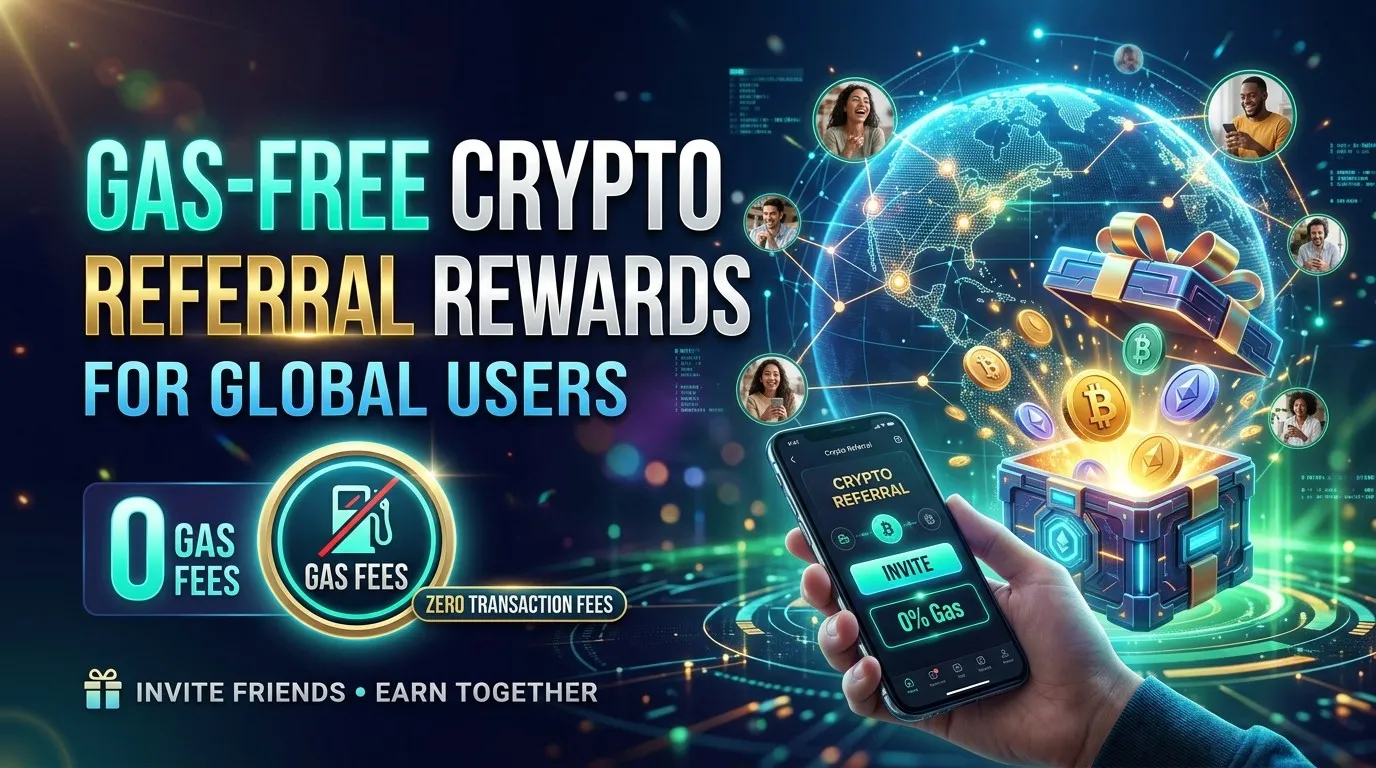
Gas-Free Crypto Referral Rewards For Global Users
Introduction: Why Gas-Free Referrals Matter in Crypto
Imagine discovering a promising cryptocurrency platform through a friend, signing up to receive a welcome reward, and then discovering that you need to purchase another cryptocurrency just to claim it. For a newcomer, this is more than an inconvenience. It creates confusion, uncertainty, and an additional financial barrier before the experience has even started.
This is where Crypto Referral Rewards can become more accessible through gas-sponsored transactions. Instead of asking participants to acquire a network’s native token before they can complete every required action, a project can cover eligible blockchain transaction fees on their behalf. That small change can make a referral experience feel simpler, especially for people entering the crypto ecosystem for the first time.
The idea is particularly relevant to international platforms serving users with different banking options, levels of blockchain knowledge, and access to digital assets. Someone familiar with decentralized finance might understand network fees immediately. A first-time user may have no idea why a wallet needs ETH, BNB, or another network token before a transaction can proceed.
Well-designed Crypto Referral Rewards can address this problem by making the first interaction easier to understand. However, a gas-free experience is not automatically free of every cost, risk, or technical limitation. The platform must decide who pays transaction fees, which actions qualify, how rewards are delivered, and what happens when suspicious activity appears.
This guide explains how gas-free referral programs work, which reward models suit different projects, how platforms can serve international communities, and what users should examine before participating. It also explores the technology behind sponsored transactions and the practical steps businesses can take to develop trustworthy referral programs.
What Are Gas-Free Crypto Referral Rewards?
Crypto Referral Rewards are incentives provided when existing users introduce new participants to a platform, product, service, or blockchain application. Depending on the program, the inviter, the new participant, or both may receive a reward after completing specified requirements.
In a conventional crypto referral program, users might receive tokens, stablecoins, trading-fee discounts, collectibles, or account credits. The reward may be distributed after registration, identity verification, a qualifying purchase, a deposit, or another action defined in the terms.
A gas-free model adds another element: the platform arranges to pay eligible blockchain transaction fees for users.
On many blockchains, executing a transaction requires a network fee. That fee compensates the infrastructure involved in processing and including transactions. Its amount can vary according to network conditions, transaction complexity, and the blockchain being used.
When a referral program sponsors the necessary fee, the eligible participant may not need to hold the network’s native token for that particular transaction.
For example, a user might qualify for a token reward after completing an approved on-chain action. Rather than requiring the user to acquire a small amount of ETH to claim it, the application could use a supported transaction-sponsorship mechanism.
The user still interacts with the blockchain, and the transaction still consumes network resources. The difference is that another party pays the eligible fee.
What Does “Gas-Free” Actually Mean?
The phrase should be understood carefully because it can describe several different arrangements.
| Model | How it works | What users should know |
|---|---|---|
| Gas-sponsored transaction | The application or a sponsor pays the eligible network fee | Sponsorship may have limits |
| Off-chain referral tracking | The platform records referrals in its own database | No blockchain fee is needed for each tracking event |
| Platform-funded reward | The business pays the reward from its own budget | Reward delivery may still incur transaction fees |
| Fee abstraction | The wallet or application handles gas payment through supported infrastructure | Availability depends on the wallet and network |
| Subsidized claim | The platform pays for selected reward-claim transactions | Other transactions may remain chargeable |
These models can work together, but they are not interchangeable.
For instance, a platform might record a referral off-chain, calculate eligibility in its application, and then distribute a token reward through an on-chain transaction sponsored by a third party. In that arrangement, referral tracking itself is not the source of the gas expense. The reward delivery is.
Crypto Referral Rewards become easier to understand when a business clearly explains which actions are sponsored and which might still require payment.
An effective user-facing explanation should answer three questions: Is there a transaction fee? Who pays it? Are any limits or conditions attached to the sponsorship?
Avoid absolute statements such as “everything is free forever” when the actual offer applies only to certain actions or has a spending limit.
Why Gas Sponsorship Can Improve Referral Participation
Referral marketing works because people often trust a recommendation from someone they already know. However, a recommendation only creates an opportunity. The product experience determines whether the new participant continues.
Even a strong referral offer can lose its appeal when registration is confusing, reward conditions are unclear, or claiming an incentive requires an unexpected expense.
Gas sponsorship can reduce one of these obstacles.
1. It removes an avoidable onboarding barrier
Someone joining a platform for the first time may not own the network token required to submit a transaction. They might understand the reward, have a compatible wallet, and still be unable to proceed.
A sponsored transaction can remove that specific obstacle.
This is useful when a program aims to introduce non-technical users to token-based memberships, blockchain games, decentralized applications, or digital collectibles.
However, sponsorship should support a valuable product experience rather than become the entire reason someone joins.
2. It makes the reward easier to evaluate
Suppose two platforms advertise comparable incentives. One clearly explains that qualifying users can claim their rewards without personally paying the supported transaction fee. The other reveals a fee requirement only after registration.
The first offer is easier to understand and compare.
Well-designed Crypto Referral Rewards should communicate the real value of an offer rather than relying on a large headline number. A token reward may look attractive, but users also need to understand its eligibility rules, usability, possible market-price changes, and withdrawal restrictions.
Clear communication helps potential participants make informed decisions before they invest time in a program.
3. It reduces uncertainty during the first transaction
Blockchain transactions can feel unfamiliar to beginners. Users may worry about selecting the correct network, keeping enough native tokens in their wallets, approving a transaction, or accidentally signing something dangerous.
A guided, sponsored process can reduce some of that friction.
The application should still show what the user is authorizing. Gas sponsorship must not become a reason to hide wallet permissions, token approvals, or transaction details.
4. It can support repeat participation
A successful referral experience does not end when somebody creates an account. A business may want newcomers to explore features, understand the product, and return when they find genuine value.
A sensible incentive structure can encourage those steps without requiring participants to complete unnecessary transactions.
For example, a platform might offer an initial onboarding incentive, followed by a smaller reward for an eligible product milestone. Each milestone should correspond to meaningful participation rather than artificial activity.
In the long run, Crypto Referral Rewards are more sustainable when the program attracts users who remain active because the product is useful.
5. It can make international campaigns more approachable
A project serving multiple countries cannot assume that every potential user has the same access to exchanges, payment services, or cryptocurrency infrastructure.
A sponsored transaction can remove the need to acquire a small amount of the network’s native token for selected actions. It cannot solve every regional limitation, but it can simplify one important part of the journey.
For global campaigns, Crypto Referral Rewards should be designed around the user’s entire experience, including wallet compatibility, available networks, language, local restrictions, and access to customer support.
How a Gas-Free Crypto Referral Program Works
A successful program typically combines referral attribution, eligibility validation, reward calculation, and transaction execution. These functions may operate through a centralized application, smart contracts, or a hybrid system.
Understanding the process helps businesses avoid a common mistake: treating a referral link and a token transfer as though they were the same system.
Step 1: The existing user receives a referral link
The platform assigns an identifier to an existing participant and generates a referral link or code.
When another person follows that link, the system records the referral information. Depending on the implementation, attribution may be stored in a backend database, linked to a wallet address, or recorded through a smart contract.
The business should explain how long referral attribution remains valid and whether cookies, account registration, or wallet connections are necessary.
Step 2: The invited person joins
The new participant opens the application, reviews the offer, and completes registration.
Some campaigns require only account creation. Others require additional conditions, such as identity verification, a qualifying purchase, or a genuine use of the platform.
The requirements should be visible before the participant takes action.
Step 3: The system verifies eligibility
The platform checks whether the referred user meets the stated conditions.
Possible checks include account status, referral attribution, wallet ownership, duplicate-account signals, geographic eligibility, and completion of the qualifying event.
The objective is to distinguish legitimate participation from attempts to exploit the incentive system. Verification should be proportionate to the actual risks and should avoid collecting unnecessary personal information.
Step 4: The reward is calculated
Once eligibility is confirmed, the system determines the reward amount and applicable conditions.
The reward might be fixed, tiered, proportional to a qualifying activity, or divided between the inviter and the new user.
A clear calculation method is especially important when rewards use volatile tokens. Users should understand whether the stated amount is denominated in tokens, a fiat equivalent, points, or platform credits.
Step 5: Gas sponsorship is applied
If the reward requires an on-chain action, the application checks whether the transaction is eligible for sponsorship.
The sponsorship provider may assess the requested operation, available budget, supported network, and applicable policy.
If the transaction qualifies, the sponsor pays the relevant network fee through the supported infrastructure. Otherwise, the application should explain the limitation and provide a legitimate alternative when available.
Step 6: The reward is delivered and recorded
The application records the reward status and provides a receipt, transaction identifier, or other useful confirmation.
For on-chain transfers, users can often verify the transaction through the relevant blockchain explorer. Off-chain credits may instead appear in the user’s account history.
These distinctions matter because a displayed reward, an approved reward, and a completed on-chain transfer are not necessarily the same thing.
Popular Models for Gas-Free Crypto Referral Rewards
Different businesses need different incentive structures. A wallet application may prioritize account activation, while a gaming platform may value returning players and an NFT community may focus on collecting or marketplace activity.
The strongest model depends on the business objective, reward economics, technical architecture, and expected user behavior.
Two-sided referral rewards
Both the inviter and the invited participant receive an incentive after the new user satisfies the qualification requirements.
For example, the invited participant might receive a small welcome reward, while the existing user earns a referral bonus.
This model gives both sides a reason to participate. However, its economics must account for duplicate accounts, reward abuse, customer acquisition costs, and users who register but never return.
Crypto Referral Rewards using this structure should explain whether the inviter’s payment is conditional on the invitee completing a qualifying action.
One-sided referral rewards
Only the inviter receives an incentive.
This model can be suitable for communities where existing members are motivated to introduce genuinely relevant users. It may also simplify the reward budget.
The potential disadvantage is that newcomers receive no direct financial incentive beyond the product’s own value proposition. Whether that matters depends on the audience and the experience being promoted.
Milestone-based rewards
Participants receive benefits after completing a sequence of legitimate milestones.
A basic structure might include registration, a first meaningful product interaction, and a later retention milestone. Each stage can have separate eligibility requirements.
Milestones help businesses reward useful participation rather than simply count registrations. However, avoid forcing users through excessive actions solely to unlock an advertised reward.
Tiered referral programs
Reward levels can increase when a participant brings in several eligible users or reaches a clearly defined performance threshold.
For instance, a business could provide a standard incentive for each qualifying referral and an additional benefit after a larger number of legitimate participants join.
The rules must define what counts toward each tier, whether bonuses stack, and when the calculation resets.
Community-based rewards
Some projects focus on contributions rather than pure recruitment. Participants might receive points or benefits for helpful tutorials, event participation, educational contributions, or community support.
A referral link can introduce people to the community, but rewards should reflect valuable activity where possible. Otherwise, the program may attract low-quality sign-ups that disappear once incentives end.
The Technology Behind Gasless Transactions
Gas-free experiences are not achieved by eliminating blockchain computation. They are generally created by changing how transactions are submitted, authorized, or paid for.
The technical model matters because it influences security, costs, supported wallets, and the reliability of the referral experience.
Smart accounts and account abstraction
Traditional blockchain accounts have established transaction-signing and fee-payment models. In many cases, an externally owned account needs a balance of the native network currency to pay transaction fees.
Account abstraction introduces more flexible account behavior, including smart-contract-based validation and alternative gas-payment arrangements.
Ethereum’s account abstraction documentation explains how smart accounts can support features such as sponsored gas, batched operations, and more flexible account controls.
For a referral application, a compatible smart account may allow the user to authorize an operation while an eligible sponsor pays its network fee.
This can simplify interactions that otherwise require the user to maintain a separate gas balance. The exact experience still depends on the wallet, network, implementation, and sponsorship policy.
Paymasters and transaction sponsorship
In an ERC-4337 architecture, a paymaster is a component that can agree to cover gas costs for eligible user operations.
A simplified sequence looks like this:
- The user authorizes an eligible action through a compatible smart account.
- The application prepares the requested operation.
- A bundler and the account-abstraction infrastructure process the operation.
- The paymaster’s policy determines whether sponsorship is permitted.
- The transaction is included and executed if the required validation and network conditions are satisfied.
The sponsor pays the relevant fees according to the implementation. It may impose restrictions on supported contracts, transaction types, spending limits, or users.
A referral application should therefore treat sponsorship as a controlled resource rather than an unlimited entitlement.
Relayers and sponsored transactions
Some systems use relayers or other transaction-submission services to submit actions on behalf of users.
The precise mechanism varies by protocol. In some architectures, a relayer pays transaction fees and may receive compensation elsewhere. In others, smart accounts and paymasters coordinate sponsorship through account-abstraction infrastructure.
A project should not assume every wallet supports the same approach. Technical documentation, network compatibility, and transaction-signing behavior should be tested before a global campaign begins.
What sponsorship does not remove
Even when the user pays no direct gas fee, the transaction still consumes network resources and creates costs for somebody.
The business may pay those costs through a sponsorship provider, an application budget, protocol economics, or another arrangement. Network congestion and infrastructure limitations can still affect execution.
Crypto Referral Rewards advertised as gas-free must therefore distinguish between the user’s out-of-pocket transaction fee and the total cost of delivering the incentive.
This distinction makes the offer more transparent and helps the business build an accurate operating budget.
Designing a Better Referral Experience for Global Users
A global program must work for people with different technical backgrounds, devices, languages, and levels of crypto familiarity.
Making the transaction fee disappear from the user’s immediate experience is only one part of designing a usable product.
Make the offer understandable
The landing page should state the incentive, qualification requirements, reward timing, supported networks, and sponsorship limitations.
Avoid requiring users to explore several documents before discovering a minimum deposit, purchase requirement, or regional restriction.
A clear explanation should tell users what they need to do, what they can receive, and which costs they may still encounter.
Reduce unnecessary wallet complexity
A first-time participant should not have to learn advanced blockchain concepts just to understand the basic referral process.
Use clear labels and plain-language explanations for wallet connections, transaction approvals, network selection, and reward status.
If an action cannot be sponsored, explain why instead of presenting an unexplained failure message.
Provide accessible support
International campaigns should account for different time zones, communication preferences, and language needs.
A concise help center can explain common issues such as missing referrals, delayed rewards, unsupported wallets, failed transactions, and eligibility reviews.
Avoid asking users to disclose seed phrases or private keys when investigating a support ticket. Legitimate customer support does not require those secrets.
Explain reward availability
Not every digital incentive can be immediately transferred, exchanged, or withdrawn.
The platform should distinguish between points, locked rewards, promotional tokens, transferable assets, and assets that can be redeemed only under specific conditions.
When a reward has a lockup period or a withdrawal threshold, the terms should be visible before users begin participating.
These details make Crypto Referral Rewards more credible because users can evaluate the real offer instead of relying on a promotional headline.
Fraud Prevention Without Creating Unnecessary Friction
Referral programs can attract abuse when the potential payout exceeds the effort required to create fake accounts or manipulate attribution.
Gas sponsorship can introduce an additional cost exposure because a malicious participant may try to generate large volumes of subsidized transactions.
A responsible design must protect the program while preserving a reasonable experience for legitimate users.
Sybil attacks and duplicate accounts
A Sybil attack involves using multiple identities or accounts to gain an unfair advantage.
A participant might create several accounts, refer themselves, or use automated scripts to collect welcome bonuses. In some cases, the attacker may try to generate sponsor-paid transactions without creating any lasting product value.
Potential controls include referral-rate limits, account-age requirements, transaction limits, wallet-level rules, and risk-based verification.
No single signal is sufficient in every situation. Shared devices, household networks, and legitimate users with more than one wallet can resemble certain fraud patterns.
Review systems should therefore consider multiple signals before taking restrictive action.
Fake activity and low-quality referrals
A campaign that rewards every registration may generate large numbers of accounts without meaningful engagement.
Businesses can reduce this problem by aligning rewards with legitimate product use, applying reasonable qualification periods, and monitoring retention alongside registrations.
The objective should be to reward meaningful participation, not merely increase the number of tracked referral links.
Smart contract and sponsor abuse
Smart contracts and sponsorship services require careful configuration, testing, monitoring, and access control.
A sponsor may need transaction limits, allowlists, contract restrictions, budget alerts, and an emergency process for suspending sponsorship if suspicious activity appears.
The sponsor’s permissions should be limited to what the business actually needs. A referral program should never request broad wallet authority merely to distribute a small promotional reward.
Fair rules and appeals
Fraud controls should be disclosed at an appropriate level without exposing sensitive security logic that would make abuse easier.
Users should be able to understand the main eligibility conditions and the general reasons a reward may be delayed, rejected, or reversed where the terms legally permit it.
Create a process for correcting mistaken attribution and reviewing legitimate users who are incorrectly flagged.
Crypto Referral Rewards work better over time when users trust that the rules are consistent, proportionate, and applied fairly.
Privacy, Transparency, and User Control
A referral program may process wallet addresses, account identifiers, referral links, transaction histories, device signals, or identity-verification information.
These data types do not all present the same privacy risks. A public blockchain address may not directly state a person’s real-world identity, but transaction patterns can sometimes be associated with other publicly available information.
Businesses should be deliberate about what they collect and why.
Collect only what the program needs
A platform may need enough information to link a referral to a qualifying account and prevent obvious abuse. It does not automatically need to collect every available device or behavioral signal.
Establish a clear purpose for each data field, restrict access, and define appropriate retention periods. Privacy notices should explain how information is processed, shared, and protected.
Explain the relationship between privacy and eligibility
Some users prefer limited disclosure when participating in a digital-asset community. Others are comfortable with identity verification if it is necessary for a regulated service or a particular reward.
A privacy-conscious design should explain which actions are public on-chain, which information remains within the application’s systems, and whether any personal verification is required.
Projects researching approaches to privacy-preserving participation may find the concepts discussed in Anonymous Crypto Referral Systems useful when considering how to balance data minimization with eligibility verification.
Privacy does not mean promising complete anonymity when the underlying architecture or applicable rules cannot provide it. Accurate disclosures are more valuable than absolute claims.
Protect wallet security
A referral reward should never require a user to share a recovery phrase or private key with an inviter, website operator, or support representative.
Users should review wallet signatures and permissions before approving them. Projects should clearly distinguish legitimate transaction sponsorship from requests that could transfer assets or authorize unwanted contract interactions.
Gas-free onboarding must make the process safer and more understandable, not encourage users to approve unknown actions because the transaction appears free.
Choosing Rewards That Users Actually Value
The reward itself is just as important as the transaction experience.
An incentive can be technically effortless to claim and still disappoint users if it has little practical value, restrictive conditions, or unclear redemption options.
Fixed token rewards
A fixed number of tokens is easy to communicate.
However, the market value of a transferable token may fluctuate. A campaign should avoid presenting a changing market value as a guaranteed cash-equivalent outcome.
Where relevant, explain the token amount, any vesting conditions, and the difference between an indicative market value and a guaranteed redemption amount.
Stablecoin incentives
Some projects prefer stablecoins because their target value is designed to track a reference currency.
That does not eliminate issuer, custody, smart contract, liquidity, transfer, or regulatory risks. Availability and redemption options may also differ across jurisdictions.
The platform should specify which asset and network it uses, how recipients can access it, and whether additional conditions apply.
Points, credits, and fee discounts
Points and platform credits can be suitable when the business wants users to experience its service before distributing transferable assets.
For example, credits might support eligible in-app purchases or discounts on selected platform fees.
The terms should make clear whether credits expire, can be transferred, or have any cash value. Calling non-redeemable points cryptocurrency can mislead participants about what they are receiving.
NFTs and digital collectibles
A referral campaign may award a digital collectible or membership NFT instead of, or in addition to, a fungible token.
This model can be appropriate when the collectible offers meaningful utility, such as access to a community, an event, a membership feature, or an in-game benefit.
Users who want to understand the ecosystem can explore NFT Marketplaces to learn how platforms differ in discovery, trading functionality, and supported assets.
However, an NFT reward should not be advertised as an investment with guaranteed future appreciation. Market demand, trading costs, liquidity, and actual utility can vary considerably.
Reward distribution and delivery
A program must also decide how and when incentives reach eligible participants.
Some rewards are credited immediately after an approved event. Others are released after a review period or distributed in scheduled batches to control transaction costs and reduce abuse.
The right timing depends on the reward type, the user’s expectations, the risk profile, and the platform’s accounting requirements.
For projects using NFTs, the principles behind NFT Reward Distribution offer a useful starting point for thinking about how reward timing and utility can support longer-term participation.
Whatever the mechanism, communicate the status accurately. A pending reward is not the same as a completed transfer, and an issued collectible is not necessarily a liquid or easily transferable asset.
International Compliance and Regional Restrictions
A website can be accessible worldwide without every aspect of its referral offer being available in every country.
Crypto-related rewards may raise questions involving financial promotions, consumer protection, privacy, sanctions, tax reporting, token distribution, gambling-related restrictions, or licensing obligations. Which requirements apply depends on the jurisdiction, the business model, and the characteristics of the asset or service.
A general educational article cannot determine whether a particular campaign is lawful in every country. A business should obtain qualified legal and compliance advice before launching a cross-border promotion.
Define eligible regions clearly
If a campaign is limited to certain countries, display those restrictions before users invest time in registration or qualification.
Geographic limits should be enforced consistently and in accordance with applicable law and privacy requirements.
A platform should also explain what happens if a user changes residence or if a reward cannot legally be distributed in a particular location.
Review the nature of the reward
Tokens, stablecoins, platform credits, and NFTs can have different legal characteristics.
A reward that gives access to a service may be treated differently from one marketed as an investment or linked to revenue-sharing rights. Marketing language, redemption arrangements, and the rights attached to the asset can all matter.
Avoid assuming that a reward falls outside regulation simply because it is labelled a bonus or distributed through a referral link.
Explain possible tax responsibilities
Recipients may have tax obligations depending on the asset, transaction, value, and jurisdiction.
The platform should not promise that a reward is tax-free unless that statement is legally supportable for the relevant participant and circumstance.
Where appropriate, provide transaction records and clear reward histories so users can review their own records with a qualified adviser.
Keep the offer honest
Marketing should explain the conditions that materially affect a reward.
If participation requires a qualifying purchase, identity checks, or a minimum activity level, these conditions should not be hidden behind vague statements about effortless earnings.
Credible Crypto Referral Rewards prioritize accurate information over exaggerated claims about guaranteed income, instant profits, or universal availability.
Measuring Performance and Improving the Program
A referral system should be evaluated as a business process, not just a distribution mechanism.
The number of registered users can be useful, but it does not reveal whether the campaign attracts engaged participants, generates sustainable revenue, or costs more than it creates in value.
Referral conversion rate
Measure how many eligible visitors complete the intended action after opening a referral link.
Depending on the campaign, the desired action could be account creation, a verified registration, or a meaningful product interaction.
Track the stages separately so the business can identify where users abandon the process.
Cost per qualified referral
Calculate program costs against the number of participants who meet the stated quality or eligibility criteria.
Relevant expenses may include rewards, sponsored gas, infrastructure, support, fraud review, and campaign management.
A campaign that attracts many sign-ups but consumes a disproportionate amount of sponsorship budget may need a revised eligibility model.
Reward claim completion
Measure how many eligible participants successfully receive their reward.
A low completion rate could indicate confusing instructions, unsupported wallets, failed transactions, inadequate fee coverage, or unclear reward conditions.
Reviewing failed and pending claims can reveal user-experience problems that raw registration totals conceal.
Retention and long-term activity
Monitor whether referred users return after their initial incentive.
Retention can help distinguish a campaign that attracts real product users from one that mostly attracts people seeking a one-time bonus.
The appropriate measurement period depends on the product. A gaming application, a digital membership service, and a financial application may have very different usage cycles.
Sponsorship cost and return
Track the average sponsored transaction cost, total gas expenditure, failed-operation costs where applicable, and cost per retained user.
The program should define an acceptable budget and create alerts when spending approaches its limits.
Crypto Referral Rewards should remain financially sustainable even when network costs change or a campaign becomes more popular than expected.
A useful dashboard might include these core measures:
| Metric | What it reveals | Why it matters |
|---|---|---|
| Referral conversion | Percentage of referred visitors who qualify | Shows whether the offer and onboarding process are effective |
| Qualified referrals | Number of users who satisfy program rules | Distinguishes valid participation from raw registrations |
| Reward claim rate | Percentage of eligible rewards successfully delivered | Identifies technical or communication issues |
| Cost per qualified user | Total acquisition expense divided by qualified users | Helps assess campaign efficiency |
| Sponsored gas per user | Average fee sponsorship cost per participant | Keeps transaction subsidies measurable |
| Retention rate | Percentage of referred users who return | Indicates whether users find lasting value |
| Fraud rate | Estimated share of activity involving abusive behavior | Helps evaluate controls and program integrity |
| Support resolution time | Time taken to resolve participant issues | Measures the quality of the post-registration experience |
These metrics should be reviewed together. A very low cost per sign-up is not necessarily positive if participants leave immediately, while a higher acquisition cost may be justified when users remain active and contribute lasting value.
Helping Recipients Understand Digital Assets
An effective referral program should make the reward understandable beyond the moment it is received.
For token and NFT incentives, users need a basic understanding of ownership, transferability, network compatibility, and potential market volatility.
Educational resources can explain what a wallet does, how transaction confirmations work, and why an asset’s displayed market price may differ from the price someone can actually receive in a trade.
A project distributing NFTs should also explain metadata, supported marketplaces, transfer restrictions, and the rights associated with the collectible.
Users comparing digital assets may benefit from an independent NFT Trader Guide that explains trading environments and the practical differences between marketplaces.
Education is not a substitute for risk disclosure. It simply helps participants understand what they have received and what choices may be available afterward.
The same principle applies to Crypto Referral Rewards involving tokens or credits. Explain the practical utility, the limits of the reward, and any additional steps required to transfer, redeem, or use it.
A Practical Launch Checklist for Businesses
Before announcing a global gas-free referral campaign, a business should confirm that the offer, infrastructure, and operating process are ready.
Program design
Write the eligibility rules before promoting the campaign. Specify the qualifying event, reward amount, payout timing, referral attribution rules, expiration dates, and relevant restrictions.
Decide whether both participants receive benefits and whether any rewards depend on additional milestones.
Technical readiness
Test the entire journey from opening a referral link to receiving the reward.
Confirm compatibility across supported wallets and networks. Test failed transactions, interrupted sessions, duplicate submissions, unavailable sponsorship, and situations where a transaction remains pending.
Review smart contract security and ensure that the sponsorship system has appropriate spending controls.
Fraud and support procedures
Establish reasonable limits for suspicious activity and create a process for human review when automated checks produce uncertain results.
Prepare support documentation covering missing rewards, incorrect attribution, rejected eligibility, wallet compatibility, and transaction status.
Budget and monitoring
Calculate the expected cost of incentives, gas sponsorship, infrastructure, and operational support.
Set total campaign limits and monitoring alerts. Decide who can pause the campaign if unusual activity or technical problems emerge.
User communication
Make the terms available before users participate.
Use clear language to distinguish sponsored transaction fees from other costs, transferable digital assets from points, and estimated market value from guaranteed value.
Explain the steps required to claim the reward and the information participants will need to provide.
Post-launch optimization
Start with a controlled rollout rather than assuming every component will behave as expected at scale.
Review conversion rates, reward completion, support tickets, sponsored gas expenditure, fraud indicators, and returning-user behavior.
Use those findings to simplify genuine user journeys and strengthen weak points without introducing unnecessary restrictions.
Example: How a Gas-Free Referral Journey Could Work
Consider a hypothetical blockchain membership platform that wants to introduce new users to its digital community.
The platform creates a two-sided referral campaign. Existing members receive a referral link, and invited users receive a small membership incentive after completing the published eligibility requirements.
A newcomer opens the link, reviews the offer, and creates an account. The application explains which network it supports and whether wallet creation or connection is required.
The user completes the qualifying action. The referral system checks attribution and eligibility, then marks the reward as approved.
If reward delivery requires a supported on-chain transaction, the platform requests fee sponsorship within a defined budget. After the transaction is successfully executed, the application updates the reward history and displays the transaction details.
The existing member receives their eligible incentive according to the same published rules.
The business then evaluates whether the referred user returns, uses the membership, and finds genuine value in the service. It also checks sponsorship expenditure and looks for suspicious activity.
In this example, Crypto Referral Rewards serve as an introduction to the actual product instead of functioning as an isolated promise of easy earnings.
The same model can be adapted for digital collectibles, blockchain gaming, wallet onboarding, or token-based membership services. The reward format changes, but the principles remain consistent: transparent eligibility, responsible fee sponsorship, secure execution, fair fraud controls, and measurable user value.
Conclusion
Gas-free crypto referral programs can make blockchain participation more approachable by removing the need for users to personally fund eligible transaction fees. However, sustainable Crypto Referral Rewards require more than attractive incentives. They depend on secure sponsorship infrastructure, transparent eligibility rules, sensible fraud controls, privacy-conscious data practices, and compliance with relevant regional requirements. Businesses should also measure successful reward delivery, retention, and total acquisition costs rather than focusing only on registrations. When users understand the offer, can complete the required steps safely, and receive genuine value from the product, referral incentives can support lasting participation instead of short-lived promotional activity.
Frequently Asked Questions (FAQ)
1. What are Crypto Referral Rewards?
Crypto Referral Rewards are incentives given to existing users, invited participants, or both when a referral satisfies a program’s stated conditions. Rewards can include tokens, stablecoins, digital collectibles, points, or platform benefits.
2. What makes a crypto referral program gas-free?
A gas-free program sponsors eligible blockchain transaction fees so participants do not have to pay those fees directly for supported actions. The underlying transaction still consumes network resources, and the sponsor or another party covers the applicable cost.
3. Do gas-free referral rewards require a crypto wallet?
Not always. Some programs track referrals and issue off-chain points without requiring a wallet. A program distributing blockchain-based assets may require a compatible wallet, depending on how rewards are issued and managed.
4. Who pays the gas fees in a sponsored referral program?
The application operator, sponsorship provider, paymaster, or another designated party may pay the eligible fees. The arrangement depends on the technical architecture and the program’s terms.
5. Can users receive Crypto Referral Rewards without buying cryptocurrency first?
Yes, in some programs. Users may receive off-chain credits or sponsored on-chain rewards without purchasing the network’s native token for the qualifying action. However, requirements differ between platforms, and other restrictions may apply.
6. Are gas-free crypto referral programs completely free?
Not necessarily. Gas sponsorship covers specific blockchain transaction costs, but a program may still involve other expenses or conditions, such as purchases, deposits, verification requirements, exchange charges, or withdrawal fees. Users should read the terms before participating.
7. How can users identify an unsafe crypto referral program?
Warning signs include guaranteed-profit promises, unclear eligibility rules, requests for private keys or recovery phrases, unexplained wallet permissions, pressure to deposit money, and rewards that depend on misleading claims. Verify the platform and review the transaction details before approving any action.
8. Can NFTs be used as Crypto Referral Rewards?
Yes. A project can offer NFTs as digital collectibles, membership credentials, access passes, or other program benefits. Their usefulness, transferability, and market value depend on the asset and its terms. An NFT should not be assumed to have a guaranteed resale value.
9. Are Crypto Referral Rewards available worldwide?
Availability depends on the platform, supported blockchain infrastructure, payment or wallet access, and applicable laws. Some programs restrict eligible locations or reward types. Participants should review the current conditions that apply to their jurisdiction.
10. How can businesses measure the success of gas-free referral programs?
Businesses can measure referral conversion, qualified participants, reward-claim completion, sponsored transaction costs, fraud rates, customer acquisition costs, and retention. Evaluating these metrics together helps determine whether the program attracts genuine users and delivers sustainable value.