
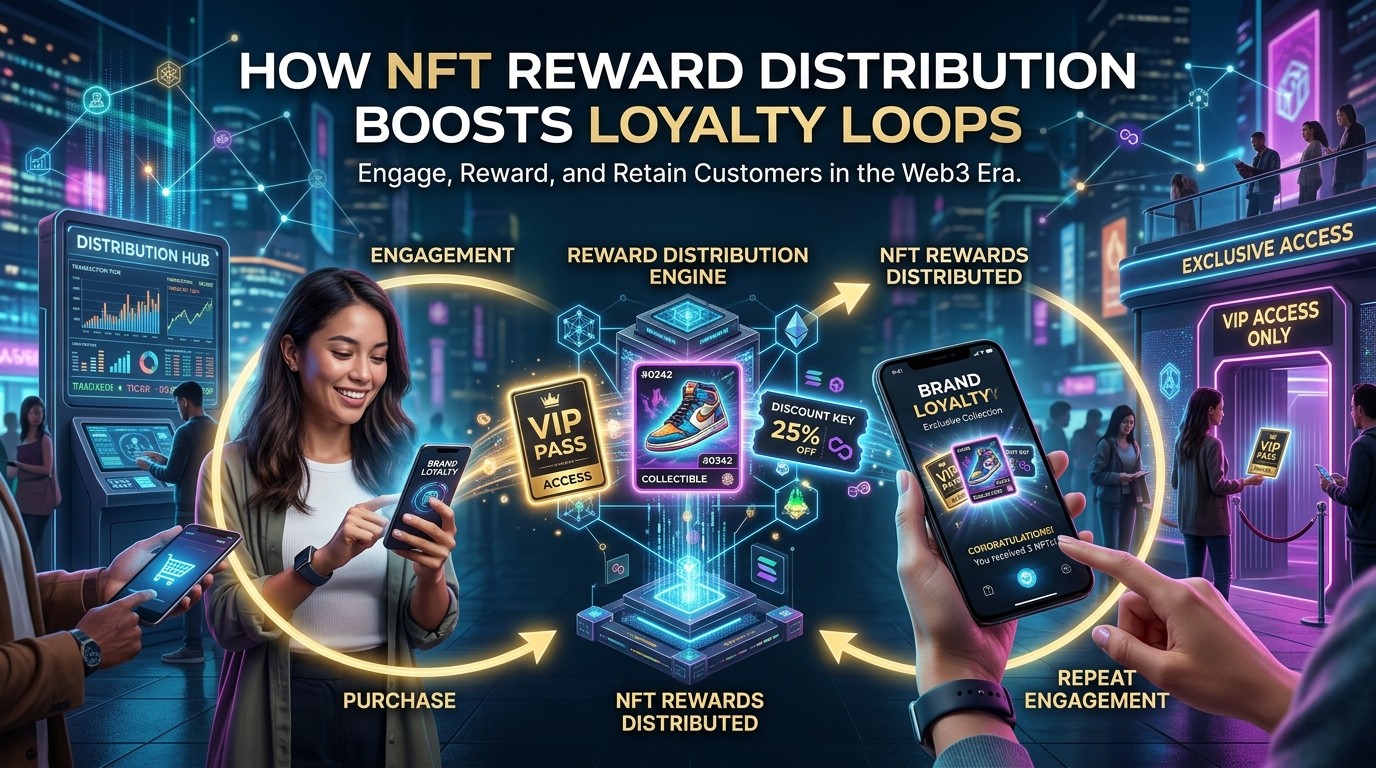
NFT Reward Distribution can strengthen loyalty loops by turning participation into visible ownership, status, access, and repeatable rewards that keep customers and communities engaged.
NFT Reward Distribution is becoming an increasingly interesting strategy for brands, creators, communities, games, and digital platforms that want to make loyalty more meaningful. Traditional programs often rely on points, coupons, cashback, or account-based reward balances. Those systems can be effective, but they typically keep the reward inside one company’s database.
NFT Reward Distribution introduces a different possibility by turning a completed action into a recognizable digital asset. Instead of receiving a number that only exists inside a loyalty dashboard, a participant may receive an NFT representing an achievement, membership, contribution, event, referral, or milestone.
The deeper opportunity comes from connecting that reward to a repeatable behavioral loop. A participant completes an action, receives recognition, gains a benefit, becomes more invested, and returns for another interaction. When designed thoughtfully, NFT Reward Distribution can become a visible part of that cycle rather than a one-time promotional gimmick.
The technology alone does not create loyalty. The reward needs meaning, utility, accessibility, and a logical connection to the behavior the business wants to encourage. This article explores how those pieces work together.
What Is NFT Reward Distribution?
NFT Reward Distribution refers to issuing non-fungible tokens to eligible participants after they complete predefined actions or milestones. Those actions may include purchasing a product, referring another customer, attending an event, completing a course, participating in a community, reaching a gaming achievement, or maintaining membership.
NFT Reward Distribution can involve automatic delivery, user-initiated claims, scheduled batch distribution, or a hybrid process involving both blockchain and traditional software. The NFT may be transferable, non-transferable, collectible, utility-focused, or designed primarily as a credential.
One important point is that NFT Reward Distribution does not require the reward to have speculative market value. A company can issue an NFT simply as a digital certificate, access pass, achievement badge, membership credential, or proof of participation.
The strategic question is therefore not “Why should we use NFTs?” It is “What behavior should the reward reinforce, and does an NFT improve that experience?”
Why Loyalty Loops Matter
NFT Reward Distribution becomes more useful when it is connected to a loop rather than a single reward event. A one-time coupon can encourage a transaction, but a loyalty loop aims to create repeated participation.
NFT Reward Distribution can provide visible evidence that the participant is progressing. A first achievement can unlock access, a second can provide status, and a later milestone can create a deeper benefit.
A basic loyalty loop looks like this:
Action → Recognition → Reward → Benefit → Return → New Action
The psychological strength of this structure comes from continuity. The participant can see that today’s action contributes to tomorrow’s opportunity.
When rewards are disconnected from future experiences, loyalty may weaken after the incentive has been consumed. When the reward remains useful or meaningful, the participant has a reason to continue.
Ownership Psychology and Emotional Attachment
NFT Reward Distribution can take advantage of the psychological importance people place on ownership. A reward feels different when it becomes something associated with the participant’s identity, history, or achievements.
A customer who receives a digital badge for completing a major milestone may value it because it represents effort. A community member may value a founding-member NFT because it proves early participation.
NFT Reward Distribution becomes stronger when the asset tells a story. Instead of being an arbitrary image, the NFT can represent a specific moment in the user’s relationship with the brand.
This also changes how people remember participation. A points balance can disappear into a dashboard, while a digital collectible can remain visible as a personal record.
The most successful programs understand that emotional value can matter even when there is little or no financial value attached to the NFT.
Turning Rewards Into Utility
NFT Reward Distribution becomes more compelling when the reward does something useful. An NFT might provide access to a private community, unlock special content, provide event privileges, grant an exclusive discount, or identify a particular membership level.
Utility gives participants a reason to keep the asset relevant.
A digital reward that unlocks a future experience can influence behavior beyond the moment of issuance. The customer may return because the NFT represents something they can still use.
NFT Reward Distribution should therefore be designed around the benefit instead of the asset. The NFT is the delivery mechanism or ownership layer; the actual customer value comes from what it represents or enables.
For example, an NFT can function as a digital membership pass, but the real value comes from the community, event access, product benefits, or experiences behind that pass.
Milestones, Progress, and Gamification
Progress is one of the strongest elements in loyalty design. People are more likely to continue when they can understand how close they are to the next meaningful achievement.
NFT Reward Distribution can transform milestones into visible digital achievements. A program might issue one NFT after the first purchase, another after the third, and a special credential after the tenth.
Each stage becomes a reason to continue.
This is where a micro-milestone strategy becomes especially useful. Micro-Tier Reward Frameworks can make larger loyalty goals feel more attainable by dividing progress into smaller achievements.
NFT Reward Distribution can give those achievements a persistent identity. Instead of seeing only a progress bar, participants can collect digital evidence of what they have accomplished.
That collection itself can become motivational.
Community Participation and Social Recognition
Communities often depend on members who contribute more than money. People may answer questions, welcome newcomers, create content, attend events, refer friends, test products, or support other participants.
NFT Reward Distribution can recognize those contributions with digital credentials or collectible achievements.
A member who receives an “early contributor” NFT may feel that the community recognizes their role. That recognition can become part of the participant’s identity inside the ecosystem.
Social visibility can make the effect stronger. Profiles, community roles, leaderboards, or collectible displays can allow genuine achievements to become visible to others.
A structured Gamified Discord Referral Strategy can complement this model by connecting community referrals with participation mechanics.
NFT Reward Distribution can then convert verified contribution into lasting recognition.
Referral Programs and Advocacy Loops
Referral programs naturally fit loyalty loops because one participant can introduce another person to the ecosystem.
NFT Reward Distribution can reward the advocate after the referred user completes a meaningful qualifying action. The action could be a purchase, subscription, event registration, game achievement, or retained membership.
The important word is meaningful. Rewarding every signup may increase referral counts without creating real business value. A stronger program rewards outcomes that matter.
The referral reward can also become an ambassador credential. A participant may accumulate several advocacy achievements over time, creating a visible record of contribution.
That creates another loop:
Recommend → Convert → Receive Recognition → Gain Status → Recommend Again
NFT Reward Distribution can make the status component more tangible by associating progress with collectible or credential-based assets.
Gaming Communities and Digital Achievements
Gaming is a natural environment for digital rewards because players already understand achievements, progression, collections, rarity, and status.
NFT Reward Distribution can recognize tournament participation, guild contributions, referrals, seasonal achievements, special events, or player milestones.
The reward might be purely commemorative, or it might unlock community access, cosmetics, special experiences, or other functionality.
A gaming reward should fit the broader ecosystem instead of feeling like an unrelated marketing object.
For readers exploring specialized digital-asset environments, NFT Gaming Marketplaces provides additional context about environments where game-related blockchain assets can be discovered and traded.
NFT Reward Distribution can become more meaningful when it reflects actual player behavior and progression.
Ecommerce Loyalty Applications
Ecommerce brands can use NFT Reward Distribution to recognize purchasing milestones without relying entirely on discounts.
A first purchase could create a welcome NFT. A third purchase could unlock a loyalty badge. A seasonal collection could reward customers who purchase from several product categories.
These rewards can be connected to additional benefits, creating a reason to return.
NFT Reward Distribution should not turn every order into a token issuance event. Excessive rewards can create clutter and weaken perceived significance.
Instead, businesses should identify moments that deserve recognition.
A premium product launch, anniversary purchase, collection completion, or referral conversion may feel more meaningful than a routine transaction.
The NFT becomes a digital memory of an important customer interaction rather than another piece of automated marketing.
SaaS Customer Loyalty
Software companies can also use digital rewards around product milestones.
NFT Reward Distribution could recognize onboarding completion, certification, advanced feature adoption, long-term membership, community contribution, or successful referrals.
A B2B SaaS company might issue a non-transferable credential to users who complete advanced training. A developer platform could recognize users who contribute tutorials or community solutions.
These rewards can support customer education as well as loyalty.
When the NFT unlocks access to advanced resources or private communities, it can also encourage continued engagement.
The reward should align with customer success. The goal is not to make a SaaS dashboard look more like a collectible gallery. The goal is to reinforce behaviors that make customers more successful with the product.
Events, Conferences, and Experiences
Events provide a strong use case because participation already has a clear date and story.
NFT Reward Distribution can recognize attendance, speaker participation, volunteering, workshop completion, networking milestones, or special event achievements.
An event NFT can then remain useful after the event ends. It could unlock recordings, future registration privileges, private communities, or partner benefits.
That changes the relationship between the event and the attendee.
Instead of the experience ending when the conference closes, the digital reward becomes a bridge into the next interaction.
NFT Reward Distribution works particularly well here because the token can represent an actual memory rather than an arbitrary promotional object.
The more meaningful the event, the more valuable the commemorative aspect may become.
Creator and Fan Communities
Creators can use NFT Reward Distribution to recognize their strongest supporters.
A creator might issue digital collectibles for attending a live stream, supporting a launch, completing community challenges, offering valuable feedback, or remaining active for a particular period.
The reward can function as a digital thank-you.
For fans, the emotional value may be more important than market value.
A fan could keep an NFT because it represents the moment they joined the creator’s community or supported a major milestone.
NFT Reward Distribution can also provide creators with a way to distinguish long-term contributors from occasional followers.
That distinction can support private content, special events, early releases, or community privileges.
The strongest creator programs make recognition feel authentic rather than transactional.
Personalization and Dynamic Rewards
Not every reward needs to look identical.
NFT Reward Distribution can support different designs, attributes, tiers, or metadata according to the participant’s behavior.
A long-term customer might receive an NFT with different characteristics from a new participant. A person who completes multiple activities could unlock additional attributes.
Dynamic systems can create a sense of progression because the asset may evolve as the participant becomes more engaged.
However, personalization should remain understandable.
Participants should know what causes their NFT to change and what additional value comes from the change.
The system becomes confusing when users cannot explain why their reward looks different.
Good personalization feels like recognition, not randomness.
Transferable vs Non-Transferable Rewards
NFT Reward Distribution can use transferable assets when collectibility, ownership, or secondary-market participation is part of the experience.
A commemorative event collectible may benefit from being transferable because the participant genuinely owns a digital souvenir.
Other rewards may be more appropriate as non-transferable credentials.
A qualification badge, professional certificate, or personal achievement usually represents something about the original participant rather than something that should be sold.
NFT Reward Distribution therefore needs a clear purpose before transferability is chosen.
The key question is simple: should the reward represent a person’s achievement, or should it function as a collectible object?
The answer affects the entire design.
Wallet Experience and Friction
The technical experience can make or break an NFT loyalty campaign.
NFT Reward Distribution can fail when customers are required to understand complicated wallets, blockchain networks, gas fees, private keys, or transaction signatures before receiving a small reward.
Mainstream audiences may prefer embedded or simplified wallets, while experienced blockchain users may expect direct wallet ownership.
The ideal approach depends on the audience.
NFT Reward Distribution should make the user journey as simple as possible without hiding important information.
A participant should understand what they earned, why they earned it, where it is stored, and what they can do with it.
The blockchain can remain behind the interface when necessary.
The participant does not need to become a blockchain engineer to appreciate a useful digital reward.
Gas Fees and Distribution Economics
Onchain rewards can create transaction expenses.
NFT Reward Distribution must therefore account for blockchain fees, minting frequency, transaction volume, network conditions, and who pays the gas.
Low-value rewards can become economically inefficient if the distribution cost is greater than the value of the reward.
Businesses can consider lower-cost networks, sponsored transactions, batch distribution, claim-based models, or other infrastructure approaches where appropriate.
The reward economics should be modeled before launch.
NFT Reward Distribution is useful when blockchain adds meaningful benefits that justify the cost and complexity.
A company should never assume that putting a reward onchain automatically makes it more valuable.
The economics need to work on both sides.
Fraud, Sybil Activity, and Reward Abuse
Incentives attract both genuine participants and people looking for loopholes.
NFT Reward Distribution can be abused through self-referrals, fake accounts, multiple wallets, automated activity, manipulated purchases, or other forms of reward farming.
Blockchain rules can prevent some forms of abuse, but they cannot identify every real-world relationship.
Businesses may therefore combine onchain checks with offchain fraud monitoring.
Useful controls include purchase verification, eligibility windows, unique-user rules, rate limits, reward caps, suspicious-activity review, and retention requirements.
NFT Reward Distribution should be designed around realistic abuse scenarios before launch rather than after a campaign becomes popular.
A reward system that is easy to exploit can become financially expensive very quickly.
Security and Smart Contract Design
Security is foundational because reward contracts can control digital assets.
NFT Reward Distribution systems should undergo proper testing, code review, access-control analysis, and security assessment when the financial exposure justifies it.
Developers should examine minting logic, authorization, upgrade mechanisms, administrative permissions, external dependencies, token behavior, and emergency controls.
A secure contract can still be surrounded by an insecure front end. A malicious website, compromised administrator account, or fraudulent campaign link may attack the user before the contract is ever reached.
NFT Reward Distribution therefore needs security across the whole architecture.
Users should also receive clear instructions about suspicious links, wallet prompts, and support interactions.
Security should be treated as part of customer experience, not merely as a development task.
Privacy and Compliance
Public blockchains can expose wallet activity, which creates privacy considerations for businesses.
NFT Reward Distribution should avoid placing unnecessary personal information in token metadata or public transactions.
Customer identities, purchase records, and sensitive referral information can often remain offchain while the blockchain stores the minimum information needed for ownership or settlement.
Compliance is equally important.
NFT Reward Distribution may intersect with privacy law, promotional rules, tax requirements, consumer protection, digital-asset regulation, or other obligations depending on the jurisdiction and design.
Businesses operating worldwide should obtain appropriate legal review before launching transferable or financially valuable rewards.
Global technical infrastructure does not remove local legal responsibilities.
Measuring Whether Loyalty Actually Improved
A large number of NFTs does not prove that a loyalty program worked.
NFT Reward Distribution should be evaluated using behavioral and financial measurements.
| Metric | What It Helps Measure |
|---|---|
| Claim rate | Whether users value the reward |
| Repeat participation | Whether behavior continues |
| Referral conversion | Quality of advocacy |
| Retention | Long-term loyalty |
| Reward cost | Incentive efficiency |
| Utility usage | Whether benefits matter |
| Active holders | Continuing engagement |
| Customer lifetime value | Commercial impact |
| Fraud rate | Program integrity |
NFT Reward Distribution becomes more useful when the business links these metrics to a control group or previous baseline.
For example, if repeat purchases rise after the program launches, testing can help determine whether the increase is meaningfully associated with the reward system.
Measurement should focus on incremental value rather than vanity numbers.
Onchain and Offchain Architecture
NFT Reward Distribution does not require an entire business to move onto a blockchain.
A hybrid architecture can often be more practical.
The application can handle customer accounts, purchases, analytics, personal information, and fraud checks. The smart contract can then handle NFT issuance, ownership, or other blockchain-specific functions.
A simplified flow might look like:
User Action → Verification → Eligibility → Reward Trigger → Smart Contract → NFT → Utility
This structure can reduce transaction costs and protect sensitive information.
NFT Reward Distribution should put only the necessary information onchain.
Businesses should also decide who controls contract permissions, how upgrades work, and what happens during an emergency.
The blockchain should provide a useful trust or ownership layer rather than becoming an unnecessary replacement for every existing system.
Building a Sustainable Reward Program
The best loyalty campaigns start with behavior, not technology.
A company should first decide whether it wants more repeat purchases, referrals, event participation, contributions, retention, or product adoption.
NFT Reward Distribution can then be designed around that objective.
Next, define the qualifying action.
Then determine the reward.
Then decide what happens after the reward is received.
Then calculate the maximum program cost.
Then test potential abuse.
Then simplify onboarding.
NFT Reward Distribution becomes sustainable when every component supports a measurable outcome.
Businesses should launch gradually rather than starting with complicated multi-tier systems across several networks.
A controlled rollout makes it easier to identify friction and improve the experience before scaling.
Reward Design Principles That Increase Loyalty
A useful loyalty NFT should be understandable, meaningful, and connected to something the participant values.
The strongest designs often combine several elements:
Recognition: The NFT proves that an achievement happened.
Utility: It provides an actual benefit.
Identity: It communicates a role or status.
Collectibility: It becomes part of a larger personal story.
Progress: It encourages the participant to reach the next milestone.
Access: It creates opportunities that would otherwise remain unavailable.
NFT Reward Distribution becomes stronger when at least one of these elements continues after the moment of issuance.
The reward should not become irrelevant immediately.
A participant should have a reason to look at it again, use it again, share it, or earn another one.
Designing the Complete Loyalty Journey
A complete journey can be structured around seven stages:
Discover → Participate → Qualify → Receive → Use → Share → Return
NFT Reward Distribution sits near the center of this loop, but every stage matters.
Discovery determines whether people enter the experience.
Participation determines whether they complete meaningful actions.
Qualification determines whether the program remains fair.
The reward creates recognition.
Utility gives the reward continuing value.
Sharing can bring new participants.
Returning closes the loop.
NFT Reward Distribution should therefore be treated as part of a customer journey instead of a standalone technical feature.
The experience becomes stronger when each stage naturally leads to the next.
Future of NFT Loyalty Ecosystems
NFT Reward Distribution may become increasingly connected to digital identity, memberships, gaming, events, communities, and creator ecosystems.
A participant might eventually build a long-term collection of credentials representing years of interaction with a brand.
One reward could represent an event.
Another could represent referrals.
Another could represent product mastery.
Another could represent community contribution.
Those assets could potentially unlock different experiences across compatible platforms.
NFT Reward Distribution therefore has the potential to shift loyalty from a simple points ledger toward a richer digital identity layer.
The most important question will remain the same: does the reward make participation more valuable?
Technology will evolve, but meaningful loyalty will still depend on trust, relevance, recognition, and useful experiences.
Conclusion
NFT Reward Distribution can strengthen loyalty loops by turning customer actions into recognizable digital achievements, ownership signals, access rights, and lasting memories. Instead of ending when a coupon is redeemed, a well-designed reward can remain connected to identity, status, utility, and future participation. The strongest programs combine meaningful milestones, simple onboarding, useful benefits, fraud protection, privacy-aware architecture, and measurable business outcomes. Organizations should focus on behaviors that create genuine value rather than maximizing token issuance. When every reward gives participants a clear reason to return, contribute, share, or progress, NFT-based incentives can become a durable part of a loyalty ecosystem instead of functioning as a short-lived promotional tactic.
Frequently Asked Questions (FAQ)
1. What is NFT Reward Distribution?
NFT Reward Distribution is the process of giving eligible participants NFTs after they complete defined actions, achievements, purchases, referrals, events, or community milestones. The NFT can act as a collectible, credential, access pass, or recognition asset.
2. How does NFT Reward Distribution improve loyalty?
NFT Reward Distribution can make progress visible and give participants a lasting representation of their relationship with a brand or community. When rewards also provide utility, access, or status, they can create additional reasons for repeat participation.
3. Do loyalty NFTs need financial value?
No. NFT Reward Distribution can involve non-transferable credentials, event badges, achievement collectibles, membership passes, or other digital assets that have functional or emotional value without being designed as financial investments.
4. Can NFT Reward Distribution work for referral campaigns?
Yes. A brand can connect a reward to a qualified referral, such as a referred user completing a purchase or maintaining an active subscription. This allows the reward to recognize genuine advocacy instead of simply counting link clicks.
5. What businesses can use NFT rewards?
Ecommerce companies, SaaS providers, gaming platforms, creators, event organizers, educational communities, membership organizations, and digital brands can all design loyalty programs around meaningful customer or community behaviors.
6. Should loyalty NFTs be transferable?
It depends on the purpose. A collectible souvenir may benefit from transferability, while a certification or personal achievement may be more appropriate as a non-transferable credential. The reward’s purpose should determine the model.
7. Can NFT Reward Distribution be automated?
Yes. Smart contracts and connected applications can automate issuance or claims after predefined conditions are verified. A hybrid architecture can keep customer data and business logic offchain while using blockchain for ownership and settlement.
8. What are the biggest challenges with NFT loyalty programs?
Important challenges include wallet friction, blockchain transaction costs, smart contract security, fraud, privacy, customer education, legal requirements, and ensuring that rewards provide genuine value rather than unnecessary complexity.
9. How can businesses prevent NFT reward abuse?
Businesses can combine smart-contract rules with account controls, purchase verification, eligibility windows, fraud monitoring, reward limits, activity analysis, and other anti-abuse measures. One blockchain wallet does not necessarily represent one unique human.
10. How should NFT Reward Distribution performance be measured?
Measure retention, repeat participation, referral conversion, claim rates, utility usage, customer lifetime value, reward costs, active holders, and fraud. The number of NFTs issued should not be treated as the primary success metric.