
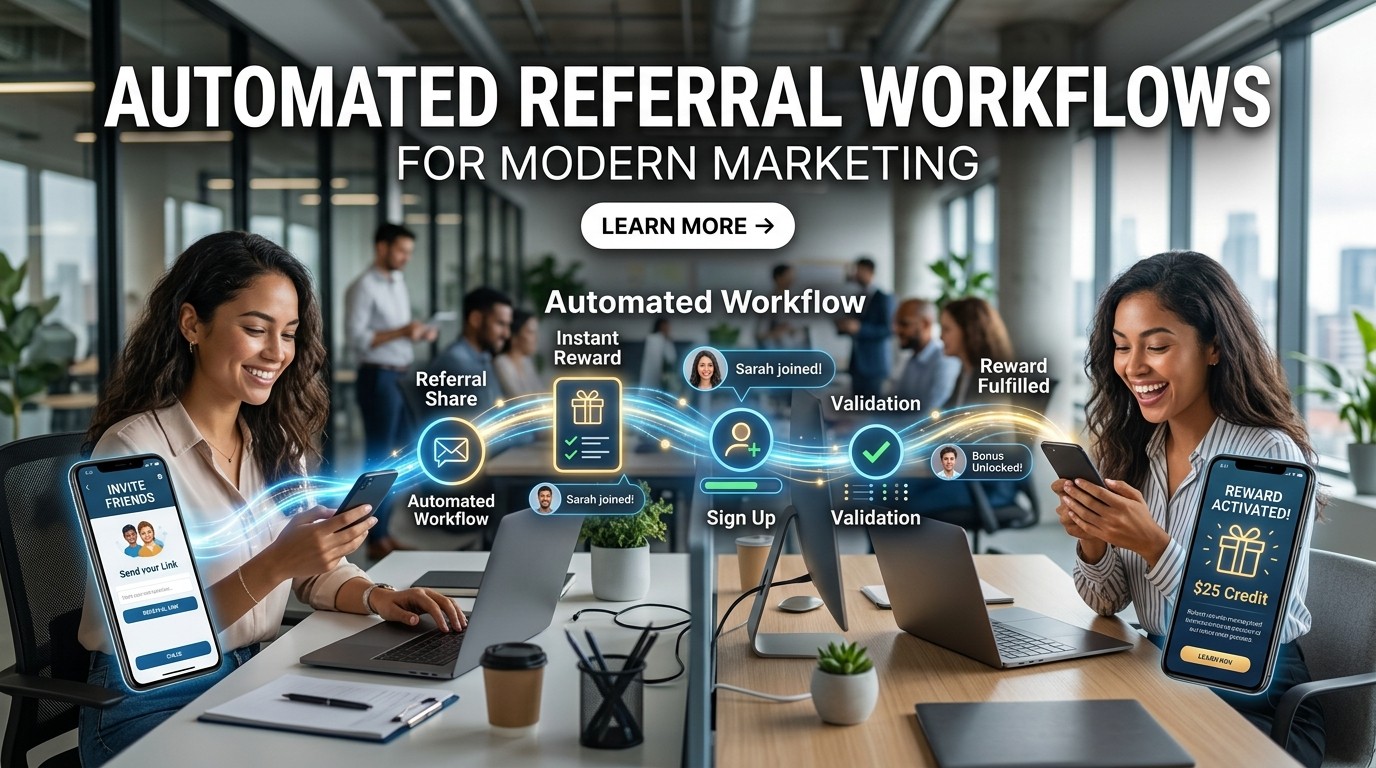
Automated Referral Workflows help modern marketing teams capture more word-of-mouth growth, reduce manual follow-up, and turn referrals into a predictable, measurable, and scalable system overall.
Automated Referral Workflows are changing how modern marketing teams think about trust, advocacy, and growth. Referrals have always been powerful because people trust people more than they trust ads. But referral programs often fail when they depend on manual reminders, scattered spreadsheets, and inconsistent follow-up. Automated Referral Workflows solve that problem by turning referrals into a structured, repeatable, and trackable system that can run quietly in the background while the marketing team focuses on strategy.
The real advantage is not simply speed. It is confidence. When a marketer knows that every referral submission is tracked, every reward is logged, every reminder is sent on time, and every advocate receives a clear next step, the program becomes easier to trust. That trust changes behavior. Teams invest more energy in referral campaigns when they believe the system will not break. Customers participate more often when the process feels simple and transparent. Automated Referral Workflows create that feeling by removing the friction that usually kills momentum.
Modern marketing is already crowded with channels, metrics, and tools. Teams are expected to do more with less while keeping the customer experience personal. Automated Referral Workflows help by reducing repetitive tasks and keeping the program consistent across every stage. Instead of worrying about whether someone remembered to send a reward email or update a tracking sheet, the team can build a durable process that handles those steps automatically. That is why automation is not just a technical upgrade. It is a growth strategy built for how people actually behave.
Why Referral Automation Matters
Referrals work best when the process feels easy. If someone has to fill out too many forms, wait too long for a reward, or wonder whether their submission was received, participation drops. Automated Referral Workflows remove those friction points. They make the experience more immediate, more reliable, and more rewarding.
Automated Referral Workflows also reduce the operational burden on the marketing team. Every referral program creates recurring tasks: checking submissions, validating leads, assigning rewards, updating records, and sending follow-ups. Those tasks are important, but they are not strategic by themselves. Once automation handles them, the team can spend more time improving the offer, refining the audience, and strengthening the message.
There is also a psychological reason automation matters. People are more likely to participate in programs they understand. A clear flow lowers hesitation and increases trust. This automation makes the journey visible. Participants know what happens next, and that clarity increases engagement. In marketing, clarity often beats complexity.
What a Referral Workflow Should Do
A useful referral system should do more than collect names. Automated Referral Workflows should capture the submission, route it to the right place, validate eligibility, track progress, and trigger the appropriate communication at each step. The system should also support rewards, reminders, and reporting without requiring manual intervention every time.
This workflow is most effective when it acts like a living process instead of a static form. A referral should move through clear stages: submission, verification, qualification, reward, and follow-up. Each stage should have a defined owner or rule, so nothing gets lost. That structure makes the program feel organized from the participant’s point of view and manageable from the team’s point of view.
The best workflow also leaves room for exceptions. Not every referral is identical. Some may need manual review. Some may require special handling because of region, product line, or customer status. Automated Referral Workflows should handle the common path automatically while still allowing the team to step in when judgment is needed.
The Business Benefits

The first major benefit is scale. The system lets a small team manage a much larger program without adding the same amount of manual work. That matters because referrals can grow quickly when the offer is good and the process is simple.
The second benefit is speed. The system can confirm submissions, notify participants, and trigger next steps much faster than a human team working from a spreadsheet. Faster response usually improves participation because people feel the system is active and dependable.
The third benefit is accuracy. Manual tracking often creates mistakes, duplicate entries, or missed rewards. The workflow reduces those errors by using rules and logs. That improves trust in the program, which is especially important when rewards have real value.
The fourth benefit is measurement. If the workflow is built well, it becomes much easier to see where referrals come from, which participants convert, and what the program is producing. The workflow makes the data more reliable, and reliable data makes decisions better.
A Simple Process View
| Stage | Manual Problem | Automation Advantage |
|---|---|---|
| Submission | Forms get missed | Instant capture |
| Validation | Checks take time | Rule-based review |
| Tracking | Spreadsheet errors | Live status updates |
| Rewarding | Delayed payouts | Automatic triggering |
| Reminders | Forgotten follow-ups | Scheduled nudges |
| Reporting | Hard to measure | Clear performance data |
This structure is the heart of the system. The workflow should be easy to understand, consistent to operate, and strong enough to grow with the business.
Building the Right Referral Program
A strong referral program starts with a simple promise. People need to understand why they should refer, what they get, and how the process works. The system supports that promise by keeping the program clean and responsive.
The offer must feel fair. If the reward is too small, participation drops. If the rules are confusing, trust drops. If the process is too slow, enthusiasm disappears. Automated Referral Workflows help solve those issues by ensuring that the participant does not have to wait in uncertainty. The next step happens automatically, which keeps the energy alive.
It also helps to design the workflow from the participant’s perspective rather than the marketer’s perspective. A marketer may care about source attribution and reporting. A participant mainly cares about simplicity and reward clarity. Automated Referral Workflows should serve both groups without making either one work harder than necessary.
Where Automation Helps Most
One of the biggest friction points in referral marketing is submission handling. The system captures the referral immediately and sends the right response without delay. That first impression matters because it tells the participant that the system is working.
Another key area is eligibility. Some referrals qualify, others do not. Automated Referral Workflows can use rules to determine whether a referral meets the basic criteria before the team spends time reviewing it. That saves effort and keeps the process more consistent.
Reward delivery is another strong use case. Whether the reward is cash, credit, gift cards, discounts, or points, Automated Referral Workflows can help trigger the right action at the right time. That makes the program feel more professional and less dependent on manual follow-up.
Choosing the Right Tooling Stack
A referral workflow rarely exists alone. It usually connects to CRM systems, email tools, landing pages, and analytics platforms. Automated Referral Workflows work best when they fit into that broader stack instead of creating another disconnected island.
For many teams, SaaS Marketing Tools are the backbone of the broader growth operation. Referral automation should fit naturally into that ecosystem so the team can manage campaigns, contacts, and results from a more unified environment.
Tool selection should also consider usability. A powerful system is not helpful if the team cannot maintain it. Automated Referral Workflows should be simple enough to understand, flexible enough to adapt, and reliable enough to trust. The ideal tool lowers administrative load instead of adding it.
The Role of Data and Trust
Referral programs live or die on trust. If participants believe the system is fair and responsive, they are more likely to recommend others. Automated Referral Workflows help create that trust by ensuring that the process is consistent every time.
Data quality matters here too. If the tracking logic is wrong, the reward rules are unclear, or the conversion status is not updated correctly, participants may feel the program is broken. Automated Referral Workflows should therefore be built on clean data, clear definitions, and a simple rule set.
Trust also depends on visibility. People want to know whether the referral was received, reviewed, and rewarded. Automated Referral Workflows should provide those moments of confirmation so the participant never feels ignored. That reassurance is a small detail, but small details often decide whether people engage again.
Automation and Human Psychology
Referral behavior is emotional. People share because they believe in the product, want to help someone, or want a reward. Automated Referral Workflows work best when they respect that psychology. The process should feel rewarding, not bureaucratic.
When the system sends timely updates, the participant feels acknowledged. When the reward arrives without delay, trust grows. When the instructions are clear, hesitation drops. Automated Referral Workflows succeed because they make the experience feel smooth and respectful. That emotional simplicity can be just as important as the technical logic.
This also means the workflow should not feel robotic in a bad way. The automation should support human behavior, not flatten it. Good referral systems use automation to remove friction while preserving warmth. That is where great marketing systems stand apart from basic ones.
Tracking, Attribution, and Reporting

One of the hardest parts of referral marketing is knowing what actually worked. Automated Referral Workflows make tracking much easier by connecting each referral to its source, status, and outcome. That creates a clean record that can be used for reporting and optimization.
With better tracking, the team can see which channels bring the best advocates, which incentives lead to conversion, and which parts of the workflow need improvement. Automated Referral Workflows also make it easier to compare performance over time. That matters because referral growth is often cumulative rather than immediate.
Attribution should be designed carefully. If the logic is unclear, the team may reward the wrong participant or miss the real source of the lead. Automated Referral Workflows should therefore include clear IDs, timestamps, and status rules. That structure protects both reporting and fairness.
Referral Rewards and Motivation
Rewards are not the only reason people refer, but they do matter. Automated Referral Workflows can improve motivation by making the reward system visible and reliable. If the participant knows what they will receive and when they will receive it, they are more likely to act.
The best reward structure is simple. Complicated reward tiers can make the program hard to explain and hard to manage. Automated Referral Workflows are strongest when the reward logic is easy to understand and easy to deliver. That keeps both the participant and the internal team on the same page.
Different audiences may respond to different incentives. Some people prefer cash. Others prefer credits, discounts, or experiential rewards. Automated Referral Workflows should be flexible enough to support the right incentive model without turning the workflow into a manual burden.
Where AI Can Help
AI Tools for Affiliate Marketing can also support broader referral and partner programs by identifying patterns, helping optimize messaging, and surfacing performance trends. That does not replace the workflow itself, but it can make the system smarter.
When AI is used well, it can help segment participants, identify high-potential advocates, and suggest improvements to the referral journey. Automated Referral Workflows benefit from that insight because the system becomes more adaptive over time.
AI should be used carefully, though. It works best when the referral rules are already clear. Automated Referral Workflows still need a strong foundation of logic, tracking, and fairness. AI can improve the system, but it cannot rescue a broken one.
Centralized Management
Many organizations prefer to manage everything from one place. A Referral Marketing Software Hub can serve as that central point for referral rules, tracking, rewards, and performance visibility. That makes it easier to maintain consistency as the program grows.
Automated Referral Workflows are easier to govern when the data, actions, and reports live close together. If one team is tracking participants in one system and another team is handling rewards in another, mistakes become more likely. Centralized management reduces that problem.
The main advantage of a hub is control. It gives the team a clearer picture of what is happening and allows changes to be made faster. Automated Referral Workflows become much easier to run when the system is organized around one source of truth.
Choosing the Best Platform
The Best Referral Marketing App for one company may not be the best for another. The right choice depends on the program’s size, the desired level of automation, the complexity of rewards, and the amount of reporting needed. Automated Referral Workflows should be supported by a platform that fits those needs.
A strong app should be easy to set up, easy to maintain, and easy to understand. It should support workflow rules without requiring constant technical help. Automated Referral Workflows work best when the team can control them without friction.
Support quality matters too. If the workflow breaks or needs adjustment, the vendor should be able to help. Referral programs depend on reliability, so the tool behind them should be dependable as well.
Common Mistakes
One common mistake is making the process too complicated. If participants need to navigate too many steps, they may stop before completing the referral. Automated Referral Workflows should reduce complexity, not add to it.
Another mistake is failing to test the logic before launch. If the wrong trigger fires or the reward rule is broken, the team may have to fix problems after the campaign is already live. Automated Referral Workflows should always be tested carefully before going public.
A third mistake is not communicating clearly. People should know how the referral works, what the reward is, and when they can expect confirmation. Automated Referral Workflows are most effective when the instructions are simple and the process feels transparent.
How to Launch Successfully

Start with one clear use case. Automated Referral Workflows do not need to solve every possible referral problem on day one. A focused launch builds confidence and gives the team a chance to learn from real behavior.
Keep the form short. Make the reward easy to understand. Show confirmation quickly. These small details can dramatically improve participation. Automated Referral Workflows should feel smooth from the participant’s first click to the final reward.
Then measure what happens. Review submission volume, conversion rate, reward delivery time, and participant engagement. Automated Referral Workflows should gradually get better as the team learns what works and what creates friction.
Why Simplicity Wins
People do not refer because the process is clever. They refer because the process is easy. Automated Referral Workflows succeed when they remove hesitation and make the next step obvious.
That is also why the best programs are often the simplest ones. A clean offer, a clear reward, and a fast confirmation path are often more effective than a highly complex campaign. Automated Referral Workflows should feel light, not heavy.
When a program is easy to explain and easy to use, word of mouth becomes more likely. The participant feels respected, the team stays organized, and the system scales more naturally.
Operational Benefits for the Marketing Team
The internal team gains just as much as the participant. Automated Referral Workflows reduce manual checking, eliminate repetitive emails, and make it easier to keep programs running without constant intervention. That saves time and mental energy.
When teams are freed from routine tasks, they can focus on better campaign design and stronger audience engagement. That shift is one of the biggest benefits of automation. Automated Referral Workflows are not just about making the program faster. They are about making the team smarter. That consistency also protects morale, because people feel less like operators of chaos and more like builders of growth daily.
This also improves collaboration. Sales, marketing, and operations can all see the same workflow stage and act accordingly. That kind of shared visibility reduces confusion and improves execution.
Conclusion
Automated Referral Workflows give modern marketing teams a better way to turn advocacy into measurable growth. They reduce manual effort, make participation smoother, and give the business more reliable tracking and reporting. The real benefit is not only efficiency but confidence. When the process is clear, participants trust it, teams can manage it, and leaders can measure it. The best referral systems are simple, transparent, and built around human behavior rather than around internal convenience. When automation is done well, referrals stop feeling like an occasional campaign and start functioning like a dependable growth engine across every stage of growth.
Frequently Asked Questions (FAQ)
1. What are Automated Referral Workflows?
They are referral processes that use software rules to handle submissions, tracking, rewards, reminders, and reporting automatically.
2. Why are Automated Referral Workflows useful?
They reduce manual work, improve consistency, increase speed, and make referral programs easier to manage at scale.
3. What is the biggest benefit for participants?
Participants get faster confirmation, clearer instructions, and a more reliable reward experience.
4. What is the biggest benefit for marketing teams?
Marketing teams save time, reduce errors, and get better visibility into program performance.
5. Do Automated Referral Workflows need a lot of setup?
They need thoughtful setup, but the best systems are simple enough to maintain once the core rules are defined.
6. How do rewards fit into the workflow?
Rewards can be triggered automatically after eligibility and conversion rules are met, which keeps the program moving smoothly.
7. Can AI improve referral programs?
Yes, AI can help with pattern detection, segmentation, and optimization, but it works best on top of a solid workflow.
8. What causes referral programs to fail?
They often fail because the process is confusing, slow, hard to trust, or too manual to maintain.
9. Should referral tools connect with other marketing systems?
Yes. Integration with CRM, email, analytics, and marketing platforms makes the workflow much more useful.
10. How do I know if the workflow is working?
Look at submission rate, conversion rate, reward speed, and participant engagement over time.