
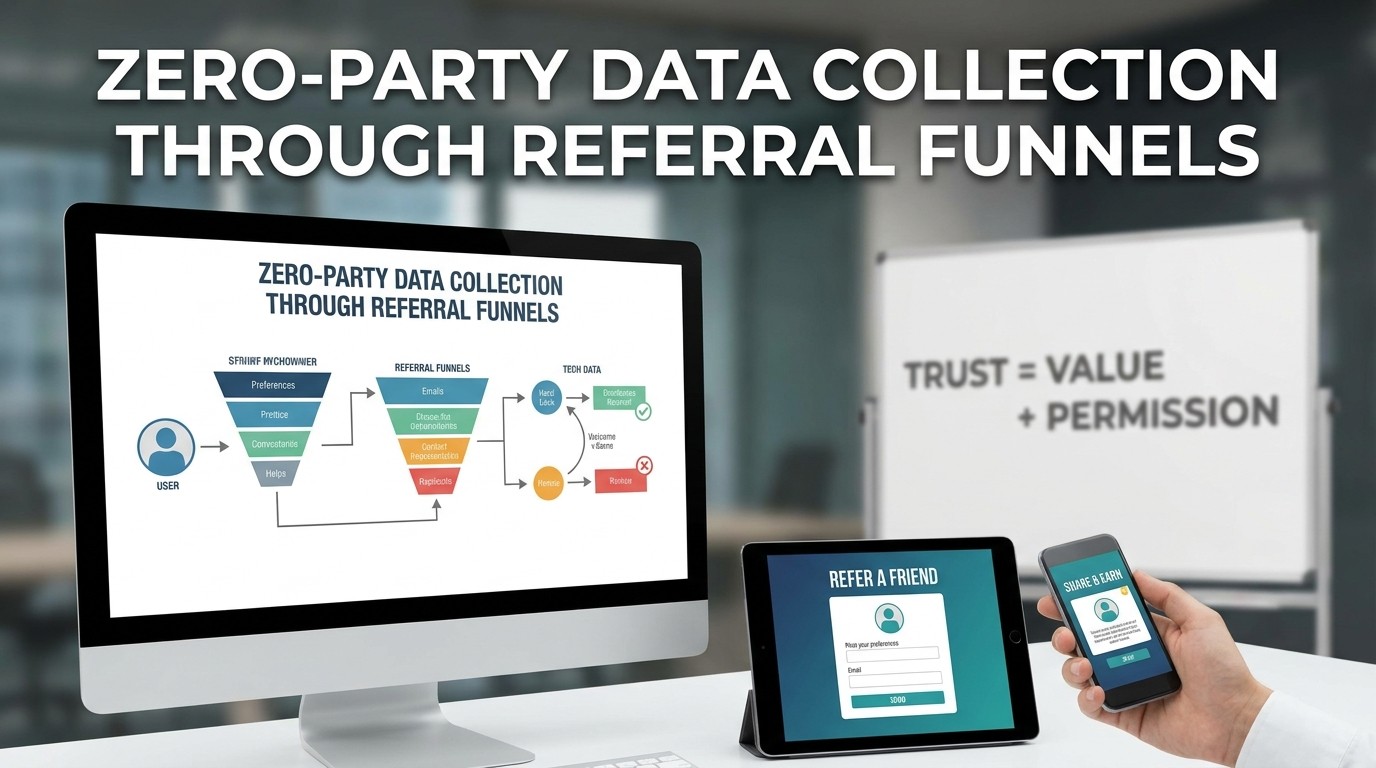
Zero-Party Data Collection becomes a powerful growth asset when referral funnels invite customers to voluntarily share preferences, motivations, and needs in exchange for relevant value.
Modern marketing increasingly depends on understanding what people actually want rather than guessing from what they click. That shift makes Zero-Party Data Collection especially valuable because the information comes directly from customers who intentionally provide it.
Traditional analytics can show which page someone visited, what product they viewed, or which advertisement generated a visit. Those signals are useful, but they often reveal behavior without revealing intent. A visitor may click several products without seriously considering any of them. Another person may purchase after reading only one page. Behavioral data records actions, while Zero-Party Data Collection can uncover the reasons behind those actions.
Referral funnels create an unusually strong environment for collecting this type of information because referrals are built around participation, trust, incentives, and identity. A person who is willing to recommend a brand is often also willing to answer a short question about what they like, what problem they are solving, or which offer fits them best.
The strategic opportunity is simple: instead of collecting more data indiscriminately, marketers can create better moments for people to deliberately share useful information.
What Is Zero-Party Data Collection?
Zero-Party Data Collection refers to information a customer intentionally and proactively provides to a company. Typical examples include declared preferences, purchase intentions, product interests, communication preferences, personal needs, favorite categories, sizing information, and answers to preference questions.
The defining feature is consent through participation. The customer is not merely being observed. They are communicating something about themselves directly.
Zero-Party Data Collection is therefore different from first-party behavioral data. First-party data may tell a company that someone repeatedly visits a pricing page. Zero-party information can tell the company that the visitor is comparing plans because they need a solution for a five-person team.
The distinction matters because intent often sits behind behavior.
Why Intent Is More Valuable Than Raw Activity
Imagine a customer visits ten product pages. An analytics platform may identify those visits but still fail to understand the customer’s final goal. A short referral-funnel question such as “What are you shopping for today?” could produce a direct answer.
That answer can influence product recommendations, follow-up messages, landing-page personalization, referral incentives, and customer segmentation.
Zero-Party Data Collection works particularly well when the questions feel useful rather than intrusive. The customer should perceive the exchange as beneficial: “You tell us what you need, and we will make the experience more relevant.”
This is where psychology becomes important.
People are more likely to share information when they understand why the information is requested, receive a visible benefit, and feel that they retain control. Referral funnels can combine all three elements.
Why Referral Funnels Are Ideal for Zero-Party Data Collection
Referral funnels already contain moments of high engagement. A customer may receive an invitation to refer a friend, unlock an incentive, select a reward, or participate in a referral challenge.
Each interaction can become a micro-moment for voluntary information sharing.
For example, a software company could ask a referrer which feature their friend is most likely to need. A fitness brand could ask whether the referred person is interested in strength, mobility, endurance, or general wellness. A local service company could ask what type of service the referral is seeking.
These questions do more than improve segmentation. They can make the referral process itself easier.
Zero-Party Data Collection becomes stronger when information gathering is integrated into the customer’s task rather than added as an unrelated survey.
The Psychology Behind Voluntary Sharing
Customers do not naturally want to complete long forms. They want progress.
A referral funnel can therefore use progressive questions. The first question should require minimal effort and provide immediate relevance. Later questions can appear only when necessary.
For instance:
| Funnel Stage | Customer Interaction | Data Opportunity |
|---|---|---|
| Referral invitation | “Who would benefit?” | Relationship or audience type |
| Preference question | “What are they looking for?” | Product/service intent |
| Recommendation | “Which option sounds right?” | Preference signal |
| Incentive selection | “Choose your reward” | Motivation |
| Follow-up | “How should we contact you?” | Communication preference |
| Conversion | Purchase or signup | Confirmed intent |
This process allows Zero-Party Data Collection to happen naturally throughout the funnel instead of appearing as a separate research activity.
Designing a Referral Funnel Around Customer Intent

A high-performing referral funnel should answer one central question: what information would make the next customer experience meaningfully better?
That question prevents marketers from collecting unnecessary details simply because a form allows them to.
Zero-Party Data Collection should be purpose-driven. Every field needs a business reason and a customer-facing explanation.
Step 1: Define the Decision You Want to Improve
Start with a practical marketing decision.
Maybe the goal is to recommend the right product. Perhaps the goal is to decide which content a new subscriber receives. It could also be deciding whether a lead should receive a discount, a consultation, a local offer, or an educational sequence.
The desired decision determines the information you should request.
For example, if a referral program serves several customer types, asking “Which describes your primary goal?” may be more valuable than collecting demographic information.
Step 2: Ask Questions With Obvious Utility
A question feels invasive when its purpose is unclear.
Instead of asking:
“Tell us more about yourself.”
Ask:
“Which result are you trying to achieve?”
The second question connects directly to the customer’s objective.
Zero-Party Data Collection should make customers think, “That question will help them help me.”
That is a powerful psychological trigger because relevance reduces resistance.
Step 3: Use Choice Architecture
People answer questions more easily when possible answers are clearly structured.
Use a small number of meaningful choices rather than requiring customers to write long responses. Multiple-choice options can increase completion rates because the mental cost is lower.
Example:
“What matters most to you?”
- Lower cost
- Faster results
- Premium quality
- Simpler setup
- Expert support
These choices provide immediate segmentation without making the user feel like they are completing a research questionnaire.
The Value Exchange Model
Successful referral funnels usually involve a value exchange.
The customer provides an answer, recommendation, or preference. In return, they receive something meaningful.
That reward does not always need to be monetary.
It can be:
- A personalized recommendation
- Early access
- Exclusive content
- A better referral reward
- A discount
- A customized comparison
- A faster onboarding path
- A relevant checklist
- A useful assessment
The strongest Zero-Party Data Collection experiences connect the answer directly to the reward.
For example, after asking a customer which type of product they prefer, the funnel can immediately display a personalized recommendation. The person sees the outcome of sharing their information.
That creates a reinforcement loop.
Why Immediate Feedback Matters
If customers answer several questions and then receive nothing meaningful, the exchange feels one-sided.
But when the funnel responds immediately, participation feels productive.
A retailer might ask three preference questions and instantly generate a “Best Match” collection.
A B2B company could ask about team size, primary challenge, and buying timeline, then present the appropriate resource package.
A service business could ask the customer’s goal and location, then recommend the appropriate service category.
In each example, Zero-Party Data Collection improves personalization while simultaneously improving customer experience.
Building a Privacy-First Referral Experience
Privacy expectations are changing the way people evaluate brands. Customers increasingly want to know what information is being collected, why it matters, and how it will be used.
That makes transparent design essential.
Zero-Party Data Collection is naturally aligned with a privacy-first approach because the information is intentionally supplied. However, voluntary disclosure does not remove the responsibility to explain usage clearly.
Explain the Reason for the Question
A short explanation can dramatically reduce uncertainty.
For example:
“Choose your main goal so we can recommend the most relevant options.”
That sentence tells the customer what the information does.
Avoid vague language such as “for marketing purposes” when a more specific explanation is possible.
Collect Less, Learn More
The objective is not maximum data volume.
The objective is maximum decision value per question.
A company may gain more useful insight from three precise questions than from a twenty-field form.
Zero-Party Data Collection becomes more powerful when every answer changes something meaningful in the experience.
That principle also improves trust.
Customers notice when a company asks unnecessary questions. Excessive data collection can make even a well-designed referral program feel transactional.
Referral Incentives That Encourage Better Data
Incentives influence behavior, but the wrong incentive can create poor data.
Suppose a referral program offers a large discount simply for completing a questionnaire. People may rush through the questions or select random answers.
A better approach is to align the incentive with useful participation.
For example:
“Complete your preferences to unlock a personalized bundle.”
Now the reward depends on an action that also improves the customer experience.
Zero-Party Data Collection should not be treated as a toll gate. It should function as part of the product journey.
Emotional Drivers Behind Referral Participation
People refer brands for several reasons.
They may want to help friends, earn rewards, express loyalty, identify with a community, or share something they genuinely enjoy.
A smart referral funnel recognizes these motivations.
For example, a customer who wants recognition may respond well to status-based rewards. A practical customer may prefer discounts. A socially motivated customer may prefer giving their friend an exclusive benefit.
The funnel can ask:
“What would make referring a friend most valuable to you?”
The answer itself becomes useful marketing intelligence.
Combining Zero-Party Data With Segmentation
The most practical use of Zero-Party Data Collection is segmentation.
Instead of placing every customer into broad demographic buckets, marketers can segment by declared intent.
A useful segmentation structure might include:
| Segment | Declared Need | Recommended Experience |
|---|---|---|
| Explorer | Learning and comparison | Educational content |
| Evaluator | Comparing solutions | Reviews and comparisons |
| Ready Buyer | Strong purchase intent | Offer and product details |
| Advocate | Wants to share | Referral rewards |
| Loyal Customer | Existing relationship | VIP benefits |
These segments can power email journeys, landing pages, product recommendations, advertising audiences, and customer-success workflows.
Intent-Based Segmentation Beats Demographic Guessing
Demographics can sometimes be helpful, but intent often explains immediate behavior better.
A 22-year-old and a 52-year-old may have completely different profiles, but both may be looking for the same solution.
Zero-Party Data Collection gives marketers access to declared intent without relying entirely on assumptions.
That makes segmentation more actionable.
Using Referral Questions as Market Research
Referral funnels can also reveal language customers naturally use.
This is particularly valuable for messaging.
Suppose customers repeatedly describe a problem as “too complicated to set up.” That phrase can become a messaging insight for landing pages, ads, emails, and sales scripts.
Another group may consistently describe the benefit as “saving time.”
The marketer now has customer-generated language.
Zero-Party Data Collection can therefore become an ongoing voice-of-customer system.
Capture the Words Customers Actually Use
Open-ended questions should be used strategically.
Instead of asking customers to write long responses, ask targeted questions such as:
“What is the biggest challenge you are trying to solve?”
A short text field can reveal emotional drivers that fixed choices might miss.
Those responses can help identify recurring pain points, objections, motivations, and desired outcomes.
However, open text should be used when its potential insight justifies the additional effort.
Integrating Referral Funnels With Content Strategy
Customer answers can influence content strategy.
Imagine that a company discovers that most referred prospects are uncertain about implementation. The content team can develop guides, checklists, videos, comparisons, and FAQs around implementation.
This creates a feedback cycle:
Customer answers → insights → content → better funnel → better answers.
Zero-Party Data Collection becomes part of the company’s learning system rather than a one-time campaign tactic.
Personalizing Content Distribution
Different segments can receive different educational journeys.
Someone who wants beginner information might receive foundational content.
Someone already comparing options might receive a comparison guide.
A high-intent lead may receive case studies, testimonials, pricing information, and implementation details.
This level of relevance can increase engagement because the customer receives content aligned with their stated needs.
Referral Funnels for Local Businesses
Local businesses can also use referral funnels effectively.
A clinic, home service provider, restaurant, salon, repair company, or professional service can ask a few questions before presenting the best next step.
For example:
“What service are you looking for?”
“When do you need it?”
“What is most important: price, speed, or premium service?”
The answers can improve lead routing and customer communication.
Businesses investing in local discovery should also think beyond direct acquisition. Some referral customers may later search for reviews, maps, or business information. Strong local visibility can support the referral process.
This is where broader strategies such as Local SEO And Reputation Mastery become relevant to the full customer journey, although the referral funnel should remain focused on its own objective.
Connecting Referral Funnels With Community Growth

Communities offer another strong application.
A business running a private community can ask members about interests, goals, or preferred topics during referral invitations.
For example, a member could invite a friend and select the reason for the invitation:
- They need educational resources
- They are looking for a service
- They want networking opportunities
- They may benefit from discounts
- They are interested in the community topic
Those selections reveal the social context around referrals.
A community-focused brand may even use a strategy similar to Monetize Chat Groups, where referral incentives and member preferences work together to create a more relevant experience.
The key is that the data must support the community rather than exploiting it.
Creating a Multi-Step Referral Funnel
A sophisticated funnel can be organized into several stages.
Stage 1: Referral Trigger
The customer receives a compelling reason to refer.
The message should emphasize the benefit for both the sender and recipient.
Stage 2: Recipient Context
The referrer answers one lightweight question about the person or need.
This helps determine which experience the recipient should receive.
Stage 3: Personalized Entry
The referred user arrives on a page tailored to the declared intent.
This reduces friction.
Stage 4: Preference Exchange
The new visitor answers a few questions to improve recommendations.
Zero-Party Data Collection is especially valuable at this point because the visitor has a clear reason to engage.
Stage 5: Relevant Offer
The funnel provides an offer, recommendation, resource, or next step based on the answers.
Stage 6: Consent-Based Follow-Up
Communication preferences are collected explicitly.
Stage 7: Conversion and Referral Loop
After conversion, the customer becomes eligible to refer another person.
The process becomes cyclical.
Common Mistakes to Avoid
Not every referral funnel produces useful data.
Some programs fail because marketers focus too heavily on extracting information instead of improving the customer journey.
Asking Too Many Questions
Long forms create friction.
Start with the smallest set of questions that can change the experience.
Asking Questions Too Early
A visitor who has not yet understood the value of the offer is unlikely to provide detailed information.
Build context first.
Hiding the Purpose
Customers should understand why a question matters.
Transparency supports trust.
Offering Irrelevant Rewards
The incentive should reinforce meaningful participation.
Using Data Without Updating the Experience
Collecting preferences and then sending generic messages wastes the value of the information.
Treating Every Customer the Same
Declared preferences should lead to meaningful segmentation.
Ignoring Data Quality
Customers may select answers carelessly when questions are confusing or overly broad.
Question wording matters.
How to Measure Referral Funnel Performance
A successful funnel should be evaluated at both the acquisition and information layers.
Useful metrics include:
| Metric | What It Reveals |
|---|---|
| Referral participation rate | Interest in sharing |
| Question completion rate | Friction level |
| Preference response rate | Willingness to disclose |
| Referral conversion rate | Quality of referrals |
| Segment conversion rate | Value of declared intent |
| Reward redemption rate | Incentive effectiveness |
| Repeat referral rate | Advocacy strength |
| Customer lifetime value | Long-term impact |
Zero-Party Data Collection should ultimately be connected to business outcomes.
A question is valuable when the information changes an action that improves customer experience or business performance.
Measure Information Quality, Not Only Quantity
A database with thousands of weak preference records is less useful than a smaller dataset containing accurate, decision-relevant information.
Track whether declared preferences correlate with:
- Product selection
- Conversion
- Retention
- Referral behavior
- Content engagement
- Customer satisfaction
- Revenue
Over time, the company can determine which questions produce the strongest predictive value.
A/B Testing Your Referral Questions
Question design should be tested.
For example, compare:
“What are you interested in?”
with:
“What result are you trying to achieve?”
The second question may produce clearer intent.
You can also test:
- Question order
- Number of choices
- Incentive placement
- Explanation text
- Progress indicators
- Personalized recommendation timing
- Reward structure
Zero-Party Data Collection improves when marketers continuously test how questions affect participation and downstream outcomes.
Test One Variable at a Time
A clean experiment makes it easier to understand what changed.
Suppose completion rates increase after the brand shortens a form. That provides a clearer lesson than changing the form, headline, reward, layout, and CTA simultaneously.
Testing should create learning, not simply generate better numbers.
Automation and Customer Journeys
Automation can turn customer responses into immediate actions.
For example:
A customer selects “beginner” → receives introductory content.
A customer selects “ready to buy” → receives product comparison information.
A customer selects “needs expert help” → receives a consultation option.
A customer selects “wants discounts” → enters a promotion-focused sequence.
This transforms Zero-Party Data Collection into an activation engine.
CRM Integration
Referral responses can be stored as structured attributes inside a CRM or marketing platform.
Useful fields might include:
- Primary goal
- Preferred product category
- Purchase timeline
- Communication preference
- Referral motivation
- Customer stage
- Content interest
- Service requirement
The system should also preserve consent status and maintain clear rules for how the information can be used.
Privacy-First Referral Funnels
A privacy-first approach is not merely a compliance exercise.
It can be a competitive advantage.
When customers know exactly what they are sharing and receive visible value in return, participation becomes more intentional.
Privacy-first messaging can be simple:
“We only ask for information needed to personalize your recommendation.”
That makes the exchange understandable.
Zero-Party Data Collection should always prioritize transparency, relevance, security, and customer control.
Think in Terms of Permission
A useful internal question is:
“Would the customer reasonably expect us to use this answer in this way?”
If the answer is unclear, the process needs more transparency.
Customers should not have to decode complicated explanations to understand the basic exchange.
From Data Collection to Customer Intelligence
The ultimate goal is not merely to collect information.
The goal is to understand customers well enough to make better decisions.
Referral funnels can reveal:
- Why customers buy
- Why people refer
- Which benefits matter most
- Which products attract specific needs
- Which objections appear repeatedly
- Which incentives motivate participation
- Which content customers actually value
- Which segments convert more effectively
Zero-Party Data Collection makes these insights more explicit because customers are directly communicating their perspective.
That makes the data especially useful for strategy.
Turning Answers Into Better Messaging
Customer language can improve:
- Headlines
- Product descriptions
- Ad copy
- Sales scripts
- Referral emails
- Landing pages
- FAQs
- Onboarding flows
Suppose customers repeatedly select “I want something simple.”
That insight can influence positioning.
Instead of emphasizing technical complexity, the company can highlight ease of use.
This is human psychology in practice: people respond when brands frame solutions around the outcomes customers already value.
The Future of Referral-Led Personalization
Referral funnels are increasingly becoming more than acquisition mechanisms.
They can function as interactive research, personalization systems, and customer-intelligence channels.
The strongest models treat each interaction as a conversation.
The company asks something meaningful.
The customer answers.
The company responds with something useful.
That cycle creates a better experience and better information.
Zero-Party Data Collection therefore works best when it is embedded into the experience rather than attached to it.
Build the Funnel Around Questions That Matter
Before adding a question, ask:
Does the answer change anything?
Will the customer see a benefit from answering?
Can we use the information responsibly?
Can the system act on it?
Does the question feel easy and natural?
If the answer to these questions is yes, the information is more likely to be valuable.
Practical Framework for Implementation

A company can launch a referral-based data strategy through a simple sequence.
First, define the customer decision the funnel needs to improve.
Second, identify three to five preference signals that directly influence that decision.
Third, convert those signals into simple questions.
Fourth, connect each important answer to a recommendation, content path, offer, or routing rule.
Fifth, create a clear value exchange.
Sixth, make consent and data usage understandable.
Seventh, connect the information to the CRM or customer platform.
Eighth, measure downstream outcomes rather than only form completion.
Ninth, remove questions that do not produce useful decisions.
Tenth, continuously test wording, incentives, and personalization.
This approach keeps Zero-Party Data Collection practical and customer-centered.
Final Strategic Perspective
The best referral funnels do not feel like data collection systems.
They feel like helpful experiences.
The customer receives a relevant recommendation, a useful reward, a faster path, or a more personalized interaction. In exchange, the brand receives explicit insight into customer intent.
That is the strongest form of the model.
Zero-Party Data Collection becomes strategically powerful when information, personalization, trust, and value are designed as one connected experience.
Instead of asking customers to surrender more information, brands can create better reasons for customers to share the information they genuinely want to communicate.
The difference is subtle but important.
Data extraction focuses on the business.
Value exchange focuses on the relationship.
Referral funnels can bridge both.
Conclusion
Zero-Party Data Collection gives referral funnels a deeper strategic role by turning voluntary customer input into actionable intent, personalization, segmentation, and relationship insight. The strongest approach asks only useful questions, clearly explains the value exchange, protects customer control, and immediately uses responses to improve the experience. When referral incentives, privacy, automation, content, and customer intelligence work together, brands can build funnels that do more than generate leads. They can create a continuous feedback loop where customers communicate what they need and businesses respond with greater relevance. That makes Zero-Party Data Collection a practical foundation for more trusted, personalized, and sustainable referral-driven growth.
Frequently Asked Questions (FAQ)
What is Zero-Party Data Collection?
Zero-Party Data Collection is the practice of gathering information that customers intentionally and proactively provide, such as preferences, interests, intentions, and communication choices. The information is valuable because it comes directly from the customer rather than being inferred solely from observed behavior.
Why are referral funnels useful for Zero-Party Data Collection?
Referral funnels already involve active customer participation, making them natural environments for asking relevant preference questions. The customer is completing an action, receiving an incentive, or helping someone they know, so carefully designed questions can feel like part of the experience rather than an interruption.
What type of information should a referral funnel collect?
A referral funnel should prioritize information that improves a specific business or customer decision. Useful examples include customer goals, product preferences, buying timelines, service needs, preferred communication channels, referral motivations, and content interests.
How many questions should a referral funnel ask?
There is no universal number, but fewer relevant questions generally create less friction than long forms. Start with the smallest number of questions needed to produce a useful recommendation, segment, or next action, then expand only when additional information provides clear value.
What makes customers willing to share zero-party information?
Customers are more likely to share information when questions are easy, relevant, transparent, and connected to an obvious benefit. Personalized recommendations, discounts, useful content, faster service, better product matching, and meaningful referral rewards can strengthen the value exchange.
How is zero-party data different from first-party data?
First-party data is information a company collects directly through customer interactions, including observed behavior such as page visits, purchases, and engagement. Zero-party data is specifically information the customer intentionally provides, such as stated preferences, goals, or interests.
Can Zero-Party Data Collection improve personalization?
Yes. Because the customer explicitly states what they want or need, the company can use those responses to personalize product recommendations, content, offers, onboarding, email sequences, and referral experiences. The key is ensuring that personalization actually reflects the information provided.
How can businesses protect privacy when collecting referral data?
Businesses should clearly explain why information is requested, collect only what is necessary, provide appropriate consent and preference controls, and use the information in ways customers can reasonably understand. Privacy should be designed into the referral experience rather than treated as an afterthought.
What metrics should be used to evaluate referral data collection?
Important metrics can include referral participation, question completion, preference response rates, referral conversion, conversion by customer segment, reward redemption, repeat referrals, retention, and customer lifetime value. Measuring downstream business impact is more valuable than focusing only on the number of records collected.
Can small businesses use Zero-Party Data Collection?
Yes. Small businesses can implement the strategy with simple tools such as referral forms, quizzes, landing pages, email automation, or CRM fields. A small number of high-value questions can provide meaningful customer insight without requiring a complex enterprise data infrastructure.