
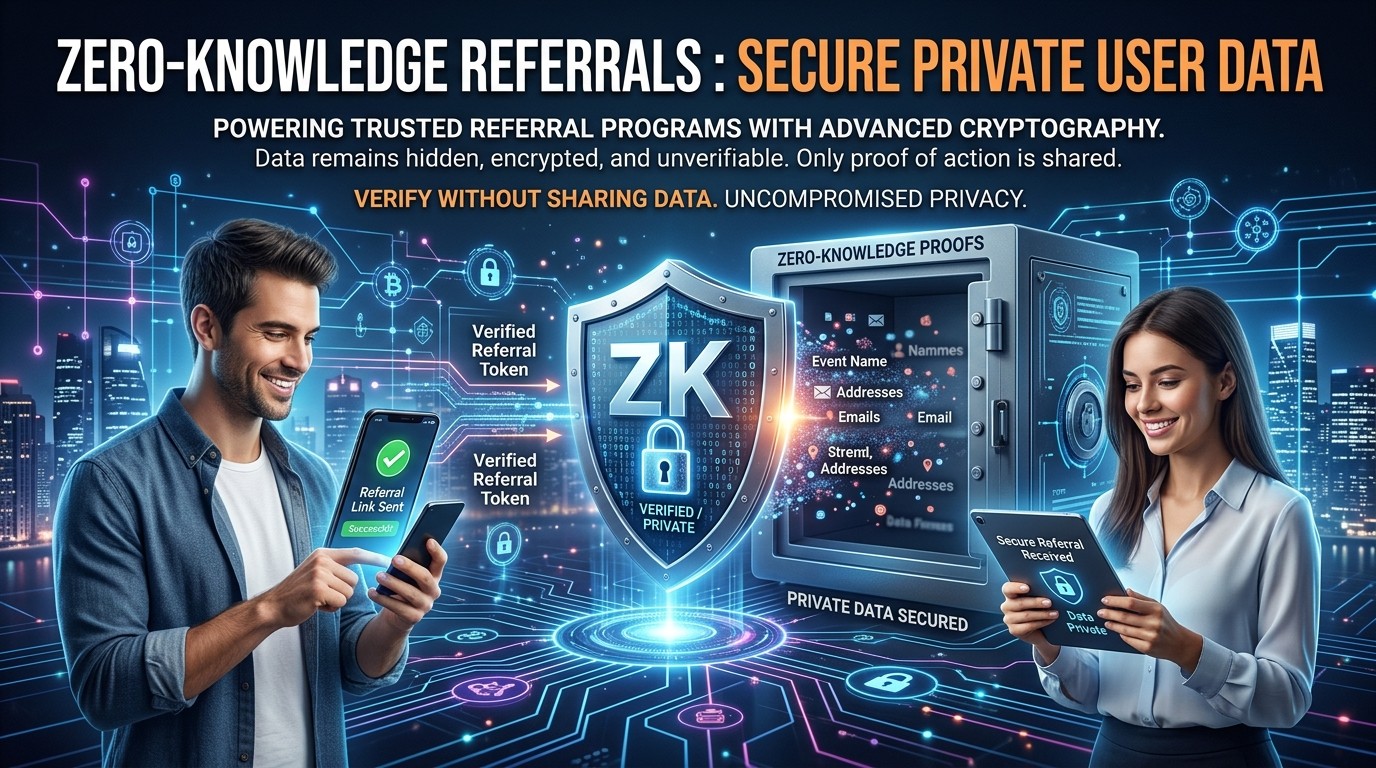
Zero-Knowledge Referrals use privacy-preserving cryptography to verify referral eligibility, rewards, and relationships without unnecessarily exposing sensitive user information across marketing systems or private community activity.
Referral marketing has always depended on relationships. One customer recommends a product to another person, a community member introduces a service to a colleague, or a creator shares a useful tool with an audience. The business then tries to determine where that new customer came from and whether a reward should be issued.
Traditional referral systems often solve this problem by collecting large amounts of information. They may store referring user IDs, recipient identities, timestamps, device information, contact details, campaign parameters, and conversion records. That approach can make attribution easier, but it can also create a large data footprint.
Zero-Knowledge Referrals approach the same challenge from a different direction: instead of proving everything, prove only what is necessary.
A referral platform might need to know that a person was eligible for a reward, that a referral relationship existed, that a purchase occurred, or that a reward has not already been claimed. It may not need to know the entire underlying social graph or every piece of personal information that contributed to the event.
Zero-Knowledge Referrals use zero-knowledge proof concepts to make selective verification possible. In a well-designed system, a user can demonstrate that a statement is true without revealing all the information used to establish that statement.
This can be especially valuable for companies operating in privacy-sensitive environments, blockchain ecosystems, private communities, membership programs, or products where users are uncomfortable exposing their network relationships.
The goal is not to make referral programs invisible. The goal is to make them more privacy-aware.
What Are Zero-Knowledge Referrals?
Zero-Knowledge Referrals describe referral systems that use privacy-preserving cryptographic techniques to verify referral conditions while minimizing the information revealed about the people, accounts, or relationships involved.
The idea builds on zero-knowledge proofs, a category of cryptographic methods that allows one party to prove the truth of a statement to another party without necessarily revealing the underlying secret.
For referral marketing, the statement might be:
- “This user is an eligible member.”
- “This person completed the required action.”
- “This referral has not previously generated a reward.”
- “The referrer belongs to an approved community.”
- “The referred user satisfies the campaign criteria.”
Zero-Knowledge Referrals do not mean that no data exists. Data may still exist at one or more points in the architecture. The important difference is that the verification layer can be designed so the verifier receives only the evidence needed to establish the required claim.
That distinction is critical.
A privacy-preserving system should never be described as automatically anonymous simply because it uses zero-knowledge technology. Identity, compliance, fraud prevention, and operational records may still be required depending on the product and jurisdiction.
The Basic Principle
Traditional verification often looks like this:
“Show me your information so I can determine whether you qualify.”
A zero-knowledge approach aims for:
“Prove that you qualify without revealing unnecessary information.”
That change sounds subtle, but it can reshape the architecture of referral programs.
Why Zero-Knowledge Technology Fits Referral Systems
Referral systems contain a surprising amount of relationship data.
A conventional database may reveal:
- Who referred whom
- When the referral occurred
- Which campaign generated it
- Which account belongs to which person
- Which reward was issued
- Which device completed the conversion
- Which network or community produced the referral
For some applications, this information is useful. For others, collecting all of it creates unnecessary privacy exposure.
Zero-Knowledge Referrals can reduce the amount of raw relationship information that must be passed between systems.
Imagine a private professional community that wants to provide a referral reward to members. The program does not necessarily need to reveal a member’s entire contact network. It may only need a cryptographic proof that the new participant came through a valid member-controlled invitation.
This can preserve the functionality of the program while limiting unnecessary disclosure.
The same principle applies to loyalty programs, creator communities, decentralized applications, and member-only campaigns.
Data Minimization as a Design Goal
Data minimization means collecting and processing only what is needed for a defined purpose.
Zero-Knowledge Referrals naturally support this philosophy because cryptographic proofs can separate the question being verified from the underlying data.
The business can define the claim first.
Then the system can determine the minimum evidence needed to prove that claim.
This is fundamentally different from collecting every available data point and deciding later which ones matter.
How Zero-Knowledge Referrals Work
A simplified referral architecture can contain several components.
The Referrer
The existing participant initiates a referral.
This could happen through a private link, wallet interaction, invitation code, QR code, application action, or another mechanism.
The Referred User
The new participant completes a required action such as account creation, purchase, signup, verification, or membership activation.
The Proof Generator
A client application or backend process creates a cryptographic proof that the required referral condition has been satisfied.
The Verifier
The receiving system checks the proof.
The verifier does not necessarily receive all of the underlying referral information.
The Reward System
If the proof satisfies the defined policy, the reward is issued.
Zero-Knowledge Referrals can therefore separate eligibility verification from raw identity disclosure.
A Simple Example
Suppose a campaign requires a new customer to be:
- A valid member,
- Referred by an existing participant,
- Making a qualifying purchase,
- Claiming the reward for the first time.
A conventional system may send all related records to a central server.
A privacy-preserving system could potentially create a proof that all four conditions are true.
The verifier checks the proof.
The reward system receives the result.
It does not necessarily need to know the user’s entire relationship graph.
Zero-Knowledge Proofs in Simple Language
The mathematics behind zero-knowledge systems can become highly technical, but the user-facing concept is easier to understand.
Imagine a locked room with a secret passage.
You know how to open the passage.
You want to prove to another person that you know the secret without telling them the secret itself.
You could enter through one side and emerge through another side at the correct moment. Repeating the process under unpredictable conditions can give the other person confidence that you know the secret.
Modern zero-knowledge proofs achieve this using sophisticated cryptography rather than physical tricks.
Zero-Knowledge Referrals apply the same high-level principle to business claims.
A user may prove that they satisfy a campaign condition without directly exposing all underlying information.
That could include age-related eligibility, membership status, referral qualification, uniqueness conditions, or transaction requirements.
The exact implementation depends on the proof system being used.
What Data Can Be Hidden?
The precise privacy benefits depend on the architecture, but referral systems may attempt to minimize exposure of information such as:
- Personal identity
- Direct contact details
- Private social relationships
- Full referral graphs
- Internal customer identifiers
- Membership details
- Unnecessary transaction history
- Community affiliation
- Private campaign metadata
Zero-Knowledge Referrals do not magically hide everything.
A system still needs enough information somewhere to construct a valid proof.
The key question is where the sensitive information lives and what the verifier learns.
That leads to one of the most important design principles in privacy engineering:
Hide what does not need to be revealed, rather than assuming all data can disappear.
Selective Disclosure
Selective disclosure allows a participant to reveal a narrow property instead of an entire profile.
For example, the system might verify:
“User is an eligible member.”
It does not necessarily need to reveal:
“User is member #20491, joined on a specific date, belongs to three private groups, and has referred seven people.”
The first statement may be enough to issue a reward.
Zero-Knowledge Referrals become useful when the verification question is smaller than the underlying data set.
Zero-Knowledge Referrals vs Traditional Referral Tracking
Traditional referral tracking often prioritizes visibility.
The business wants complete attribution.
Privacy-preserving referral tracking prioritizes minimum necessary disclosure.
Neither approach is universally appropriate. The correct model depends on the business objective, legal environment, risk profile, and user expectations.
| Area | Traditional Referral System | Zero-Knowledge-Oriented System |
|---|---|---|
| Attribution | Detailed | Selective |
| Raw relationship data | Often centralized | Can be minimized |
| Identity exposure | Potentially high | Potentially reduced |
| Verification | Database records | Cryptographic proofs plus required data |
| Privacy | Depends on controls | Designed around limited disclosure |
| Fraud controls | Database and rules | Rules plus cryptographic verification |
| Architecture | Usually centralized | Can be hybrid or decentralized |
| Complexity | Generally lower | Generally higher |
| User transparency | Depends on implementation | Can be strong when proof logic is documented |
Zero-Knowledge Referrals may therefore involve higher technical complexity in exchange for a smaller verification data footprint.
Designing the Referral Claim
The most important design decision is defining exactly what needs to be proven.
Weak designs often start with technology:
“Let’s add zero-knowledge proofs.”
A stronger approach begins with the business rule:
“What do we actually need to establish?”
Possible claims include:
Eligibility Claim
The participant qualifies for the campaign.
Relationship Claim
A valid referral relationship was created.
Completion Claim
The referred person completed the required action.
Uniqueness Claim
The same reward has not already been claimed.
Threshold Claim
A user reached the required number of referrals.
Membership Claim
A participant belongs to a verified community or customer group.
Zero-Knowledge Referrals become easier to design when each business rule has a narrowly defined cryptographic claim.
This also makes auditing and testing easier.
Referral Trees and Social Graph Privacy
Referral programs can create graph data.
A graph describes relationships between participants.
For example:
A → B → C → D
This could mean that A referred B, B referred C, and C referred D.
The graph may reveal professional relationships, social connections, community structure, or influential users.
Businesses may use this information to optimize campaigns, but users may not want their relationships exposed.
Zero-Knowledge Referrals can potentially allow a system to prove that a referral path satisfies certain rules without exposing the complete path to every participant.
For example, a platform might verify that a person was invited through an eligible referral tree without publicly revealing every person connecting the two users.
This can be valuable for privacy-sensitive communities.
Why Referral Graphs Are Sensitive
A single relationship may seem harmless.
Thousands of relationships can reveal an organization’s structure.
A referral graph could potentially indicate:
- Who knows whom
- Which communities overlap
- Which members influence others
- Which customers are highly connected
- Which accounts belong to the same organization
Privacy-aware architecture should therefore consider graph information separately from ordinary customer attributes.
Privacy-Preserving Referral Codes
Referral codes are simple, but they can still leak information.
A code like:
REF-JOHN-123
directly exposes part of the referrer’s identity.
A better architecture may use random identifiers, cryptographic commitments, or application-generated references.
Zero-Knowledge Referrals can extend this idea by proving that a referral token is valid without exposing the underlying identity relationship.
The user experience can remain simple:
“Share your referral link.”
The technical backend can be much more privacy-preserving.
What Makes a Good Referral Identifier?
A strong identifier should be:
- Hard to guess
- Difficult to forge
- Revocable when necessary
- Unique where required
- Safe to share
- Unrelated to unnecessary personal data
These principles help reduce accidental information leakage.
Zero-Knowledge Referrals for Membership Programs
Membership-based businesses often need to verify that a person belongs to a qualifying group.
Examples include:
- Paid communities
- Professional associations
- Loyalty programs
- Alumni networks
- Creator memberships
- Partner ecosystems
- Customer clubs
The business may need to establish membership without revealing unnecessary account details.
Zero-Knowledge Referrals can support this pattern.
A member could generate a proof that they belong to the required group.
Another system verifies the proof.
The exact membership identity may remain outside the verification transaction.
This can be particularly useful when membership itself is considered private.
For communities, privacy can be part of the product rather than merely a compliance requirement.
Zero-Knowledge Referrals in Web3 Ecosystems
Web3 environments are particularly relevant because blockchain systems already rely heavily on cryptographic verification.
A referral program might involve:
- Wallet addresses
- NFT ownership
- Token balances
- Smart contracts
- Community memberships
- On-chain transactions
- Governance participation
Publishing all of this information can create privacy concerns because blockchain records are often transparent.
Zero-Knowledge Referrals can potentially verify conditions while limiting the information revealed about a user’s complete activity.
For example, instead of proving publicly that a wallet owns a specific set of assets, a system could prove that the wallet satisfies a predefined eligibility rule.
This principle can support privacy-aware campaigns.
In ecosystems where participants already value pseudonymity, selective verification can be an important design layer.
Connecting Real-World Asset Communities
Blockchain-based asset ecosystems can also benefit from privacy-preserving referral architecture.
Suppose a platform operates a marketplace for tokenized physical or financial assets. The platform may want existing participants to introduce qualified users without publicly revealing every commercial relationship. Specialized RWA NFT Marketplaces can have especially complex requirements around eligibility, access, and user verification.
Zero-Knowledge Referrals can potentially provide proof-based eligibility checks while keeping some customer information outside the marketplace’s general visibility.
The architecture still needs to comply with applicable requirements, especially where identity verification or regulated transactions are involved.
Privacy technology should reduce unnecessary exposure, not become a way to bypass legitimate legal obligations.
Regulatory and Financial Context
Referral systems can sometimes overlap with regulated financial activity.
This is where terminology becomes important.
A blockchain token can have different legal characteristics depending on the rights it represents. A business evaluating Tokenized Securities vs NFTs should therefore distinguish between the technical format of an asset and its legal or financial function.
The same principle applies to referral rewards.
A referral payment could be:
- A discount
- A service credit
- A loyalty reward
- A commission
- A financial payment
- Another benefit
Different structures can create different legal, tax, consumer-protection, or reporting considerations.
Zero-Knowledge Referrals do not change those underlying obligations.
Cryptography changes how information can be verified. It does not rewrite applicable law.
Compliance by Design
A privacy-preserving referral platform should define:
- What identity information must be collected
- What information can remain private
- Which claims need proof
- Which records must be retained
- Which events require auditability
- Which jurisdictions apply
- Which users or transactions require additional verification
The result should be privacy-aware and operationally compliant.
Fraud Prevention With Zero-Knowledge Referrals
Privacy and fraud prevention are sometimes treated as opposing goals.
They do not have to be.
A referral program can preserve sensitive information while still proving that certain rules were satisfied.
For example, the system can prove:
- The participant is eligible.
- The referral is unique.
- The required purchase occurred.
- The reward has not already been claimed.
- The invitation was issued by an authorized account.
Zero-Knowledge Referrals can therefore reduce unnecessary data exposure without abandoning verification.
Sybil Resistance
A major challenge in digital referral systems is Sybil behavior, where one actor creates many identities to collect rewards.
Zero-knowledge systems can help prove certain uniqueness properties, but “one person equals one account” is not automatically solved by Anonymous Crypto Referral Systems.
A system may need stronger signals such as:
- Verified identity
- Trusted credentials
- Device controls
- Payment verification
- Account history
- Reputation
- External attestations
The appropriate choice depends on the application.
Referral Rewards and Privacy-Preserving Incentives
Referral rewards are often used to stimulate participation.
A business may provide a discount to both users, give a credit to the referrer, or unlock benefits based on successful invitations.
Privacy becomes important when rewards are connected to social relationships.
A user may want the benefit without exposing exactly who they referred.
Zero-Knowledge Referrals can potentially support this model by proving reward eligibility without displaying the entire referral history.
For blockchain-based programs, NFT Incentives can also be integrated with eligibility proofs, allowing a system to confirm that a participant qualifies for a benefit without publishing unnecessary personal or relational information.
The design should still include clear reward conditions.
Users need to understand:
- What action earns the reward
- How eligibility is established
- When the reward arrives
- Whether rewards expire
- Which behaviors are prohibited
- How disputes are handled
Privacy should improve the architecture, not make the business rules mysterious.
Authentication, Credentials, and Attestations
A zero-knowledge referral system often benefits from verifiable credentials or attestations.
An attestation is essentially a statement issued by a trusted party.
For example:
“User belongs to the premium customer group.”
Or:
“This wallet completed a qualifying purchase.”
A zero-knowledge proof can then demonstrate that the necessary attestation exists and satisfies the campaign rules.
The verifier does not necessarily need to receive every credential detail.
This can create a layered architecture:
Credential → Proof → Verification → Reward
Zero-Knowledge Referrals can sit between the credential layer and the business decision layer.
Why Attestations Matter
They allow one system to establish a fact while another system relies on that fact.
This can be useful across ecosystems where user information should not be copied into every application.
Zero-Knowledge Referrals and Data Breach Risk

Centralized databases create concentration risk.
If a referral platform stores every customer relationship, a breach could expose a large amount of sensitive information.
Privacy-preserving architectures can reduce what needs to be centralized.
That does not eliminate security risk.
Proof-generation systems, key management, APIs, credentials, smart contracts, databases, and front-end applications can all have vulnerabilities.
Zero-Knowledge Referrals should therefore be treated as one security layer rather than a complete security solution.
Minimize the Blast Radius
A useful design question is:
“If this database were compromised, how much relationship information would be exposed?”
If the answer is “the entire referral graph,” there may be unnecessary concentration of data.
If the answer is “only reward status and non-sensitive operational information,” the architecture may have a smaller privacy blast radius.
This is one of the strongest arguments for data minimization.
User Experience: Privacy Should Feel Simple
Advanced cryptography should not force ordinary users to understand advanced cryptography.
The ideal experience may look like:
Invite → User qualifies → Proof generated → Reward verified → Benefit issued
The technical complexity remains behind the interface.
Users should not need to understand circuits, witnesses, polynomial commitments, or proof systems to use the referral program.
Zero-Knowledge Referrals should therefore be optimized for invisible complexity and visible clarity.
Explain the Benefit
Instead of telling users:
“Your referral uses a zk-SNARK-based eligibility proof.”
a consumer-facing interface might say:
“Your referral eligibility is verified without sharing unnecessary personal information.”
That explanation is easier to understand while remaining truthful.
Technical Architecture
A privacy-preserving referral system can be designed using multiple layers.
Application Layer
This is where users generate and receive referral invitations.
Identity Layer
This handles accounts, credentials, wallets, or other identifiers.
Data Layer
Sensitive data can remain in protected storage rather than being published to every system.
Proof Layer
The proof engine generates evidence that a required statement is true.
Verification Layer
A verifier checks the proof according to predefined rules.
Reward Layer
The result triggers a reward, access decision, discount, or another action.
Audit Layer
The system maintains records necessary for security, governance, accounting, or compliance.
Zero-Knowledge Referrals can therefore be implemented as a selective-verification layer rather than a complete replacement for all existing infrastructure.
Choosing a Proof System
Different zero-knowledge technologies have different trade-offs.
Common families include:
- zk-SNARK-based systems
- zk-STARK-based systems
- Bulletproof-style constructions
- Recursive proof systems
- Application-specific proving systems
The important question is not which technology sounds most advanced.
The question is which system fits the use case.
Evaluation criteria may include:
- Proof generation time
- Verification time
- Proof size
- Trusted setup requirements
- Hardware requirements
- Developer tooling
- Security assumptions
- Availability of mature libraries
- Blockchain compatibility
- Operational complexity
Zero-Knowledge Referrals should use cryptographic infrastructure that is appropriate for the threat model and the business requirements.
On-Chain and Off-Chain Design
Not every referral event needs to happen on-chain.
A hybrid architecture can keep sensitive business records off-chain while storing only a compact proof, commitment, or verification result on-chain.
This can reduce:
- Transaction costs
- Public information exposure
- Storage requirements
- Unnecessary blockchain activity
At the same time, on-chain verification can provide durable evidence for certain events.
The correct split depends on the application.
Zero-Knowledge Referrals can therefore operate in fully off-chain environments, blockchain-based systems, or hybrid architectures.
When On-Chain Verification Helps
On-chain verification can be useful when:
- Multiple parties need a shared verification layer
- The reward is blockchain-native
- Transparency around eligibility is useful
- Smart contracts execute the reward
- Participants do not want to rely on one central verifier
But public verification can also reveal metadata.
Privacy must be evaluated at the entire transaction level, not only at the proof level.
Metadata Leakage
A zero-knowledge proof can hide information inside the statement while metadata still reveals information outside the proof.
For example, a public transaction might reveal:
- When the reward was claimed
- Which smart contract was used
- The approximate campaign activity
- Wallet addresses
- Transaction frequency
- Amounts
- Interaction patterns
Zero-Knowledge Referrals therefore require broader privacy analysis.
The proof may be private while the surrounding environment is not.
This is why privacy engineering should consider:
Data content + metadata + timing + relationships + repeated behavior
A system can fail privacy expectations even when the cryptography itself is mathematically sound.
Selective Reward Verification
A particularly useful application is proving reward eligibility without publishing all referral history.
Imagine a loyalty platform offering a bonus after three successful referrals.
The business might need to verify:
“This user has at least three valid referrals.”
It may not need to publicly disclose the identity of those three customers.
Zero-Knowledge Referrals can potentially prove the threshold without revealing the complete referral list.
The same model can be adapted for:
- Tiered rewards
- VIP access
- Community status
- Loyalty levels
- Referral milestones
- Event eligibility
The user sees the benefit.
The verifier sees the proof.
Sensitive relationship details remain more controlled.
Privacy-Preserving Analytics
Analytics teams still need data.
The challenge is deciding what level of data is actually necessary.
Instead of storing every referral relationship, a business may use aggregated or proof-derived metrics such as:
- Number of qualified referrals
- Reward conversion rate
- Campaign performance
- Referral-assisted revenue
- Average reward cost
- Fraud rate
- Retention of referred users
Zero-Knowledge Referrals can contribute to an analytics architecture where the company learns about campaign performance without retaining every individual relationship forever.
Aggregate Data Can Be Enough
Marketing teams often want trends rather than personal histories.
For strategic decision-making, the important question may be:
“How many qualified referrals did this campaign generate?”
rather than:
“Which private conversation led every individual user to this website?”
Privacy-preserving measurement aligns naturally with this distinction.
Dark Social and Private Communities
Private communication creates one of the most important environments for privacy-aware referrals.
People share links through messaging apps, private groups, email, workplace channels, and closed communities.
These environments already have limited attribution visibility.
Zero-Knowledge Referrals can complement this by proving referral conditions without requiring the entire conversation or social graph to be copied into a centralized system.
This approach can be particularly useful when communities value confidentiality.
The goal is not to inspect private conversations.
The goal is to let users voluntarily participate in measurable referral programs without converting every private relationship into a permanent database record.
Designing Consent and User Control
Privacy technology should be supported by clear user controls.
A referral participant should understand:
- What information is collected
- What information is not collected
- What the proof establishes
- Who verifies it
- How long records are retained
- Whether participation is optional
- How rewards are calculated
- How data can be deleted where applicable
Zero-Knowledge Referrals can reduce disclosure, but user trust still depends on communication.
A technically private system with confusing policies can still create poor user experiences.
Give Users Control Over Sharing
A good system should make sharing voluntary.
Users can choose whether to send an invitation.
They should not be forced to upload contact lists.
They should not need to expose private message content.
The referral product should make it easy to recommend something without requiring unnecessary access to personal networks.
Governance and Auditability
Privacy does not mean the system should be impossible to audit.
Businesses still need to investigate:
- Fraud
- Duplicate claims
- Security incidents
- Reward disputes
- System abuse
- Incorrect proof generation
Zero-Knowledge Referrals should therefore define what audit evidence is retained.
A system might store proof identifiers, timestamps, policy versions, transaction references, or internal audit records without keeping the entire underlying relationship graph.
This creates a balance between accountability and data minimization.
Policy Versioning
Referral policies can change.
For example:
“Minimum qualifying purchase = $50”
might later become:
“Minimum qualifying purchase = $75.”
A proof should therefore be tied to a specific rule or policy version.
This prevents ambiguity when historical referrals are reviewed.
Building a Zero-Knowledge Referral Product
A practical development process can follow several stages.
Stage 1: Define the Business Rule
Identify exactly what qualifies as a successful referral.
Stage 2: Map the Data
Document every piece of information currently collected.
Mark each field as:
- Required
- Useful
- Optional
- Unnecessary
Stage 3: Define the Privacy Boundary
Decide what the verifier needs to learn and what should remain private.
Stage 4: Design the Proof
Translate the business condition into a cryptographically provable statement.
Stage 5: Choose the Infrastructure
Select the proving framework, storage model, verification environment, and integration architecture.
Stage 6: Test Security
Conduct code review, threat modeling, proof validation, key-management testing, and abuse simulations.
Stage 7: Build the User Experience
Make the system understandable and simple.
Stage 8: Measure Outcomes
Track referral quality, reward cost, conversion, fraud, and retention.
Stage 9: Review Privacy
Check whether implementation accidentally exposes metadata or identifiers.
Zero-Knowledge Referrals should be treated as an end-to-end product design problem rather than a cryptography feature added at the final stage.
Testing the System
Testing should happen at several levels.
Functional Testing
Does a valid referral generate a valid proof?
Negative Testing
Does an invalid referral fail verification?
Replay Testing
Can the same proof be reused?
Identity Testing
Can one participant improperly claim another participant’s eligibility?
Boundary Testing
What happens when a user reaches exactly the qualification threshold?
Expiration Testing
Can an old referral still generate a reward after the campaign ends?
Fraud Testing
Can automated accounts exploit the system?
Privacy Testing
Can observers infer information from timing, metadata, or transaction patterns?
The privacy layer needs testing just as seriously as the business logic.
Performance and Scalability
Zero-knowledge proofs can require more computational resources than ordinary database checks.
This may affect:
- Mobile devices
- Browser applications
- Backend infrastructure
- Latency
- Battery consumption
- Cloud costs
The proving process and verification process should therefore be optimized independently.
A system may generate proofs on a powerful backend while allowing users to interact with the result through a lightweight interface.
Zero-Knowledge Referrals can scale effectively when the proof system is designed around the actual volume and complexity of referral claims.
Batch Verification
Some systems can verify multiple proofs together or use recursive techniques to reduce repeated work.
This may be useful for large campaigns.
However, optimization should come after correctness and security.
A fast privacy system that produces incorrect proofs is worse than a slower system that reliably enforces the intended rules.
The Economics of Privacy-Preserving Referrals
Privacy has economic value, but privacy infrastructure also has costs.
A business should compare:
Data minimization benefits + trust benefits + security benefits
against:
Development costs + infrastructure costs + maintenance + technical complexity
The appropriate decision depends on the scale and sensitivity of the referral program.
A small loyalty program may not need sophisticated zero-knowledge infrastructure.
A global membership ecosystem handling sensitive relationship data may have a stronger reason to consider it.
Zero-Knowledge Referrals become strategically interesting when the cost of excessive data collection, centralized exposure, or user distrust becomes significant.
Measuring Success
Privacy-preserving architecture changes some measurement priorities.
Instead of obsessing over the amount of personal data captured, teams can focus on business outcomes.
| Metric | Why It Matters |
|---|---|
| Qualified referrals | Measures useful acquisition |
| Conversion rate | Shows referral quality |
| Reward redemption | Measures incentive engagement |
| Customer retention | Shows downstream value |
| Fraud rate | Measures program integrity |
| Proof success rate | Measures technical reliability |
| Verification latency | Measures user experience |
| Cost per verified referral | Measures economics |
| Data volume retained | Measures privacy efficiency |
| User trust signals | Indicates acceptance of the model |
A privacy-preserving referral system should still prove that it produces business value.
Privacy is not a substitute for performance.
Common Mistakes to Avoid
Mistake 1: Assuming Zero-Knowledge Means Total Anonymity
Zero-knowledge proofs hide information defined by the proof statement. They do not automatically hide every identity, transaction, or metadata signal.
Mistake 2: Starting With Cryptography
The business rule should come first.
Mistake 3: Storing Everything Anyway
A system can generate a zero-knowledge proof and still maintain a massive centralized database.
That would undermine part of the privacy objective.
Mistake 4: Ignoring Fraud
Privacy and abuse resistance must be designed together.
Mistake 5: Forgetting Metadata
Timing, transaction patterns, wallet addresses, and public interactions can leak information outside the proof.
Mistake 6: Overcomplicating the User Experience
Users should not need cryptography knowledge to participate.
Mistake 7: Treating Proofs as Compliance
Cryptography verifies claims. Legal compliance remains a separate responsibility.
Mistake 8: Failing to Document the Trust Model
Users and auditors should know which components they must trust.
Zero-Knowledge Referrals work best when privacy expectations, security boundaries, and business rules are explicitly documented.
Zero-Knowledge Referrals and Future Marketing Systems
Digital marketing is becoming increasingly dependent on identity, attribution, and personalization.
At the same time, users are becoming more sensitive to how much information companies collect about them.
That creates a tension.
Businesses want measurement.
Users want privacy.
Zero-Knowledge Referrals represent one possible way to reduce that tension by separating proof of eligibility from disclosure of the underlying data.
Future referral systems could potentially verify:
- Membership
- Purchase eligibility
- Customer status
- Referral relationships
- Loyalty tiers
- Community participation
- Credential ownership
- Geographic eligibility
- Age-related conditions
- Reward uniqueness
The important trend is not “put everything into zero knowledge.”
The more useful trend is:
Verify only what is necessary.
The Human Psychology of Privacy
Privacy is not only a technical issue.
People make decisions based on perceived control.
When users feel that a referral system requires access to their address book, private messages, or social relationships, they may avoid participating even when the reward is attractive.
Zero-Knowledge Referrals can potentially reduce that psychological friction.
The user can understand:
“I can receive the benefit without exposing my entire network.”
That perception of control can increase trust.
However, trust depends on accurate communication.
A company should never promise that no information is collected if some information is still required.
The strongest privacy message is usually specific.
Explain what is protected.
Explain what is still processed.
Explain why.
When Zero-Knowledge Referrals Make the Most Sense
A zero-knowledge architecture can be especially relevant when:
- Referral relationships are sensitive
- Communities are private
- Identity exposure creates risk
- The application has many participants
- Fraud prevention requires verifiable claims
- Users resist centralized data collection
- Blockchain infrastructure is already present
- Cross-platform verification is necessary
It may be less useful when:
- The referral program is extremely simple
- No sensitive information is involved
- The technical complexity outweighs the benefit
- Existing privacy controls are already sufficient
The goal should always be proportionality.
Use advanced cryptography where it solves a meaningful problem.
A Practical Implementation Checklist
Before launching a privacy-preserving referral program, review the following:
| Area | Core Question |
|---|---|
| Purpose | What exactly does the referral system need to prove? |
| Data | Which information is genuinely necessary? |
| Privacy | What should the verifier never learn? |
| Identity | Is full identity required or only eligibility? |
| Proof | What exact statement is being proven? |
| Fraud | How will duplicate or fake referrals be detected? |
| Rewards | What triggers the benefit? |
| Metadata | What information can leak outside the proof? |
| Security | How are keys and proof systems protected? |
| Compliance | What records must legally be retained? |
| UX | Can ordinary users understand the process? |
| Governance | Who can change referral rules? |
| Auditing | What evidence exists when something goes wrong? |
| Performance | Can proofs be generated and verified efficiently? |
| Exit | How can users stop participating or revoke access? |
This checklist helps transform the concept into a practical product architecture.
What Businesses Should Communicate to Users

A privacy-focused referral program should use simple language.
Instead of presenting complex mathematical terminology, explain the practical benefit.
A useful explanation could communicate that:
- Referral eligibility is verified securely.
- Only necessary information is disclosed.
- Private relationships are not unnecessarily exposed.
- Rewards are issued according to clear rules.
- Fraud prevention remains active.
- Legal or identity checks may still apply where required.
The wording should match the actual system.
Zero-Knowledge Referrals can create strong privacy benefits, but inaccurate marketing language can destroy trust.
Transparency About Limitations
Also explain what the system does not guarantee.
For example:
- Public blockchain metadata may still be visible.
- Certain identity checks may still be required.
- Proof systems depend on secure implementation.
- Third-party systems may have separate privacy policies.
Honest limitations make technical products easier to trust.
Final Perspective: Privacy as a Referral Feature
Referral marketing has traditionally asked a simple question:
“Who referred this customer?”
A privacy-preserving system asks a more nuanced question:
“What do we actually need to know to verify the referral?”
That shift can have meaningful consequences.
Instead of building giant relationship databases, businesses can potentially build systems around claims, credentials, proofs, and selective disclosure.
Zero-Knowledge Referrals can support this direction by turning sensitive referral information into verifiable statements.
The technology does not eliminate identity, compliance, fraud, or security challenges.
It changes how those challenges can be approached.
For privacy-sensitive communities and modern digital businesses, that distinction can be valuable.
The strongest implementation is not the one with the most sophisticated cryptography.
It is the one that collects less, proves precisely what matters, communicates clearly, and gives users more control over their information.
Conclusion
Zero-Knowledge Referrals offer a practical way to rethink referral tracking around minimum disclosure rather than maximum data collection. By using cryptographic proofs, businesses can verify eligibility, prevent duplicate rewards, and measure outcomes without storing every underlying relationship in systems. The model can improve privacy, user trust, and architectural resilience, but it does not remove compliance, identity, fraud, or implementation requirements. Strong deployments begin with clear data boundaries, carefully defined claims, secure cryptography, transparent consent, and simple user experiences. As privacy expectations increase, Zero-Knowledge Referrals could become a useful foundation for referral programs that balance measurable growth with responsible data practices.
Frequently Asked Questions (FAQ)
What are Zero-Knowledge Referrals?
Zero-Knowledge Referrals are referral systems that use privacy-preserving cryptographic proofs to verify claims such as eligibility, successful referrals, membership, or reward conditions without necessarily revealing all underlying data.
Do Zero-Knowledge Referrals make users completely anonymous?
No. Zero-knowledge proofs can hide specific information defined by the proof, but they do not automatically hide identity, blockchain metadata, transaction timing, or other information that may exist elsewhere in the system.
How do zero-knowledge proofs help referral programs?
They can allow a system to verify that a referral condition is true without requiring the verifier to receive all of the underlying information used to establish that condition.
Can Zero-Knowledge Referrals prevent referral fraud?
They can strengthen verification by proving specific conditions, but they do not solve every form of fraud. Sybil accounts, fake identities, collusion, device abuse, and other attacks may require additional controls.
Are Zero-Knowledge Referrals useful for private communities?
Yes. They can be useful when a community wants to verify membership or referral eligibility without unnecessarily revealing its complete member relationships or social graph.
Can businesses still perform analytics with privacy-preserving referrals?
Yes. Businesses can measure aggregated information such as qualified referrals, conversion rates, reward costs, retention, and fraud levels without necessarily retaining every individual relationship in a centralized database.
Are Zero-Knowledge Referrals only for blockchain projects?
No. Zero-knowledge technology can be used in traditional web applications, membership platforms, loyalty programs, identity systems, financial applications, and other environments that require privacy-preserving verification.
Does zero-knowledge technology remove legal compliance requirements?
No. Cryptographic privacy does not remove requirements related to identity verification, taxation, financial regulation, consumer protection, record retention, or other applicable laws.
What is the biggest benefit of Zero-Knowledge Referrals?
The central benefit is selective verification: proving that a user satisfies a specific referral rule while reducing unnecessary exposure of the underlying personal or relationship data.
What should businesses consider before implementing Zero-Knowledge Referrals?
Businesses should first define the exact referral claims they need to verify, map the data involved, determine privacy boundaries, evaluate fraud and compliance requirements, select an appropriate proof architecture, test security, and ensure the user experience remains simple and transparent.