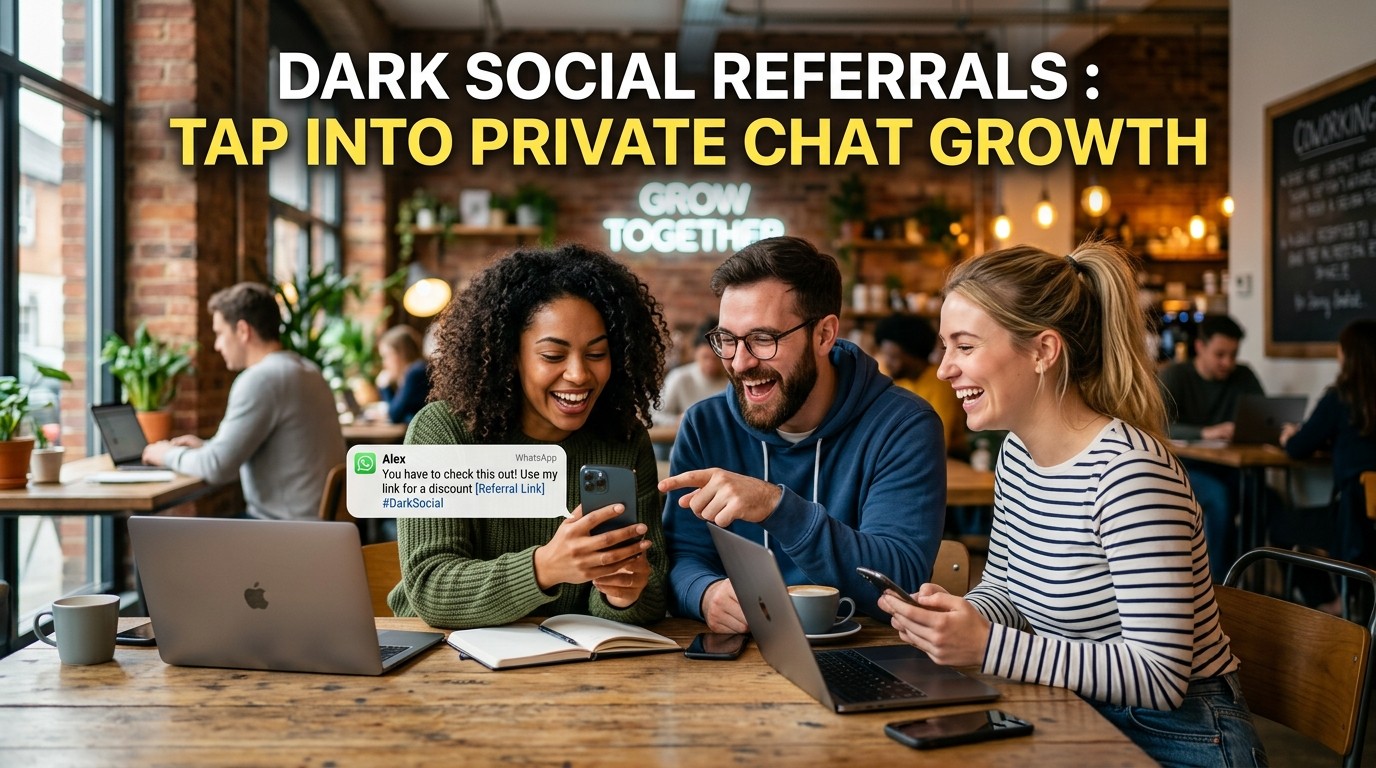
Private conversations influence buying decisions every day, yet much of that sharing remains invisible to analytics, creating opportunities for brands to understand, support, and grow trusted word-of-mouth.
People rarely make every purchasing decision alone. They send a product link to a friend, forward a useful article inside a group chat, ask a colleague whether a service is trustworthy, or share a screenshot with someone they know. These conversations can influence demand long before a person reaches a tracked landing page. Dark Social Referrals describe this less-visible layer of referral behavior where traffic or recommendations originate through private communication rather than clearly attributable public channels.
The term “dark” does not imply anything negative or suspicious. It refers to limited visibility. When someone copies a URL from a website and pastes it into a private WhatsApp conversation, Facebook Messenger thread, Telegram group, email, SMS, or another closed environment, analytics platforms may have difficulty identifying the original source. The resulting visit can look like direct traffic even though a real recommendation caused it.
Understanding Dark Social Referrals matters because private recommendations often carry unusually strong psychological signals. A person may ignore a banner advertisement but pay close attention when a friend says, “You should look at this.” Trust changes the meaning of the same message.
Modern marketers therefore need to think beyond public shares, visible referral links, and campaign dashboards. Dark Social Referrals reveal a broader reality: people frequently market products to each other without considering themselves marketers.
What Are Dark Social Referrals?
Dark Social Referrals are visits, leads, purchases, or other actions influenced by sharing that occurs through private or difficult-to-track communication channels. These interactions can happen through messaging apps, private social posts, closed communities, direct messages, email, text messages, workplace collaboration tools, and private groups.
Suppose a customer discovers a useful software tool through Google. Instead of clicking the company’s “share” button, that customer copies the URL and sends it to a coworker in Slack. The coworker later types the URL into a browser. Analytics may classify that session as direct traffic. However, the actual discovery path was a private recommendation.
That difference matters. Dark Social Referrals can make referral programs appear smaller than they really are because attribution systems may not capture the complete customer journey. A brand might conclude that direct traffic is growing organically when some of that activity actually came from private recommendations.
The same issue appears in content marketing. A reader may find an article through search, send it to a small community, and trigger dozens of secondary visits. Those visits can become difficult to connect back to the original share. Dark Social Referrals therefore create an attribution gap between what people actually do and what dashboards can clearly display.
For marketers, the objective is not to identify every private conversation. That is neither realistic nor desirable from a privacy perspective. The objective is to recognize patterns, encourage measurable sharing where appropriate, and interpret analytics with greater context.
Why Private Sharing Has So Much Influence
Private recommendations often feel more personal than public promotion. When a friend sends an article directly, the recipient usually interprets the information through an existing relationship. Dark Social Referrals benefit from this transfer of trust.
Consider two messages:
“New productivity app available. Try it now.”
“I’m using this for project planning, and it saved me a lot of time. You might find it useful.”
The second message carries social context. It communicates not only information but also a reason to pay attention. Dark Social Referrals frequently work because people process recommendations differently when they come through trusted relationships.
There is also less public pressure. On a public social network, people may hesitate to share a commercial link because they do not want to appear promotional. In a private chat, that barrier disappears. One-to-one communication can be casual, specific, and highly relevant.
Another psychological factor is relevance. A person rarely forwards something to a friend randomly. They tend to share content that matches the recipient’s problem, interest, job, hobby, or immediate need. This creates highly targeted exposure.
For brands, the lesson is important: not every valuable marketing interaction needs to be public. Dark Social Referrals can emerge naturally when people find something worth discussing privately.
Where Dark Social Referrals Usually Happen
Private referral behavior is broader than messaging apps alone. Different environments create different types of sharing.
| Channel | Typical sharing behavior | Attribution challenge |
|---|---|---|
| Product links, articles, recommendations | Often limited referral data | |
| Messenger | Personal recommendations | Traffic can look direct |
| Telegram | Group and private forwarding | Source may be unclear |
| SMS | Short links and offers | Minimal campaign context |
| Articles, products, work resources | Referrer may not pass reliably | |
| Slack | Workplace recommendations | May appear direct or internal |
| Discord | Community discussions and links | Closed-community visibility |
| Private Facebook Groups | Advice and recommendations | Public analytics may be incomplete |
| iMessage | Product and content sharing | Referral source may be hidden |
| Private Instagram DMs | Product discovery and sharing | Public engagement is not visible |
These environments can produce Dark Social Referrals at different stages of the customer journey. Someone might first see a product publicly, ask a friend about it privately, receive a direct recommendation, and finally convert through a website.
That journey illustrates why referral attribution cannot always be linear. The first touchpoint may have been a search result, the trust-building moment may have happened inside a chat, and the final transaction may have happened through direct navigation.
Dark Social Referrals therefore should be viewed as part of a customer journey rather than as a standalone channel.
Dark Social Referrals vs. Traditional Referral Traffic

Traditional referral traffic usually gives analytics systems a visible indication that another website or identifiable platform sent the visitor. A user clicks a link from a public website, and the referring page may be passed through browser metadata or campaign parameters.
Dark Social Referrals are different because the referring environment may not transmit useful source information. A copied URL can arrive without a meaningful referrer. A private app may intentionally limit referral data. Browser privacy controls and security policies can also reduce available information.
This creates an important distinction:
Traditional referral attribution asks, “Which identifiable source sent this visitor?”
Dark social analysis asks, “What evidence suggests that private sharing influenced this visitor?”
That second question requires more interpretation.
A marketer may see direct traffic rise after a successful community campaign. That does not prove that private sharing caused the increase. However, if direct visits rise alongside untagged mobile traffic, branded search growth, referral-code redemptions, customer interviews, and survey responses mentioning friends, the combined evidence becomes more informative.
Dark Social Referrals therefore require triangulation rather than blind dependence on one analytics field.
The Customer Journey Behind Private Sharing
Private sharing can appear at almost every stage of the funnel.
Discovery
A user encounters a piece of content through search, social media, advertising, or a creator. The content solves a problem or triggers curiosity.
Validation
The person shares it with someone they trust. They may ask whether the product is legitimate, whether the price is reasonable, or whether the feature really works.
Comparison
The recipient researches alternatives, reads reviews, watches videos, or visits competitor websites.
Conversion
After trust is established, the person signs up, purchases, books a meeting, downloads an app, or takes another meaningful action.
Advocacy
The new customer later shares the same product with someone else.
This produces a loop. Dark Social Referrals can therefore function as both acquisition and retention mechanisms. A customer acquired through one channel can later become an informal distribution source.
The important insight is that referral behavior often starts before the measurable conversion event. A person can influence another person without ever appearing in the analytics report as a referring user.
Why Dark Social Referrals Are Difficult to Measure
Attribution becomes difficult because private environments prioritize user privacy, security, and controlled data access. Platforms may not provide detailed referral information to websites. Browsers can also restrict tracking signals.
Another challenge comes from human behavior. People frequently copy and paste links rather than using tracked sharing buttons. They may remove tracking parameters, shorten URLs, or share screenshots without links. Some recommendations happen verbally before the person ever visits the website.
Dark Social Referrals can therefore involve multiple invisible interactions.
For example:
A customer sees a LinkedIn post.
The customer sends the URL to a colleague.
The colleague searches the company name on Google.
The colleague visits the website.
The colleague purchases after reading several pages.
Analytics may attribute the final conversion mostly to organic search even though the conversation created the initial motivation.
This does not mean search deserves no credit. It means attribution models can simplify a journey that was actually collaborative.
How to Detect Dark Social Referrals
You cannot reliably expose every private interaction, but you can build stronger evidence.
Use Direct-Traffic Analysis
Look at changes in direct traffic rather than treating the category as meaningless. Sudden increases in direct sessions after campaigns, media exposure, creator activity, or community events can provide useful clues.
However, Dark Social Referrals should not be assumed solely from direct traffic. Many legitimate sources can create direct visits.
Add UTM Parameters
Brands can create share-friendly links with UTM parameters for channels they control. A link shared through a newsletter, ambassador campaign, private community, or official messaging sequence can then retain source information.
The key is to use parameters consistently.
For example:
?utm_source=whatsapp&utm_medium=referral&utm_campaign=customer_share
The specific naming convention matters less than maintaining a clean internal system.
Create Share Buttons
Make private sharing easy. A user who clicks “Send to WhatsApp” can receive a pre-tagged URL. Dark Social Referrals become easier to observe when the brand gives users a convenient sharing path.
The sharing message should also be natural. A generic “Check this out!” may not be enough. Personalized prompts such as “Send this guide to someone comparing analytics tools” can create useful context without feeling overly promotional.
Use Referral Codes
Referral codes offer another signal. A recipient can type a code manually or apply it during checkout, creating attribution even when the original conversation remains private.
The code should be easy to remember and simple to use.
The Role of Surveys in Dark Social Measurement
Analytics tells you what happened. Surveys can help explain why it happened.
Post-purchase questions can ask:
“How did you first hear about us?”
“What made you decide to try us?”
“Did someone recommend us?”
“Where did you receive the recommendation?”
These questions can reveal Dark Social Referrals that conventional attribution missed.
Qualitative responses are especially valuable. A customer might say, “My brother sent me the link,” or “Someone in our private Facebook group recommended it.” That information gives marketers a clearer view of social influence.
The data should be collected responsibly. Brands do not need to inspect private messages or identify individuals. A simple voluntary survey can reveal useful trends without invasive monitoring.
Dark Social Referrals and Content Marketing
Content that naturally solves problems is highly shareable in private spaces. A detailed buying guide, comparison article, checklist, calculator, research report, or practical tutorial can become a private recommendation asset.
This is different from content designed only to generate public engagement. Private-sharing content often needs immediate usefulness.
Imagine an article titled “How to Choose a CRM for a Small Sales Team.” A reader may never post it publicly. Instead, they send it to a manager before a meeting. That one private share can influence an important business decision.
Dark Social Referrals are therefore closely connected with content usefulness. People share what helps someone they know.
Content creators can also strengthen this behavior by making information easy to quote, save, forward, and discuss. Clear headings, concise takeaways, original data, examples, visual explanations, and practical frameworks improve private sharing potential.
User-Generated Content and Private Recommendations
People often share content privately because they want another person’s opinion. Reviews, screenshots, customer stories, tutorials, and real-world examples can become conversation starters.
This is where User-Generated Content can support a broader referral ecosystem. Instead of relying entirely on brand-created claims, businesses can give customers useful material that makes a recommendation easier to trust.
A customer might share a real product photo, a before-and-after result, a workflow demonstration, or a personal experience. That content can be more persuasive because it provides evidence from another user’s perspective.
Dark Social Referrals often become stronger when the content being shared feels authentic instead of overly polished.
Building Content That People Want to Forward
Forwardability is a useful content principle. Before publishing a page, ask:
“Would someone send this to one person they know?”
That question changes the writing strategy.
A long article can still be highly forwardable when it solves a specific problem. A complicated industry report can become easier to share when the most important insights are clearly explained. A technical tutorial can spread privately because one employee wants another employee to follow the same process.
The goal is not to force sharing. The goal is to create information that people naturally want to pass along.
Brands should also consider the emotional reason behind a share. People share content to help, warn, entertain, educate, prove a point, save someone time, or maintain a relationship.
Dark Social Referrals benefit from all of these human motivations.
Designing a Referral-Friendly Customer Experience
Referral growth becomes easier when the customer experience itself creates conversation.
A product should be simple enough to explain.
A landing page should answer common questions quickly.
Pricing should be understandable.
Benefits should be easy to describe without industry jargon.
Customer support should reduce uncertainty.
Every one of these elements can affect whether a customer feels comfortable recommending the brand.
One useful approach is to identify “conversation moments.” These are situations where a customer might naturally mention the product to someone else.
Examples include:
“I finally found a tool that does this.”
“This guide answered exactly what I was looking for.”
“You should try this before making that decision.”
Dark Social Referrals can emerge when a brand creates memorable customer outcomes that are easy to describe.
Micro-Tier Rewards and Private Sharing
Referral programs frequently fail when the reward structure feels complicated or requires too much effort. Smaller milestones can create a smoother behavioral path.
For example, a program might reward a user for making a first referral, generating a qualified visit, completing a successful referral, and bringing multiple users over time.
The concept behind Micro-Tier Reward Frameworks can be relevant here because smaller progression steps can make participation feel achievable instead of distant.
The strongest referral incentives also match the customer’s motivation. A community member may prefer recognition. A customer may prefer account credit. A professional may value access to premium resources.
Dark Social Referrals should never depend entirely on cash incentives. Trust, usefulness, identity, and reciprocity can be powerful motivators on their own.
Dark Social Referrals in B2B Marketing

B2B buying is particularly influenced by private conversations. Employees regularly send software recommendations through email, Slack, Teams, LinkedIn messages, and private professional groups.
A buyer may begin with a search, but internal discussion determines whether the product reaches the shortlist.
For example, one employee might forward a cybersecurity guide to the IT manager. Another might share a SaaS pricing page with procurement. A sales leader might send a case study to the finance team.
Dark Social Referrals can therefore influence accounts rather than only individual users.
B2B marketers should track account-level patterns where possible, but they should avoid pretending that every anonymous visit can be personally attributed. Intent signals should be interpreted as probabilities and patterns, not guaranteed identities.
Dark Social Referrals in Ecommerce
In ecommerce, private sharing frequently happens around products with strong visual or practical appeal. Customers send clothing, gadgets, beauty products, gifts, home items, travel products, and other recommendations directly to friends.
A buyer may ask:
“Which one looks better?”
“Have you tried this brand?”
“Is this worth the price?”
Private conversation can move someone from browsing to purchase.
Ecommerce brands can support this behavior with easy mobile sharing, product comparison links, wish lists, gift-oriented copy, and referral codes.
Dark Social Referrals are especially relevant on mobile because private sharing is deeply integrated into everyday communication behavior.
Dark Social Referrals and Community Marketing
Communities create an environment where recommendations can happen continuously. Discord servers, private Facebook groups, Telegram communities, customer groups, member-only forums, and professional communities can all influence purchasing behavior.
Community members already share context. That makes recommendations more relevant.
A person asking “Which analytics tool should I use?” may receive several answers from people with similar needs. One recommendation can generate an entire research journey.
Brands should avoid entering communities only to push promotional links. Communities respond better to useful contributions, transparent participation, and genuine problem-solving.
Dark Social Referrals become more sustainable when the brand earns a place in the conversation rather than interrupting it.
Private Sharing and Cross-Channel Discovery
Content often travels between unrelated interests. A marketing article may be shared inside a business group, while a gaming concept may move from a public post into a private community before returning to search.
This makes cross-channel content architecture important. Brands should connect related topics so readers can continue exploring after a private recommendation.
For example, someone researching digital assets may move from a content page about ownership to a deeper resource discussing NFT Interoperability and later explore how Blockchain Gaming Economies connect assets with broader player incentives.
These links are not substitutes for dark-social measurement. They illustrate how privately shared information can lead users into broader topic clusters and create additional measurable interactions after the original recommendation.
How Analytics Teams Should Interpret Dark Traffic
One of the biggest mistakes is labeling every unexplained direct visit as dark social.
Direct traffic can come from bookmarks, manually entered URLs, browser behavior, privacy restrictions, apps, offline references, and other causes. Dark Social Referrals are only one possible explanation.
A better framework is to examine multiple signals:
Direct traffic changes
Mobile vs. desktop differences
Landing-page patterns
Branded search growth
Referral-code usage
Survey responses
Campaign timing
Content share activity
New user behavior
Conversion changes
The more signals align, the more confidence you can have that private sharing contributed to the outcome.
Analytics teams should also document assumptions. A dashboard that says “estimated dark social influence” should be clearly different from a dashboard showing confirmed tracked referrals.
A Practical Measurement Framework
A useful dark-social measurement system can contain four layers.
| Layer | What to track | Example |
|---|---|---|
| Observable | Measurable referral signals | Tagged shares, referral codes |
| Behavioral | Traffic patterns | Direct mobile growth |
| Qualitative | Customer feedback | “A friend sent this” |
| Business | Outcome metrics | Leads, sales, retention |
The first layer provides the strongest attribution because the source is explicitly tracked.
The second layer provides patterns.
The third layer provides human context.
The fourth layer shows whether the activity actually matters commercially.
Dark Social Referrals become strategically useful when marketers combine these layers instead of searching for a single perfect metric.
KPIs for Dark Social Growth
Not every metric needs to mention dark social explicitly. Focus on indicators that reveal whether private sharing creates downstream value.
Useful KPIs include:
Private-share click-through rate
Referral-code redemption rate
Shared-link conversion rate
Customer-reported recommendation rate
Direct-traffic growth after share campaigns
New-user conversion from tagged shares
Number of referral-generated customers
Repeat purchase from referred customers
Average order value of referred customers
Customer lifetime value of referred users
These metrics help separate attention from impact.
A campaign that generates thousands of shares but very few conversions may need a different approach from one that produces modest sharing but high-value customers.
Privacy Should Come Before Attribution
Attempting to measure private communication can create serious ethical and legal problems when marketers cross boundaries. Brands should not attempt to inspect personal conversations simply to discover where users discussed a product.
Privacy-aware marketing uses consent, aggregated signals, voluntary surveys, tagged links, referral codes, and transparent program mechanics.
Dark Social Referrals should be measured through what users willingly share with the business, not through invasive surveillance.
This approach can also strengthen trust. Customers are more likely to recommend brands that respect their boundaries.
The goal is to understand behavior without turning private life into a tracking dataset.
Common Mistakes Marketers Make
Mistake 1: Treating Direct Traffic as Dark Social
Direct traffic is broader than private sharing. Assuming otherwise creates inaccurate reports.
Mistake 2: Measuring Only Public Shares
Visible social engagement does not represent total word-of-mouth. Many influential conversations happen privately.
Mistake 3: Making Sharing Difficult
If users need to copy, edit, and manually clean a URL, fewer will share it. One-click sharing can reduce friction.
Mistake 4: Overusing Incentives
Large rewards can attract people who care more about the incentive than the product. Referral quality matters more than raw referral volume.
Mistake 5: Ignoring Content Quality
No tracking system can manufacture genuine recommendation behavior from weak content.
Mistake 6: Confusing Correlation With Proof
A traffic increase following a social campaign can be suggestive without proving causation. Dark Social Referrals should be treated as an evidence-based inference when direct attribution is unavailable.
Mistake 7: Forgetting Mobile UX
Private sharing is often mobile-first. Broken layouts, slow pages, difficult checkout forms, and confusing links can destroy referral momentum.
A Step-by-Step Strategy for Businesses
A practical approach can start small.
Step 1: Identify Likely Private-Sharing Content
Review articles, products, tools, resources, and pages that already receive direct or branded traffic. Look for content that solves a specific problem.
Step 2: Add Share-Friendly Links
Create clean URLs and standardized campaign parameters.
Step 3: Make Private Sharing Easy
Add WhatsApp, Messenger, email, copy-link, and other relevant sharing options.
Step 4: Introduce Referral Codes
Use simple codes that users can remember and recipients can enter without friction.
Step 5: Ask Customers How They Found You
Add a short post-purchase or signup question.
Step 6: Monitor Patterns
Compare direct traffic, mobile traffic, branded search, referral activity, and conversion trends.
Step 7: Improve the Content
Identify which pages generate the strongest downstream outcomes and create more content with similar utility.
Step 8: Build Community
Give customers places where recommendations can happen naturally.
Dark Social Referrals should become part of an overall growth system rather than a disconnected marketing experiment.
How Brands Can Create More Shareable Experiences
People share experiences more readily when there is something worth communicating.
A strong product result is shareable.
A surprising insight is shareable.
A useful shortcut is shareable.
A simple checklist is shareable.
A strong customer story is shareable.
A clear comparison is shareable.
This means marketers should ask not only, “How do we get users to click?”
They should ask, “What would make one customer immediately think of another person?”
That question leads to more natural advocacy.
Dark Social Referrals often happen because one person wants to help another person make a better decision. The recommendation is therefore an act of utility, not just promotion.
The Future of Dark Social Referrals

Private communication is unlikely to disappear. Messaging, community platforms, collaborative tools, and direct conversations are becoming increasingly integrated into how people discover information.
As privacy expectations grow, marketers may have access to less granular source information. That does not make referral behavior less important. It makes interpretation more important.
Future measurement systems will likely combine first-party analytics, consent-based tracking, referral infrastructure, qualitative data, and predictive modeling to estimate hidden influence more responsibly.
AI can also assist with identifying patterns across large datasets, such as unusual direct-traffic movements, referral-code behavior, customer survey themes, and campaign timing. However, analytical models should not be presented as proof when the underlying source is uncertain.
The long-term opportunity is not perfect surveillance. It is better measurement combined with better customer experiences.
Final Takeaway for Marketers
The strongest marketing often happens when a brand is not present in the conversation.
A customer sees something useful.
They remember it.
They send it to someone they know.
The recipient trusts the sender.
The recipient explores the brand.
Eventually, a measurable action happens.
That journey can be difficult to capture completely, but its business importance remains real.
Dark Social Referrals remind marketers that analytics does not always show the full story behind demand. Private recommendations can influence awareness, consideration, conversion, and loyalty without producing a clean referral signal.
The practical response is not to chase impossible attribution. Build useful content, simplify sharing, use measurable links where appropriate, collect voluntary customer feedback, analyze patterns carefully, and respect privacy.
When these elements work together, private sharing can become a meaningful part of a sustainable referral strategy.
Conclusion
Dark Social Referrals reveal how much marketing influence happens outside visible public channels. Friends, coworkers, communities, and customers can shape decisions through private messages that analytics often cannot attribute directly. Dark Social Referrals become more understandable when marketers combine tagged links, referral codes, surveys, direct-traffic patterns, and conversion data. Dark Social Referrals also show why useful content matters: people naturally forward resources that solve problems or help someone they trust. Businesses can encourage this behavior through simple sharing tools, strong customer experiences, relevant incentives, and privacy-conscious measurement. Ultimately, sustainable Dark Social Referrals come from trust, usefulness, relevance, and genuine customer advocacy rather than intrusive tracking tactics.
Frequently Asked Questions (FAQ)
What does Dark Social Referrals mean?
Dark Social Referrals refer to traffic, leads, purchases, or other customer actions influenced by private sharing channels where the original referral source is not fully visible in standard analytics.
Why are they called “dark” social referrals?
“Dark” describes limited attribution visibility, not harmful or secretive behavior. The term is used because analytics tools may not know that a private conversation generated a visit.
Are Dark Social Referrals the same as direct traffic?
No. Direct traffic can include manually entered URLs, bookmarks, browser behavior, privacy limitations, and other sources. Private referral traffic is only one possible contributor.
Which platforms generate the most private referrals?
Private messaging apps, email, Slack, Discord, Telegram, private social groups, SMS, Messenger, and other closed communication environments can all generate private referral activity.
Can Google Analytics track private sharing?
Sometimes. Tagged URLs, identifiable referrers, referral codes, and certain sharing methods can provide attribution. However, many private shares will still appear without a clearly identifiable source.
How can a business measure private referrals?
Businesses can combine UTM-tagged links, referral codes, share-button data, customer surveys, direct-traffic analysis, branded search trends, and conversion behavior to build a more complete picture.
Can private referrals be measured without invading customer privacy?
Yes. Consent-based tracking, voluntary surveys, aggregated analytics, referral codes, and first-party data can provide useful insights without inspecting people’s private conversations.
Why do people share products privately?
People may share products or content because they want to help someone, solve a problem, ask for an opinion, entertain a friend, compare options, or recommend something they genuinely trust.
Do referral rewards increase private sharing?
Rewards can encourage referrals, but incentives are not the only motivation. Relevance, trust, usefulness, social identity, convenience, and customer satisfaction can also drive private sharing.
What is the most important lesson about private referral growth?
The biggest lesson is that measurable analytics and real customer influence are not always identical. Brands should use multiple evidence sources, create genuinely useful experiences, make sharing easy, and respect user privacy.