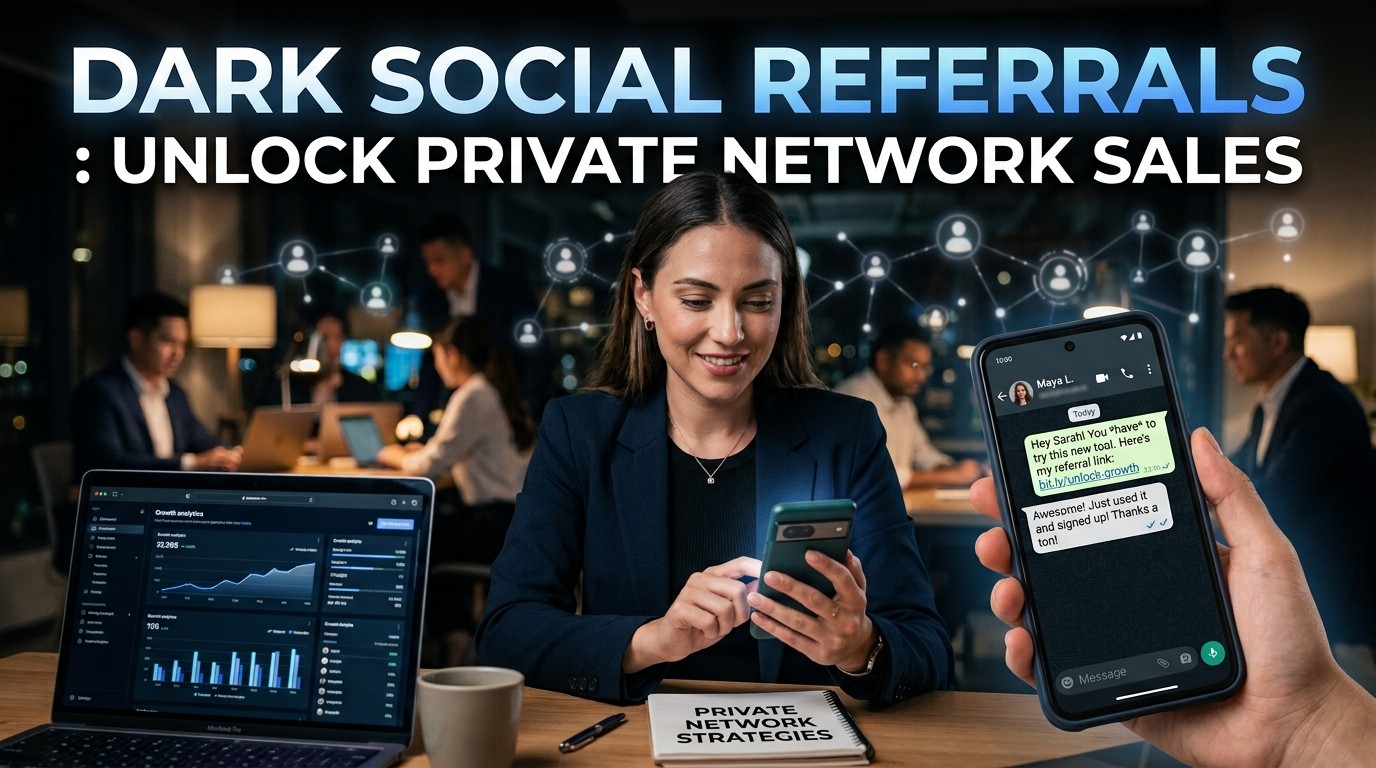
Dark Social Referrals turn private conversations, recommendations, communities, and direct messages into measurable growth opportunities without forcing every customer journey through public channels.
Dark Social Referrals describe the sales and discovery activity that happens through private communication channels where conventional analytics often struggle to identify the original source.
A prospect may discover a business through a colleague’s WhatsApp message, receive a product link through Messenger, discuss a service inside a private Discord group, get a recommendation in a Slack channel, or share a useful article through email. The recipient clicks, visits the website, and eventually becomes a customer. The business may record the resulting visit as direct traffic even though the journey actually started with a private recommendation.
That hidden layer is the central reason Dark Social Referrals deserve serious attention.
Traditional digital marketing measurement was built around visible journeys. Search queries, advertisements, social posts, public comments, referral links, and campaign parameters create signals that analytics platforms can often classify. Private sharing creates a different environment. People naturally recommend things inside conversations without thinking about attribution.
This behavior is especially important because recommendations from trusted individuals often carry more psychological weight than generic promotional messages. A person receiving a recommendation from a friend, colleague, professional peer, or community leader does not experience it as another advertisement. They experience it as social information.
Dark Social Referrals therefore sit at the intersection of word-of-mouth marketing, private communities, relationship-based selling, creator distribution, messaging platforms, and modern attribution challenges.
The opportunity is not to spy on private conversations. The goal is to create ethical, voluntary mechanisms that make private recommendations easier to act on and easier to measure while respecting user privacy.
Businesses that understand this distinction can build more realistic acquisition systems.
What Are Dark Social Referrals?
Dark Social Referrals are customer or prospect referrals generated through private or difficult-to-measure communication environments.
The word “dark” does not mean suspicious, illegal, or deceptive. It refers to visibility within analytics. When people share content privately, the original referral context can disappear before the user reaches the business website.
Dark Social Referrals commonly originate from:
- Messaging apps
- Private social groups
- Direct messages
- Community platforms
- Workplace chats
- One-to-one conversations
- Small invitation-only networks
- Private creator communities
The fundamental idea is simple.
One person trusts another person enough to recommend something. The recommendation moves through a private channel. The recipient interacts with the brand. The brand may struggle to identify the exact source.
This creates a measurement gap.
Private Sharing Is a Normal Human Behavior
People rarely announce every recommendation publicly.
Imagine someone asking a colleague, “Which SEO agency do you use?”
The colleague replies with a private message containing a company website.
That conversation could influence a purchase more strongly than several public social interactions, yet conventional attribution may record the resulting website visit as direct.
Dark Social Referrals exist because private communication is a natural part of how people make decisions.
The more expensive, specialized, or trust-sensitive the product, the more important these conversations can become.
Why Dark Social Referrals Matter to Modern Businesses
Businesses often optimize the channels that are easiest to measure.
Search advertising generates click data.
Social advertising generates engagement data.
Organic search produces query and landing-page data.
Email campaigns provide open and click measurements.
Private conversations are much harder to observe.
That can create a dangerous assumption: if a channel is difficult to measure, it must be less important.
Dark Social Referrals challenge that assumption.
A customer may encounter a brand publicly but make the final decision after discussing it privately with someone they trust.
This is particularly common in industries where credibility matters.
Examples include:
- Professional services
- Software
- Healthcare-related information services
- Financial technology
- Enterprise products
- Education
- Real estate
- Luxury products
- B2B consulting
- Specialized technology
In these markets, people often ask others for confirmation before committing.
The private conversation becomes a decision accelerator.
Trust Changes the Meaning of a Recommendation
Advertising says, “This company wants you to buy.”
A recommendation can communicate, “Someone I know believes this is worth considering.”
That difference matters psychologically.
The second message can reduce uncertainty because the recommendation comes with implicit social context.
Dark Social Referrals can therefore be valuable even when the actual number of referred visitors appears small.
Ten highly trusted referrals can sometimes generate more commercial significance than hundreds of low-intent impressions.
That does not mean private referrals should replace measurable marketing channels. Instead, they should be understood as another layer of the customer journey.
How Dark Social Referrals Work
A typical referral journey can be represented like this:
Discovery → Private Recommendation → Shared Link or Mention → Visit → Evaluation → Conversion → Referral Loop
The first discovery may happen through search, advertising, a creator, a public social post, an event, or an offline interaction.
The private recommendation occurs later.
Someone sends a direct message or verbally recommends the business.
The prospect then visits the website.
At this point, attribution can break.
The analytics platform knows that someone arrived, but the original referral context may be missing.
Dark Social Referrals become easier to understand when businesses intentionally create a bridge between private recommendations and trackable actions.
That bridge might be a referral code, personalized landing page, invitation link, member identifier, QR code, or simple self-reported attribution field.
The system should make participation effortless.
Where Dark Social Referrals Usually Happen

Private referrals exist across many digital environments.
Messaging Applications
Messaging apps are one of the most obvious sources.
Users regularly forward:
- Product pages
- Videos
- Articles
- Discounts
- Event invitations
- Service recommendations
- Registration links
A person may send something to one friend or several contacts.
The shared content can create a direct commercial interaction without passing through a public social feed.
Private Social Groups
Facebook Groups, LinkedIn communities, Telegram groups, Discord servers, and other private communities can become powerful recommendation environments.
A member may ask:
“Does anyone know a reliable company for this?”
A group participant answers with a recommendation.
The recommendation can generate a highly qualified lead.
Dark Social Referrals are particularly relevant here because community administrators may not allow obvious promotional behavior. Useful recommendations often emerge naturally from discussion.
Email is another overlooked environment.
A professional may forward an article to a client.
A manager may send a software recommendation to a team.
A friend may email a product link to another friend.
Analytics systems can lose the original context once a link is forwarded or copied.
Workplace Collaboration Tools
Slack, Microsoft Teams, internal company channels, and project-management platforms can facilitate recommendations among colleagues.
These referrals may be highly valuable for B2B companies because the recipient already belongs to a professional network relevant to the product.
Dark Social Referrals and Buyer Psychology
Understanding the psychology behind referrals is more useful than simply counting links.
People do not usually share something privately without a reason.
They may want to:
- Help another person
- Demonstrate expertise
- Save someone time
- Solve a problem
- Share a useful discovery
- Strengthen a relationship
- Earn a reward
- Improve their professional reputation
- Participate in a community
Dark Social Referrals become stronger when the act of sharing provides value to both sides.
The Trust Transfer Effect
When one person recommends a business, some of their credibility can transfer to the recommendation.
The recipient may still investigate the brand, but the first layer of skepticism can be lower.
This is especially powerful when the sender has relevant experience.
A software recommendation from another marketer carries more contextual value for a marketer than a random advertisement.
An accountant’s recommendation of accounting software may carry more relevance within a business-owner community.
The quality of the relationship therefore influences referral performance.
Social Proof Without Public Metrics
Public reviews are one form of social proof.
Private recommendations are another.
The difference is that private social proof can feel more personalized.
Instead of reading hundreds of anonymous reviews, a prospect receives a direct message from someone they already know.
That creates a form of conversational validation.
Designing a Dark Social Referral Strategy
A good strategy begins with the customer journey rather than the referral code.
Ask where customers naturally talk about your product.
Do customers recommend it through WhatsApp?
Do they discuss it in Facebook Groups?
Do they share it over email?
Do employees recommend it to colleagues?
Do creators discuss it inside private communities?
Do existing customers regularly answer questions from their network?
These answers reveal where referral opportunities actually exist.
Dark Social Referrals should be designed around behavior that already happens rather than forcing customers into an artificial referral process.
Step 1: Identify High-Trust Moments
Look at moments where customers naturally feel confident.
Examples:
- After a successful purchase
- After achieving a measurable result
- After receiving excellent support
- After completing a project
- After using a product for several weeks
- After sharing a positive experience
These moments often create better referral conditions than generic “Tell a Friend” buttons.
Step 2: Give People Something Worth Sharing
A referral system cannot compensate for weak value.
People tend to share things they believe will help someone else.
Useful referral assets include:
- Comparison guides
- Calculators
- Free tools
- Educational resources
- Special invitations
- Product demos
- Research reports
- Templates
- Checklists
The content itself should create enough value to justify sharing.
Making Private Sharing Trackable
Attribution should be introduced without violating privacy.
The most practical systems give users optional tracking mechanisms.
Referral Codes
A customer receives a unique code.
The code can be entered during signup or checkout.
This is simple and works even when the original link context is lost.
Personalized Links
A referral URL can identify the referring participant.
For example:
example.com/ref/username
The actual technical implementation can be more sophisticated, but the principle remains the same.
Dedicated Landing Pages
Businesses can create referral-specific landing pages.
The sender shares the page directly with a friend.
The visitor enters through a context that can be measured.
Self-Reported Attribution
A signup form can ask:
“How did you hear about us?”
Possible choices can include:
- Friend
- Colleague
- Private community
- Search
- Social media
- Advertisement
- Other
This method does not provide perfect attribution, but it captures information that analytics platforms may miss.
Dark Social Referrals often require a combination of technical tracking and self-reported data.
Tracking Without Invading Privacy
The objective should never be to monitor private conversations without consent.
A responsible referral program only tracks the minimum information necessary to operate the program.
Businesses should avoid collecting:
- Private message content
- Personal conversations
- Unnecessary contact lists
- Sensitive personal information
- Private community discussions without permission
Instead, useful data might include:
- Referral ID
- Conversion event
- Timestamp
- Transaction value
- Reward status
- Aggregate referral performance
Dark Social Referrals work best when participants understand what is being tracked and why.
Privacy Builds Referral Confidence
People may hesitate to share referral programs if they believe the business is monitoring their contacts.
Clear privacy communication can reduce that friction.
Explain:
What is tracked?
What is not tracked?
Why is the information required?
How long is it retained?
Who can access it?
Can the participant opt out?
Transparency can become a competitive advantage.
Building a Private Referral Funnel
A private referral funnel should be simple.
Trigger → Share → Click or Code → Landing Page → Conversion → Reward → Follow-Up
The first trigger should come from a positive customer experience.
The sharing step should require minimal effort.
The landing page should immediately explain why the recipient is there.
The conversion process should be short.
The reward should be easy to understand.
Dark Social Referrals become weaker when the recipient must complete too many steps.
Optimize the First Five Seconds
When a referred user arrives, they should immediately understand:
- What the product is
- Why it was shared
- Who it may help
- What action to take
A personalized headline can make a major difference.
For example:
“You were invited by a community member to explore our reporting toolkit.”
That message provides context without exposing private information.
Referral Incentives That Actually Make Sense
A referral reward should create a reason to share without distorting behavior.
Some programs reward the sender.
Others reward both sender and recipient.
Others provide non-financial benefits.
Dark Social Referrals can use incentives such as:
- Discounts
- Credits
- Membership upgrades
- Exclusive access
- Extended trials
- Service upgrades
- Educational resources
- Loyalty points
- Event invitations
The incentive should match the product.
A premium B2B service may benefit more from account credits than a small consumer discount.
An online education platform might offer additional learning access.
A community product might offer premium membership time.
Avoiding Incentive Abuse
Referral programs can attract people who only care about rewards.
That creates low-quality signups, fake accounts, spam, and self-referrals.
Useful safeguards include:
- Minimum purchase requirements
- Verified accounts
- Delayed reward activation
- Referral limits
- Fraud detection
- Duplicate-account checks
- Clear terms
Dark Social Referrals should reward genuine customer acquisition rather than artificial activity.
Using Community Leaders
Not every referral needs to come from ordinary customers.
Community leaders can have enormous influence inside private networks.
These might include:
- Industry experts
- Group administrators
- Consultants
- Coaches
- Creators
- Professional organizers
- Niche community owners
The value of these relationships comes from trust and relevance.
Rather than paying someone simply for posting a link, businesses can build structured partnerships around educational value.
For example, a community leader might host an exclusive workshop, share a resource, or provide members with a special onboarding experience.
Dark Social Referrals generated through trusted community leaders can become more contextual than conventional influencer promotion.
Employee Referrals as a Private Growth Channel
Employees already participate in professional networks.
A sales employee may know potential clients.
A developer may know other technical teams.
A designer may participate in creative communities.
An HR professional may have a large professional network.
Businesses can create internal referral programs that make it easier for employees to share relevant resources.
The system should never pressure employees to spam contacts.
Instead, provide useful materials that employees can recommend when genuinely relevant.
Dark Social Referrals can be particularly valuable in B2B settings because professional trust often develops through repeated interactions rather than one-time advertising.
Creator Communities and Private Audiences
Creators have audiences across public and private environments.
A creator may have:
- Email subscribers
- Discord members
- Telegram users
- Paid community members
- Course students
- Coaching clients
- Private group participants
Public reach provides visibility.
Private communities provide depth.
A creator can introduce a product through educational content and then answer questions inside the community.
That conversational environment can accelerate decision-making.
Dark Social Referrals work particularly well where prospects need explanations before purchasing.
The key is relevance.
A creator should recommend something because it fits the audience rather than because a referral payment exists.
Dark Social Referrals for B2B Sales
B2B purchasing is often a network process.
A buyer may ask colleagues:
“Has anyone used this platform?”
Someone responds with a recommendation.
Another person forwards a case study.
A manager sends the website to procurement.
The original acquisition path becomes distributed across several people.
Traditional last-click attribution can struggle with this journey.
Dark Social Referrals provide a framework for recognizing that influence.
Account-Based Referral Mapping
B2B organizations can map referrals by account rather than focusing exclusively on individual clicks.
Useful indicators include:
- New contacts within an existing account
- New meetings after a customer referral
- Multiple visitors from the same organization
- Referral-assisted opportunities
- Expansion opportunities
- Partner introductions
This approach gives sales teams a broader view of network-driven growth.
Measuring Referral-Assisted Revenue
One of the biggest mistakes is evaluating Dark Social Referrals only by direct conversions.
A referral may influence a purchase without being the final acquisition source.
A prospect could:
- Hear about the company privately.
- Search the brand on Google.
- Read several pages.
- Watch a demo.
- Talk to sales.
- Convert through a tracked campaign.
The final click does not represent the whole journey.
This is why businesses can use multiple attribution approaches.
Useful Referral Metrics
| Metric | What It Shows |
|---|---|
| Referral visits | Traffic generated by identifiable referral mechanisms |
| Referral signups | New users influenced by referral activity |
| Referral conversion rate | Quality of referred traffic |
| Assisted conversions | Referrals involved before the final conversion |
| Revenue per referrer | Economic value of participating customers |
| Share rate | Frequency of referral actions |
| Activation rate | Quality of new referred users |
| Retention | Long-term value of referrals |
| Fraud rate | Quality and safety of referral activity |
Dark Social Referrals should ultimately be evaluated through customer quality rather than raw traffic alone.
Dark Social Attribution Challenges
Perfect attribution is unrealistic.
Private sharing can happen offline, across multiple devices, through screenshots, copied URLs, forwarded messages, or verbal recommendations.
A user might hear about a company from a friend and later search for it manually.
That journey could be impossible to reconstruct completely.
Therefore, Dark Social Referrals should be treated as a measurable influence layer rather than a perfectly observable channel.
Blended Measurement
A stronger measurement strategy combines:
- Analytics
- Referral codes
- CRM data
- Customer surveys
- Self-reported attribution
- Community feedback
- Sales notes
- Conversion data
When several signals point toward the same source, confidence increases.
Common Mistakes Businesses Make
Mistake 1: Calling All Direct Traffic “Organic”
A rise in direct traffic can sometimes reflect private sharing rather than people manually typing the website URL.
Mistake 2: Using Complicated Referral Flows
Every additional field or step reduces participation.
Mistake 3: Overusing Rewards
Aggressive financial incentives may attract low-quality users.
Mistake 4: Ignoring the Recipient Experience
A referral program designed only for the sender can produce a confusing landing experience.
Mistake 5: Tracking Too Much
Over-collection can create privacy concerns.
Mistake 6: Measuring Only Clicks
The commercial value of a referral depends on conversion and retention.
Mistake 7: Ignoring Offline Recommendations
Some of the strongest referrals never contain a clickable link.
Mistake 8: Treating Private Communities Like Advertising Inventory
Communities are relationships, not simply audiences waiting for promotions.
Dark Social Referrals become more sustainable when businesses behave like useful participants instead of intrusive advertisers.
SEO and Dark Social Distribution

Private sharing also influences content marketing.
A valuable article can spread through:
- Private newsletters
- Group chats
- Team channels
- Client emails
- Community discussions
- Direct messages
The initial traffic may not always be attributed correctly, but the secondary effects can include:
- More branded searches
- More backlinks
- More mentions
- More returning visitors
- Higher awareness
- More referral conversations
This creates an important connection between private distribution and public search visibility.
A piece of content may start in a private conversation and eventually generate public SEO benefits.
Dark Social Referrals therefore should not be evaluated only inside the social media category.
Content That People Naturally Share Privately
Not every article generates referrals.
Private sharing often favors content that solves a specific problem.
Strong examples include:
Comparison Content
People share comparisons when a colleague is evaluating options.
Research Reports
Original statistics can give people something valuable to forward.
Templates
Useful templates are easy to recommend.
Tools
Calculators and interactive resources have strong sharing potential.
Case Studies
Real examples help prospects validate decisions.
Tutorials
Practical guides are naturally useful inside professional communities.
Dark Social Referrals become easier to generate when the content has obvious utility.
Creating Share-Worthy Messaging
The wording around a referral can influence response.
Compare:
“Check out this company.”
with:
“This tool helped us reduce reporting time, so I thought it might be useful for your team.”
The second message provides context.
That context increases relevance.
A referral template can help participants share naturally without making the message feel like an advertisement.
However, templates should remain optional.
Authentic wording is often more persuasive than corporate language.
Give the Sender a Story
A useful referral message answers:
Why did you try it?
What problem did it solve?
Why might this person care?
What should they do next?
Dark Social Referrals often work because recommendations contain stories rather than simply URLs.
Dark Social Referrals and Customer Advocacy
Referral systems should not begin at the moment a customer purchases.
Advocacy is built through the entire experience.
A customer who receives excellent onboarding, support, outcomes, and communication has more reasons to recommend the business.
That means referral performance can reveal something about customer satisfaction.
If customers consistently recommend a company without being heavily incentivized, the product may have genuine advocacy potential.
If referrals require extremely large rewards, the underlying experience may deserve additional examination.
Dark Social Referrals can therefore function as both an acquisition strategy and a customer-feedback signal.
Designing a Referral Program Around Trust
A strong program should answer four questions immediately:
Why should I share?
The participant should understand the benefit.
Why should my friend click?
The recipient should see clear value.
Is this safe?
The privacy and data policy should be understandable.
What happens next?
The conversion experience should be predictable.
When these questions are answered, referral friction falls.
The psychological objective is not to pressure users into sharing. It is to make genuine recommendations easier.
When Anonymous Referral Structures Are Useful
Privacy-preserving referral models can be useful in communities where participants do not want their identity publicly displayed.
For example, a system could associate a referral with a wallet or pseudonymous identifier rather than exposing the participant’s personal profile.
However, privacy should not be confused with immunity from legal responsibilities.
Businesses may still need identity verification, fraud prevention, tax records, or reporting depending on the product and jurisdiction.
Dark Social Referrals should therefore use privacy as a design principle rather than as a promise of absolute anonymity.
A practical system minimizes unnecessary data while preserving the information required to operate safely.
Dark Social Referrals for Web3 and Crypto Communities
Web3 & Anonymous Crypto Referral Systems communities naturally rely heavily on direct communication.
Members use Discord, Telegram, private groups, X direct messages, community forums, and wallet-to-wallet interactions.
A recommendation inside one of these environments can lead to:
- NFT Incentives
- RWA NFT Marketplaces
- NFT discovery
- Token research
- Marketplace participation
- Community joining
- Product adoption
- Event registration
- Education enrollment
This makes private network behavior highly relevant for blockchain businesses.
A referral infrastructure might use unique links, campaign IDs, wallet identifiers, or community-specific landing pages.
The same principles still apply: transparency, privacy, fraud controls, and clear incentive terms.
Building a Referral Dashboard
A useful dashboard should turn fragmented referral signals into understandable business information.
Possible sections include:
Referral Acquisition
Track new users associated with referral mechanisms.
Referrer Performance
Identify participants generating high-quality referrals.
Conversion
Measure how many referred prospects become customers.
Revenue
Connect successful referrals with transaction value.
Retention
Determine whether referred customers stay longer.
Community Sources
Compare referral performance across communities or programs where measurement is ethically and technically appropriate.
Assisted Influence
Track referral interactions that occurred before another measurable conversion source.
Dark Social Referrals become much easier to optimize when the organization can connect referral activity to business outcomes.
A Practical Implementation Framework
Businesses can implement a private referral strategy in phases.
Phase One: Research
Interview customers and sales teams.
Ask:
“How did you first hear about us?”
“Did someone recommend us?”
“Where did that conversation happen?”
“What made you decide to explore the product?”
This creates qualitative evidence.
Phase Two: Tracking
Introduce:
- Referral links
- Codes
- Self-reported attribution
- CRM fields
- Dedicated landing pages
Phase Three: Activation
Create easy sharing experiences.
Make the referral message useful.
Phase Four: Incentives
Add relevant rewards only after the underlying system works.
Phase Five: Optimization
Analyze conversion quality, retention, revenue, and fraud.
Dark Social Referrals should evolve based on observed customer behavior.
How to Optimize the Recipient Experience
The recipient is often forgotten.
Imagine clicking a referral link and landing on a generic homepage.
The recommendation context disappears.
Instead, create continuity.
The landing page can explain:
“You were referred by a member of our community.”
Then immediately demonstrate the benefit.
A strong recipient experience can include:
- Clear context
- Concise value proposition
- Social proof
- Relevant offer
- Simple signup
- Referral acknowledgment
- Helpful onboarding
Dark Social Referrals become more effective when the website continues the conversation rather than restarting it.
The Role of Referral Loops
A mature referral system can create a continuous loop:
Customer → Recommendation → New Customer → Positive Experience → New Recommendation
The loop becomes stronger when the product itself creates moments worth discussing.
Examples include:
- Visible achievements
- Useful reports
- Shareable results
- Member milestones
- Exclusive experiences
- Team successes
The goal is to create organic reasons for customers to talk.
Dark Social Referrals become powerful when the referral action feels like an extension of the product experience.
Comparing Public and Private Referral Channels
| Characteristic | Public Referral | Private Referral |
|---|---|---|
| Visibility | High | Low |
| Attribution | Often easier | Often incomplete |
| Trust context | General | Personal |
| Audience | Potentially large | Usually smaller |
| Conversation | Broad | Direct or community-based |
| Privacy | Lower | Higher |
| Virality | Can be high | Often network-driven |
| Optimization | Often data-rich | Requires blended signals |
Neither format operates in isolation.
The customer journey can move from one to the other.
A person may discover a brand publicly, ask a friend privately, research through search, and finally convert after a sales conversation.
That is why modern growth measurement needs a multi-touch perspective.
Advanced Strategies for Dark Social Referrals

Once the foundation is established, businesses can introduce more sophisticated strategies.
Network-Based Segmentation
Different referral sources have different levels of trust.
Segment participants by:
- Customer type
- Professional role
- Community
- Purchase history
- Engagement level
- Referral quality
Personalized Referral Assets
A consultant may receive one landing page.
A customer may receive another.
A community leader may receive a third.
This makes the referral experience more relevant.
Lifecycle Referral Timing
The ideal referral moment may differ by customer.
A SaaS user may refer after successful activation.
A retailer customer may refer after receiving the product.
A B2B client may refer after measurable business results.
Dark Social Referrals perform better when the timing matches the customer’s confidence level.
The Future of Private Network Sales
Private communication is unlikely to become less important.
As people become more selective about public social media consumption, smaller communities and direct conversations can remain important decision environments.
Businesses are therefore likely to invest more in:
- Community-led growth
- Customer advocacy
- Messaging-based commerce
- Creator communities
- Referral infrastructure
- Privacy-aware attribution
- Relationship-driven acquisition
The technology will evolve, but the underlying principle is simple.
People trust people.
Dark Social Referrals provide a framework for understanding that trusted network activity without pretending that every private conversation can or should be tracked.
The future belongs to systems that combine measurement with respect for user choice.
Final Strategic Checklist
Before launching a private referral strategy, review these questions:
| Area | Question |
|---|---|
| Audience | Who naturally recommends the product? |
| Trigger | When are customers most confident? |
| Sharing | What is the easiest private sharing action? |
| Tracking | How can referrals be measured voluntarily? |
| Privacy | What information is actually necessary? |
| Incentive | What benefit encourages genuine participation? |
| Recipient | Does the landing experience preserve context? |
| Attribution | Can assisted conversions be recognized? |
| Fraud | How will abuse be detected? |
| Retention | Do referred customers stay engaged? |
| Revenue | What commercial value comes from referrals? |
| Optimization | Which parts of the process should be improved? |
Dark Social Referrals become sustainable when every component serves the same objective: helping people make useful recommendations while giving businesses enough measurement to understand what works.
Conclusion
Dark Social Referrals reveal an important part of modern customer acquisition that traditional analytics often misses. Private messages, communities, emails, workplace conversations, and personal recommendations can influence purchasing decisions even when referral sources disappear from tracking data. Businesses can respond by creating simple referral mechanisms, voluntary attribution methods, privacy-conscious tracking, relevant incentives, and recipient experiences that preserve recommendation context. The strongest systems focus on genuine customer advocacy instead of aggressive promotion. By combining analytics with surveys, CRM information, referral codes, and qualitative feedback, companies can understand more of the hidden customer journey. Dark Social Referrals are ultimately about turning trusted private conversations into measurable, respectful, and sustainable growth opportunities.
Frequently Asked Questions (FAQ)
What are Dark Social Referrals?
Dark Social Referrals are referrals that originate from private communication channels such as messaging apps, email, direct messages, private communities, workplace chats, or offline conversations and may not be fully visible in standard analytics.
Why are private referrals difficult to track?
When a link is copied, forwarded, or shared inside a private conversation, analytics systems may lose the original referral information. The resulting visit can appear as direct traffic or another uninformative source.
Are Dark Social Referrals the same as word-of-mouth marketing?
They overlap but are not identical. Word-of-mouth can happen offline or online, while dark social specifically emphasizes sharing environments where the original referral source is difficult for analytics platforms to identify.
How can businesses measure private referrals?
Businesses can combine referral codes, personalized links, dedicated landing pages, CRM fields, customer surveys, self-reported attribution, and assisted-conversion analysis to capture more referral activity.
Do Dark Social Referrals require financial rewards?
No. Referral motivation can come from useful content, community recognition, exclusive access, discounts, credits, educational resources, or simply the desire to help another person.
How can businesses protect customer privacy?
They should collect only the information necessary to operate the referral system, clearly explain tracking practices, avoid monitoring private conversations, provide appropriate consent mechanisms, and protect stored referral data.
Can private community referrals work for B2B companies?
Yes. B2B purchasing often involves colleagues, consultants, professional peers, and industry communities. Private recommendations can introduce highly relevant prospects even when the original referral cannot be directly attributed.
How can referral programs prevent fraud?
Common safeguards include verified accounts, referral caps, delayed rewards, duplicate-account detection, minimum purchase requirements, suspicious activity monitoring, and clearly defined eligibility rules.
Should businesses replace paid advertising with private referrals?
Private referrals and paid advertising serve different functions. Referrals can provide trust and relationship-based influence, while paid advertising can provide scalable reach and more structured measurement. A broader acquisition strategy can use both.
What makes Dark Social Referrals successful?
Successful programs generally combine genuine product value, strong customer experiences, simple sharing mechanisms, privacy-conscious measurement, appropriate incentives, clear referral terms, and a recipient journey that maintains the context of the recommendation.