
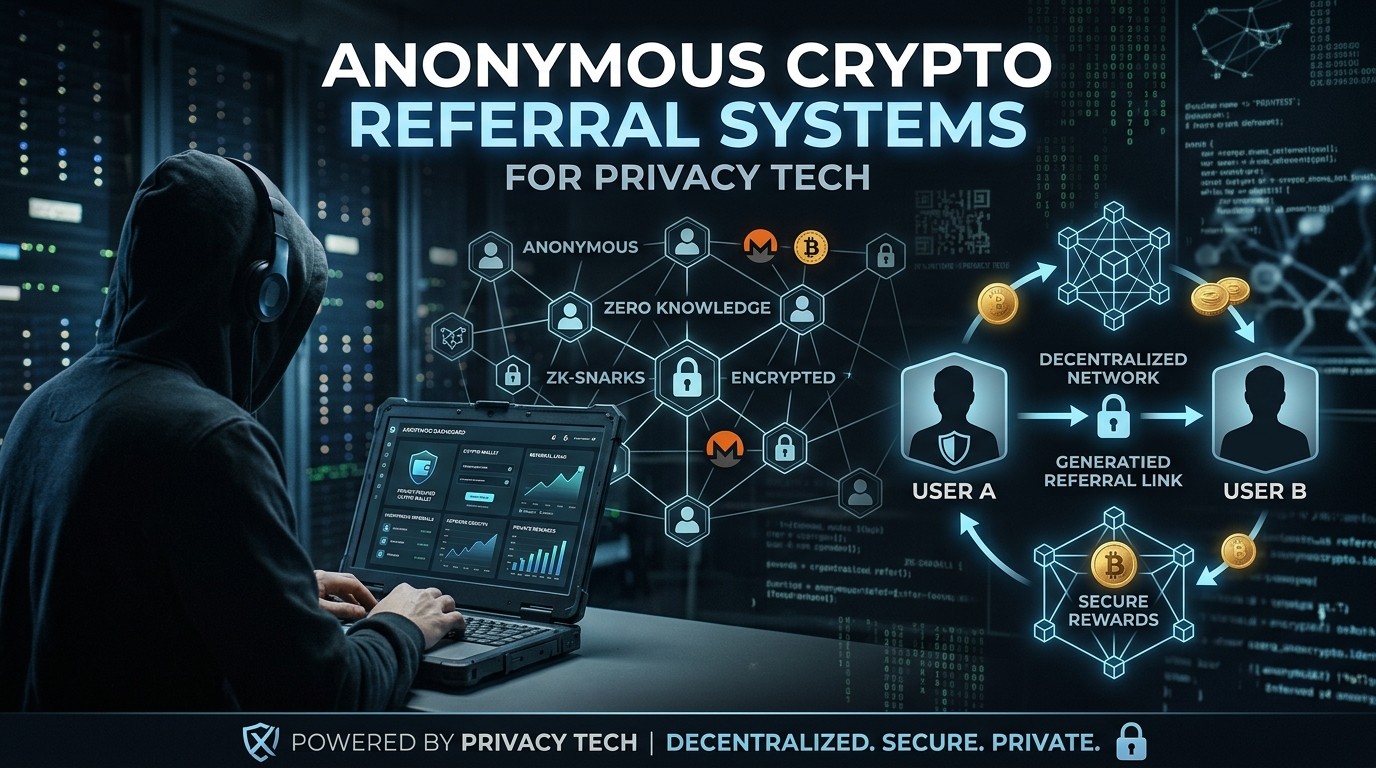
Anonymous Crypto Referral Systems explore privacy-preserving referral design for blockchain communities while balancing user confidentiality, fraud prevention, transparency, compliance, and sustainable growth.
Privacy has become one of the most important conversations in digital finance, especially as blockchain networks make transactions visible, traceable, and permanently recorded. This creates an interesting challenge for businesses that rely on referral marketing. Traditional referral programs often require users to submit names, email addresses, phone numbers, cookies, or other identifiable information. Crypto communities, however, frequently include users who value wallet-based identities, pseudonymity, and minimal disclosure.
This is where Anonymous Crypto Referral Systems enter the discussion.
Anonymous Crypto Referral Systems are referral frameworks designed to reduce unnecessary exposure of personal identity while still allowing businesses, communities, applications, or protocols to attribute referrals and reward legitimate participation. The objective is not necessarily to eliminate every form of identification. Instead, the objective is to minimize the amount of personally identifiable information that needs to be revealed for a referral relationship to function.
The concept becomes especially interesting in privacy-focused technology because blockchain already provides programmable ownership and transaction records. A referral system can potentially use wallet addresses, cryptographic proofs, referral codes, signatures, or privacy-preserving credentials rather than relying entirely on conventional customer databases.
However, privacy should not be confused with invisibility.
Anonymous Crypto Referral Systems still need to address fraud, duplicate accounts, reward manipulation, abuse, sybil behavior, money laundering risks, malicious referrals, and applicable legal requirements. A useful privacy system therefore tries to achieve selective disclosure rather than simply hiding everything.
Understanding that distinction is important for anyone researching Anonymous Crypto Referral Systems as a marketing or growth technology.
What Are Anonymous Crypto Referral Systems?
At the simplest level, Anonymous Crypto Referral Systems are referral mechanisms that allow one participant to introduce another participant to a blockchain-based service without requiring the referral process to depend on conventional personal identity information.
Instead of saying:
“Give us your full name and contact details so we can connect this referral to you,”
a privacy-oriented system might use:
- A wallet address
- A referral identifier
- A cryptographic signature
- A privacy-preserving credential
- A one-time claim code
- A zero-knowledge proof
- A pseudonymous account
- A smart-contract event
The specific architecture depends on the platform and its objectives.
Anonymous Crypto Referral Systems can therefore be understood as an intersection between referral marketing, blockchain identity, cryptography, customer acquisition, and privacy engineering.
The most important word is not necessarily “anonymous.”
It is “controlled.”
Users should have more control over what information is disclosed, who receives it, and why it is needed.
Why Privacy Matters in Referral Marketing
Traditional referral marketing often depends on tracking.
A business may record:
- Who referred the customer
- Who was referred
- Referral timestamps
- Email addresses
- Device information
- IP addresses
- Cookies
- Purchase history
- Campaign identifiers
- Reward status
This data can be commercially useful, but it also creates a growing privacy burden.
Every additional data point creates another potential security concern.
Blockchain introduces another issue: public ledgers can expose transaction history even when users do not publish their real names.
Therefore, Anonymous Crypto Referral Systems attempt to solve a specific problem: how can a company measure referrals without unnecessarily exposing a participant’s complete identity?
Anonymous Does Not Mean Unaccountable
One of the biggest misconceptions around Anonymous Crypto Referral Systems is that privacy requires the total elimination of identity verification.
That is not necessarily true.
A well-designed privacy architecture can separate identity from transaction activity.
For example, a user may prove that they are eligible to participate without revealing their complete identity to every other participant. A service provider may hold required information privately while allowing a blockchain system to operate using a pseudonymous credential.
This model is closer to selective disclosure than absolute anonymity.
The distinction matters because some businesses have legitimate obligations to verify users, prevent fraud, monitor suspicious transactions, or maintain records.
Privacy technology should reduce unnecessary disclosure rather than provide a mechanism for bypassing legitimate controls.
The Difference Between Privacy and Anonymity
Privacy means controlling the exposure of information.
Anonymity generally means that identifying a person is difficult or impossible.
Pseudonymity means activity is associated with an identifier that does not directly reveal a real-world name.
Blockchain systems often operate in a pseudonymous environment.
A wallet address can be visible publicly without directly displaying the owner’s legal name.
However, transaction patterns can sometimes be analyzed and linked to other information.
Therefore, Anonymous Crypto Referral Systems should not make unrealistic promises such as “your identity can never be discovered.”
A more credible approach is to explain exactly what information the system protects and from whom.
How Anonymous Crypto Referral Systems Can Work
A basic referral workflow may look like this:
Step 1: Referrer Creates an Identifier
The referring participant receives a unique code or cryptographic referral identifier.
Step 2: Referral Link Is Shared
The identifier is embedded into a referral URL, wallet interaction, QR code, or application flow.
Step 3: New User Arrives
The prospective customer interacts with the service through the referral path.
Step 4: Referral Is Verified
The platform determines whether the referral qualifies based on predefined conditions.
Step 5: Reward Is Recorded
A reward may be issued through an internal ledger, blockchain transaction, points system, or another mechanism.
Step 6: Personal Data Exposure Is Minimized
The system attempts to avoid collecting unnecessary identifying information.
This general model can be adapted to different products without requiring the platform to publish a participant’s real identity.
Wallet-Based Referral Attribution
Wallet addresses are one potential mechanism for referral attribution.
A referral relationship could associate a unique identifier with a wallet or account.
When qualifying activity occurs, the system checks whether the required conditions are satisfied.
Anonymous Crypto Referral Systems may use wallet-based attribution because blockchain wallets already act as digital identifiers.
However, a wallet should not automatically be treated as a private identity.
Blockchain activity can sometimes be analyzed across transactions, applications, and public data sources.
A privacy-conscious architecture should therefore explain what wallet information is recorded and how it is handled.
Cryptographic Referral Codes
Referral codes do not have to be conventional text strings.
A system could generate cryptographically signed referral claims.
For example, a referrer could receive a signed credential proving that they are authorized to participate in a campaign.
The credential could be verified without publishing unnecessary personal information.
This approach gives Anonymous Crypto Referral Systems greater flexibility than standard database-based affiliate tracking.
The system can potentially separate the proof that a referral happened from the identity of the person behind the referral.
Zero-Knowledge Proofs and Referral Privacy
Zero-knowledge proofs are one of the more advanced technologies relevant to privacy-preserving referral systems.
At a high level, a zero-knowledge proof can allow someone to demonstrate that a statement is true without revealing the underlying information used to prove it.
In referral marketing, a similar concept could potentially allow a participant to demonstrate eligibility without disclosing unnecessary personal details.
For example, the system might need to know whether a participant meets a certain requirement without needing to expose every attribute associated with that participant.
This makes zero-knowledge technology conceptually attractive for Anonymous Crypto Referral Systems.
However, implementation complexity should not be underestimated.
A system should not use sophisticated cryptography simply because it sounds advanced.
The privacy technology should solve a measurable privacy problem while remaining understandable, secure, auditable, and maintainable.
Referral Trees and Graphs
Traditional affiliate systems often maintain a referral tree.
User A refers User B.
User B refers User C.
User C refers User D.
In a blockchain environment, this structure could potentially be represented through wallet identifiers, signed claims, smart-contract events, or off-chain attribution systems.
Anonymous Crypto Referral Systems can preserve the relationship between participants without necessarily publishing their real-world identities.
However, referral graphs can create another privacy concern.
Even if names are hidden, relationship patterns themselves can reveal sensitive information.
For example, repeated interactions between certain addresses could expose organizational or commercial relationships.
Therefore, privacy design should consider metadata and relationship visibility, not just names.
Referral Attribution Without Excessive Tracking
Many conventional referral systems depend heavily on cookies and device tracking.
A privacy-first model can reduce dependence on these mechanisms by using user-controlled identifiers.
For example, a user might intentionally activate a referral credential rather than being silently tracked across unrelated websites.
This approach can provide clearer user consent.
Anonymous Crypto Referral Systems become especially useful when businesses want attribution while reducing invasive behavioral monitoring.
The user knows that a referral credential is being used for a specific purpose.
That is fundamentally different from collecting unrelated browsing activity.
Privacy-Preserving Reward Distribution
Reward distribution is another area where privacy can matter.
A company may want to pay rewards while keeping sensitive user information off a public ledger.
A blockchain transaction could expose a wallet address, amount, and timestamp.
Depending on the design, additional methods may reduce the visibility of sensitive relationships.
For example, a platform could separate referral validation from public reward settlement.
One system determines eligibility.
Another system handles user records.
A payment system processes the reward.
This layered architecture can limit unnecessary exposure.
Anonymous Crypto Referral Systems do not need to place every piece of referral data directly on-chain.
What Can Be Used as a Referral Reward?
Referral rewards can take many forms.
Token Rewards
A business may issue digital tokens as incentives.
Discounts
A referrer may receive a fee reduction or product discount.
Loyalty Points
Points can reward successful introductions without becoming transferable assets.
Access
Users could unlock features, communities, or premium tools.
Digital Collectibles
A referral could generate a unique digital item.
Partner Benefits
Referrers may receive access to partner services.
The appropriate reward depends on the product and legal structure.
The reward should also be proportionate to genuine value creation.
Referral Incentives and User Psychology
Referral programs work partly because people trust recommendations from people they already know.
Crypto communities add another psychological dimension.
Users may be motivated by:
- Community belonging
- Early access
- Exclusivity
- Recognition
- Financial incentives
- Contribution
- Reputation
- Privacy
- Ownership
Anonymous Crypto Referral Systems can appeal to users who want to participate in referral programs without publicly attaching their real identity to every recommendation.
Yet privacy alone may not create referrals.
The product still needs to be valuable.
The referral experience must also be understandable.
The reward must be credible.
The attribution mechanism must work.
And users must believe that the platform will honor its commitments.
Building Trust Without Revealing Identity
Trust is often associated with identity.
People may think:
“If I know who someone is, I can trust them.”
Blockchain privacy systems challenge that assumption.
A better framework is verifiable trust.
Instead of relying entirely on personal identity, users can demonstrate that:
- A credential is valid
- A referral is legitimate
- A transaction occurred
- A requirement was satisfied
- A reward was earned
This changes the question from:
“Who are you?”
to:
“What can you cryptographically prove?”
That shift is central to the philosophy behind Anonymous Crypto Referral Systems.
Sybil Resistance
Privacy systems face an important problem: one person can potentially create many digital identities.
This is called sybil behavior.
If a referral program rewards every new wallet, one participant might generate hundreds of wallets and attempt to claim rewards repeatedly.
Therefore, Anonymous Crypto Referral Systems need mechanisms for distinguishing legitimate participants without unnecessarily collecting identity information.
Possible approaches at a high level include:
- Proof-of-eligibility systems
- Reputation signals
- Account history
- Credential-based access
- Rate limitations
- Economic deposits
- Behavioral anomaly detection
- Human verification where appropriate
No single mechanism eliminates every form of abuse.
The challenge is balancing privacy with program integrity.
Fraud Prevention
Referral fraud can involve:
- Self-referrals
- Duplicate accounts
- Fake conversions
- Automated registrations
- Reward farming
- Collusive referrals
- Manipulated attribution
- Stolen credentials
A completely open referral system can become expensive.
Privacy therefore cannot mean “no controls.”
Anonymous Crypto Referral Systems should combine privacy protections with strong fraud controls.
A useful architecture separates the identity question from the abuse question.
The platform may not need to know someone’s full identity to identify suspicious behavior.
It can instead monitor patterns and require additional proof only when necessary.
Selective Disclosure
Selective disclosure is one of the most important concepts in privacy technology.
Instead of asking users to disclose everything, a system requests only what is needed for the specific transaction.
For example, a platform may need proof that:
The participant is eligible.
The referral is unique.
The referral relationship existed.
The reward condition was completed.
But it may not need to know every detail about the participant.
Anonymous Crypto Referral Systems can use selective disclosure as a design principle.
This can minimize data collection while preserving useful verification.
On-Chain and Off-Chain Data
Not every referral record belongs on a blockchain.
On-chain data is visible to network participants and can be difficult to change.
Off-chain databases can be private, flexible, and easier to update.
A hybrid design may be appropriate.
For example:
On-chain:
- Referral proof
- Transaction event
- Reward settlement
- Cryptographic commitment
Off-chain:
- Customer-support records
- Compliance information
- Detailed fraud signals
- Internal campaign metadata
Anonymous Crypto Referral Systems can become more privacy-friendly when sensitive information remains outside the public ledger.
Smart Contracts for Referral Programs
Smart contracts can automate simple referral conditions.
For example:
“If a qualifying user completes a defined action, record the referral and release the designated reward.”
This can reduce reliance on manual approval.
Smart contracts can also improve transparency because participants can inspect predefined rules where the contract is publicly verifiable.
However, smart contracts cannot understand every real-world condition automatically.
If a referral qualifies based on customer-service approval, identity checks, fraud investigations, or off-chain activity, an external system may still be required.
Therefore, the best architecture combines automation with appropriate human and backend processes.
Privacy-Preserving Referral Dashboards
A referral dashboard does not need to expose all participant information.
A privacy-focused dashboard could display:
- Number of successful referrals
- Reward balance
- Referral conversion rate
- Campaign status
- Claim history
- Qualification status
It may hide:
- Real names
- Exact locations
- Private transaction relationships
- Unnecessary behavioral data
Anonymous Crypto Referral Systems can therefore improve the user experience by giving participants control over what information is publicly associated with them.
Referral Links and Metadata
Referral URLs can leak information.
A URL may contain a campaign identifier, affiliate code, user identifier, or tracking parameter.
If improperly designed, these identifiers can reveal relationships.
Privacy-oriented referral systems should carefully consider:
- How referral codes are generated
- Whether codes are reusable
- Whether codes contain personal information
- Whether links expire
- Whether identifiers are publicly searchable
- Whether referral metadata appears in analytics systems
The goal is to make referral attribution useful without unnecessarily exposing participant relationships.
Private Referral Credentials
A privacy-preserving platform could issue a referral credential to a participant.
The credential can establish that the participant is part of a specific campaign.
The user can then present that credential when introducing another customer.
This approach separates identity from authorization.
Anonymous Crypto Referral Systems can become more flexible when users control their credentials instead of relying exclusively on centralized referral databases.
Referral Systems for DAOs and Web3 Communities
Decentralized communities often depend heavily on member-driven growth.
Members might refer:
- Developers
- Investors
- Creators
- Customers
- Contributors
- Partners
- New community participants
A privacy-preserving referral structure can help members participate without requiring their public profile to reveal every commercial or personal connection.
However, DAO communities also need anti-abuse mechanisms.
Governance can define:
Who qualifies as a referral?
What counts as successful onboarding?
What rewards are available?
How are disputes handled?
How are fraudulent referrals investigated?
The rules should be understandable before participants begin.
Referral Programs for Privacy Products
Privacy products themselves create a particularly interesting contradiction.
A privacy application may want aggressive growth while its users strongly value confidentiality.
A traditional referral system could undermine the product’s own positioning by requiring extensive personal data.
Anonymous Crypto Referral Systems allow privacy products to design marketing infrastructure that is more consistent with the product philosophy.
For example, a privacy-oriented wallet or identity platform may prefer user-controlled referrals instead of centralized contact harvesting.
Referral Programs for Wallets
Wallets can use referral systems for:
- New-user onboarding
- Premium features
- Partner services
- Educational campaigns
- Community growth
A privacy-oriented referral program could use wallet-based identifiers rather than requiring participants to reveal unnecessary personal information.
The wallet provider must still consider fraud, regulatory requirements, security, and customer support.
Privacy design should never weaken account recovery or security controls.
Referral Programs for NFT Communities
NFT communities often depend on social sharing and member participation.
Referral structures can reward users for bringing new participants into a collection, membership club, event, or digital ecosystem.
A privacy-focused system can help users participate without making their full identity public.
For instance, a collector might introduce another participant through a pseudonymous wallet credential.
This can be particularly relevant when projects involve premium physical products or blockchain-connected assets. A business working with Physical Assets to NFTs may use referral mechanisms to grow a community around authenticated real-world products without making every customer relationship publicly visible.
Referral Programs for Asset Tokenization Platforms
Tokenization platforms may serve users interested in property, commodities, collectibles, art, or other real-world assets.
These platforms can potentially use privacy-aware referrals to attract new participants while keeping unnecessary customer data private.
However, financial products can require stronger identity and compliance processes than ordinary digital memberships.
Businesses should therefore distinguish privacy-preserving attribution from identity elimination.
This is also relevant when comparing products in the wider token economy. Someone researching Tokenized Securities vs NFTs should understand that referral infrastructure does not change the underlying legal nature of the token being marketed.
Referral Programs for High-Value Communities
High-value customer segments can be sensitive to unnecessary public exposure.
A customer may want to recommend a service while keeping their purchasing behavior, investment interests, or network relationships private.
A referral system can therefore be designed around private invitations, controlled access, or pseudonymous credentials.
An especially exclusive growth model could use Ultra-Exclusive Invite-Only Referral Hubs where access is provided through controlled invitations instead of open public registration.
The central principle remains consent.
Users should know what is happening and what information is being collected.
Building Referral Programs for High-Net-Worth Audiences
Premium customers often care about service quality, discretion, status, access, and personal relationships.
A privacy-oriented referral system should therefore avoid creating unnecessary friction.
Rather than forcing customers through a lengthy public referral workflow, a platform may allow a private introduction process.
For brands that want customers to become advocates, the experience should feel like an exclusive recommendation rather than a mass-market affiliate transaction.
This is particularly relevant to strategies designed to Turn Elite HNW Clients Into Brand Evangelists, where trust and discretion may be central to the relationship.
Privacy UX: Make It Understandable
Privacy technology can become confusing very quickly.
Users should not need to understand advanced cryptography to understand a referral program.
A good interface can simply explain:
“What information is shared?”
“Who can see it?”
“How long is it retained?”
“What is required to earn the reward?”
“Can the referral be revoked?”
“Can the identifier be reused?”
“Is identity verification required?”
These explanations can increase user trust.
Anonymous Crypto Referral Systems should make privacy visible without overwhelming users with technical jargon.
Data Minimization
Data minimization means collecting only information necessary for a specific purpose.
For referral systems, this could mean avoiding collection of:
- Full address
- Personal phone number
- Unrelated browsing history
- Unnecessary device identifiers
- Unneeded social profiles
Instead, the platform can use a referral credential or pseudonymous identifier.
The benefit is not just privacy.
Reducing stored data can also reduce the consequences of a future data breach.
Encryption and Access Control
Sensitive referral information should be protected through appropriate security controls.
A privacy-oriented system should define:
Who can access referral records?
What can administrators see?
What information is encrypted?
How are keys managed?
How long is data retained?
What happens when a campaign ends?
Anonymous Crypto Referral Systems should treat security and privacy as connected disciplines.
A system cannot claim strong privacy if internal administrators can freely access every participant detail.
Data Retention
A referral platform should avoid retaining information forever simply because storage is inexpensive.
Different information can have different retention periods.
For example, campaign analytics may not need to be stored as long as legally required transaction records.
A privacy-focused architecture should identify retention periods in advance.
Users should have a clear explanation of what happens to referral information after a campaign ends.
Public Transparency vs Private Operations
Blockchain introduces a useful architectural possibility.
Some activity can be publicly verifiable while sensitive information remains private.
For example, the system might publish that:
“A qualified referral reward was issued.”
It does not necessarily need to publicly publish:
“The reward was issued to this person’s real-world identity.”
This separation can produce a stronger privacy model.
Anonymous Crypto Referral Systems can therefore combine transparency with confidentiality.
Reputation Without Full Identity
Traditional reputation systems may depend on verified names.
Privacy technology can create alternative models.
A participant could accumulate reputation associated with a cryptographic identity.
The reputation may reflect:
- Successful referrals
- Community participation
- Verified contributions
- Account age
- Transaction history
- Quality signals
The challenge is preventing reputation from becoming permanently tied to personal behavior in ways the user cannot control.
Portable and selective credentials can offer another approach.
Preventing Referral Gaming
A referral program is vulnerable when rewards are easy to exploit.
Suppose the reward is $10 for every new wallet.
A user creates 1,000 wallets.
The business could lose $10,000 or more.
A better design might require a meaningful qualifying action.
For example, the new participant might need to:
- Complete onboarding
- Use the service
- Maintain activity
- Purchase a product
- Complete a legitimate contribution
Even then, fraud detection remains necessary.
Anonymous Crypto Referral Systems should reward genuine acquisition rather than wallet creation alone.
Reward Timing
Reward timing affects behavior.
Immediate rewards can attract short-term participation.
Delayed rewards can reduce low-quality registrations.
Milestone-based rewards can encourage deeper engagement.
A business should choose reward timing based on the actual customer lifecycle.
For example, if a SaaS application typically needs 30 days before a customer becomes profitable, a referral reward could be tied to a meaningful activation event rather than the initial signup.
Privacy does not change this fundamental marketing principle.
Referral Program Economics
A referral system must be economically sustainable.
A simple framework is:
Referral Value = Customer Lifetime Value − Acquisition Cost − Referral Reward − Operational Cost
Suppose a customer is worth $500 over their lifetime.
The business spends $100 on ordinary acquisition.
A referral reward costs $50.
Program administration costs $20.
The remaining contribution is:
$500 − $100 − $50 − $20 = $330
The exact economics vary by business.
The important point is that privacy infrastructure should support sustainable acquisition, not simply increase referral volume.
Measuring Referral Performance
Anonymous Crypto Referral Systems can still generate useful analytics.
Track metrics such as:
Referral Conversion Rate
How many referred visitors become qualifying customers?
Qualified Referral Rate
How many referrals satisfy the actual program requirements?
Reward Cost Per Customer
How much does the business spend on referral rewards for each acquired customer?
Referral Retention
Do referred users remain active?
Referral Revenue
How much revenue comes from referred customers?
Fraud Rate
What percentage of referrals are suspicious or invalid?
Customer Lifetime Value
How valuable are referred users over time?
Privacy should not mean abandoning measurement.
It means measuring with less unnecessary personal data.
Building a Privacy-Friendly Analytics Layer
A privacy-conscious analytics system can aggregate information instead of tracking individuals continuously.
Instead of recording every interaction, the system might report:
- Total referrals
- Total qualified conversions
- Aggregate conversion rate
- Aggregate reward expense
- Campaign-level revenue
The result can provide useful management information without building excessive personal profiles.
Anonymous Crypto Referral Systems are most powerful when privacy is incorporated into the analytics layer rather than applied only to the referral link.
Compliance and Legal Boundaries
Privacy technology does not remove legal obligations.
Certain industries may require customer identification, sanctions screening, transaction monitoring, taxation records, consumer disclosures, or other controls.
A referral system connected to a regulated financial service may therefore require information that a simple social referral program does not.
The correct approach is to identify the minimum legally required information and protect it appropriately.
Anonymous Crypto Referral Systems should therefore be described accurately.
They are privacy-preserving systems, not automatic legal-exemption mechanisms.
Avoiding Privacy Theater
Some products advertise themselves as private while collecting extensive information in the backend.
That is privacy theater.
A genuinely privacy-focused referral product should document:
- What is collected
- Why it is collected
- Where it is stored
- Who can access it
- How long it is retained
- What is published on-chain
- What can be correlated externally
- What users can control
Transparency creates credibility.
Security Threat Model
A privacy referral system should consider threats from:
- Attackers
- Fraudulent participants
- Malicious referrers
- Compromised wallets
- Database breaches
- Administrator abuse
- Phishing
- Fake referral links
- Smart-contract vulnerabilities
- Colluding users
Threat modeling helps identify where privacy can fail.
A system should evaluate not only what information it intends to protect but also what information an attacker might infer.
Usability vs Privacy
Highly private systems can become difficult to use.
Users may need to manage credentials, keys, signatures, or privacy settings.
If the process becomes too complex, adoption may decline.
Therefore, privacy engineering should be balanced with usability.
A good Anonymous Crypto Referral Systems implementation can hide technical complexity behind a simple interface.
Users should be able to benefit from advanced privacy without needing to understand every cryptographic mechanism.
Interoperability
Modern blockchain users may interact with multiple wallets, chains, applications, and identities.
A referral credential that only works inside one isolated environment may have limited utility.
Standards-based identity and credential systems can potentially improve interoperability.
The goal is to allow users to control their referral identity across supported ecosystems while minimizing unnecessary data exposure.
Multi-Chain Referral Systems
Some crypto businesses operate across multiple networks.
A user may have:
- Wallet A on Chain 1
- Wallet B on Chain 2
- Wallet C on Chain 3
If a referral reward depends on identifying the same participant across networks, privacy and attribution become more difficult.
The system may need a privacy-preserving way to prove relationship or eligibility without publicly linking every wallet.
This is a complex area and should be approached carefully.
Social Recovery and Referral Identity
A referral credential can become valuable over time.
If a user loses access to the associated wallet, the referral relationship may also be lost.
Therefore, privacy-friendly systems should consider recovery mechanisms.
Possible approaches include controlled credential recovery, social recovery, backup credentials, or account abstraction-based systems.
The goal is to preserve access without creating a centralized database that unnecessarily exposes identity.
Portable Referral Reputation
Imagine a user participates in several privacy-oriented applications.
Instead of rebuilding referral reputation from zero each time, the user could potentially carry verifiable credentials across ecosystems.
A privacy layer might allow them to prove:
“I have successfully referred qualifying users before.”
without revealing:
“Here is my complete history across every platform.”
This model can create more user-centric referral ecosystems.
Community Governance
Referral programs sometimes become part of broader community governance.
Participants might vote on:
- Reward amounts
- Eligibility
- Campaign duration
- Fraud policies
- Partner programs
- Referral limits
However, anonymous voting can introduce governance problems of its own.
One person may create multiple identities.
Therefore, privacy-preserving governance needs both privacy and sybil resistance.
The same principle applies to referral programs.
Ethical Considerations
Privacy should benefit users, not merely businesses.
A company should not use anonymous referral mechanisms to hide manipulative marketing practices.
Referral relationships should be understandable.
Rewards should be transparent.
Users should not be tricked into promoting products without understanding the incentive.
A privacy-friendly system can still be unethical if its underlying marketing practices are deceptive.
Therefore, ethical design should accompany technical privacy.
The Role of Consent
Consent is particularly important when referrals involve personal connections.
A system should not automatically import a user’s contact list or expose private relationships simply because someone wants to invite friends.
A better approach is user-controlled sharing.
The person decides:
Who receives the invitation.
What information is shared.
Which campaign is associated with it.
Whether a reward is involved.
This approach aligns referral marketing with privacy principles.
Privacy-Preserving Referral Design for Brands
Consumer brands can use privacy-focused referral systems for:
- Loyalty programs
- Premium product launches
- Memberships
- Product authentication
- Private communities
- Digital collectibles
- Customer advocacy
For luxury and high-value brands, discretion may be part of the customer experience.
The referral program should therefore feel like a personal invitation rather than a publicly visible sales funnel.
Referral Systems and Customer Advocacy
The highest-value referrals often come from satisfied customers.
A customer who genuinely believes in a product can create stronger trust than a paid advertising impression.
The challenge is preserving authenticity.
If every interaction becomes a visible financial transaction, the recommendation can feel commercial.
A privacy-preserving system can keep the incentive mechanism discreet while still providing attribution.
The reward should never become more important than the reason for recommending the product.
Designing a High-Trust Referral Experience
A strong privacy-oriented referral experience can follow a simple structure:
Discover
The user learns about the referral opportunity.
Understand
The user sees what information will be used.
Share
The user generates or activates a referral credential.
Convert
The referred person completes the relevant action.
Verify
The system confirms eligibility.
Reward
The referrer receives the defined benefit.
Control
The participant can review or manage their referral information.
This structure creates predictability.
Anonymous Crypto Referral Systems and Brand Differentiation
Privacy can become a brand attribute.
A company that minimizes data collection can differentiate itself from competitors that rely heavily on personal tracking.
However, privacy claims should be specific.
Instead of saying:
“We protect your privacy.”
A stronger explanation is:
“We do not require your phone number to create a referral relationship.”
Specific claims are easier to understand and verify.
Anonymous Crypto Referral Systems can therefore become part of a broader privacy-focused brand strategy.
Cost Considerations
Privacy technology may introduce development costs.
Potential expenses include:
- Smart-contract development
- Cryptographic infrastructure
- Security audits
- Identity and credential systems
- Backend infrastructure
- Analytics
- Fraud detection
- Compliance reviews
- User education
A small business may not need advanced cryptography.
A global financial platform may need much more sophisticated infrastructure.
The system should therefore be proportional to the actual risk and privacy requirement.
Build vs Buy
Businesses have two broad choices.
Build
Advantages can include complete control, custom functionality, and deep integration.
Challenges include development cost, security responsibility, maintenance, and compliance complexity.
Buy or Integrate
Advantages can include faster deployment and existing infrastructure.
Challenges include vendor dependency, data-sharing concerns, limited customization, and integration restrictions.
Anonymous Crypto Referral Systems should be evaluated according to the organization’s resources and privacy requirements.
A Practical Implementation Roadmap
Phase 1: Define the Privacy Goal
Determine exactly what information should remain private.
Do not start with technology.
Start with the privacy requirement.
Phase 2: Map the Referral Data
Document every data point used by the existing referral program.
Then ask:
“Do we actually need this?”
Phase 3: Select the Attribution Method
Choose between wallet identifiers, signed credentials, referral codes, privacy-preserving proofs, or hybrid methods.
Phase 4: Design Fraud Controls
Build mechanisms for detecting duplicate participation, suspicious activity, and reward abuse.
Phase 5: Define Reward Rules
Make qualifying conditions clear.
Phase 6: Build the Prototype
Test the referral journey with a small participant group.
Phase 7: Security Review
Conduct code review, threat modeling, and appropriate testing before scaling.
Phase 8: Privacy Review
Determine what information can still be inferred even when names are hidden.
Phase 9: Launch Gradually
Start with a controlled campaign.
Phase 10: Measure and Improve
Analyze conversion, fraud, reward cost, retention, and user feedback.
Example Architecture
A practical privacy-oriented referral platform could contain six layers.
Layer 1: User Wallet or Account
Provides the participant identifier.
Layer 2: Referral Credential
Associates the participant with a campaign.
Layer 3: Attribution Engine
Tracks whether a new participant arrived through the referral.
Layer 4: Qualification Engine
Determines whether the activity meets the reward criteria.
Layer 5: Fraud and Risk Layer
Looks for abuse without collecting unnecessary information.
Layer 6: Reward Layer
Delivers the defined benefit.
This modular architecture allows businesses to improve one layer without redesigning the entire referral experience.
What Not to Put on a Public Blockchain
Avoid placing sensitive personal information directly on a public ledger.
Examples can include:
- Full names
- Home addresses
- Phone numbers
- Government identifiers
- Private customer-support records
- Sensitive financial details
A public blockchain can be persistent and difficult to modify.
Referral infrastructure should therefore use blockchain selectively.
The blockchain can record proof.
It does not need to store every underlying piece of personal data.
Privacy Metrics
Businesses can also measure privacy performance.
Useful metrics may include:
Data Collection Reduction
How much less personal information is collected compared with the previous system?
Public Exposure
How much referral information appears publicly?
User Control
How much information can the participant choose to disclose?
Retention Reduction
How much less data is retained?
Incident Impact
How much information would be exposed if a database were compromised?
These metrics make privacy measurable instead of purely promotional.
Common Mistakes to Avoid
Mistake 1: Treating Privacy as Total Anonymity
No system should make unrealistic guarantees.
Mistake 2: Collecting Everything Anyway
A privacy-branded platform that stores excessive information defeats its own purpose.
Mistake 3: Ignoring Sybil Attacks
A referral program must prevent users from generating unlimited artificial participants.
Mistake 4: Putting Sensitive Data On-Chain
Public blockchains are not appropriate for arbitrary personal information.
Mistake 5: Overengineering
Advanced cryptography is useful only when it solves a real problem.
Mistake 6: Ignoring Compliance
Privacy technology does not eliminate lawful verification requirements.
Mistake 7: Making the UX Too Complicated
Users should not need to become cryptography experts to claim a referral reward.
Mistake 8: Rewarding Low-Quality Activity
Registrations are not the same as genuine customers.
The Future of Privacy-Preserving Referral Marketing
Referral marketing is likely to become increasingly connected with digital identity, wallets, credentials, privacy technology, and programmable incentives.
Users may eventually control reusable credentials that work across multiple applications.
Instead of businesses collecting large identity databases, users could present only the information required for a particular interaction.
Anonymous Crypto Referral Systems fit into this broader shift toward user-controlled digital identity.
The future may not be “anonymous everywhere.”
It may be “disclose only what is necessary.”
That is a more practical and sustainable privacy model.
Anonymous Crypto Referral Systems and User Ownership
One of the most compelling ideas is moving referral identity from being a company-owned database record to a user-controlled credential.
Traditional systems say:
“The company owns your referral profile.”
A decentralized or privacy-oriented model can instead say:
“You control the credential that proves your referral participation.”
This does not eliminate platform responsibility.
The business still needs secure systems, fraud prevention, reliable reward logic, and appropriate governance.
But it can shift the balance toward greater user control.
Anonymous Crypto Referral Systems and Sustainable Growth
Privacy is not only a technical feature.
It can become a growth advantage when it reduces friction and increases trust.
Users may be more comfortable recommending a product if they know the process does not expose unnecessary personal information.
Organizations may also reduce storage and security costs when they collect less data.
The best Anonymous Crypto Referral Systems therefore create value on both sides of the relationship.
Users gain more control.
Businesses gain useful attribution.
Privacy teams gain smaller data exposure.
Marketing teams retain measurable acquisition data.
Anonymous Crypto Referral Systems: Final Strategic Framework
Before launching a privacy-oriented crypto referral system, a business should answer ten questions:
- What exactly needs to remain private?
- Which referral data is genuinely necessary?
- Can attribution work through a pseudonymous identifier?
- What legal verification is required?
- How will sybil attacks be controlled?
- How will referral fraud be detected?
- Which information belongs on-chain?
- Which information should remain off-chain?
- What does the user control?
- How will the system prove that rewards were earned?
If these questions are answered clearly, the project has a stronger foundation.
Anonymous Crypto Referral Systems should not be treated as a shortcut around identity, regulation, or accountability.
They should be treated as privacy-oriented infrastructure for attribution and rewards.
Final Takeaway
The most important idea behind Anonymous Crypto Referral Systems is not complete invisibility.
It is proportional disclosure.
A user should not have to expose more information than necessary simply to recommend a product or receive a legitimate reward.
At the same time, businesses need effective protection against fraud and must respect applicable legal obligations.
The strongest systems therefore combine:
Privacy.
Selective disclosure.
Cryptographic verification.
Fraud resistance.
Clear incentives.
User control.
Security.
Transparent policies.
A referral program built around these principles can serve blockchain communities without turning every recommendation into a permanent public identity record.
As privacy technology matures, referral marketing can move from “track everything” toward “prove what matters.”
That shift could make digital growth more respectful, more secure, and more aligned with the expectations of privacy-conscious users.
Conclusion
Anonymous Crypto Referral Systems offer a privacy-oriented approach to referral marketing by reducing unnecessary identity exposure while preserving attribution, verification, and reward functionality. Their real value comes from combining user-controlled identifiers, selective disclosure, cryptographic verification, fraud prevention, and carefully designed incentives. Privacy does not require removing every form of accountability, especially where legitimate verification obligations apply. Businesses should therefore separate personal identity from referral attribution wherever practical, minimize data collection, keep sensitive information off public blockchains, and make reward rules transparent. As blockchain identity and privacy technologies develop, referral programs can become more user-controlled while still delivering measurable acquisition and sustainable growth.
Frequently Asked Questions (FAQ)
1. What are Anonymous Crypto Referral Systems?
Anonymous Crypto Referral Systems are referral mechanisms designed to reduce unnecessary exposure of personal identity while still allowing referral attribution, eligibility checks, and reward distribution.
2. Are crypto referral systems completely anonymous?
Not necessarily. Many systems are pseudonymous or privacy-preserving rather than absolutely anonymous. Blockchain activity can sometimes be analyzed and connected with external information.
3. Can referral programs work without collecting names?
In some use cases, yes. A platform may use wallet addresses, referral codes, cryptographic credentials, or other identifiers instead of requiring names for every referral interaction.
4. How can privacy referral systems prevent fake accounts?
They can combine privacy-preserving verification with mechanisms such as rate limits, reputation signals, eligibility proofs, behavioral analysis, economic requirements, and additional verification when necessary.
5. Can smart contracts manage crypto referral rewards?
Yes. Smart contracts can automate certain predefined referral conditions and reward distribution. Off-chain systems may still be required for fraud checks, customer support, compliance, and other real-world conditions.
6. Should personal information be stored on a public blockchain?
Sensitive personal information generally should not be placed directly on a public blockchain. Privacy-focused designs can store necessary information off-chain and use blockchain-based proofs or records selectively.
7. What is selective disclosure?
Selective disclosure allows a user to provide only the information needed for a particular interaction rather than revealing all available personal information.
8. Can businesses use anonymous referral systems for high-value customers?
Yes. Privacy-oriented referral infrastructure can be useful for premium communities where customers value discretion, controlled access, and reduced public exposure.
9. Are anonymous crypto referrals suitable for regulated businesses?
They can potentially support privacy-preserving parts of a referral workflow, but regulated businesses may still have legal obligations requiring identity verification, recordkeeping, monitoring, or other controls.
10. What makes a privacy-friendly crypto referral system effective?
A strong system combines minimal data collection, clear consent, secure attribution, sybil resistance, fraud prevention, transparent rewards, appropriate compliance controls, and a simple user experience.