
Learn how to build invite-only referral hubs that create scarcity, accelerate qualified growth, strengthen trust, and turn private communities into repeatable acquisition engines.
Modern referral marketing is no longer limited to sending customers a generic referral link and offering a discount. The strongest referral systems increasingly behave like private networks, where access itself becomes part of the value proposition. Instead of making every offer publicly available, businesses can create controlled environments where members receive access through invitations, trusted introductions, milestones, or carefully managed eligibility rules.
That shift creates a powerful psychological effect. People tend to pay more attention to opportunities that appear limited, private, or difficult to enter. When exclusivity is combined with genuine utility, a referral program can feel less like a promotion and more like membership in a valuable network. This is where Ultra-Exclusive Invite-Only Referral Hubs become strategically important.
Ultra-Exclusive Invite-Only Referral Hubs are private referral environments designed around controlled access, trusted relationships, and selective member growth. Their purpose is not merely to generate more referrals. The deeper objective is to create a network in which each participant has a reason to protect the community, invite qualified people, and continue engaging after the initial conversion.
The best systems are not difficult because of technology. They are difficult because the business must coordinate positioning, eligibility, incentives, messaging, data, trust, moderation, attribution, and retention. A poorly designed private referral hub simply becomes a closed group with little activity. A well-designed one can become a compounding acquisition engine.
This guide explains how to design Ultra-Exclusive Invite-Only Referral Hubs quickly while preserving quality, creating legitimate scarcity, reducing friction, and building a scalable referral process.
Understanding the Strategic Model
The first step is recognizing that a private referral hub is different from a standard referral program.
A traditional referral program often follows a simple sequence:
Customer buys → customer receives referral link → customer shares link → friend converts → customer gets reward.
An invite-only hub introduces additional layers:
Qualified member enters → member receives identity and access → member understands community value → member receives invitation capacity → member invites a relevant person → new member is evaluated or accepted → both members benefit → network expands.
Ultra-Exclusive Invite-Only Referral Hubs therefore operate more like controlled ecosystems than basic affiliate structures.
The distinction matters because the perceived value of the program can be influenced by the quality of the network. When people believe membership gives them access to useful people, better information, exclusive opportunities, priority support, unique products, or status, they are more likely to treat invitations seriously.
Why exclusivity changes behavior
Exclusivity can influence motivation through scarcity, status, curiosity, social proof, and fear of missing out. However, artificial scarcity often loses credibility quickly.
There is a major difference between saying, “Only 50 people can ever join,” and actually limiting access because the organization is maintaining a specific quality standard.
The first approach can look like marketing theater. The second becomes a legitimate operating model.
Ultra-Exclusive Invite-Only Referral Hubs work best when exclusivity is supported by a real reason.
That reason could be:
- limited expert capacity
- premium customer support
- specialized industry access
- confidential resources
- community quality controls
- early product access
- exclusive pricing
- curated networking
- invite-only events
- private education
- high-value introductions
The rule is simple: the private experience must provide something meaningfully better than the public experience.
The Core Architecture of a Private Referral Hub
A fast launch does not mean skipping structure. It means reducing unnecessary complexity and building only what directly supports the intended behavior.
A practical architecture usually contains seven layers.
| Layer | Purpose | Key Question |
|---|---|---|
| Positioning | Defines why the hub exists | Why should someone care? |
| Access | Controls entry | Who is allowed in? |
| Identity | Establishes member context | Who is this person? |
| Referral | Creates invitations | Who can they invite? |
| Qualification | Protects quality | Who gets accepted? |
| Incentives | Encourages action | Why should members refer? |
| Retention | Sustains activity | Why should members stay? |
Ultra-Exclusive Invite-Only Referral Hubs become much easier to build when these layers are defined before choosing software.
Many businesses make the opposite mistake. They select a platform first and then attempt to force their referral model into the platform’s existing workflow.
Strategy should come first.
Define the promise before the mechanics
Start with one sentence:
“This private hub exists to help [specific audience] gain [specific benefit] through [unique mechanism].”
For example:
“This private hub gives high-value SaaS customers access to implementation experts, early product features, private events, and trusted business introductions.”
That statement immediately establishes a reason for exclusivity.
A referral hub should never depend entirely on the reward. If the only reason members participate is to earn a coupon, the network is vulnerable to reward fatigue. Once the reward stops being exciting, engagement falls.
The strongest Ultra-Exclusive Invite-Only Referral Hubs combine transactional rewards with social and functional value.
Designing the Ideal Member Profile

Not every customer should automatically become a referral member.
The quality of the network depends heavily on who is admitted.
A useful ideal-member framework can score prospects across several dimensions:
Customer value: Is the person already receiving meaningful value?
Relationship strength: Does the organization have enough trust with them?
Network relevance: Are their contacts likely to match the target audience?
Engagement: Have they demonstrated active participation?
Behavior: Do they naturally advocate for products they genuinely like?
Reputation: Could their presence strengthen or weaken the community?
Ultra-Exclusive Invite-Only Referral Hubs should prioritize members who improve the network, not merely people who are willing to invite the largest number of contacts.
Build tiers instead of treating everyone equally
A tiered structure can make the experience more motivating.
For example:
| Tier | Qualification | Invitation Capacity | Benefits |
|---|---|---|---|
| Member | Basic eligibility | 2 | Core access |
| Advocate | Successful referrals | 5 | Bonus resources |
| Insider | High-quality referrals | 10 | Priority access |
| Ambassador | Exceptional performance | 20 | Premium benefits |
This model gives participants a reason to continue contributing.
Importantly, higher tiers should be earned through meaningful behavior rather than simply purchasing access.
Create Legitimate Scarcity
Scarcity is powerful only when users believe it.
Ultra-Exclusive Invite-Only Referral Hubs should define exactly what is scarce.
Maybe only a limited number of businesses can access a private advisory community. Perhaps each member can invite only three people per month. Maybe onboarding capacity is limited because every new member receives a personalized consultation.
The scarce resource does not have to be the membership itself.
It can be:
- onboarding capacity
- invitation slots
- mentor time
- product availability
- event seats
- premium benefits
- geographic availability
- category exclusivity
This distinction is useful because it allows a business to grow while maintaining a meaningful feeling of selectivity.
Invitation limits can increase quality
Unlimited referral invitations often create low-intent behavior.
When a member has only three invitations, each one becomes more valuable. The member must think:
“Who would genuinely benefit from this?”
That mental filter can improve referral quality.
Ultra-Exclusive Invite-Only Referral Hubs can use invitation quotas as a quality-control mechanism rather than as a purely promotional tactic.
Building the Invitation Experience
The invitation itself is one of the most important parts of the system.
A weak invitation says:
“Join this referral program and get $20.”
A stronger invitation explains why the recipient was selected.
For example:
“You were invited by a member of our private business network because they believe our resources could be relevant to your team.”
That wording changes the emotional context.
The recipient is not simply clicking a sales link. They are receiving a trusted recommendation.
The invitation should answer five questions
The prospective member should quickly understand:
Who invited me?
The inviter’s identity should be visible.
Why was I invited?
Give the invitation a clear contextual reason.
What do I get?
Explain the primary value without overwhelming the reader.
Why is this private?
Describe the legitimate reason access is controlled.
What happens next?
Make the acceptance process obvious.
Ultra-Exclusive Invite-Only Referral Hubs gain conversion strength when uncertainty is removed before the registration step.
Use Trust as the Primary Growth Mechanism
People are more likely to act on a recommendation when it comes from someone they trust.
That means the referral system should make the relationship visible.
Consider including:
- inviter name
- inviter company
- shared relationship
- invitation date
- personalized message
- reason for recommendation
- relevant benefit
- community rules
The objective is not to manufacture trust. It is to transfer existing trust into the new relationship.
This is one reason social introductions can outperform cold outreach.
However, trust should not be exploited. Invitations should never imply endorsements that do not exist.
Connecting Outreach and Referral Systems
Private referral communities become especially powerful when paired with targeted outbound strategies.
Businesses can use email, social messaging, professional networks, account-based campaigns, partnerships, communities, and events to find potential advocates before activating referral invitations.
The challenge is avoiding fragmented activity.
A centralized measurement system should examine acquisition source, outreach cost, engagement, referral rate, conversion, and revenue contribution. Businesses evaluating Multi-Channel Outreach And ROI can use these referral metrics to determine which acquisition channels are producing the strongest downstream members.
Ultra-Exclusive Invite-Only Referral Hubs can then become the conversion layer that turns external attention into an owned network.
Choose channels based on relationship quality
The “best” channel is not necessarily the one that produces the most clicks.
For referral programs, relationship quality matters more.
A business selling enterprise software may find that LinkedIn introductions, customer advisory groups, email introductions, and partner ecosystems outperform mass social campaigns.
A consumer brand may benefit from messaging apps, creator communities, loyalty applications, and private social groups.
When assessing the Best Channel Mix for Sales Outreach, businesses should consider where prospects already trust the brand and where existing customers naturally communicate.
Capture Better Data Without Destroying Trust
A referral hub needs data, but asking for too much information too early can reduce adoption.
The ideal registration process collects only what is necessary to deliver the experience.
For example:
Required at entry: name, email, inviter, organization.
Collected later: interests, preferences, purchasing priorities.
Behavioral signals: referrals sent, referrals accepted, interactions, participation.
Optional profile data: industry, role, goals, location.
This layered model reduces friction.
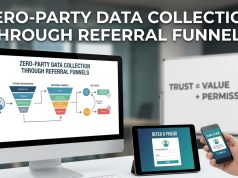
Ultra-Exclusive Invite-Only Referral Hubs can benefit from Zero-Party Data Collection because members can voluntarily share preferences and intentions directly instead of the business relying entirely on inferred behavior.
Make privacy part of the value proposition
Privacy is not simply a compliance concern.
In a private community, members may be sharing professional contacts, preferences, business challenges, buying intentions, or personal recommendations. People need confidence that their information will not be misused.
A privacy-first approach should explain:
- what data is collected
- why it is collected
- who can access it
- how long it is retained
- what members can control
- whether information is shared externally
Ultra-Exclusive Invite-Only Referral Hubs should make privacy expectations visible before asking members to contribute more information.
Build the Referral Funnel
The referral funnel should be simple enough for a member to understand immediately.
A practical structure is:
Stage 1: Qualification
A customer becomes eligible.
Stage 2: Invitation
The member receives limited referral capacity.
Stage 3: Personalization
The member selects an appropriate contact and adds context.
Stage 4: Acceptance
The recipient accepts the invitation.
Stage 5: Qualification
The new prospect meets basic criteria.
Stage 6: Activation
The new member completes the desired action.
Stage 7: Recognition
The referring member receives the appropriate reward or status benefit.
Stage 8: Expansion
The new member eventually becomes an advocate.
This loop is important.
A referral program should not end at conversion.
The ideal outcome is:
Customer → Advocate → Inviter → New Member → Advocate.
Ultra-Exclusive Invite-Only Referral Hubs become strategically valuable when they create this recurring cycle.
Reduce Friction at Every Step
Every additional field, verification step, confusing rule, or slow approval can reduce momentum.
That does not mean removing all controls.
Instead, controls should appear where they are most useful.
For example, allow a fast invitation request but perform deeper qualification after acceptance.
Or let an advocate nominate someone without immediately asking the recipient to complete a long profile.
The objective is to preserve exclusivity without creating unnecessary friction.
Use progressive qualification
A useful approach is:
Step 1: Basic invitation.
Step 2: Short eligibility check.
Step 3: Full profile after acceptance.
Step 4: Additional verification only when necessary.
This structure keeps the first interaction lightweight.
Ultra-Exclusive Invite-Only Referral Hubs should feel selective, not bureaucratic.
Designing Incentives That Do Not Cheapen the Brand
Incentives need careful consideration.
A discount is simple, but it may not suit a premium positioning.
Other options include:
- early access
- private events
- bonus services
- educational resources
- account upgrades
- priority support
- exclusive products
- professional introductions
- recognition
- charitable contributions
- membership upgrades
The best reward reinforces the identity of the community.
For premium businesses, status can sometimes be more motivating than a small monetary benefit.
For example, a member might receive “Insider” status, access to a private session, or priority access to a new release.
The reward should feel proportional to the effort.
Prevent Referral Spam
Referral hubs can collapse when members discover that quantity is rewarded more than relevance.
Avoid incentives such as:
“Invite 100 people and receive a large bonus.”
That structure encourages indiscriminate sharing.
Instead, reward successful, qualified outcomes.
For example:
- accepted referral
- activated account
- completed purchase
- retained customer
- qualified business introduction
Ultra-Exclusive Invite-Only Referral Hubs should optimize for network quality rather than raw invitation volume.
A useful metric is qualified referral rate:
Qualified Referral Rate = Qualified Referrals ÷ Total Referrals
A second useful measure is referral conversion:
Referral Conversion Rate = Converted Referrals ÷ Accepted Referrals
These metrics are much more informative than invitation volume alone.
Create Referral Rules That Members Can Understand
Rules should be short.
A member should quickly understand:
Who can I invite?
How many people can I invite?
What makes someone eligible?
What behavior is prohibited?
How are rewards earned?
Can invitations expire?
Can invitations be transferred?
What happens if someone violates the rules?
Ambiguous referral rules can create disputes and reduce trust.
Ultra-Exclusive Invite-Only Referral Hubs should publish straightforward guidelines that protect both the business and members.
Add a Moderation Layer
Private does not automatically mean high quality.
A referral hub requires governance.
Moderation may include:
- invitation review
- profile verification
- fraud detection
- duplicate account checks
- inappropriate-content monitoring
- referral abuse detection
- inactive-member management
- rule enforcement
For high-value communities, a manual review process can be worth the additional effort.
For larger networks, automation can identify suspicious behavior and route edge cases to human reviewers.
The right balance depends on risk.
Choose the Right Technology Stack
You do not need a massive custom platform to launch.
A lean version can use:
Landing page: Explains the private hub.
Form: Captures nomination or registration details.
CRM: Stores member and referral relationships.
Automation: Sends invitations and reminders.
Database: Tracks member status and referral links.
Community layer: Provides private interaction.
Analytics: Measures conversion and retention.
Payment system: Handles purchases where relevant.
Ultra-Exclusive Invite-Only Referral Hubs should begin with the simplest stack that can support the core workflow.
The goal is to validate behavior before investing heavily in custom development.
Minimum viable technology
A first version can often include:
- Referral landing page.
- Unique invitation links.
- Member database.
- Referral attribution.
- Automated notifications.
- Basic approval logic.
- Reward tracking.
- Performance dashboard.
Once usage grows, additional layers can be added.
These may include fraud scoring, advanced segmentation, CRM synchronization, member dashboards, dynamic invitation quotas, API integrations, and predictive analytics.
Measure the Economics
A referral program should be evaluated as a business system, not merely a marketing campaign.
Important metrics include:
Invitation Rate
How many members send at least one invitation?
Acceptance Rate
How many invited people accept?
Qualification Rate
How many accepted people meet the desired criteria?
Activation Rate
How many qualified members take the target action?
Referral Revenue
How much revenue comes from referred users?
Referral CAC
How much does it cost to acquire each referred customer?
Member Lifetime Value
How valuable are referred customers over time?
Advocate Retention
How long do active referrers remain engaged?
Ultra-Exclusive Invite-Only Referral Hubs should ultimately be judged by incremental economic value.
Compare referral economics with paid acquisition
Suppose a paid channel generates customers at $80 acquisition cost.
A referral system may have:
- $10 technology cost per acquired customer
- $15 average incentive
- $5 operational cost
Total referral acquisition cost:
$10 + $15 + $5 = $30
If referred customers also retain longer or spend more, the advantage becomes even larger.
However, businesses should avoid assuming referral is automatically cheaper.
A sophisticated analysis should include:
- platform expenses
- incentives
- employee time
- support
- fraud losses
- onboarding
- community management
- opportunity cost
Create a Member Dashboard
A private dashboard can make participation feel tangible.
Useful dashboard elements include:
Your status
Shows the member’s current tier.
Invitation credits
Displays available invitations.
Successful referrals
Shows accepted and converted members.
Benefits unlocked
Shows progress.
Recommended actions
Suggests the next best step.
Community activity
Highlights relevant opportunities.
Ultra-Exclusive Invite-Only Referral Hubs become more engaging when members can see how their participation changes their position within the network.
Use Status Carefully
Status can strengthen communities, but it must be earned fairly.
Potential status signals include:
- member badges
- contribution levels
- invitation authority
- ambassador roles
- private event access
- recognition pages
- early-access privileges
The status system should reward valuable contribution rather than simply money spent.
A person who consistently introduces ideal customers may deserve greater recognition than someone who simply purchases at a higher value.
Build a Feedback Loop
Every accepted referral is a data point.
Businesses should study:
Who gets invited?
Who accepts?
Who converts?
Which messages perform?
Which incentives work?
Which members consistently produce high-quality referrals?
Which channels produce the strongest advocates?
That information can improve the program over time.
Ultra-Exclusive Invite-Only Referral Hubs should therefore be designed as learning systems.
The first version does not have to be perfect.
It needs to produce enough reliable feedback to improve.
Make the Experience Feel Exclusive

Exclusivity is experienced through design, language, and access.
A generic interface can undermine the psychological positioning.
Instead, the experience should feel intentional.
Consider using:
- private member areas
- personalized greetings
- invitation identifiers
- curated onboarding
- exclusive resources
- limited-access announcements
- member-only events
- personalized rewards
The objective is not luxury for appearance alone.
Every design element should reinforce the idea that membership has meaning.
Ultra-Exclusive Invite-Only Referral Hubs should make members feel that their access is purposeful.
Develop a Strong Onboarding Sequence
After acceptance, do not immediately ask the new member to invite someone else.
First deliver value.
A simple onboarding sequence could be:
Day 0: Welcome and explain the community.
Day 1: Deliver a useful resource.
Day 3: Introduce a member benefit.
Day 5: Explain referral privileges.
Day 7: Ask whether they know someone who could benefit.
This timing allows trust to develop.
Referral behavior is easier when the member has already experienced value.
Use Personalization Without Overcomplication
Personalization can increase relevance, but it should not become invasive.
Good personalization uses information the person willingly provided or reasonably expects the business to use.
Examples include:
- industry-specific resources
- relevant events
- role-based recommendations
- personalized onboarding
- referral suggestions based on declared interests
Poor personalization exposes hidden assumptions and can feel uncomfortable.
Ultra-Exclusive Invite-Only Referral Hubs should use personalization to reduce friction and improve relevance, not to create surveillance.
Protect the Community From Abuse
Invite-only networks can attract fraudulent accounts because exclusivity may create perceived status.
Potential threats include:
- fake identities
- duplicate accounts
- referral loops
- self-referrals
- incentive farming
- purchased invitations
- automated account creation
- misleading invitations
- low-quality lead dumping
A layered defense is useful.
Start with simple safeguards:
Unique invitation tokens
Email verification
Device or account controls
Duplicate detection
Referral history
Conversion validation
Manual escalation
The system should become stricter as risk increases.
Build a Referral Score
A referral score can help identify high-value advocates.
For example:
Referral Score = Conversion × Quality × Retention
A simple weighted model could assign:
- 40% conversion performance
- 30% customer fit
- 20% retention
- 10% engagement
The exact formula should reflect business objectives.
The goal is not mathematical perfection.
The goal is better prioritization.
High-scoring advocates can receive:
- additional invitations
- earlier access
- special recognition
- dedicated support
- ambassador status
Turn Members Into Community Builders
The strongest referral programs eventually become communities in which members contribute beyond referrals.
Members might:
- share expertise
- answer questions
- recommend tools
- make introductions
- attend events
- provide feedback
- create educational resources
- collaborate on projects
At that point, Ultra-Exclusive Invite-Only Referral Hubs begin generating value independent of direct referrals.
This increases retention because members now have multiple reasons to remain.
Use Events to Reinforce Exclusivity
Private events can significantly increase the perceived value of membership.
Possible formats include:
- expert roundtables
- product previews
- private workshops
- networking sessions
- customer advisory meetings
- virtual office hours
- invitation-only launches
The events do not always need to be expensive.
The key is relevance.
A 30-minute conversation with a valuable expert can create more perceived value than a flashy event with little substance.
Create a Referral Calendar
Referral behavior should not depend entirely on occasional campaigns.
A simple monthly calendar can include:
Week 1: Member education.
Week 2: Success story.
Week 3: Invitation opportunity.
Week 4: Recognition and rewards.
This creates rhythm without excessive promotional pressure.
Ultra-Exclusive Invite-Only Referral Hubs should feel active but not noisy.
Use Success Stories as Social Proof
Success stories help prospects understand what membership can produce.
A useful story includes:
Starting point: What problem existed?
Referral: Who introduced the member?
Experience: What happened after joining?
Outcome: What measurable value resulted?
Next step: Why did the member remain active?
Avoid exaggerated claims.
Credible stories are more persuasive than unrealistic testimonials.
Build a Fast Launch Plan
A fast implementation can be organized into four phases.
Phase One: Strategy
Define:
- target member
- core value
- access criteria
- referral rules
- incentive structure
- success metrics
Phase Two: Infrastructure
Build:
- landing page
- application
- invitation mechanism
- member database
- referral attribution
- automation
- reporting
Phase Three: Pilot
Invite a small group of existing customers.
Watch:
- completion rates
- invitation behavior
- acceptance
- referral quality
- support questions
- abuse patterns
Phase Four: Scale
Expand gradually.
Do not open access to everyone immediately.
Ultra-Exclusive Invite-Only Referral Hubs should scale according to the organization’s ability to maintain the member experience.
A Practical 30-Day Launch Framework
A focused 30-day rollout could look like this:
| Days | Primary Objective | Output |
|---|---|---|
| 1–5 | Strategy | Positioning and eligibility |
| 6–10 | Design | Referral journey |
| 11–15 | Setup | Technology and tracking |
| 16–20 | Content | Invitations and onboarding |
| 21–25 | Pilot | Initial member group |
| 26–30 | Optimization | Fix friction and scale |
During the first week, avoid debating minor design details.
Focus on the behavioral architecture.
During the pilot, watch actual user behavior rather than assuming what users will do.
What to Automate
Automation is especially helpful for repetitive operations.
Automate:
- invitation emails
- reminders
- referral attribution
- reward notifications
- tier updates
- onboarding messages
- approval alerts
- inactive-member reminders
- reporting
Do not automate every decision.
Human review can remain valuable for:
- premium membership
- sensitive referrals
- unusual cases
- community disputes
- high-risk activity
- ambassador selection
Automation should increase consistency without eliminating judgment.
What Not to Automate
Avoid completely automated decisions when the consequences are significant.
For example, an algorithm should not automatically reject a valuable business prospect solely because the person does not match a narrow profile score.
Similarly, community moderation should provide an appeal or review route when appropriate.
Ultra-Exclusive Invite-Only Referral Hubs depend on trust, and excessive automation can make the experience feel cold or unfair.
Align Incentives With Long-Term Value
An important mistake is rewarding the first conversion while ignoring retention.
Suppose a member refers a customer who purchases $100 today but cancels tomorrow.
That referral may look successful in the dashboard but fail economically.
A better reward structure may include:
Initial reward: after activation.
Secondary reward: after retention milestone.
Tier reward: after repeated high-quality contribution.
This encourages members to think about fit rather than speed.
Use Retention as the Final Test
A referral network is healthy when members remain valuable over time.
Track:
- active members
- repeat referrals
- community participation
- benefit utilization
- retention
- advocate activity
Ultra-Exclusive Invite-Only Referral Hubs should not be optimized only for the number of invitations sent.
The real measure is whether the network keeps producing valuable relationships.
Common Mistakes to Avoid
Making exclusivity purely cosmetic
A private URL does not create exclusivity.
There must be a meaningful reason access is controlled.
Overloading the application
Long forms create friction.
Ask only what you need at the beginning.
Rewarding quantity over quality
Large rewards for mass invitations encourage spam.
Hiding referral rules
Members should know how the system works.
Ignoring existing customers
Your best advocates often already exist within the customer base.
Treating every member identically
Different contribution levels can justify different privileges.
Launching without attribution
Without referral tracking, optimization becomes guesswork.
Failing to moderate
Private communities still require governance.
Overusing urgency
Fake countdowns and exaggerated scarcity damage trust.
Scaling too quickly
A poor private experience can become a reputation problem.
A Simple Operating Dashboard
A management dashboard can include:
| Metric | Purpose |
|---|---|
| Active Members | Measures network health |
| Invitation Rate | Measures advocacy participation |
| Acceptance Rate | Measures invitation quality |
| Qualification Rate | Measures member fit |
| Conversion Rate | Measures commercial impact |
| Revenue per Referral | Measures economic value |
| Referral CAC | Measures efficiency |
| Retention | Measures long-term quality |
| Top Advocates | Identifies valuable members |
| Fraud Rate | Monitors system abuse |
Review these metrics weekly during the pilot.
Once the system stabilizes, a monthly strategic review may be enough for broader trends.
How Privacy and Trust Reinforce Exclusivity
Privacy can become part of the reason people value the network.
A member may be more willing to discuss a business challenge inside a controlled environment than in an open social channel.
That creates a meaningful differentiation.
Ultra-Exclusive Invite-Only Referral Hubs should therefore communicate that privacy protects the quality of interactions rather than simply restricting access.
The message should be:
“This community is private because the quality of participation matters.”
That is much stronger than:
“This community is private because we want you to feel special.”
Building a Strong Referral Culture
Technology cannot create advocacy by itself.
Culture matters.
The organization should consistently reinforce:
Relevance over volume.
Value over promotion.
Trust over pressure.
Contribution over extraction.
Long-term relationships over short-term conversions.
Members learn what behavior the organization rewards.
When good referrals are recognized and spam is discouraged, the culture becomes self-reinforcing.
Ultra-Exclusive Invite-Only Referral Hubs work best when participation feels like a contribution to the network rather than another marketing task.
Advanced Expansion Strategies
Once the basic system is working, businesses can introduce more sophisticated features.
Geographic exclusivity
A local business may allow only one or a limited number of members per territory.
Industry exclusivity
A professional network may limit competing companies from sharing the same category.
Expert matching
Members can receive introductions based on stated needs.
Dynamic invitation capacity
Members who consistently create successful outcomes can earn additional invitation credits.
Member-to-member rewards
Members can reward other members for valuable introductions.
Priority access
High-contributing members can receive earlier opportunities.
These advanced models can significantly increase the perceived value of the network.
When Invite-Only Referral Hubs Work Best
This model is especially useful when:
- customer trust matters
- the average customer value is meaningful
- referrals have strong economics
- community quality matters
- access to expertise is valuable
- the product has an advocacy component
- customers naturally know similar buyers
- exclusivity strengthens positioning
It may be less suitable when the product is purely transactional, extremely low-priced, or purchased with almost no consideration.
Even then, certain elements can still be adapted.
The Psychology Behind the Model

Several psychological principles help explain why this structure can work.
Scarcity: Limited access increases perceived importance.
Social proof: A trusted person’s invitation reduces uncertainty.
Identity: Membership creates a sense of belonging.
Reciprocity: Valuable access encourages participants to contribute.
Status: Achievement levels can reinforce continued participation.
Commitment: Once someone contributes referrals, they may become more invested in the ecosystem.
Consistency: Members who identify as advocates are more likely to continue advocacy-aligned behaviors.
These principles should support genuine value.
Psychology becomes harmful when it is used to manipulate people into taking actions they would not otherwise want.
Ultra-Exclusive Invite-Only Referral Hubs should use behavioral design to make valuable participation easier, not to manufacture false urgency.
Final Implementation Checklist
Before launch, confirm that the system has:
- clear positioning
- a defined ideal member
- legitimate exclusivity
- simple entry requirements
- limited invitation rules
- personalized invitations
- visible member benefits
- transparent privacy information
- referral attribution
- clear rewards
- fraud prevention
- moderation
- onboarding
- retention mechanisms
- reporting
- a feedback loop
If these elements are in place, the business has the foundation for a sustainable private referral ecosystem.
The most important principle is straightforward: exclusivity should never be the entire product.
It should be the environment in which superior value is delivered.
Ultra-Exclusive Invite-Only Referral Hubs are most effective when members genuinely believe that participation improves their access, relationships, opportunities, information, or outcomes.
That is what turns a referral mechanism into a network advantage.
Conclusion
Ultra-Exclusive Invite-Only Referral Hubs can transform referrals from isolated promotional actions into controlled communities that compound trust, relevance, and customer acquisition. The strongest model combines real exclusivity, clear eligibility, limited invitations, personalized introductions, useful member benefits, privacy, strong attribution, and intelligent incentives. Businesses should prioritize qualified relationships instead of referral volume and use data to continuously improve the experience. Start with a focused pilot, validate member behavior, remove friction, and scale only when quality remains strong. When exclusivity is supported by genuine value, members become more than referrers: they become trusted network builders who help create a sustainable acquisition ecosystem.
Frequently Asked Questions (FAQ)
What are Ultra-Exclusive Invite-Only Referral Hubs?
Ultra-Exclusive Invite-Only Referral Hubs are private referral communities where access is controlled through invitations, qualifications, or limited membership rules. They combine referral marketing with community, status, trust, and controlled access.
How do Ultra-Exclusive Invite-Only Referral Hubs differ from normal referral programs?
Traditional referral programs usually focus on referral links and rewards. Ultra-Exclusive Invite-Only Referral Hubs place greater emphasis on member quality, access control, private benefits, relationships, and long-term community value.
Why does exclusivity improve referral behavior?
Legitimate exclusivity can increase perceived value, attention, and commitment. When people know invitations are limited and membership provides meaningful benefits, they may become more selective about whom they introduce.
Should every customer receive an invitation?
Not necessarily. The strongest programs usually prioritize customers with good product experience, strong relationships, relevant networks, positive engagement, and a history of advocacy.
What should members receive for making referrals?
Rewards can include discounts, upgrades, early access, premium content, private events, priority support, recognition, status, or exclusive services. The right reward should match the positioning of the business.
How many people should each member be allowed to invite?
There is no universal number. A business can start with a small invitation quota and increase capacity for members who consistently produce qualified, successful referrals.
How can businesses prevent referral spam?
Reward qualified or converted referrals rather than raw invitation volume. Use invitation limits, unique links, verification, referral attribution, duplicate detection, and manual review for suspicious activity.
What data should a referral hub collect?
Start with essential information such as identity, contact details, inviter information, and eligibility. Additional preferences and behavioral information can be collected progressively when members understand why it is useful.
Can a small business build an invite-only referral hub?
Yes. A small business can start with a landing page, form, CRM, unique referral links, automation, and a simple member database. The system can become more advanced as participation increases.
How do businesses know whether the referral hub is successful?
Success should be measured using qualified referral rate, acceptance rate, conversion rate, referral acquisition cost, revenue, retention, member activity, repeat referrals, and the long-term value of referred customers.