
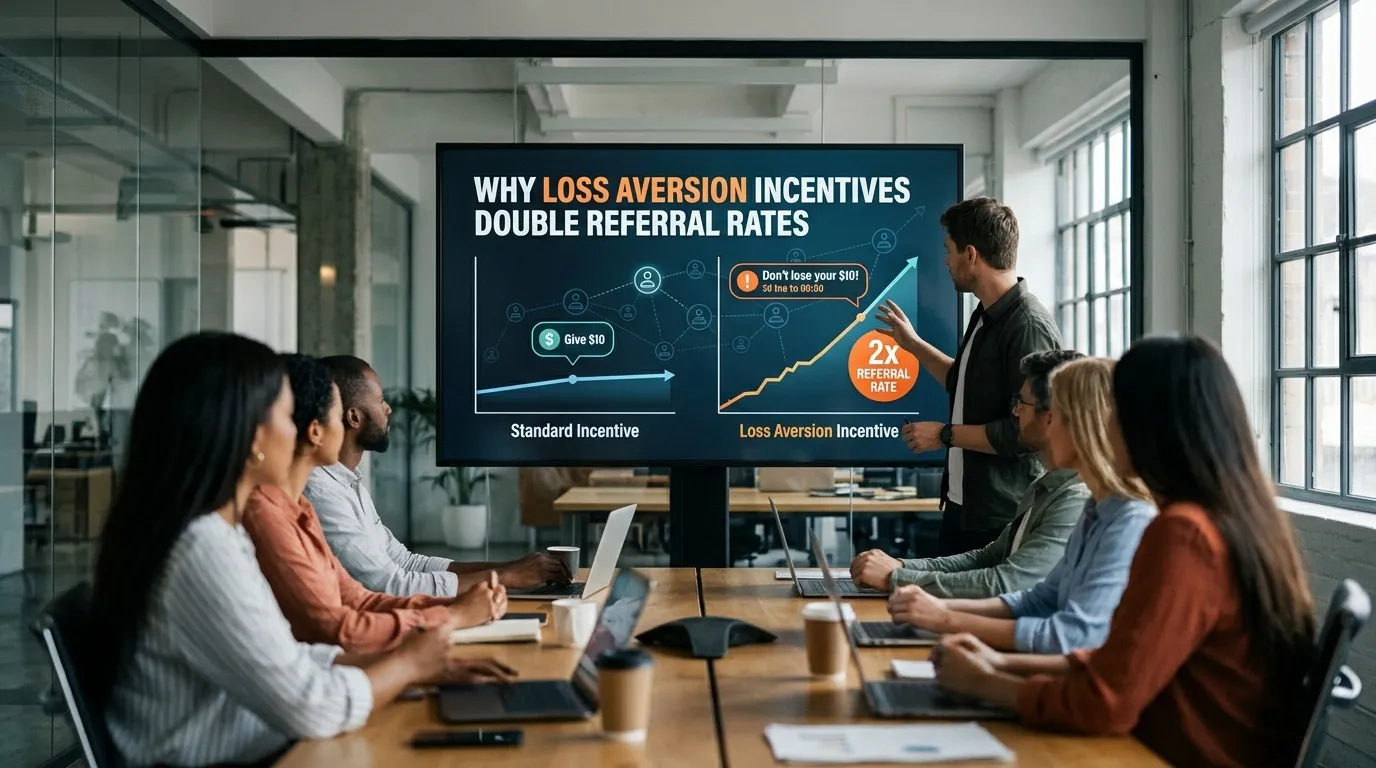
Loss aversion incentives motivate customers to refer friends by making missed rewards feel more significant, increasing participation through urgency, perceived value, social influence, and carefully designed referral experiences.
Referral marketing has always depended on a simple human behavior: people are more likely to trust recommendations from friends, family members, and colleagues than messages from unfamiliar brands. However, even satisfied customers do not automatically recommend a product. They may forget to share it, postpone the decision, feel uncomfortable promoting a company, or simply see no compelling reason to take action.
This is where psychology becomes especially valuable. Businesses need more than an attractive referral link or a generic discount. They need to understand what motivates customers to act now rather than later.
One powerful psychological principle is loss aversion. People often experience the possibility of losing something they already value more intensely than the satisfaction of gaining an equivalent benefit. Referral programs can use this behavioral tendency to make rewards more meaningful, encourage timely participation, and reduce hesitation.
Loss Aversion Incentives apply this principle by presenting referral rewards, exclusive benefits, or time-sensitive opportunities in ways that help customers recognize what they could miss if they do not participate. Instead of communicating only what a customer might gain, a well-designed program also makes the cost of inaction clear.
For example, consider two referral messages. The first says, “Invite a friend and earn $10.” The second says, “Your $10 referral reward is available until Sunday when your friend makes a qualifying purchase.” Both communicate a benefit, but the second introduces a specific opportunity and a genuine deadline.
That distinction can influence behavior. However, the result depends on the offer, audience, trust, and customer experience. No incentive strategy automatically doubles referral rates, and businesses should validate performance through controlled experiments rather than assume a guaranteed outcome.
This guide explains the psychology behind loss aversion, how to apply it ethically, which incentive structures are worth testing, and how to measure whether they actually improve referral performance.
What Are Loss Aversion Incentives?
Loss Aversion Incentives are rewards or promotional mechanisms designed around the psychological tendency to place greater weight on avoiding a perceived loss than obtaining an equivalent gain.
In a referral program, the perceived loss might involve missing an available bonus, allowing a limited-time opportunity to expire, losing access to a reward tier, or failing to complete a milestone that unlocks an additional benefit.
The central idea is not to frighten customers into promoting a business. It is to make an existing opportunity understandable, relevant, and sufficiently valuable that customers have a reason to act.
Understanding the psychology of loss aversion
Behavioral economics distinguishes between the emotional impact of gaining something and the impact of losing something. These experiences are not always equal.
Imagine that a customer receives a $20 reward. The reward may create a positive feeling, but the possibility of losing an already-earned $20 credit could create a stronger reaction. The precise difference varies by person, context, and the way the decision is presented.
This concept is associated with prospect theory, developed by psychologists and behavioral economists Daniel Kahneman and Amos Tversky. Their work helped explain why people evaluate outcomes relative to reference points instead of considering every outcome in purely objective financial terms.
Referral marketers can apply this insight by giving customers a clear reference point. That reference point could be a reward they have unlocked, a milestone they are approaching, or a benefit that remains available for a defined period.
For instance, a customer who has already earned a $5 referral credit may be more motivated to complete the next step toward a $15 bonus than someone who sees an entirely new promotion with no established progress.
The difference is psychological as well as financial: the customer can now understand the benefit in relation to something already within reach.
How loss aversion differs from ordinary incentives
Traditional incentives emphasize the positive outcome of taking action. Loss-oriented incentives also explain the opportunity that disappears when the action is not completed.
| Incentive approach | Example message | Main psychological mechanism |
|---|---|---|
| Standard reward | Refer a friend and earn $10 | Anticipated gain |
| Loss-focused reminder | Your available referral bonus expires Sunday | Avoiding a perceived loss |
| Progress-based reward | You are one successful referral away from the next tier | Goal proximity and progress |
| Exclusive opportunity | Complete your referral this week to unlock early access | Scarcity, exclusivity, and urgency |
| Social incentive | Your friend can receive a welcome credit when joining | Reciprocity and shared value |
| Milestone protection | Complete the qualifying action to retain your earned benefit | Preserving an established reward |
These approaches can overlap. A deadline creates urgency, while progress tracking can make a reward feel more attainable. The strongest program usually combines compatible mechanisms rather than relying on a single psychological trigger.
Why Loss Aversion Can Improve Referral Rates

Referral behavior involves several decisions. A customer must notice the program, understand the offer, identify someone appropriate to invite, share the invitation, and often persuade the recipient to complete a qualifying action.
Every step introduces friction.
A customer might like a product but see little reason to recommend it immediately. Another customer might share the link but forget to follow up. Someone else may be interested in the reward but find the program’s conditions confusing.
Loss-oriented incentives can address some of these barriers by making the benefit more concrete and giving the customer a reason to complete the next step.
It gives customers a reason to act now
Without a deadline, customers can postpone participation indefinitely. An offer that remains available forever often feels less urgent than an opportunity with a clear expiration date.
A genuine deadline changes the decision from “I might do this someday” to “I need to decide whether this opportunity is worth acting on before it expires.”
For example, an e-commerce brand might offer a referral bonus during a seven-day campaign. The customer sees the reward, the deadline, and the qualifying purchase requirement in one place.
This structure can help customers prioritize the action without creating confusion.
The key is authenticity. If a business repeatedly resets a supposedly final deadline, customers may stop believing its messages. Trust is more valuable than a temporary increase in clicks.
It makes the reward feel more tangible
A vague promise of future value can be easy to ignore. A clearly defined benefit is easier to evaluate.
Consider a referral program that says customers can earn points toward future purchases. Some users may struggle to understand what those points are worth.
Now consider a program that explains that 500 points equal a $5 store credit and that the customer has already earned 350 points. The remaining progress becomes more concrete.
The customer can understand both the value and the distance to the next milestone.
Well-designed Loss Aversion Incentives build on this clarity by explaining what remains available and what action is required to secure the benefit.
It reduces the temptation to postpone decisions
Procrastination is not always caused by a lack of motivation. Sometimes, the customer simply has too many competing priorities.
A short, relevant reminder can bring the referral opportunity back into view. If the customer has already expressed interest, a deadline reminder may help turn that intention into action.
For example:
- Monday: Introduce the referral offer.
- Wednesday: Explain how the reward works.
- Friday: Remind eligible customers that the offer ends Sunday.
- Sunday: Send a final reminder only to customers who have consented to relevant communications and have not already completed the action.
This sequence creates opportunities to act without sending repetitive messages every few hours.
It makes progress easier to recognize
People often become more motivated when they can see that they are approaching a meaningful goal.
A referral dashboard might display three successful referrals out of four required to unlock a bonus. The remaining step becomes obvious, and the customer can decide whether completing it is worthwhile.
This mechanism is particularly useful when rewards are tiered, because it connects an immediate action to a larger outcome.
However, businesses should avoid presenting incomplete referrals as completed achievements. Progress indicators must reflect actual eligibility and transaction status.
The Main Psychological Principles Behind Loss Aversion Incentives
Understanding the mechanisms behind referral behavior helps marketers design programs that feel persuasive without becoming manipulative.
Reference points shape perceived value
People frequently judge outcomes relative to a reference point. That point might be their current balance, an established benefit, a previous price, or a reward they have already earned.
A $10 bonus can feel different depending on how it is presented.
If it appears as an unfamiliar promotional offer, customers may compare it with other available discounts. If it is a confirmed credit in their account, customers may think about whether they want to preserve or use that benefit.
This does not mean every customer will react identically. It means the context surrounding a reward can influence how valuable it feels.
Referral marketers should establish reference points honestly. They should never suggest that a customer owns a reward when the customer has not met the program’s eligibility requirements.
The endowment effect encourages ownership
The endowment effect describes the tendency for people to value something more once they perceive it as their own.
Referral programs can create a similar sense of ownership when customers receive a genuine credit, unlock an account benefit, or accumulate progress toward a reward.
For example, a customer who has received a confirmed $8 credit may be more interested in retaining that benefit than in pursuing an unfamiliar $8 promotion.
This is one reason transparent reward dashboards can be useful. They show customers what they have earned, what remains pending, and which actions are necessary to unlock additional value.
A pending reward should be clearly labeled as pending. Otherwise, the experience can create frustration when customers discover that a benefit they thought was theirs has not actually been earned.
Anticipation can motivate action
Rewards are not motivating only when they arrive. The anticipation of receiving a reward can also influence behavior.
A referral program may let customers see the benefit associated with a successful invitation before the invited friend completes registration or makes a purchase.
That visibility creates a clear connection between the customer’s action and the potential outcome.
However, the reward should not be so uncertain that customers feel misled. Explain whether rewards are guaranteed, conditional, random, or dependent on a limited inventory.
Social proof reduces uncertainty
Customers may hesitate to recommend a service if they are unsure whether their friends will find it useful. Social proof can help reduce this uncertainty when it provides credible information about other people’s experiences.
For example, a referral page could explain that existing customers use the service to manage a particular problem or save time on a recurring task.
If a business publishes participation statistics, those figures should be accurate, current, and appropriately contextualized.
Social proof should support the decision rather than pressure customers into copying others.
Reciprocity makes the invitation more attractive
Referral programs often involve two people: the customer who shares the invitation and the friend who receives it.
When both people receive a meaningful benefit, the invitation can feel more generous and less transactional.
For example, the existing customer may earn $10 in credit while the new customer receives $10 off a qualifying first purchase.
This structure gives the sender a natural reason to share the offer: the recipient receives something useful as well.
Reciprocity works best when the product itself provides value. A reward cannot compensate indefinitely for a poor experience or an offer that the recipient does not need.
The goal-gradient effect encourages completion
The goal-gradient effect describes how motivation may increase as people approach a goal.
A customer who has completed four of five qualifying referrals may feel closer to the final milestone than a customer starting from zero.
A progress bar can make this distance visible, but the reward should remain worthwhile on its own merits.
The program should not encourage customers to invite unsuitable recipients simply because they are close to a milestone.
Scarcity influences perceived opportunity
Scarcity can increase the perceived value of an opportunity, especially when availability is genuinely limited.
A campaign with a fixed number of premium rewards may create a legitimate reason to participate early. A deadline tied to a real seasonal offer can also make the opportunity more concrete.
Artificial scarcity is different. Claims such as “only two rewards remain” are misleading if the business has no actual limit.
Effective Loss Aversion Incentives depend on truthful scarcity, clear eligibility, and a reasonable explanation of why the opportunity is limited.
How to Design Loss Aversion Incentives for Referral Campaigns
A successful referral campaign begins with the customer experience, not the wording of a promotional message.
The following framework helps businesses build an incentive system that is easy to understand, financially sustainable, and measurable.
Step 1: Define the referral action that matters
First, decide what a successful referral means.
It might be a new account, a completed appointment, a first purchase, a paid subscription, or a qualified business lead. These outcomes have different values and require different incentive structures.
For a subscription company, a new registration may have little financial value if the user never becomes a paying customer. For a local service business, a booked appointment may be more meaningful than a website visit.
Define the primary conversion before launching the campaign.
Also establish the rules for duplicate accounts, self-referrals, cancellations, refunds, and fraudulent activity. Customers should be able to understand these conditions before participating.
Step 2: Choose a reward customers actually value
The reward should fit the audience and the product.
Possible options include:
- A fixed cash-equivalent credit.
- A percentage discount on a future purchase.
- Free delivery or an additional service.
- Access to a premium feature.
- Loyalty points with a clearly explained value.
- A tiered bonus for several successful referrals.
- A shared benefit for both the referrer and the recipient.
A $20 reward may be compelling to one audience and insignificant to another. The right amount depends on purchase value, margins, customer lifetime value, and the effort required to complete a referral.
Do not assume that increasing the reward will always improve profitability. A larger incentive can attract more low-quality referrals, increase fraud, or subsidize purchases that would have happened anyway.
Step 3: Establish a legitimate reference point
A reference point helps customers understand the opportunity.
For example, the dashboard might display:
- Current eligible referral credit: $10.
- Additional bonus available: $5.
- Required action: One friend must complete a qualifying first purchase.
- Offer deadline: 31 October.
- Reward delivery: Within seven business days after validation.
This presentation is specific and verifiable.
By contrast, messages such as “You are about to lose everything” create unnecessary pressure and do not explain what the customer needs to do.
The goal is to make the decision easier, not to overwhelm the customer emotionally.
Step 4: Introduce deadlines carefully
Deadlines can help customers prioritize an opportunity, but they should be tied to an actual campaign rule.
A limited-time promotion should have a published start date and end date. The referral page, email, and account dashboard should communicate the same information.
If the offer ends on Sunday, do not continue displaying a countdown that resets on Monday while claiming that the promotion is ending.
A deadline should also allow enough time for the recipient to complete the required action. A campaign that expires before a friend can reasonably evaluate the product may generate frustration rather than trust.
Step 5: Remove unnecessary referral friction
Even a compelling reward cannot compensate for a confusing process.
Make the referral journey straightforward:
- The customer understands the offer.
- The customer finds a referral link or invitation button.
- The customer selects an appropriate sharing channel.
- The recipient sees the offer and its conditions.
- The recipient completes the qualifying action.
- The system validates the referral.
- The reward is delivered or its status is explained.
Avoid requiring unnecessary forms, repeated account creation, or unclear verification steps.
A well-structured experience may also benefit from Dopamine-Driven Referral UX Design, particularly when progress feedback, reward visibility, and completion messages are used to make the journey easier to follow.
Step 6: Communicate what happens if the customer does nothing
The loss-aversion element should be precise.
A customer might need to know that a promotional bonus will expire, a seasonal reward will no longer be available, or a tier upgrade requires another successful referral before a specified date.
Do not imply that the customer will lose an existing benefit if the actual rule only means that a future bonus will become unavailable.
The difference matters because the first message describes the loss of an established benefit, while the second describes a missed opportunity.
Clear wording protects the relationship between the business and the customer.
Step 7: Test the complete experience
Do not judge a referral campaign only by email opens or link clicks.
Track whether customers share invitations, whether recipients register, whether they complete the qualifying action, and whether their activity generates sustainable value.
If the program offers multiple rewards, compare their impact on the entire funnel rather than assuming that the most attention-grabbing offer is the best performer.
Referral Incentive Structures Worth Testing

Different incentive models create different motivations. A business should select the model that fits its product, audience, and economics.
| Incentive structure | Example | Why it may work | Main risk |
|---|---|---|---|
| Expiring bonus | Earn an extra $5 by Sunday | Encourages timely action | Deadline fatigue |
| Dual-sided reward | Both people receive $10 | Creates shared value | Higher total incentive cost |
| Milestone reward | Four referrals unlock a premium feature | Makes progress visible | Low-quality referrals near the target |
| Tiered rewards | Earn larger bonuses at higher milestones | Encourages sustained participation | Complex rules |
| Loyalty-credit protection | Use your earned credit before its valid expiry | Makes an existing benefit relevant | Confusion about expiration |
| Limited-edition reward | Qualifying referrals unlock a genuine limited release | Adds exclusivity | Perceived unfairness |
| Seasonal incentive | Extra credit during a real seasonal campaign | Provides contextual urgency | Short-term participation spikes |
Expiring bonus incentives
An expiring bonus adds a temporary benefit to the standard referral offer.
For example, a company could offer its normal $10 referral credit throughout the year and an additional $5 bonus during a clearly defined campaign.
This approach lets the company test whether a temporary incentive changes customer behavior without permanently increasing the base reward.
Measure the incremental cost of the bonus against the additional qualified referrals it generates.
Dual-sided referral rewards
A dual-sided reward benefits both the referrer and the recipient.
Suppose an existing customer receives $10 after a friend makes a qualifying purchase, while the friend receives $10 off the first order.
The combined incentive cost is $20 before accounting for margin, fulfillment, and other campaign expenses.
This model can make the referral feel like a shared opportunity rather than a request to promote a brand.
However, businesses should ensure that the recipient’s discount is useful and that the referrer’s reward does not encourage unwanted invitations.
Tiered referral incentives
Tiered incentives reward customers for reaching progressively higher milestones.
A company might offer $5 for two successful referrals, $15 total for four, and an additional premium benefit for six. The exact structure should be based on realistic participation levels and customer profitability.
The advantage is that customers can see a path toward a larger reward. The disadvantage is that complex tiers may be difficult to understand.
Use a simple progress display and show exactly how each milestone is calculated.
Reward protection and retention incentives
Some programs reward customers for maintaining a benefit or completing a required action before a valid expiration date.
For example, a loyalty program may give customers a referral credit that remains valid for 90 days. A reminder before the expiration date helps them understand the rules and make an informed decision.
These incentives should be handled carefully. If customers have already earned a reward, the terms governing its expiration should be transparent from the beginning.
Avoid creating unexpected forfeitures simply to increase referral activity.
The Economics of Loss Aversion Incentives
Psychological effectiveness is only one part of referral marketing. A campaign can increase participation and still lose money.
To evaluate profitability, businesses need to distinguish between total conversions and incremental conversions. Some customers may have purchased even without the incentive.
Calculate the true cost of a referral
The basic cost calculation should include all benefits provided to the referrer and recipient.
Consider an illustrative campaign:
| Cost component | Example amount |
|---|---|
| Referrer reward | $10 |
| Recipient discount | $10 |
| Estimated administration cost per qualified referral | $2 |
| Total estimated campaign cost per qualified referral | $22 |
The $22 figure is an illustrative assumption, not a universal benchmark. Actual costs depend on discount redemption, reward liability, payment processing, and program operations.
Next, compare the cost with the contribution generated by the referred customer.
If a referred customer produces $60 in contribution before referral costs, subtracting the $22 campaign cost leaves $38 in contribution after those costs, before any additional acquisition or overhead expenses not already included.
This does not automatically prove the campaign is profitable. The business must also consider customer retention, repeat purchases, refunds, and the cost of servicing new customers.
Estimate incremental referral value
Suppose a business observes 100 qualified referrals during a campaign. That number alone does not reveal how many referrals the incentive caused.
If a comparable control group indicates that 20 of those referrals would likely have occurred without the added incentive, the estimated incremental volume is 80.
If the added incentive costs $5 per eligible referral, the total incremental incentive expense across 100 referrals would be $500, assuming all 100 receive the bonus.
The business would then compare the $500 expense with the contribution from the estimated 80 additional referrals, while considering any differences between groups.
The example demonstrates why measuring incremental outcomes matters more than counting every action as a campaign success.
Use a sustainable reward model
An effective reward structure must support the economics of the business.
For digital subscriptions, the relevant value may come from recurring revenue and retention. For e-commerce, contribution margin and repeat purchases may matter more than gross sales. For financial services, compliance and fraud costs may materially affect the economics.
Businesses exploring incentive systems for digital products or token-based rewards can use a Tokenomics Design Blueprint to think through reward supply, distribution, utility, and long-term sustainability.
The same principle applies to traditional loyalty points: a reward that appears inexpensive at launch may become costly when redemption volume increases.
Applying Loss Aversion Incentives Across Industries
The psychology of referral behavior is broadly relevant, but the right execution depends on the customer journey and the value being offered.
E-commerce and retail
Retailers can test limited-time referral credits, shared discounts, loyalty milestones, and seasonal bonuses.
For example, an online store could offer an additional $5 credit when a referred customer completes a qualifying order during a genuine promotional period.
The message should explain whether the bonus applies to the referrer, the recipient, or both. It should also identify minimum purchase requirements and any product exclusions.
Retailers should track whether referral customers generate incremental margin or merely use discounts on purchases they would have made anyway.
Subscription businesses
Subscription companies can test extra trial time, account credits, premium features, or reduced subscription fees.
A referral program might give the existing subscriber a month of a qualifying premium feature after a friend becomes a paying customer.
The incentive should reflect the service’s retention economics. A large reward may attract sign-ups that cancel immediately after receiving the benefit.
Monitor activation, paid conversion, retention, and cancellation rates alongside referral volume.
Financial technology and payment services
Financial services may use referral rewards tied to account opening, verified identity, eligible transactions, or other qualifying conditions.
These campaigns need particularly clear terms. Customers should know which steps are required and when the reward is expected.
Financial promotions may also be subject to jurisdiction-specific rules covering disclosures, eligibility, incentives, and customer communications. Legal and compliance teams should review the program before launch.
Gaming and digital communities
Games and digital platforms can reward successful invitations with access to features, cosmetics, subscription benefits, or other digital items.
Some projects connect these incentives to digital ownership, creating a relationship between referral rewards and broader participation in The Global NFT Market.
The design should prioritize genuine utility rather than speculative promises. If a reward is tradable, explain the applicable restrictions, fees, and risks. Do not imply that a digital asset will increase in value.
Marketplaces and creator platforms
Marketplaces can reward sellers, buyers, or creators for introducing qualified participants.
For example, a creator platform may offer a promotional credit after a referred creator publishes approved content and reaches a legitimate participation milestone.
Marketplaces should assess whether new users improve the overall quality and activity of the platform. An increase in sign-ups is not necessarily beneficial if users remain inactive or transactions are low quality.
Where referral activity affects trading behavior, NFT Marketplace Liquidity provides a useful related perspective on why the depth and quality of marketplace participation matter beyond headline activity.
How to Measure Whether Referral Rates Actually Double
The phrase “double referral rates” is an ambitious performance target, not a guaranteed result of applying loss aversion. A business should define the metric before running the campaign.
Choose the right referral metrics
Referral programs have several measurable stages.
| Metric | What it measures | Why it matters |
|---|---|---|
| Referral participation rate | Eligible customers who share an invitation | Indicates how many customers engage |
| Share rate | Customers who share divided by customers exposed to the offer | Measures the impact on invitation behavior |
| Click-through rate | Recipients who click referral links | Indicates whether invitations attract interest |
| Referral conversion rate | Recipients who complete the qualifying action divided by referred visitors | Measures the effectiveness of the recipient journey |
| Qualified referral rate | Referrals that satisfy program conditions | Helps exclude incomplete or invalid activity |
| Reward redemption rate | Eligible rewards actually redeemed | Shows whether the reward is useful |
| Cost per qualified referral | Campaign costs divided by qualified referrals | Measures acquisition efficiency |
| Incremental contribution | Additional contribution attributable to the campaign | Helps evaluate business value |
The primary metric should reflect the objective. If the goal is to increase qualified customer acquisition, a higher email click rate is not enough.
Calculate the improvement correctly
Assume a business has a baseline referral participation rate of 5%. After introducing a new incentive, the rate rises to 10%.
The relative increase is 100%, meaning the participation rate doubled. The absolute increase is five percentage points.
These figures describe different things, so reports should state both.
The same calculation should not be confused with referral conversion rate. A campaign could double the number of customers who share invitations without doubling the percentage of recipients who become customers.
Use controlled experiments
A randomized A/B test is one way to estimate the effect of an incentive.
- Control group: Receives the existing referral offer.
- Test group: Receives the revised offer with a clearly defined loss-aversion element.
- Primary metric: A prespecified measure such as qualified referrals per eligible customer.
- Guardrail metrics: Fraud rate, complaints, unsubscribes, contribution margin, and recipient conversion.
- Evaluation period: Long enough to capture the complete qualifying action and reward cycle.
Random assignment helps reduce the risk that differences between groups are caused by audience composition rather than the incentive.
Where practical, keep the reward amount constant while testing the framing. This helps isolate whether the message itself changes behavior. If both the reward and the message change, it becomes harder to determine which factor caused the result.
Allow for statistical uncertainty
A small test can produce a large apparent improvement simply because of random variation.
For example, if only a few dozen people participate in each group, a difference of several conversions may not provide strong evidence that the new strategy will work at scale.
Sample size depends on the baseline conversion rate, the smallest effect worth detecting, the desired statistical power, and the chosen significance threshold.
Businesses should avoid ending experiments as soon as the results look favorable. Define the evaluation plan in advance, examine confidence intervals, and repeat tests when results are uncertain.
Monitor long-term customer quality
Short-term urgency can produce a spike in referrals without improving customer value.
A complete evaluation should consider whether referred customers activate, make repeat purchases, remain subscribed, or continue using the product.
It should also check whether the campaign changes the quality of the customers acquired. If a new incentive attracts customers who only want the reward, short-term acquisition numbers may overstate its real value.
Ethical Risks and Common Mistakes

Loss-oriented messaging is powerful enough to require careful boundaries. Customers should understand the opportunity and retain a genuine choice about whether to participate.
Creating artificial urgency
A countdown timer is only useful when it represents a real deadline.
Resetting the timer or repeatedly claiming that a promotion ends “tonight” can damage trust. Customers may eventually ignore all future deadlines, including legitimate ones.
Better approach: Publish the actual campaign end date and remove the promotion when it expires.
Making customers fear losing rewards they never earned
A business should not describe an unearned bonus as money already belonging to the customer.
For example, “Your $50 reward is disappearing” is misleading if the customer has not yet completed the qualifying steps.
Better approach: Say, “Complete one qualifying referral before Sunday to become eligible for the $50 bonus.”
The second message explains the opportunity without inventing ownership.
Overloading customers with reminders
Repeated notifications can create fatigue and encourage customers to disengage from the program.
Better approach: Use a small number of relevant reminders, respect communication preferences, and suppress messages when customers have completed the action or the offer is no longer available.
Encouraging unsuitable referrals
Aggressive milestone structures may encourage people to invite everyone in their contact list, regardless of relevance.
This can harm the recipient experience and make the sender appear untrustworthy.
Better approach: Make sharing optional, provide useful invitation text, and focus on customers who may genuinely benefit from the product.
Ignoring fraud and incentive abuse
Referral programs may attract duplicate accounts, self-referrals, fabricated transactions, or other forms of abuse.
Fraud can make an apparently successful campaign unprofitable and distort performance reporting.
Better approach: Establish proportionate validation rules, monitor unusual patterns, explain disqualification conditions, and provide a reasonable process for resolving disputed rewards.
Avoid collecting unnecessary personal data or using intrusive tracking methods that exceed legitimate program needs.
Measuring urgency instead of value
A high click-through rate can create the impression that a campaign is successful even when few recipients complete the required action.
Better approach: Evaluate the entire funnel, including qualified conversions, customer retention, costs, complaints, and incremental contribution.
Ethical design is not separate from commercial performance. Customers who understand an offer are more likely to trust the brand and make informed decisions.
A Practical Launch Checklist
Before launching a referral campaign built around loss aversion, review the following points.
Offer design
- The qualifying referral action is defined.
- Eligibility requirements are easy to find.
- The deadline reflects a genuine campaign rule.
- The customer can distinguish earned rewards from potential bonuses.
- The total reward cost fits the business model.
Customer experience
- The recipient understands the offer before taking action.
- The progress display reflects real referral status.
- The reward delivery timeline is stated clearly.
- Reminders are relevant and appropriately limited.
- Customers can find help when a referral does not qualify.
Measurement and governance
- A control group or suitable comparison method is available.
- The test period covers the complete conversion process.
- Fraud, complaints, and unsubscribe rates are monitored.
- Customer quality and contribution are measured.
- Legal and compliance requirements are reviewed.
- Results are documented before the next campaign iteration.
Frequently Asked Questions (FAQ)
What are Loss Aversion Incentives in referral marketing?
Loss Aversion Incentives are rewards or promotional structures that emphasize a genuine opportunity customers may miss if they do not act. They can include expiring bonuses, progress-based rewards, and clearly defined referral milestones.
Can loss aversion really double referral rates?
It can contribute to substantial improvements in some situations, but doubling is not guaranteed. Results depend on the audience, reward value, product quality, baseline performance, and campaign design. Controlled experiments are necessary to establish the actual impact.
What is an example of a loss-aversion referral offer?
A company might offer its standard $10 referral reward plus a genuine additional $5 bonus for qualifying referrals completed before a published deadline. The offer should clearly explain eligibility and the expiration date.
How is loss aversion different from scarcity marketing?
Loss aversion concerns the perceived impact of losing something relative to a reference point. Scarcity marketing emphasizes limited availability or access. They can work together, but scarcity should always reflect genuine limitations.
Are loss-oriented referral messages manipulative?
Not necessarily. Messages are more likely to be ethical when they communicate real deadlines, accurate reward conditions, and useful benefits. False urgency, misleading ownership claims, and excessive pressure undermine customer trust.
Which referral rewards work best with loss aversion?
There is no universally best reward. Cash-equivalent credits, shared discounts, loyalty points, tiered bonuses, and premium access can all work when they are valuable to the target audience and financially sustainable for the business.
Should both the referrer and the friend receive a reward?
Dual-sided rewards can make an invitation more attractive because both people benefit. However, the additional incentive cost must be justified by incremental conversions and long-term customer value.
How can a business measure whether its referral campaign is effective?
Measure referral participation, recipient conversion, qualified referrals, cost per qualified referral, fraud, retention, and incremental contribution. Compare the new campaign with a suitable control group instead of relying on clicks alone.
Can small businesses use loss-aversion referral strategies?
Yes. Small businesses can test simple approaches such as a genuine seasonal referral bonus, a clearly explained loyalty milestone, or a limited-time shared discount. They should start with a manageable budget and track profitability.
What is the biggest mistake when using loss aversion in referrals?
The biggest mistake is creating pressure without providing genuine value. False deadlines, confusing eligibility, misleading reward claims, and excessive reminders may generate temporary activity but damage trust and reduce long-term customer loyalty.
Conclusion
Loss Aversion Incentives can strengthen referral marketing by making genuine opportunities easier to recognize and act upon. When customers understand a reward, see their progress, and receive clear information about deadlines, they may become more motivated to share useful recommendations. However, doubling referral rates is a target to test, not a guaranteed outcome. Businesses should combine thoughtful psychology with transparent communication, simple user experiences, sustainable reward economics, and controlled experiments. The strongest referral programs do more than create urgency: they give customers a worthwhile reason to participate while protecting trust, recipient choice, and long-term customer relationships.