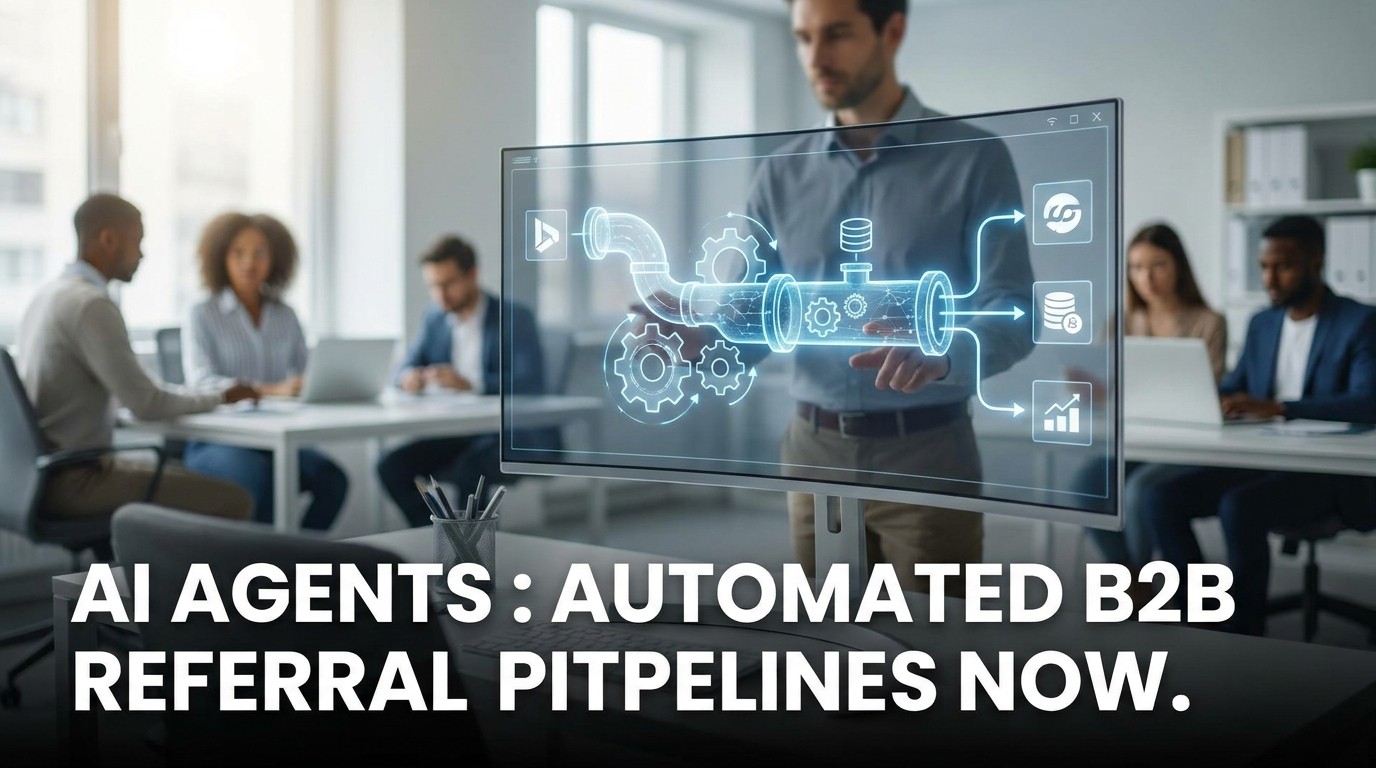
AI Agents are transforming B2B referral pipelines by automating lead discovery, qualification, outreach, follow-up, referral tracking, and relationship management while keeping human judgment in control.
B2B referrals have always been one of the strongest forms of lead generation because they arrive with something cold prospects rarely provide: context.
When a trusted customer, partner, consultant, colleague, or industry contact recommends a company, the introduction carries an invisible layer of credibility. The prospect may already understand the general problem, know something about the business, or trust the person who made the recommendation.
The difficulty is that referral growth has traditionally depended on manual processes.
A salesperson remembers to ask for introductions.
A customer-success manager notices an advocacy opportunity.
Someone copies a referral into a spreadsheet.
A sales representative sends a follow-up.
Another employee checks whether the referred prospect converted.
Eventually, the system becomes difficult to scale.
This is where AI Agents are creating a new possibility.
Instead of using artificial intelligence only to generate content or answer questions, businesses can use AI Agents to coordinate multi-step referral workflows. They can potentially identify suitable referral moments, organize customer signals, qualify opportunities, personalize communications, route leads, trigger follow-ups, and update systems based on outcomes.
The important word is coordinate.
A referral pipeline is not one task.
It is a chain of decisions.
Who should be asked?
When should they be asked?
What should they be asked?
Which customer is the best referral candidate?
What type of prospect is relevant?
How should the referral be communicated?
Who should receive the lead?
When should sales follow up?
What happens when the prospect does not respond?
A modern referral system attempts to connect those decisions into one operating process.
AI Agents do not eliminate the need for strategy. They make it possible to execute structured strategy across a larger number of customer relationships.
That distinction is critical.
Automation without a clear referral strategy simply creates more activity.
Automation with strong customer logic can create a more consistent referral engine.
What Are AI Agents?
AI Agents are software systems designed to pursue goals by interpreting information, making context-aware decisions, using connected tools, and completing sequences of actions with varying levels of autonomy.
That makes them different from a basic chatbot.
A traditional chatbot may answer:
“What are your business hours?”
An agentic system may be designed to:
Understand a customer’s request
Check business information
Determine the appropriate workflow
Use a connected tool
Complete an action
Confirm the result
Decide what should happen next
For B2B referral pipelines, this ability to coordinate tasks is especially valuable.
A referral is rarely completed through a single action.
The system may need to identify an advocate, determine fit, create a referral prompt, record the event, qualify the referred lead, assign ownership, and initiate follow-up.
That sequence is precisely where agentic automation becomes useful.
AI Agents vs Simple Automation
Rules-based automation usually follows predetermined instructions.
For example:
“If a customer gives a five-star review, send a referral email.”
An agentic system may incorporate more context:
The customer gave five stars.
They have purchased three times.
They recently praised onboarding.
They have referred one company before.
They are active this week.
The company has a likely customer segment within the person’s professional network.
Based on those signals, the system could determine that this may be an appropriate referral moment.
The difference is contextual decision-making.
Why B2B Referral Pipelines Need a New Model
B2B sales cycles can involve multiple stakeholders, long consideration periods, detailed requirements, procurement processes, and extended follow-up.
This creates operational complexity.
A referral pipeline may look like:
Customer satisfaction signal → Referral request → Introduction → Lead capture → Qualification → Sales assignment → Discovery → Proposal → Negotiation → Close → Advocacy
Every step can create delays.
Traditional systems often lose information between stages.
The customer-success team may know why the client is happy, while the sales team only sees a referral form.
The salesperson may know the prospect’s company but not the relationship context behind the introduction.
The referral program may track a click but not downstream revenue.
AI Agents can help connect those fragments.
The objective is to turn isolated referral events into structured customer journeys.
How AI Agents Can Map the Referral Lifecycle
A referral pipeline can be divided into distinct stages.
Stage 1: Advocate Identification
The system evaluates which customers may be strong referral candidates.
Potential signals include:
Customer satisfaction
Repeat purchases
Product adoption
Positive feedback
Successful outcomes
High account engagement
Previous referrals
Community participation
The goal is not to assume that every happy customer wants to refer.
It is to identify moments when a referral request is more likely to feel relevant.
Stage 2: Referral Readiness
The system considers timing.
A customer who has just complained about support is probably not the right person to receive a referral request.
A customer who recently achieved an important result may be more receptive.
Stage 3: Referral Invitation
The message should reflect the customer’s relationship and experience.
Stage 4: Introduction
The system records referral information and ensures attribution.
Stage 5: Qualification
The referred prospect is evaluated against business criteria.
Stage 6: Sales Handoff
A sales representative receives the relevant context.
Stage 7: Follow-Up
The system keeps the prospect journey moving without overwhelming the customer.
Stage 8: Outcome Tracking
The business connects referral activity to pipeline and revenue.
That final stage is frequently neglected.
AI Agents and the Psychology of Referral Requests
Technology cannot manufacture advocacy.
A customer recommends a company because something about the experience gives them a reason to believe another person would benefit.
That makes psychology central.
Trust Transfer
A referral is powerful because trust can transfer between relationships.
When a trusted colleague says:
“You should speak with this company.”
the prospect evaluates the recommendation differently from a cold advertisement.
AI Agents should therefore protect the context of the relationship.
A referral should not feel like a database-generated sales pitch.
Reciprocity
Customers who have received meaningful value may feel motivated to provide value to others.
But reciprocity becomes weak when a referral request arrives immediately after a poor experience.
Timing matters.
Social Identity
Professionals often recommend tools, providers, and companies that align with how they want to help their network.
A customer may enjoy being the person who introduces a useful solution.
Referral programs can support that identity without manipulating it.
Hyper-Relevance in B2B Referrals
B2B referral requests become more effective when they are connected to specific problems.
Suppose a customer uses a workflow platform to reduce manual reporting.
A generic request might say:
“Refer a friend and earn a reward.”
A more contextual prompt could say:
“Know another operations team spending too much time on manual reporting? You can introduce them here.”
The second message gives the advocate an obvious referral context.
The recipient can understand why the recommendation might be relevant.
This is one of the most valuable roles for AI Agents: turning customer and product data into contextual referral opportunities.
Referral Segmentation
Not every customer deserves the same referral strategy.
A business can segment advocates by:
Account size
Industry
Role
Product maturity
Advocacy history
Engagement level
Customer lifetime value
Use case
Relationship strength
Professional network relevance
A customer who runs a consulting firm may be a strong source of referrals for a B2B SaaS product.
A customer who works alone in a specialized internal role may have fewer relevant contacts.
The system should account for these differences.
Segment by Referral Potential, Not Vanity Metrics
A customer with high engagement is not automatically a great advocate.
A customer with fewer interactions may have enormous referral value if they operate inside the exact buyer network the business wants to reach.
The important question is:
“Who can generate qualified relationships?”
not:
“Who clicks the most?”
Predictive Referral Scoring
Referral pipelines can use predictive scoring to estimate advocacy probability.
Signals might include:
Customer satisfaction scores
Review behavior
Usage frequency
Renewal behavior
Referral history
Response to prior campaigns
Account health
Engagement trends
Successful outcomes
The score is not a guarantee.
It is a prioritization mechanism.
A business might categorize customers as:
High referral potential
Moderate referral potential
Low referral potential
Needs more relationship development
This helps sales and customer-success teams focus attention.
AI Agents for Referral Trigger Detection
A referral request can be triggered by an event.
Examples include:
Customer posts positive feedback
Customer renews
Customer reaches an important product milestone
Customer completes onboarding
Customer records a successful outcome
Customer recommends a feature
Customer shares a case-study result
The agent can monitor qualifying events and determine whether the moment is appropriate.
This is far more sophisticated than asking every customer for a referral thirty days after purchase.
The timing follows the relationship.
Personalizing Referral Prompts
Personalization should improve relevance.
It should not expose excessive customer information.
A good referral invitation may reflect:
The customer’s use case
The result they achieved
The type of people likely to benefit
The preferred referral method
The customer’s relationship with the brand
For example:
“You mentioned that our workflow helped your team reduce manual reporting. Know another operations leader facing the same challenge?”
That feels connected to experience.
A message like:
“We know you viewed three reports yesterday and spoke to support last week.”
would likely feel uncomfortable.
Good personalization is useful without becoming surveillance.
AI Agents for Referral Message Creation
Agentic systems can generate message variations while preserving strategic constraints.
Different customers may need different angles.
A technical buyer might prefer a practical explanation.
A senior executive may respond to business outcomes.
A consultant may prefer a client-benefit framing.
A long-time advocate may appreciate recognition.
The system can create a suggested message while allowing the customer to edit it.
That is important.
The advocate should remain the author of the recommendation.
The business provides assistance, not impersonation.
AI Agents and B2B Referral Qualification
Generating a referral is only half the problem.
The referred prospect needs qualification.
A system can potentially assess:
Company size
Industry
Job role
Business problem
Budget range
Timeline
Existing solution
Decision stage
Fit with target market
This can happen through forms, conversational interactions, CRM enrichment, or sales workflows.
The objective is not to replace sales judgment.
It is to deliver better context before a salesperson invests time.
Referral Handoff to Sales
A weak handoff creates a common experience:
“Here’s a lead.”
A strong handoff provides:
Who referred them
Why the referrer thought they were relevant
Which problem they may be experiencing
What information they requested
How urgently they need help
What communication has already occurred
This context can significantly improve the first human interaction.
AI Agents can compile that information automatically from the permitted systems involved in the workflow.
Building Automated Follow-Up
Many B2B leads do not convert after one conversation.
They need:
More information
A case study
A demonstration
Internal approval
Pricing
Technical validation
Procurement
Time
Follow-up should therefore reflect the buying stage.
A system can potentially determine when to send:
A reminder
A relevant resource
A customer proof point
A comparison
A meeting invitation
A direct sales follow-up
But frequency controls are essential.
Automation should remove forgotten follow-ups, not create endless follow-up.
AI Agents and Human Sales Teams
The strongest model is not:
AI replaces sales.
It is:
AI handles operational repetition so sales can focus on human decision-making.
Sales professionals are often better at:
Negotiation
Strategic discovery
Relationship building
Complex objection handling
Political navigation within accounts
Executive communication
An agent can handle:
Data gathering
Lead routing
Follow-up scheduling
CRM updates
Qualification questions
Reminder sequences
Referral attribution
The combination is more powerful than either system alone.
The Technology Stack Behind an Automated Referral Pipeline
A mature system may connect:
CRM
Customer-success platform
Referral software
Messaging
Analytics
Customer data
Product analytics
Scheduling
Sales automation
AI models
The agent functions as the coordination layer.
For example:
Customer success event occurs.
The system evaluates advocacy conditions.
An agent determines whether a referral prompt is appropriate.
A referral request is delivered.
The customer shares a prospect.
The system creates the lead.
Qualification begins.
Sales receives the context.
The pipeline continues.
The business records the outcome.
This is a connected workflow rather than a collection of isolated automations.
Where RCS Marketing Fits
Although B2B referral systems often rely heavily on email, direct messaging, and CRM workflows, richer messaging channels can also become useful in certain markets and use cases.
RCS Marketing may support richer mobile interactions where the environment, carrier, and device experience allow them.
The strategic lesson is not that every referral should move into a richer messaging format.
It is that the referral journey should be delivered through the channel that best matches customer behavior.
Some audiences prefer email.
Some prefer professional networking platforms.
Some prefer direct messaging.
Some referral journeys begin during a sales call and continue through CRM workflows.
The agent can coordinate these channels while maintaining one underlying customer journey.
AI Mobile Marketing and Referral Pipelines
Mobile behavior creates new opportunities for rapid, contextual communication.
A customer may receive a referral invitation soon after a successful interaction, share it through a familiar mobile workflow, and allow the referral to enter the sales process quickly.
An AI Mobile Marketing strategy can help businesses think about timing, audience, mobile context, and next-best action.
However, speed should not override relevance.
A message arriving instantly is not useful if it arrives at the wrong psychological moment.
Referral Tech Failures
As businesses automate more of the referral journey, technical failures can become more damaging.
Referral Tech Failures commonly include:
Broken links
Incorrect referral attribution
Duplicate records
Missing referral rewards
Bad CRM synchronization
Lost conversation context
Incorrect lead routing
Unclear status updates
Broken integrations
These failures damage trust because referrals depend on social credibility.
A customer who recommends a company to a colleague does not want the colleague to encounter a broken experience.
Build Monitoring Into the System
Automated pipelines need:
Error alerts
Attribution checks
Duplicate detection
Workflow monitoring
Fallback routing
Human review queues
Testing environments
The more autonomous the workflow becomes, the more important observability becomes.
Avoiding Over-Automation
The temptation is to automate everything.
That is rarely optimal.
A customer may appreciate an automated reminder.
They may dislike an automated message asking for another referral three days later.
A prospect may appreciate a qualification flow.
They may become frustrated if every unusual question gets a robotic response.
The principle is simple:
Automate repetition.
Preserve judgment.
Privacy and Consent
Referral automation involves customer data and often information about other people.
Businesses should be careful about:
Consent
Data minimization
Referral attribution
Communication preferences
Personal information
Data access
Retention
Security
An agent should not infer that a customer wants to share another person’s personal information simply because they appear connected.
The referral should remain under appropriate customer control.
AI Agents and Relationship Intelligence
B2B relationships contain signals that are difficult to organize manually.
A customer may:
Attend webinars
Renew contracts
Participate in communities
Give positive feedback
Mention competitors
Discuss industry trends
Introduce colleagues
Use multiple products
These signals can help a system understand account health and advocacy potential.
Agentic systems can potentially synthesize these signals into more useful relationship intelligence.
That makes the referral engine part of a larger customer-success system.
Creating a Referral Flywheel
A strong B2B referral system follows a flywheel:
Value → Satisfaction → Advocacy → Referral → Qualified Prospect → Customer → More Value
Each stage should strengthen the next.
The biggest mistake is trying to optimize only the referral request.
The better question is:
“What can we improve at every point that makes advocacy more likely?”
That may involve:
Better onboarding
Faster support
Clearer outcomes
Customer education
Success monitoring
Recognition
Community
Case studies
Referral experiences
Technology amplifies the system.
Customer value powers it.
Measuring Referral Pipeline Performance
Businesses should measure the complete journey.
| Stage | Example Metric |
|---|---|
| Advocacy | Advocate rate |
| Referral | Referral creation rate |
| Qualification | Qualified referral rate |
| Pipeline | Referral pipeline value |
| Sales | Opportunity conversion |
| Revenue | Closed-won revenue |
| Retention | Referral customer retention |
| Quality | Customer lifetime value |
| Efficiency | Sales time saved |
| Experience | Referral satisfaction |
The most important metric depends on the business.
A campaign generating hundreds of low-fit referrals may be worse than one creating ten highly qualified enterprise opportunities.
Referral Revenue Attribution
Attribution can become complicated when multiple marketing channels influence a prospect.
A referred customer may also:
Visit a website
Read content
Click a paid advertisement
Attend a webinar
Speak with sales
The company therefore needs clear rules for determining referral influence.
The goal is not to force every conversion into a referral category.
It is to understand the incremental value created by the referral relationship.
AI Agents for Referral Analytics
Agentic systems can potentially summarize performance across:
Customer segments
Campaigns
Referral sources
Industries
Deal sizes
Conversion rates
Sales cycles
Messages
Timing
The system might identify that referrals from existing customers in one industry produce higher-value opportunities than referrals from another.
That creates strategic intelligence.
Analytics stops being a historical report and becomes a decision input.
Referral Incentives in B2B
B2B referral programs often need more careful incentive design than consumer programs.
Possible incentives include:
Account credits
Service upgrades
Professional rewards
Exclusive access
Partner benefits
Charitable donations
Recognition
The incentive should match the relationship.
Some enterprise customers may be unable to accept certain rewards because of organizational policies.
Transparency and compliance are critical.
Recognition as a Referral Strategy
Not every advocate is motivated primarily by financial rewards.
Some value:
Recognition
Industry status
Access
Community
Early information
Influence
A company might create an advocate program that recognizes customers who consistently help others.
This can reinforce a positive identity:
“I am someone who helps my network discover useful solutions.”
That identity can strengthen long-term advocacy.
Creating a Referral-Ready Customer Experience
Referral strategy begins before the referral request.
A customer is more likely to recommend a company when they can easily explain:
What it does
Who it helps
Why it is different
What problem it solves
What result it produced
This means customer experience and positioning matter.
If customers cannot describe your value proposition, your referral system will struggle.
Make advocacy easy by making the value easy to communicate.
When Should an AI Agent Ask for a Referral?
The best moment depends on context.
Useful triggers can include:
Successful implementation
Positive NPS feedback
Positive review
Renewal
Customer milestone
Case-study participation
Product success
Resolved support issue
The system should also consider negative signals.
If the customer has unresolved frustration, delay the request.
This sounds obvious.
But automated systems often prioritize scheduled tasks over relationship context.
Designing Referral Prompts
Effective prompts usually include:
A reason
A relevant audience
A simple action
For example:
“You’ve helped your team automate reporting. Know another operations leader who might benefit from the same approach?”
The message gives:
Context
A problem
A target person
A reason to share
That is much stronger than:
“Refer someone today!”
AI Agents and Multi-Step Referral Campaigns
Referral journeys may span several steps.
Example:
Customer achieves milestone.
Agent asks whether they know someone facing the same problem.
Customer shares a contact.
Agent captures information.
Prospect receives a contextual introduction.
Lead completes qualification.
Sales receives a summary.
If no response occurs, the system waits.
If the prospect engages, the workflow progresses.
If the customer declines, the system stops.
That final behavior matters.
Good automation knows when not to continue.
Common AI Referral Automation Mistakes
Mistake 1: Automating Before Defining the Journey
Technology cannot fix unclear strategy.
Mistake 2: Treating Every Customer Identically
Different customers have different advocacy potential.
Mistake 3: Ignoring Relationship Context
A positive event is not enough if there are unresolved problems.
Mistake 4: Using AI to Impersonate Customers
Advocates should control their own recommendations.
Mistake 5: Optimizing for Referral Volume
Qualified referral quality matters more.
Mistake 6: Hiding Automation
Transparency protects trust.
Mistake 7: Allowing Agents Too Much Autonomy
High-impact decisions should have appropriate controls.
Creating Guardrails for AI Agents
Autonomous systems need boundaries.
Define:
What data the agent can access
What actions it can perform
Which messages need approval
When it must escalate
How customer preferences are respected
What happens when uncertainty is high
What actions are prohibited
For example:
An agent can recommend asking for a referral.
A human may approve a sensitive account communication.
An agent can qualify a lead.
A sales representative can determine strategic fit.
This creates a balanced operating model.
The Future of B2B Referral Pipelines
B2B referral systems are moving toward context-aware automation.
Instead of:
Send referral request to all customers after 90 days.
The future model looks more like:
Identify relationship health.
Understand recent customer outcomes.
Estimate advocacy readiness.
Determine likely referral context.
Generate a relevant invitation.
Monitor response.
Coordinate the prospect journey.
Measure commercial outcome.
That is a fundamentally different model.
It turns referral marketing from an occasional campaign into a continuously operating system.
A Practical Implementation Blueprint
Phase 1: Foundation
Define your ideal customer.
Define your ideal referral.
Document your current referral workflow.
Identify manual bottlenecks.
Phase 2: Data
Connect relevant customer and sales signals.
Create consistent referral attribution.
Phase 3: Automation
Start with low-risk repetitive tasks.
Examples:
Referral reminders
CRM updates
Lead routing
Basic qualification
Follow-up scheduling
Phase 4: Intelligence
Add scoring, segmentation, and contextual recommendations.
Phase 5: Agentic Workflows
Allow systems to coordinate approved multi-step tasks.
Phase 6: Optimization
Measure results and refine triggers, messaging, timing, and routing.
Start narrow.
Prove value.
Then expand.
A 30-Day Referral Automation Roadmap
Week 1: Audit
Document current referral sources, bottlenecks, attribution issues, and customer moments.
Week 2: Design
Define advocate segments, referral triggers, qualification rules, and escalation paths.
Week 3: Automate
Build the first workflows around referral requests, lead capture, routing, and follow-up.
Week 4: Measure
Review referral quality, response, pipeline impact, and operational efficiency.
Do not attempt to automate every stage immediately.
A narrow workflow with clear results provides a better learning environment.
Final Checklist
Before deploying AI-powered referral automation, confirm:
Is the referral strategy clearly defined?
Is customer value strong enough to create authentic advocacy?
Are referral triggers based on meaningful customer signals?
Are customers segmented appropriately?
Is personalization useful rather than invasive?
Can customers control what they share?
Is referral attribution reliable?
Can referred prospects be qualified?
Does sales receive context?
Are follow-ups frequency-controlled?
Are human escalation paths available?
Are autonomous actions governed?
Can the system detect errors?
Are privacy and security requirements addressed?
Are you measuring revenue, not just referral activity?
A referral engine should make advocacy easier, not manufacture it.
Conclusion
AI Agents are changing B2B referral pipelines by connecting customer signals, advocacy moments, referral requests, lead qualification, sales handoffs, follow-up, and revenue attribution into a coordinated workflow. Their greatest value is not simply automation but contextual decision-making across many small steps that humans struggle to manage consistently at scale. Businesses should begin with clear customer journeys, reliable data, strong referral triggers, and appropriate human oversight. The most effective systems will use AI to remove repetitive operational work while preserving customer autonomy, sales judgment, privacy, and authentic relationships. Referral growth still begins with genuine value, but intelligent automation can make that value easier to recommend, easier to track, and easier to turn into sustainable B2B pipeline.
Frequently Asked Questions (FAQ)
1. What are AI Agents in B2B referral marketing?
AI Agents are systems capable of interpreting context, using connected tools, making workflow decisions, and coordinating multiple actions. In B2B referrals, they can support advocate identification, referral requests, qualification, routing, follow-up, and analytics.
2. How are AI Agents different from normal automation?
Traditional automation generally follows predefined rules. Agentic systems can use context, evaluate information, select actions, and coordinate multi-step workflows within defined boundaries.
3. Can AI Agents generate B2B referrals automatically?
They can automate parts of the referral process, but genuine advocacy must come from customers or partners. Agents can identify referral opportunities, prompt advocates, and manage resulting workflows.
4. What data can be used to identify strong referral candidates?
Businesses may consider satisfaction, successful outcomes, engagement, repeat purchases, customer lifecycle stage, prior referral behavior, and other appropriate signals.
5. Can AI Agents qualify referred B2B leads?
Yes. They can potentially collect and organize information about company type, role, use case, timeline, and other qualification criteria before routing the lead to sales.
6. Should AI Agents replace human sales representatives?
Generally, the strongest approach is to automate repetitive operational work while allowing sales professionals to handle strategic discovery, complex objections, negotiation, and relationship building.
7. How can businesses prevent AI referral automation from becoming spam?
Use clear triggers, customer preferences, frequency controls, relevant personalization, stop conditions, and human escalation. The system should stop when a customer declines.
8. What should companies measure in automated referral pipelines?
Useful measures include qualified referral rate, referral pipeline value, conversion, revenue, customer lifetime value, sales-cycle efficiency, and operational time saved.
9. What are common risks of AI referral automation?
Risks include inaccurate personalization, broken attribution, excessive messaging, privacy issues, poor lead routing, incorrect recommendations, and excessive autonomous decision-making.
10. What is the best way to start?
Start with one high-value workflow, such as identifying referral-ready customers and automating referral follow-up. Measure results before expanding into more autonomous multi-step processes.